Search This Blog

Showing posts with label religion and democracy. Show all posts

Saturday, March 5, 2011

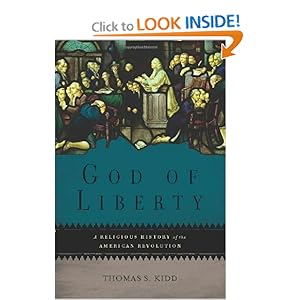
God of Liberty -- Review

GOD OF LIBERTY: A Religious History of the American Revolution.  By Thomas S. Kidd.  New York:  Basic Books, 2010. 298 pages.


It seems as if the debate over whether the Founders of the American Republic were secular Deists or Evangelical Christians will never end. Both sides marshal “evidence” to support their contentions, but reality might be much more complex than the partisans would have us believe, with early Americans ranging from strict separationists to advocates of state establishment. Thomas Paine, who had been an important publicist for the Revolution, wrote strongly worded denunciations of Christianity, while Patrick Henry and Samuel Adams defended the primacy of traditional Christian piety and practice. In God of Liberty, historian Thomas Kidd helps us sort out the complexities so that we can enter the contemporary debate on firmer ground.

A professor at Baptist-sponsored Baylor University, Kidd is sympathetic to the religious voices present at the time, as the blurbs by leading Evangelical historians Mark Noll, Harry Stout, and George Marsden, affirm. Like these esteemed historians, Kidd believes that religion played an important role in the nation’s founding, but they also are in agreement that there were a variety of voices and concerns present in the founding era, and therefore it is important to get the story right.

Kidd covers a period that stretches from the French and Indian War to the early decades of the 19th century, a period in which the last established faiths were disestablished. Standing at the center of this presentation is Kidd’s contention that Enlightenment Rationalists such as Thomas Jefferson and evangelicals such as John Leland believed that every citizen is entitled to religious liberty. The two parties may have had differing reasons for their espousal of religious liberty, but their shared belief that that a government established religion inappropriately impinged on one’s freedom of conscience proved to be foundational to the American experiment.

It was a common belief that religion played an essential role in defining the moral foundation of society. John Adams and George Washington, neither of whom was especially orthodox, believed that religion played an essential role in preserving moral virtue and respect for authority. We sometimes think of the Enlightenment providing a rather optimistic view of humanity, but the Founders were not sure that their fellow citizens were ready for self-government, so they took steps to keep a balance of power between the Federal branches of government and between states and the Federal government. There was the belief that no one entity should be given too much power. It is in light of this fear of human avarice that we need to hear the debate over disestablishment. Advocates of establishment, such as Samuel Adams (Congregationalist) and Patrick Henry (Episcopalian), believed that disestablishment would lead to societal disintegration, and therefore fought to uphold the status quo. Jefferson and Leland on the other hand believed that religion played a central role in upholding the moral foundations of society, but they believed that religious establishments were by nature coercive and ultimately corrupted both religion and government.

The First Amendment, therefore, emerged as a means by which the twin concerns for promoting virtue and liberty could be sustained. Kidd suggests that this Amendment was a “triumph for both the dissenting evangelicals and the Enlightenment Rationalists.” He goes on to say that these “two socially and theologically disparate groups each did its part to prevent America’s national government from practicing religious persecution or giving preference to one religious group at the expense of others” (p. 225). Interestingly, the chief opponents of the Constitution and the First Amendment were people who feared that the new system might “prove hostile to the interests of Christianity” (p. 226).

The history of the nation’s founding demonstrates that even if religion wasn’t the driving force of the revolutionary era, religion still played an extremely important role in the developments of the era. Some of the decisions were pragmatic in nature, so that disestablishment may have occurred at the federal level, but it took considerable time before the states were completely disestablished. In addition to acknowledging the pragmatism of many of the Founders, we must also acknowledge the presence of anti-Catholicism in this era. Another factor that we often miss in our debates is that disestablishment occurred in the South before it occurred in New England. This was due in part to the tenuous hold of Anglicanism on this region. Congregationalism faced fewer rivals in New England and so the process took longer, but even there the movement toward disestablishment couldn’t be halted.

Although defenders of establishment feared that disestablishment would prove hostile to Christianity, in the end they discovered that it encouraged religious practice and even reinforced public virtue. There seemed to be a common belief that a divine hand was involved in the nation’s founding, even if not everyone agreed as to the full identity of the God who ruled providentially over the land. Unfortunately, providentialism had a dark side, because “if God is on your side, then how can you be wrong?” (p. 251).

Although providentialism -- including it's dark-side -- marked American self-understanding, there was, according to Kidd, another key driver in the American self-understanding.  He believes this idea was even more powerful in the development of American ideals than providentialism, but it too was rooted in the nexus of faith and freedom.  This idea is "equality by creation."  This belief first undermined the ideas of aristocracy and hierarchy, opening up new vistas for everyone, but it also proved to be damaging to institutions such as slavery. 
With a century of political philosophy crystallized in the Declaration of Independence's soaring claim of human equality, revolutionary Americans came to the conviction that because God created everyone, all persons were fundamentally equal before him.  This belief immediately threw the legitimacy of slavery into a state of profound moral doubt. (p. 252).
Change didn't happen overnight, and it would take a war to rid the nation of slavery, the seeds of its destruction were planted in this belief that equality is rooted in creation.  Of course, this discovery led some, including Jefferson to ponder whether or not Africans were of the same created order.  Still in the end the seed was planted.
Although many political progressives would like to hang on to the idea that the Founders were, with a few exceptions, secularists and at most Deists, this book can help those of us who believe in the importance of recognizing the value of religious pluralism engage in a more nuanced and effective conversation about the role of religion in the public square. Perhaps the most helpful aspect of the discussion is Kidd’s reminder that the religious freedoms we have today come to us because of an unlikely partnership between Enlightenment rationalists like Jefferson and dissenting evangelicals such as John Leland. Understanding this partnership may help change the tone of the debate, and it’s for this very reason that this is an important book for Progressives to read.


A slightly expanded version of review posted at The Progressive Christian


Friday, February 25, 2011

Secular Revolutions, Religious Landscapes

I've found it rather ironic that the same people who complain about the "naked public square" in the US, are among the ones calling for the revolutions in the Middle East to be "secular."  As Shatha Almutawa writes in the Thursday edition of Sightings, while religion hasn't been driving the revolutions, religion -- especially Islam -- has been infused into the revolutions.  Many of the protests have taken place after Friday prayers.  Imams and religious teachers have sought to empower the people to claim their freedoms and rights -- even countering claims by the oligarchs that freedom leads to chaos by pointing out that stability and freedom go together fairly well in the West.   President Bush wasn't wrong about the possibilities of democracy in the Middle East.  He was wrong in his belief that we could impose it from outside through military means.  It has to be homegrown, and the seeds of homegrown democracy are being sown.  Almutawa has written an insightful piece that deserves careful attention and conversation!  

***********************

Sightings 2/24/2011


Secular Revolutions, Religious Landscapes
-- Shatha Almutawa

While the Middle East uprisings have not revolved around religion, faith has not been absent from Arab scenes of protest in the last two months. God and scripture are invoked by revolutionaries and those who oppose them for the simple reason that Arab dialects and ways of life are infused with religion.

To an outside observer the revolts of Tunisia, Egypt, Libya, Yemen and Bahrain might appear to be entirely secular, but Arabic Twitter and Facebook feeds are brimming with prayers, some formulaic and some informal, asking God to aid protesters and remove oppressors. Qur’anic verses and sayings of the Prophet Muhammad are shared on Facebook walls. One blogger titled his post: “A saying of the prophet about President Qaddafi.” In the quoted hadith Prophet Muhammed warns of a time when trivial men will speak for the people.

After Libyan president Moammar Al-Qaddafi ordered brutal attacks on demonstrators, leaving thousands dead and even more wounded, Yusuf Al-Qaradawi urged the Libyan army to kill Qaddafi. “I say to my brothers and sons who are soldiers and officers in the Libyan Army to disobey when (the government) gives orders to kill the people using warplanes,” the prominent Sunni scholar said, according to UPI. Soldiers have already defected in large numbers, and the pro-democracy army has taken hold of many Libyan cities.

In every part of the Arab world religious spaces such as mosques and churches have been stages for demonstrators as well as opposition. In the United Arab Emirates an activist was arrested after giving a speech at a mosque in solidarity with the Egyptian revolution. In his speech he invited worshippers to join him in performing a prayer for the Egyptian protesters.

In Egypt marches began at mosques after Friday prayers, and inside them imams gave speeches in favor of or opposition to the uprising. Egyptians are donating blood at mosques near the Libyan border. In Bahrain pro-democracy and pro-government protesters demonstrated outside Manama’s Al-Fateh Mosque as well as at Pearl Roundabout.

Even though religion is not the driving force behind the revolutions, religious leaders continue to defend protest in speeches that are disseminated via YouTube. Dr. Tareq Al-Suwaidan, a leader of the Muslim Brotherhood in Kuwait, gave a speech in which he urged Arabs to continue demanding freedom, human rights and an end to corruption. He challenged the governments’ claim that revolutions will lead to instability and insecurity, and that new freedoms would lead to chaos. “The west is living with these rights in stability and security, and they are making progress,” he said. “Our religion calls for these rights. Our religion guaranteed them to us.”

Al-Suwaidan’s tone is one of disbelief at dictators’ illogical statements and the contradictions in their claims. But his ridicule of government leaders is tame in comparison to the jokes made by Arabs all over the world following Al-Qaddafi’s speech. The jokes, too, involve religion. “Al-Qaddafi’s demands are simple—only that the people should say: There is no God but Al-Qaddafi,” Nael Shahwan tweeted in Arabic. Mohammad Awaad wrote, “Qaddafi ‘the god’ is a natural result of a media that has become accustomed to not saying no to a president, as if he is never wrong.” He continued, “I believe we have 22 gods”—one for each Arab country.

The opposition, too, is armed with religious rhetoric, but mosque, Qur’an, and hadith have been central in the Arab world’s struggle for freedom and democracy. Religious leaders as well as lay people have found that the language of religion is also the language of revolution. After all religion is very often the spirit of Arab life, and the inspiration for most of its endeavors—jokes and revolutions included.


Shatha Almutawa is the editor of Sightings and a PhD candidate at the University of Chicago Divinity School.


----------

In this month's Religion and Culture Web Forum, Jessica DeCou offers a comic interpretation of the theology of Karl Barth, bringing his work into a surprising and fruitful dialogue with the comedy of Craig Ferguson. Both men, she contends, “employ similar forms of humor in their efforts to unmask the absurdity and irrationality of our submission to arbitrary human powers.” The humor of Barth and Ferguson alike stresses human limitation against illusory deification. DeCou argues for understanding both the humor and the famous combativeness of Barth's theology as part of this single project, carried out against modern Neo-Protestant theology. The Religion and Culture Web Forum is at: http://divinity.uchicago.edu/martycenter/publications/webforum/


Sightings comes from the Martin Marty Center at the University of Chicago Divinity School.


Wednesday, February 16, 2011

Revolution -- Sightings (Martin Marty)

The Egyptian Revolution is in phase 2.  Phase 1 involved ridding itself of its out-of-touch dictator, now it must create a credible and free nation-state.  That will take time and a lot of hard work, and a great deal of sacrifice on the part of the Military, which has been the foundation of the existing system for nearly 6 decades.  We wonder what the future will look like -- will it be "secular"?  Martin Marty examines these questions, noting with irony that many of this calling for Egypt to be secular are the very ones working to impose their "religion" on the American system. 

Before you read Monday's post here on Wednesday, I want to announce that the Academy of Parish Clergy has officially named Marty's important book Building Cultures of Trust as its Book of the Year at our 2011 Annual Meeting where Marty is speaking to us.  So, yes, I've been in the company of Dr. Marty today.
*************************************************

Sightings 2/14/2011


Revolution
-- Martin E. Marty

C’est une révolte,” said King Louis XVI to his messenger about events on July 14, 1789. “Non, Sire, C’est une révolution,” the Duc de La Rochefoucauld-Liancourt corrected him. With this exchange Hannah Arendt pointed to a difference between a revolt—we have seen many of such—and a revolution, which we saw on television and kindred instruments last week in Egypt. The Wall Street Journal was listening, as weren’t we all, to the shouts of protesters in Cairo and elsewhere. “[I]t’s worth noting that the words heard most often . . . have been ‘dignity,’ ‘modernity,’ ‘freedom,’ ‘jobs.’” Words like these “appear to have displaced Allah as the galvanizing ideas for the young in Egypt and Tunisia.”

Add to their words one more, advanced by columnists left, right, and center: it was a “secular” revolution. And millions cheered. They keep hoping that in the chancy post-revolutionary days, Egypt will stay “secular.” Similarly, many have been watching Turkey, as it makes its way among polities and policies. They hope that, however much its people give voice to religious elements, it will also stay “secular.” In Egypt’s case, the hope of millions is that there will be no official religion or that no overwhelming religious voice--in this case the waiting-in-the-wings Muslim Brotherhood—will win at the expense of the religious and other freedoms of others.

One hears first from the talking-heads among some cable TV network commentators and their print-media colleagues, who in the Egyptian case hope for secular resolutions, and then to those same heads commenting on domestic polities where they do all they can to promote legal privileging of one particular religious ethos and framework: theirs. Each month religious newswriters receive dozens of notices that on local, state, and national levels in America there are school-board meetings, legislative proposals and court cases focused on attempts to privilege a particular “God” in salutes, pledges, and tax-supported expressions at the expense of others.

If Egypt succeeds in living with a novus ordo seclorum, that national slogan you can read on your dollar bills, a “new order of ages,” it will match what the American founders succeeded in doing through an article of the U. S. Constitution and the Bill of Rights, and with which most of us happily lived in less threatening times than our own. Time for a pause. Critics ask: What’s so good about “secular,” whether in Egypt and the Muslim world or in America and the Western-influenced Christian or “Judeo-Christian” world? Not everything by any means is “good.” The “secular” can turn ideological, as in “secularism.” It can represent a beliefless, soulless spiritual landscape that leaves whole publics in the shallows. The downsides are obvious, but . . .

If Europe and North America are turning ever more secular, it is not just because governments are not legally privileging religion. The zones of voluntary expression in life within these spheres are enormous, and the freedom to make use of religious symbols and arguments is almost limitless in those zones. “Secular” in the legal sphere can be liberating. The downgrading of the “religious” in the secular-turning orbits, be it noted, results chiefly from indifference, distraction, spiritual laziness, or godless free choice by citizens. Fearful as we are that Egypt in its post-revolution might turn officially “religious,” one hopes that it can become “secular,” in ways we were intended to be.


References

Hannah Arendt,On Revolution (Penguin Books, 1965).

"Egypt After Mubarak," Wall Street Journal, February 12, 2011.


Martin E. Marty's biography, current projects, publications, and contact information can be found at http://www.illuminos.com/.


----------


In this month's Religion and Culture Web Forum, Jessica DeCou offers a comic interpretation of the theology of Karl Barth, bringing his work into a surprising and fruitful dialogue with the comedy of Craig Ferguson. Both men, she contends, “employ similar forms of humor in their efforts to unmask the absurdity and irrationality of our submission to arbitrary human powers.” The humor of Barth and Ferguson alike stresses human limitation against illusory deification. DeCou argues for understanding both the humor and the famous combativeness of Barth's theology as part of this single project, carried out against modern Neo-Protestant theology. The Religion and Culture Web Forum is at: http://divinity.uchicago.edu/martycenter/publications/webforum/


----------


Sightings comes from the Martin Marty Center at the University of Chicago Divinity School.
http://divinity.uchicago.edu/martycenter/