Search This Blog

Showing posts with label Reviews. Show all posts

Tuesday, March 29, 2011

A View from the Back Pew -- Review

A VIEW FROM THE BACK PEW: God, Religion & Our Personal Quest for Truth. By Tim O’Donnell. Kansas City, MO: Linchpin Publishing, 2011. Xiv + 264 pages.

More and more people are identifying themselves as “spiritual but not religious.” This new category of religious people is comprised mostly of people who believe in God or at least some “higher power,” but are either dissatisfied with institutional religion or have been hurt by it. They like God, just not the institution. This “new” breed of spiritually-inclined people tends to be eclectic, though their understandings of spirituality often reflect aspects of whatever tradition they may have been born into. In this new age of spirituality, where religious observance and institutional membership aren’t required or expected people feel free to strike out on their own, picking and choosing from among the various religious offerings. In this new world of spirituality, there is no central authority, but because of the entrepreneurial spirit that is inherent in this new age, one can either choose to be one’s own spiritual authority or attach oneself to one of the many spiritual guides who have emerged in the age of new media. Ultimately, in this age of spiritual eclecticism the individual is the final arbiter of truth.

Tim O’Donnell’s apparently self-published book A View From the Back Pew offers readers a personal memoir of a spiritual journey that reflects this new spirit. The author is a business entrepreneur, former newspaper publisher, and most importantly is a former Roman Catholic. He writes about the journey he took from a rather traditional Roman Catholic upbringing, which included the requisite run-ins with narrow minded and physically abusive Nuns to the realization that he was free to embrace the God within. In large part this book is a product of what O’Donnell calls “The Deal,” a pact he made with God while a college student studying in Rome. He had a spiritual experience that led him to abandon college and pursue his fortune, which he would then use to serve God. When the Roman Church seemingly didn’t have much use for his gift, once he had made his fortune, he chose to strike out on his own and use his fortune to tell his story.

The book itself alternates between stories from his life that carry him to the point at which he could share his sense of the life in the Spirit, with his reflections on the nature of this life – including sharing his own doctrinal perspectives. In the epilogue O’Donnell provides the window by which the journey can be evaluated. The title of the book comes from a more recent experience in Rome, where he is sitting in the back pew of the chapel where he had worshiped as a college student. At that moment, he realized that “one could come to communion with God from within. In a rush of overwhelming understanding, I knew the Church was a man made institution that could not deliver a man to where God really dwelt” (p. 256).

As you read this book you can’t help but sympathize with his struggles, though as a Protestant I have to be careful not to embrace too eagerly a negative portrayal of the Roman Catholic Church (Protestants have been known to do this). But while I can understand why O’Donnell felt hemmed in by the institutional forces of religion, I also found myself needing to raise questions.

Although I could critique this book on theological and historical grounds that wouldn’t seem to make much sense. That critique might sound defensive, and I’m not sure the author would find my critique all that compelling. So, for the most part I’ll leave those issues alone. What I would like to do is raise some questions about tendencies I see in the “spiritual but not religious” movement, which are exemplified in this book, that do concern me.

I’ll start with O’Donnell’s relationship with Roman Catholicism. It is clear that his understanding of Christian faith is wrapped up tightly with what he learned and experienced growing up in the Catholic Church, especially his education in Catholic schools, including those encounters with rather physically abusive nuns. This schooling introduced Tim O’Donnell to a rather narrow view of faith, one that was rigid and punitive. There were, of course, signs of grace here and there, but these seem to be the exceptions. Although O’Donnell knows that there are other forms of Christianity, including Protestantism, he doesn’t seem interested in them. Like many who emerge from the Catholic context it’s hard to break free of this orbit. As we often hear – once you’re a Catholic always a Catholic, even if you’re a lapsed one. So, much of his argument with institutional Christianity is wrapped up in his experiences of the Catholic Church. Ironically, even though he is disenchanted with traditional Christianity, it is this faith tradition that provides the foundation for his own reflections. This Catholic Faith provides the lenses through which he reinterprets his own experiences.

More problematic in my mind is what I’ll call the “infatuation with Gnosticism” that is so prevalent among many “spiritual but not religious” folks. The idea that the Gnostic texts were excluded from the canon by a narrow minded religious institution seems to give them added authority. Whether it is the recent hullabaloo over the Gospel of Judas or the popularization of gnostic gospels in The Da Vinci Code, the idea that the Church tried to suppress alternative versions of the Jesus story has caught on in the popular mind. In an age that distrusts institutions, this process of canonization, rather than being an example of divine providence, is a sign that the church knows something to be true that they don’t want out. And what is that truth? Well, often the truth is that there is a pathway to God that bypasses the institution. But what we don’t see in this engagement with the Gnostic texts is a recognition that Gnosticism tended to be elitist (after all the Gnostics saw themselves as possessors of secret knowledge), docetic (by and large they denied the value of the physical/material world), and they also tended to be anti-Jewish (Marcion – one of the heroes of Gnosticism – believed that the God of the Old Testament was the creator of the world – which was evil – and not the God of Jesus). The existence of these texts do remind us that the early Christian community was diverse, but I would question the enthusiasm with which their message is being received, without much further examination of them.

The biggest concerns that I have about this movement, which are exemplified by the life of the author, relate to two areas that I think are related. First, there is the issue of a moral/ethical vision, and the second has to do with community.

I’ll deal first with the matter of ethics/moral foundations. Although, the author appears, from his own self-description, to be a man of high moral standards – he exhibits these in his business practices – I’m left wondering about where these standards were derived. My sense is that they were instilled in him by his Catholic upbringing. Despite this, I don’t see much concern for social justice in this understandings of spirituality. He criticizes the Catholic Church for excluding women from the priesthood, but that seems to be part of his overall reaction to the narrowness of the institution. I may have missed something, so I’d be glad to hear from the author about his vision of social justice, but something that did stick out was his rather angry rejection of a statement by a Catholic college professor that wealth was evil. Since the author wants to include Jesus in his own spiritual self-understanding, I’m wondering what he makes of Jesus’ rather regular denunciations of a pursuit of wealth, including his call for the young man to sell all his possessions and give to the poor or his suggestion that one can’t serve God and wealth. So my question is – if I am my own religious authority, who is in the position to challenge my moral/ethical standards?

The final concern that I have about the “spiritual by not religious” movement has to do with the individualism that is prevalent in this movement. O’Donnell, like many in this movement, has essentially created his own religion to fit his own perspectives (yes I know that to some degree we all do this). He is, by his own admission, the author and founder of his faith, which is rooted in the supposition that we are all somehow God incarnate. That is, while he honors Jesus, he believes that we can all be Christs, and he tries to interpret biblical texts in that light. As I read his interpretations of these texts, many of which are filtered through his embrace of the gnostic gospels, I found his interpretations to stretch the meanings beyond what they’re capable of holding, but again my focus isn’t on the doctrinal side of things. My concern is with the individualism that undermines the call to community. O’Donnell doesn’t say this, but there is a sense that if Christ is within us, and that all we need to do to find God is to look within, then why would we need a community? We are essentially spiritually self-sufficient. And if we’re self-sufficient then no one or no institution can challenge my sense of what is true and what is right. In the end, not only is the institution unnecessary (and human-made), but community is unnecessary? But as I read the biblical texts I see in them a call to community. Paul speaks of the church not as institution but as the body of Christ. It is a living being, in which every member is important. I’m wondering what will happen to the spiritual lives of those who have no connection to a community that challenges and supports one as one takes the journey of faith. I struggled with how to respond to this book, because I don’t want to come off as defensive of my tradition or the institution. I must admit that the institution and the tradition needs critique. At the same time, while I found O’Donnell’s book to be a well-written and expressive of his own journey, I believe that there are important questions that need to be posed to those who have embraced this “spiritual but not religious” idea. And these questions need to be asked now while this movement is growing at an increasingly fast pace, so fast that it is in many ways leading to the emptying out of the church that employs folks like me. So, I do have a vested interest in this conversation.

What we on the institutional side of things can learn here is that there is a strong sense of disappointment and frustration among the populace. The traditional institutions aren’t speaking to their hearts or their minds. The question is why? Why do people feel the need to strike out on their own? At the same time, I wonder if this new movement pushes the pendulum of institutionalism too far in the other direction, and what that will mean for people’s journeys as they become less and less connected to traditions once held? These are all questions that I pose to further the conversation, and not cut it off.


This review is offered as part of the TLC Book Tours,
which provided this review copy.

Thursday, March 24, 2011

Tom Oord's "Defining Love" and "The Nature of Love" -- A Review

DEFINING LOVE: A Philosophical, Scientific, and Theological Engagement. By Thomas Jay Oord. Grand Rapids: Brazos Press, 2010. Xiii +225 pages. THE NATURE OF LOVE: A Theology. St. Louis: Chalice Press, 2010. Xii +195 pages.

Christians talk a lot about love. We affirm that God is love. We say that God loves the world enough to send into the world his Son. We treasure the words of 1 Corinthians 13, with its suggestion that while faith and hope will abide, the greatest is love. We even sing, perhaps with an uneasy conscience, “They’ll Know We Are Christians by Our Love.” But, what do we mean when we talk about love? What is our definition? How do we know to discern whether someone is acting in love? In fact, where does love come from? All of these questions are raised and addressed in these two similar, but different, books authored by Nazarene theologian Thomas Jay Oord.

Tom Oord, who is Professor of Theology and Philosophy at Northwest Nazarene University and a Ph.D. graduate of Claremont Graduate University, has an agenda. He wants to move beyond simply putting love on the theological discussion table to placing love at the very center of theology. If God not only loves, but is love, then love should be “organizing principle” of theology. Unfortunately, in Oord’s mind, this has not happened. Too often it remains behind Oz’s curtain, but “only when placed at the center can the logic of love explicitly extend to all aspects of Christian theology” (Nature, p. 4).

Oord’s agenda, it would seem, requires too very different but related books. Defining Love is in many ways the foundational text. It provides the broader outlines for placing love at the center of theological reflection, but looking at love from philosophical and scientific angles as well as theological ones. In this challenging and at times dense book Oord lays out a new field of scholarship, what he calls the “love, science, and theology symbiosis” (Defining, p. 5). In this context Oord is advocating a program of “love research,” that has at its core the belief that it is possible for the world and individuals can get better. He wants to find ways in which we can discern the virtues and practices that will enable this to happen. In other words, love just doesn’t’ happen. It requires nurture and promotion and development. This requires research into the nature of love and how it is best expressed. With this in mind, Oord lays out his understandings of science and theology, trying to clearly define where they are different and where they relate to each other.

Essential to this program is to have a firm definition of love, one that can provide a foundation for research and theological reflection. The definition that he formulates provides the basis for discussion in both of these books. That basic definition reads as follows:

To love is to act intentionally, in sympathetic response to others (including God), to promote overall well-being (Defining, p. 15).
With this basic definition in mind, Oord proceeds to explore the diverse forms of love, for not all forms of love are alike, even if they have at their base the same purpose – “promotion of overall well-being.” Thus, he looks at agape, philia, and eros. While making use of theology here, he is more intent on exploring the input of philosophy to the discussion.

Moving from definitions, Oord brings to bear the “qualitative and quantitative” insights of the social sciences, including both psychology and sociology. Key to this discussion are concepts such as altruism and empathy, along with personality types and motives. He concludes that from examining research there is a clear move away from the idea that humans are by nature “inevitably and invariably egoistic” (Defining, p. 96). If the social sciences provide one vantage point, what about biology. Assuming that evolution is true, the question concerns how evolutionary development provides the conditions for love. Again the focus is on altruism, and whether there is evidence from the study of nature of self-sacrificial action. Although the explorations are still at their early stages, the key question, concerns the evidence that nonhuman creatures express love. This may still be speculative, but there is interesting evidence to pursue. Turning from biology to cosmology, with its discussions of the formation of the universe, including the principle of creatio ex nihilo, the issue here in part concerns the possibilities of divine engagement with the universe. This is a key question for we must wrestle with the way in which God might engage us. Does God have either the power or the will to change or affect in dramatic ways nature? Or does God work in a very different fashion? Here Oord, who can be considered part of the Open Theism movement, interacts with a variety of theological and biblical perspectives, including Process Theology, which he respects but doesn’t embrace completely. The point of the chapter isn’t to provide a final understanding but to lay out the parameters and possibilities for study. Finally, he reaches theology, where he expresses his hope for a partnership between the sciences and theology so that love can find its place at the center of theology.

If Defining Love has a scientific/philosophical focus, The Nature of Love focuses on theology itself. Of the two books, this is probably the easier read and may be for many the most appropriate place to start. Although no mention is made of Defining Love many of the ideas and foundations transfer from one book to the other (I’m not sure which book was written first, though from the reader's perspective Defining Love could be considered the foundational book).

In Nature of Love Oord begins with the same definition of love as in the first book, with a focus on intentionality and end result – promotion of well-being. Whereas in the first book his conversation partners are the sciences and philosophy, here they are theologians. He wrestles with Anders Nygren over agape, St. Augustine over eros, and Clark Pinnock over philia. He finds something of value in each of these theologians and their particular definitions and perspectives on love, but he also finds them to be deficient at important points. Of the three foci, I found the engagements with Nygren and Augustine the most pertinent. In both cases, Oord redefines in important ways how we understand love.

In regard to Nygren and Nygren’s claim that agape is the definitive form of Christian love, to the exclusion of other forms, Oord challenges the idea that we are simply conduits of a love that comes from God alone without any human engagement. In his view, agape should be understood as “in spite of love.” That is, agape is that form of love that intentionally seeks to promote the well-being of the other despite the fact that the other means us harm or evil. God is definitely involved, but that doesn’t mean that we have not part to play. With regard to eros, which Augustine saw as a deficient form of love, for Augustine believed that only God could truly love, and that the object of love has no value in and of itself. Oord defines eros as being “because of love,” by which God and we seek to promote overall well-being by affirming and promoting the value that is inherent in the other. This is, I believe an important step, for too often theology starts with the premise that we are some how “totally depraved” and thus having no inherent worth or value. If Oord is correct, then we must think differently, and that means that we act differently with regard to the other. Finally, he deals with philia, and in this regard looks to his late colleague Clark Pinnock with whom he has much in common, but with whom he has what might seem to be minor differences, but which have important implications. Philia is by definition the promotion of well-being by “coming alongside.” It is that friendship, community oriented form of love, which reminds us that we need each other. It speaks of cooperation with God and with one another. Where he differs from Pinnock is in Pinnock’s concern to protect God’s reputation.

In the final chapter of The Nature of Love, Oord offers his own theological program, which he calls “essential kenosis.” This program serves as the context in which love can be brought into the center. There are similarities to Process Theology, though through the use of the idea of kenosis (self-emptying), he hopes to distinguish from his own idea of a self-limiting God with that of an inherently limited divinity, but in this understanding self-limitation isn’t voluntary, it is essential to God’s nature. What he wants the reader to understand is that God’s love is a question of necessity. Whereas in other forms of kenosis theology, God need not love outside the Trinity, in his understanding God of necessity loves the Creation. Love is not contingent. It is part of God’s nature. External forces don’t limit God, but God’s nature does. Therefore, God cannot but love.

So the question is – what does it mean for God to love, and here it’s important that all three forms of love are brought into the equation. The kind of love that forms the center of theology – our understanding of God – must be “full-orbed.” We make a mistake when we think that we can settle on one form of love and define that as Christian or divine love. We must instead bring agape, eros, and philia into our definition. If this is true of God, then it is also true for us, who are called upon as God’s creation to imitate God by expressing this full-orbed love of God in our lives. I should add that in Oord’s understanding love means that God is not coercive in any way. Thus, even creation is not a coercive act, but requires the participation of the other for creation to occur. You can see the similarities to Process Theology. The borders the two are a bit fuzzy, but there is enough of a difference to keep these two as separate understandings of the nature and purpose of God.

I believe that Tom Oord is on to something important. I have found his definitions of love to be not only helpful but have provided a new orientation for understanding the unconditional nature of love, and the full-orbed nature of love. I believe his definitions are far superior to any others I’ve seen. Thus, as a pastor and a preacher, who believes that God not only loves, but is love, these definitions and the research that help sustain these definitions will help the church move forward into the future. It will assist us in moving away from self-centeredness to others-centeredness. It will help us reorient the way we do theology and understand God and God’s relationship to Creation.

Of the two books, The Nature of Love is the easiest to work with and may be the most helpful, but for those who wish to dig deeper into the project, then Defining Love is an important read. Both are well written, but neither of these books are quick reads. They require diligent engagement and reflection. That said, Tom Oord is on to something important that the church needs to hear.

Monday, March 14, 2011

Engaging the Word -- Review

ENGAGING THE WORD: The New Testament and the Christian Believer. By Jaime Clark-Soles. Louisville: WJK Press, 2010. Xii + 154 pages.

Back in the day – when I was working for a Christian bookstore – there were quite a few options when it came to Bibles. At the time I was a devotee of the New American Standard and resisted the seductiveness of the newer New International Version (though I eventually succumbed to its smoother and clearer text). Later on, having become sensitized to the issue of inclusive language I embraced the even newer New Revised Standard Version. But despite the variety that was available then, today we that era might seem relatively impoverished when it comes to bible choices. Despite all of the new translations, and there are many more since I worked at that store in the early 1980s, and despite all the study options available, biblical illiteracy continues to plague not only the broader culture, but the church as well. The Bible remains a bestseller, but it is also the least read, most misunderstood, and possibly most misused bestseller on the market.

The question that the church must address concerns not the why but the how do we change this reality? There are a number of good translations available, which should make the Bible more accessible to people, but maybe the problem isn’t the prevalence of choices but the nature of the choices. Perhaps we have become overwhelmed by marketers who have so niched the Bible that it loses its place in the life of the church. It has become a commodity to be manipulated for better sales.

Jaime Clark-Soles, a professor of New Testament at Perkins School of Theology, has taken on the task of providing wise guidance in matters of biblical study – for lay and clergy alike. Clark-Soles understands the scholarly issues of the day, from the historical Jesus quests to biblical authorship to translation issues. She is deeply embedded in that conversation, but this book isn’t written for scholars, it’s written primarily for the lay audience. It’s written with great care and with eloquence, but without the sensationalism that so often accompanies such books. She’s not trying to convince us that she has discovered something new and unique that the scholars and the preachers have been hiding from the laity. But, she wants to make the New Testament understandable to people who may find reading the Bible a daunting task. She is a critical scholar, left of center in her commitments, but she is also committed to the faith, which may be why there is a lack of sensationalism (ala Bart Ehrman).

She begins the book in an interesting manner. She takes up the question of packaging – something that addresses the consumer-driven nature of contemporary Christianity. She does this by taking a look at the current ways in which the publishers are marketing the Bible, starting with Revolve, a New Testament based on the New Century Version that is niche-marketed to teen-aged girls. This is a bible that’s relevant – that is, it is packaged as a fashion magazine. The biblical text is surrounded by fashion tips and articles dealing with relationships. The packaging might be attractive, but what does this package do to the way we read Scripture? The author points out that situated in a sidebar next to the story of Herod’s Slaughter of the Innocents is an article about “emergency pimple repair.” And what does this beauty advice have to do with Matthew 2? Clark-Soles writes “Well, as the text says, ‘Blemishes come and go, but God’s Word remains forever.’” In this opening chapter, the author deals with a number of critical issues, including the problem of separating out the New Testament from the entire biblical text, the problem of study notes and life application notes. She raises the question that has always troubled me – how do we separate out the commentary from the text, when the commentary is printed along with the text? Of course, she raises the question of the dangers that accompany hyperindividualizing these Bibles. It might be good for sales, but is it good for understanding the text of Scripture.

In reading this opening chapter, you begin to discern an ironic twist to the religious conversations of the day. Conservative evangelicals are keen to defend biblical authority, and yet it would seem that these products that largely come from evangelical publishers and marketed to evangelicals could in the end devalue the very Scriptures that evangelicals seek to defend. Indeed, as this occurs, as we begin to treat the Bible as some kind of manual to answer our beauty and relationship questions, it loses spiritual value.

So the question is – what should we do? In answer to this question, Clark-Soles offers words of guidance, beginning with a chapter on the various ways we read Scripture, showing both the “promises and pitfalls.” She introduces the reader to premodern (uncritical), modern (critical, reasonable), and postmodern (questioning and aware of cultural influences) approaches to scripture. From there she turns to the various parts of the New Testament, beginning with the Gospels. She begins this section with a question of harmonization. Should we try to harmonize the four gospels, or let them speak for themselves? Her answer is to let them speak for themselves. In that regard she deals with some of the key issues, such as the people mentioned in the four gospels – noting that when we harmonize we tend to conflate identities – such as the various Marys and Jameses. She deals with genre – noting that the gospels aren’t biographies. They’re not eyewitness accounts and that the authors framed the story to fit their own needs. For those committed to a Modernist reading, whether conservative or liberal, this can be problematic when it comes to authority. It is in this context that the author raises the issue of the four senses of scripture – the literal, the allegorical, the tropological, and the analogical. The church has understood that there is more than one way of reading the text – that the literal may not always be the best way to read and interpret the text.

Staying with the Gospels, the author deals with the so called “Synoptic Problem,” that is the relationship of Matthew, Mark, and Luke (along with the presupposed existence of Q). She deals with all of the major theories that range from Markan priority to Matthean priority. She deals with form criticism (transmission) and redaction criticism (editing). In this chapter she deals with the current fascination with the Gospel of Thomas, which is a sayings gospel and thus quite popular with those who want to assert the priority of Q, the sayings of Jesus. She also deals with John, and its place in the conversation. She feels, rightly so, that John too often gets excluded from the conversation when matters of Jesus’ life get discussed. She believes that John may have more to offer than the reigning paradigm would allow. Her point is that we are at a point in which we need to reexamine this who “synoptic problem.”

With a new book from Bart Ehrman on authorship issues (I’ve not read the book, but the title seems to give away the intent – Forged), Clark-Soles discusses the issue of authorship, especially with regard to the Pauline texts. It’s not all that controversial to say that the gospels were written anonymously, because there is no name attached to any of them. The same can’t be said for texts such as Ephesians and Colossians, which claim Pauline authorship, as is true with the Pastorals, or with the two letters attached to Peter. The letters of John are largely anonymous, and Revelation is self-attributed to a John, but necessarily the Apostle John. She deals with all the relevant issues, including the reasons why many scholars doubt that Paul wrote the so-called “deutero-Pauline” texts, issues that range from eschatology to church offices. With regard to the question raised by folks like Ehrman, she notes the questions of whether this is “dishonest,” and whether the fact that Paul might not have written Ephesians might undermine its authority. She seeks to answer these questions by pointing us to the canonization process, and the role that this process has played in how we read and experience the text. She raises more questions than she provides answers, but that’s not a bad thing. It pushes us to dig deeper.

Finally, she looks into the Historical Jesus debate and the politics of biblical interpretation. With regard to the latter, she notes how in recent years there has arisen a plethora of differing ways of reading scripture, from Feminist to Queer, from Ethnic to Post-Colonial, each of which raises question about approach and ideology. If you think that one of these approaches is politic and yours is not, she suggests that we might need to look more deeply inside to discern our own ideologies. In other words, there is no completely “objective” way of reading the Text. We all bring something to the discussion. Even as the authors were “socially located,” so are the readers. With regard to this question of social location, she provides an inventory so that we can examine questions of authority, ethnicity, gender, theology, the translations we use and more, asking how these issues affect the way we read Scripture. And in closing she reminds us all that we all have our own “canon within a canon.” We all start somewhere. There may be no one way of reading Scripture, but as Clark-Soles reminds us - -there are responsible ways of reading Scripture, and she invites us to take up this task. Her book focuses on the New Testament, but remember that she challenged us to not separate the New from the Old. Thus, it would be helpful to read (as I’ve yet to do), her book in tandem with one written on the Hebrew Scriptures by Carolyn Sharp (Wrestling the Word, WJK, 2010).

This is with a doubt a most helpful book. It raises questions, provides resources (including questions for discussion), and pushes us to be more responsible in our reading of the text. If we will heed the wisdom present in this book (and I’m assuming present in Sharp’s book), then perhaps we can begin to overcome the prevailing biblical illiteracy within the church! Oh, and she does all of this in a 148 pages of text.

Saturday, March 5, 2011

God of Liberty -- Review

GOD OF LIBERTY: A Religious History of the American Revolution.  By Thomas S. Kidd.  New York:  Basic Books, 2010. 298 pages.


It seems as if the debate over whether the Founders of the American Republic were secular Deists or Evangelical Christians will never end. Both sides marshal “evidence” to support their contentions, but reality might be much more complex than the partisans would have us believe, with early Americans ranging from strict separationists to advocates of state establishment. Thomas Paine, who had been an important publicist for the Revolution, wrote strongly worded denunciations of Christianity, while Patrick Henry and Samuel Adams defended the primacy of traditional Christian piety and practice. In God of Liberty, historian Thomas Kidd helps us sort out the complexities so that we can enter the contemporary debate on firmer ground.

A professor at Baptist-sponsored Baylor University, Kidd is sympathetic to the religious voices present at the time, as the blurbs by leading Evangelical historians Mark Noll, Harry Stout, and George Marsden, affirm. Like these esteemed historians, Kidd believes that religion played an important role in the nation’s founding, but they also are in agreement that there were a variety of voices and concerns present in the founding era, and therefore it is important to get the story right.

Kidd covers a period that stretches from the French and Indian War to the early decades of the 19th century, a period in which the last established faiths were disestablished. Standing at the center of this presentation is Kidd’s contention that Enlightenment Rationalists such as Thomas Jefferson and evangelicals such as John Leland believed that every citizen is entitled to religious liberty. The two parties may have had differing reasons for their espousal of religious liberty, but their shared belief that that a government established religion inappropriately impinged on one’s freedom of conscience proved to be foundational to the American experiment.

It was a common belief that religion played an essential role in defining the moral foundation of society. John Adams and George Washington, neither of whom was especially orthodox, believed that religion played an essential role in preserving moral virtue and respect for authority. We sometimes think of the Enlightenment providing a rather optimistic view of humanity, but the Founders were not sure that their fellow citizens were ready for self-government, so they took steps to keep a balance of power between the Federal branches of government and between states and the Federal government. There was the belief that no one entity should be given too much power. It is in light of this fear of human avarice that we need to hear the debate over disestablishment. Advocates of establishment, such as Samuel Adams (Congregationalist) and Patrick Henry (Episcopalian), believed that disestablishment would lead to societal disintegration, and therefore fought to uphold the status quo. Jefferson and Leland on the other hand believed that religion played a central role in upholding the moral foundations of society, but they believed that religious establishments were by nature coercive and ultimately corrupted both religion and government.

The First Amendment, therefore, emerged as a means by which the twin concerns for promoting virtue and liberty could be sustained. Kidd suggests that this Amendment was a “triumph for both the dissenting evangelicals and the Enlightenment Rationalists.” He goes on to say that these “two socially and theologically disparate groups each did its part to prevent America’s national government from practicing religious persecution or giving preference to one religious group at the expense of others” (p. 225). Interestingly, the chief opponents of the Constitution and the First Amendment were people who feared that the new system might “prove hostile to the interests of Christianity” (p. 226).

The history of the nation’s founding demonstrates that even if religion wasn’t the driving force of the revolutionary era, religion still played an extremely important role in the developments of the era. Some of the decisions were pragmatic in nature, so that disestablishment may have occurred at the federal level, but it took considerable time before the states were completely disestablished. In addition to acknowledging the pragmatism of many of the Founders, we must also acknowledge the presence of anti-Catholicism in this era. Another factor that we often miss in our debates is that disestablishment occurred in the South before it occurred in New England. This was due in part to the tenuous hold of Anglicanism on this region. Congregationalism faced fewer rivals in New England and so the process took longer, but even there the movement toward disestablishment couldn’t be halted.

Although defenders of establishment feared that disestablishment would prove hostile to Christianity, in the end they discovered that it encouraged religious practice and even reinforced public virtue. There seemed to be a common belief that a divine hand was involved in the nation’s founding, even if not everyone agreed as to the full identity of the God who ruled providentially over the land. Unfortunately, providentialism had a dark side, because “if God is on your side, then how can you be wrong?” (p. 251).

Although providentialism -- including it's dark-side -- marked American self-understanding, there was, according to Kidd, another key driver in the American self-understanding.  He believes this idea was even more powerful in the development of American ideals than providentialism, but it too was rooted in the nexus of faith and freedom.  This idea is "equality by creation."  This belief first undermined the ideas of aristocracy and hierarchy, opening up new vistas for everyone, but it also proved to be damaging to institutions such as slavery. 
With a century of political philosophy crystallized in the Declaration of Independence's soaring claim of human equality, revolutionary Americans came to the conviction that because God created everyone, all persons were fundamentally equal before him.  This belief immediately threw the legitimacy of slavery into a state of profound moral doubt. (p. 252).
Change didn't happen overnight, and it would take a war to rid the nation of slavery, the seeds of its destruction were planted in this belief that equality is rooted in creation.  Of course, this discovery led some, including Jefferson to ponder whether or not Africans were of the same created order.  Still in the end the seed was planted.
Although many political progressives would like to hang on to the idea that the Founders were, with a few exceptions, secularists and at most Deists, this book can help those of us who believe in the importance of recognizing the value of religious pluralism engage in a more nuanced and effective conversation about the role of religion in the public square. Perhaps the most helpful aspect of the discussion is Kidd’s reminder that the religious freedoms we have today come to us because of an unlikely partnership between Enlightenment rationalists like Jefferson and dissenting evangelicals such as John Leland. Understanding this partnership may help change the tone of the debate, and it’s for this very reason that this is an important book for Progressives to read.


A slightly expanded version of review posted at The Progressive Christian


Tuesday, March 1, 2011

Unprotected Texts -- Review


“Family values” has long been a rallying cry of politically inclined religious conservatives, especially as the sexual mores of the American people have “loosened” since the 1960s. In the face of increasing acceptance of homosexuality, premarital sex, and divorce, “family values” push for the adoption of a “biblically based” sexual morality that includes a definition of marriage limited to one man and one woman along with sexual abstinence outside of marriage. The problem with these proposals is that it’s difficult to nail down a consistent biblically based sexual ethic. First century families, Christian or otherwise, look a lot different from contemporary family structures – even among conservative Christians, not to mention variety of family groupings and guidelines found in the Hebrew Bible/Christian Old Testament. So, whose family values should we embrace? Abraham’s, Jacob’s, David’s, Jesus’, or may be Paul’s? Once you start digging deeper into the biblical text the possibility of finding such a consistent ethic is difficult to find.

Jennifer Wright Knust has taken up the question of the bible and sexuality in her provocatively titled book Unprotected Texts: The Bible’s Surprising Contradictions about Sex and Desire. While the “contradictions” might not be all that surprising to those of us who have read the Scriptures with a critical eye, for many lay readers the questions raised by Knust might prove challenging at the very least. Since this is a book written with the educated but curious general reader in mind, one can imagine the conversations that will take place around the “new books” table at the local bookstore (if such a thing still exists in your community). That the author is not only a biblical scholar (Knust is an assistant professor of religion at Boston University), but an ordained American Baptist minister might be even more provocative to some. How does a person called to serve the church write such a book?

The answer might be found in common concern among religious leaders, including clergy and religious scholars – how do we respond to the questions being asked of us concerning religion and sexuality? For some the answer is simple – stick to “traditional values” – but for others this simply doesn’t work. As we learn more about homosexuality, for instance, it’s much harder to see same-gender relationships as sinful or unnatural. And as young adults postpone marriage, it’s harder to enforce prohibitions against pre-marital sex and living together outside marriage. It is in response to these dilemmas that Knust writes, hoping that by uncovering the complexity of understandings of sexuality in Scripture Christians and Jews might find answers to festering questions. The basic purpose in writing the book, according to the author, is to present “a detailed analysis of biblical attitudes and assumptions while exploring the reception of biblical narratives by later Christian and Jewish interpreters” (p. 16).

In taking up her quest to understand the various ways sexuality is understood in scripture, she makes it clear that in her estimation the Scriptures present conflicting perspectives on sexual morality, even though all of this is done in the name of God. As we take this trip through the Bible’s discussions of sexuality we deal with such issues as whether Jonathan and David’s relationship was homoerotic and whether the Song of Solomon envisions a premarital erotic sexual relationship. The reader will also look at the variety of ways that marriage is envisioned, from the polygamous marriages of David and Solomon, to the rather negative portrayals of marriage offered by Jesus and Paul. Then, of course there are the household codes that we find in Ephesians and Colossians. Sections of the book deal with body parts and fluids – looking into questions of menstruation, circumcision, and masturbation. Another chapter deals with the “evil impulse,” that is the sexual drive, which needed to be controlled. In this particular chapter Knust responds to the suggestion by Southern Baptist megachurch pastor Ed Young that marriages can be strengthened if partners have sex every day. Knust notes that such advice would run quite contrary to the teachings of Paul and his own interpreters, who sought to control their sexuality not free it up – whether within marriage or not.

Knust’s book is an interesting and intriguing read. She covers a lot of territory and does so provocatively. As I noted earlier for many readers much of this won’t be new, though personally I found the discussion in the chapter on “Strange Flesh” illuminating. In this chapter she deals with a number of issues that range from the Sodom Gomorrah story to the suggestion that the giants and “warriors of renown” were the children of unions between angels and human women. The latter isn’t all that new or controversial, but the suggestion that the issue in Sodom centered not on either homosexuality or hospitality, but the Sodomite’s yearning to mate with angels (that is strange flesh) was new to me and intriguing. She also deals with the question of the angels whom Paul is concerned about in 1 Corinthians 11. Paul suggests that women should be veiled “on account of the angels.” Could the issue be that the angels are watching and desiring these women? Remember too that the Corinthians were engaging in angelic speech.  Another topic that many will find intriguing and challenging is her comparison of the Jezebel and Esther stories.  One is condemned for being a foreign woman who leads her husband astray (Jezebel), while the other is a Jewish woman (Esther) who leads her foreign husband to do what is right.  Both play similar roles, but one is commended and the other is not.  It is, therefore, a matter of perspective!

The book is, as noted earlier, intriguing and at times illuminating, but it is also frustrating. At times it seems as if we’re being given only two choices when it comes to reading scripture. You have to choose between either biblical literalism or biblical minimalism. As is often true of the broadsides written by folks like John Spong and Bart Ehrman (his blurb graces the front cover) there doesn’t seem to be any middle ground. Thus, although I find the “strange flesh” explanation for the Sodom story to be intriguing, I’m not sure I’m ready to jettison the idea that the problem is one of breaking the code of hospitality. Another conversation point has to do with Paul’s attitude toward sex (pp. 81ff). Although Paul prefers celibacy, I’m not convinced that this makes him anti-sex or that marriage is the second best option for controlling sexual desire. In addition, while I’m in agreement that there isn’t a consistent sexual ethic present, I wish there was more attention given to how we might make use of the biblical story/stories to construct appropriate sexual ethics in the present age. The author herself affirms that while the Bible is not perfect it is beautiful, “particularly when we do not try to force it to mean just one thing” (p. 247).

My conclusion is that Knust’s book is far from perfect.  First, I'm not always clear who the intended audience is.  There are points at which she gives some rather remedial directives as to the context of a story, while at other points going into rather deep detail in topics that require more background.  While she raises lots of important questions about the role of sexuality and family in the biblical story, often in provocative ways, I wish she had given more guidance as to how we might make sense of this diversity in creating a sexual ethic that is appropriate for this age.  Yes, there is great variety in the text, which seems to offer permission for variety of expressions in the modern age.  But, how does one discern what is appropriate and what is not when it comes to sexuality?  Although, the book is a helpful conversation starter that may serve as necessary antidote to the proof-texting methods of the "family values" crowd, but I was left wanting more. 

Offered as part of the TLC Book Tour. 

Wednesday, February 23, 2011

Starting with Spirit -- A Review

STARTING WITH SPIRIT: Nurturing your Call to Pastoral Leadership. By Bruce G. Epperly. Herndon, VA: Alban Institute, 2011. Viii + 224 pages.


A first call to ministry can be both an exciting and a terrifying opportunity, especially if that first call is a solo pastorate. If you’re a Mainline Protestant pastor you have gone through seminary, an internship, and maybe Clinical Pastoral Education (CPE), but now you’re on your own. Hopefully, during this period of preparation the new pastor has received a well-rounded education that will enable this person to step out in service to God and church with confidence, but as every first call pastor knows, this is a season of firsts and you wonder if you’re ready for what will come. In fact, it is a lot like being a new parent – you have the responsibility, but are you truly ready?

Bruce Epperly has written a wonderful book that looks at many of the issues that new pastors face as they enter their calls. Much of the material that is present in the book is culled from conversations that the author has had with first call pastors over a period of about seven years. As he examines issues that range from what one learned in seminary (and things one wished one had learned) to experiencing life as an associate minister, he draws upon these conversations. Every pastor who reads this book will identify with the journeys these men and women have taken in their ministries.

The book begins by examining the world of the pastorate. Bruce notes that many first time clergy experience both grief and anticipation as they move out into the world from seminary. While one may be “itching to get into the game,” upon leaving seminary one quickly discovers that it can be lonely out there in the real world of ministry. You may experience isolation, knowing that one cannot root one’s friendship circles in the congregation but find it difficult to make connections outside the congregation. There may also be feelings of inadequacy as one takes up many firsts in ministry from weddings to funerals.

In the course of these chapters Bruce looks into such questions as the need to continually develop new skills for ministry, developing an appropriate sense of authority that matches situations, recognizing that “honeymoons” can end quickly, along with wrestling with boundary issues and self-care. Then there is the issue of innovation. Many of us are eager to come in and do a new thing, but often congregations need time to build trust before they’re ready to innovate. Then there is death – which as the title of a chapter suggests “never takes a holiday.”

Some chapters speak clearly not only to first call pastors, but to those of us who have been at this work for some time. Chapters dealing with the spiritual life of the pastor, something that is of special concern to the author, and taking care of one’s own health are of special note for all. He talks too about the nature of our relationships, the challenges of being an associate, and the importance of continuing education.

By utilizing the conversations with first call pastors, Epperly helps his readers realize that they’re not alone, that pastors all across the country, young and not so young, have set out on a journey that demands much and that doesn’t always get a lot of respect. Ministry is like no other occupation. It is not simply a helping profession, though pastors engage in the work of helping professionals. It is not simply a teaching profession, though teaching is at the heart of this work.

Clergy are generalists, addressing all manner of issues, from administration to walking with the dying and the grieving. They are professionals, but more than professionals. They are accountable, you might say, to a higher authority. There is a certain distance that professions place between the practitioner and the one being served, but in ministry the distance is there but it’s much more fluid. And so wise guidance is needed if one is not only going to succeed but survive.

When it comes to survival it’s well known that large numbers of clergy abandon their calling soon after taking up their first call. They may not be ready for the politics that is present in many congregations or prepared for resistance to new ideas. They may experience not only resistance but abuse from congregants. And so they need wise advice, which Bruce provides.

I’m not a new pastor. I’ve been ordained for more than a quarter century, and have experienced both the ups and downs of ministry. I’ve been tempted to give up the calling on many an occasion, but there is something exciting and powerful about this vocation. Because clergy, especially solo pastors, are generalists there is something new and different to deal with each day. Yes, there is loneliness and there is frustration, but there is also great joy and satisfaction to be experienced. So, while this book is addressed to first call pastors, there is much wisdom here that we who have been on the journey for sometime can benefit from. This is clearly a book that needs wide distribution and reading. Whether in your first year or your fiftieth, this is a worthwhile read.

Wednesday, February 2, 2011

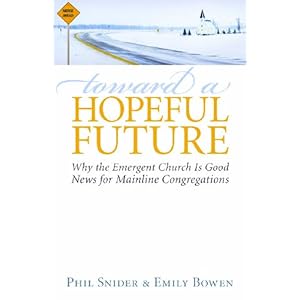
Toward a Hopeful Future -- Review

TOWARD A HOPEFUL FUTURE: Why the Emergent Church is Good News for Mainline Congregations. By Phil Snider and Emily Bowen. Cleveland: Pilgrim Press, 2010. X +290 pages.

Emergent, emerging, postmodern – these are all terms that are bandied about in certain circles, but they may not carry meaning for many people in Mainline Protestant circles. This is unfortunate because many of those who fit under these rather loose labels share much in common with Mainliners. A majority of emergent and emerging Christians are evangelicals or post-evangelicals who share with progressive Christians concerns for social justice and societal transformation. They’re concerned about poverty, the environment, and whether or not they believe in an inerrant bible, they’re more concerned about living out the faith than defending it.

It is true that there are many definitions of what it means to be emergent, emerging, post-evangelical, or postmodern. But what these definitions share in common is a growing dissatisfaction with the status quo. The Enlightenment has made its mark, but it has left many with a sense of great emptiness. Church growth, seeker services, mega-churches, conservative politics, have had an unsettling impact on many of these mostly younger Christians. They have much in common with Mainline Protestants, but they are also disenchanted with what they perceive to be a hidebound institutionalism and rationalism. And yet, with the right bridge builders, the two groups could come together, providing a natural home for Emergents and hope for the Mainline. At least, that is the belief shared by Phil Snider and Emily Bowen, two Disciples of Christ pastors who have embraced the Emergent movement and want to introduce skeptical and suspicious Mainliners to this movement.

The emergent church movement is rather diverse, though it is often linked to such people as Tony Jones, Doug Pagitt, Brian McLaren, and Rob Bell (with a nod to the much more conservative Mark Driscoll). Jones and Pagitt have, for their part, been key leaders in a movement that continually challenges the status quo in both evangelical and Mainline communities. McLaren has made a name for himself by trying to define what he calls a generous orthodoxy. All of these figures, with the exception of Driscoll, can be called post-evangelicals. I personally resonate with this group because I am myself a post-evangelical, though I began my journey outward from evangelicalism before I ever heard of any of these figures. Like them I found the evangelicalism of my earlier years to be too constrictive both theologically and socially. One of the reasons why this group needs an introduction to Mainliners is that many in the Mainline community are suspicious of evangelicals. I experienced this reality, being that I was a graduate of Fuller Seminary. Fortunately this has long since dissipated. Still, the bridge that Snider and Bowen seek to build between progressives and Emergents should prove beneficial to the Mainline Church.

The book begins by offering introductions and definitions. The authors point to several definitions, including that of Tony Jones, the former national coordinator of Emergent Village, who defines the Emergent movement as essentially a friendship or network of missional Christians. He notes that Scot McKnight, a friendly observer of things Emergent, suggests that emerging churches are prophetic, postmodern, praxis-oriented, post-evangelical, and political (that is, they are generally politically liberal evangelicals). Others would point to worship styles that seek to be both ancient and modern. There are in fact a wide variety of emergent types, which range from extremely conservative to relatively liberal. So, any definition is going to rely on adjectives. The version of the emergent church that Snider and Bowen link into is one that is open to progressive understandings. It’s one that seeks to listen for postmodern voices, is committed to social justice, is progressive in theology and expression. Snider and Bowen are attracted to the emergent perspective because it is organic and grass roots. It allows for freedom and nuance. Of course, being progressive Mainliners, the authors are very aware that most of the emergent voices are white and male. Of course, the charge of whiteness can be laid at the feet of most mainline Protestant churches.

The book is divided into three parts – Emergent Background, Emergent Ethos, and Emerging Worship. Through these three sections the authors introduce mainline progressives to the emergent movement and offer suggestions as to how this movement can enhance and empower and give hope to mainline churches. They do a good job of telling stories of people who have felt disenfranchised by both evangelicalism and Mainline Protestantism, suggesting that this movement can provide resources to transcend these difficulties. In part two the sections on justice and hospitality should prove especially helpful.

The final section deals with worship, which seems to be an ongoing point of dispute and discussion within mainline churches. Evangelicals may be conservative in their theology, but many of them have come to terms with the realities of style and technology much quicker than Mainliners. The “ancient-future” worship style that predominates among Emergents might offer some help in adapting to the needs and concerns of new generations of people who don’t connect with the traditional worship styles found in many Mainline Churches. That being said, the authors make it clear that they’re not simply adding one more voice to those that claim that simply adopting contemporary praise services will bring in hordes of young people. Snider and Bowen write:

Emerging forms of worship are much more concerned with grounding worship experiences that reflect specific contexts and theological convictions than they are with any specific style. (pp. 139-140).

That is, the question isn’t whether we should have old hymns or praise songs, organs or guitars, debates that have colored the so-called worship wars. But, the authors remind us that younger adults are more visual and kinesthetic in their orientation to worship. This is why many forms of emergent worship include candles and icons. In reaction to the seeker movement that removed Christian symbols from the worship space, Emergents have not only brought back the cross, but other visual forms – including icons that derive from the Eastern Church. Technology helps in all of this, but isn’t essential or normative.

In terms of worship, the authors make it clear that language, especially regarding gender, is important. They note the problem that exists in Mainline and Evangelical (including Emergent Churches) congregations is that the language is exclusive and patriarchal. For progressives there is the problem of hymns and songs that don’t fit their theology. This is especially true in relationship to references to the atonement and patriarchal references to God. Here is their set of guidelines relating to their choices in music at their emergent service:

[W]e hold fast to progressive approaches in general by making sure the music is grounded in nonviolence, justice, hospitality, and mutuality, and we try our best not to lose sight of the mystery and wonder of God. Like emergents in general, we focus on music that is neither highly individualistic nor concerned with pie in the sky. In short, we try to make sure that every element of the liturgy – especially our music – reflects the theology held dear by progressives and emergents so that they can joyfully sing their faith without sensing a bunch of disconnects in the process. More than anything else, it is the music that stays with the people, it is music that seeps into their bones and reimagines their world. (p. 172).

In two appendices, the authors offer more guidelines and examples of how one might construct an emergent worship experience. Being that they are Disciples of Christ, they place the celebration of the Lord’s Supper at the center of this worship, and they make a point of the fact that Disciples do not limit the celebration of the Eucharist to clergy.

Bowen and Snider have written an important introduction to emergent Christianity for progessive Mainliners. They create a bridge that will help the skeptical or suspicions deal with qualms and questions. The emergent movement isn’t a perfect vehicle, but it does offer hope to the mainline church with its deemphasis on institution and structure, while emphasizing tradition, justice, scripture, hospitality, and adaptability. The emergent movement isn’t the end all for mainline renewal; any more than was true of the seeker movement or the megachurch movement. The danger here is that a tradition that is experiencing both decline and an inability to reach younger generations will simply jump headfirst without truly understanding the ramifications. The reality is that even if the emergent movement offers a word of hope, each church will have to adapt itself in a way that is authentic to its own context and history. That being said, this book, and this movement, does offer a pointer toward a hopeful future.

Friday, January 28, 2011

Making Friends, Making Disciples -- A Review

MAKING FRIENDS, MAKING DISCIPLES: Growing Your Church through Authentic Relationships. By Lee B. Spitzer. Valley Forge, PA: Judson Press, 2010. Xiv +161 pages.


The idea of “friendship evangelism” has been with us for as long as I can remember. It’s a pretty simple concept – people are more likely to come to church if they’re invited by their friends. Sometimes, however, this principle gets turned into a manipulative program. It’s a bit like multi-level marketing. You “make friends” with the goal in mind being growing the church. If the intended “friend” (victim) doesn’t look promising, well then you drop them in and move onto a more receptive “friend.” Although Making Friends, Making Disciples does speak to the question of growing churches through friendship circles, for the most part it doesn’t fall into this trap. The key part of the subtitle is the word "authentic."  In fact, the book takes a much broader look at the importance of friendship – not just in terms of the church, but our personal lives as well. And in this day of Facebook “friends,” it pushes us to look at this friendship circle as well.

The author of this book, Lee B. Spitzer, is the Executive Minister of American Baptist Churches of New Jersey. He has had significant experience as a pastor, but in his current position has had the opportunity to work across cultural and ethnic lines, experiences that provide helpful impact to the book’s perspective. Theologically, the author would seem to come from a moderately evangelical perspective. This became evident near the end of the book when the author spoke of developing interfaith friendships, something he supports, but with two caveats – such friendships should not override the exclusivist elements of the gospel, and that it is likely problematic to bring persons of another faith into one’s closest friendship circles (Best Friends and Special Friends – that would, of course, exclude persons of another faith being one’s spouse/partner). The author’s orientation is seen also in the way the Bible is used – never heavy handed, but always present in the discussion.

Although the book has an evangelical flavor, it is not a heavy-handed one. Therefore, one need not be evangelical to find value in Making Friends, Making Disciples. The value of this book can be found not just in the insights it gives concerning drawing people into the church and sustaining relationships in the church – though that is very helpful – but one will find great assistance in examining the nature of one’s own friendships. The Appendix includes several exercises that will help the reader (and groups in the church) look at their friendship circles, which he defines as Best friends – those who are most trusted – including one’s spouse (2-3 persons); Special friends (3-5 closest friends beyond the inner circle); Social friends (7-12 persons one spends considerable time with). Finally, there are the casual friends/acquaintances – another 50-200 persons one knows by name and might either socialize with or work with. The question then becomes: how many in each circle are church friends, recognizing that if all one’s friends are church friends, the opportunity to draw in others to the faith is rather limited.

Regarding the church and friendship, the author, Spitzer notes the importance or relationships in creating a healthy church – noting that visitors can discern whether a church is for them in the first 10 minutes. With that in mind, he speaks to the kinds of things that can keep a church from being a welcoming congregation – including the way the sanctuary is set up to the reliance on meetings to sustain relationships. So, there is encouragement to “right-sizing” the sanctuary seating to having regular fellowship meals, from creation of small groups that not only meet to do business but that have strong theological foundations. I did appreciate as well the word concerning same gender relationships, which have become much more prominent. He welcomes them but notes that they need to be kept in perspective. But in relationship to the church, he notes that the days of same gender groupings maybe coming to an end, as younger people are much more comfortable gathering in cross-gender groups than same-gender groups.

A bit of wisdom that the author provides is a reminder that true friendship has to be future oriented. It has to be moving forward. In illustrating this premise, he points to the Facebook phenomenon of reconnecting with old friends from the past – usually from high school or college. Reconnecting is joyful and fun, but ultimately, after we share our memories of the good old days of yore, unless this friendship has forward movement the relationship starts to fizzle. I think all of us who have been on Facebook realize this to be true. Of course, something different can happen through social media – we can make connections with people we’ve never met, but who share common interests and commitments. This can and does at points lead to deeper friendships over time, especially if we have the opportunity to connect face-to-face at some point.

This is a book that will prove to be a quick read, provide needed wisdom for church and personal life, and yes, might even lead to growth of the church – not only in numbers but also in spirit.  I know that we always add the latter phrase, but it is important, and too often only given lip-service! 

Wednesday, January 19, 2011

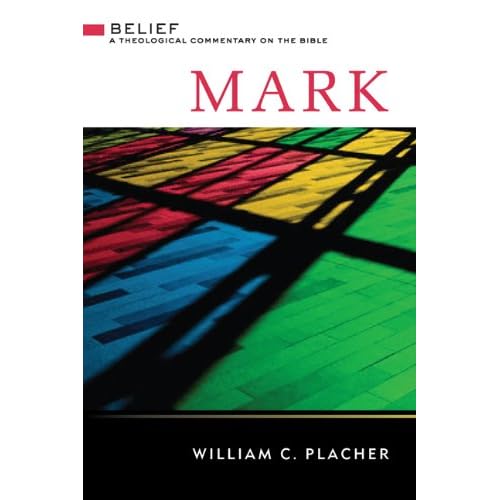
Mark (Belief) -- Review

MARK (Belief).  By William Placher.  Louisville:  WJK Press, 2010.  272 pages.

If your commentary budget has not yet run dry, check out William Placher's new book on the Gospel of Mark, the first in a new series of theological commentaries from Westminster John Knox. Placher, who died in 2008, was to be the co-editor of this series with Amy Plantinga Pauw. This volume, the last thing he wrote, is a fitting legacy.

I appreciate a commentator with deep theological sensitivity, someone who can build a bridge from the ancient text to the present faith experience. Though a theologian by training and not a biblical scholar, Placher demonstrates a keen understanding of the critical issues--but without letting this overwhelm the text's theological insights. As he notes (tipping his hat to Barth), critical scholarship is but the first step toward commentary. In Placher's hands the text comes alive as he interacts with it in the company of Augustine, Calvin and Barth.

Although Mark is the briefest teller of Jesus' story, Placher suggests that we should attend to Mark's presentation because of its historical, political, literary and theological perspectives. Mark's Gospel is closest to Jesus' own lifetime; it demonstrates awareness of the political issues of the day. While it might in some ways lack literary polish, its storytelling is sophisticated. As for theology, in the text we encounter a God who is a fellow-sufferer, one who understands our situation.

Placher takes us through Mark passage by passage, drawing from other theologians as needed and offering occasional "further reflections" on specific topics (Satan, ransom theory). The commentary begins by noting that Mark's original audience was familiar with a "book that started with archē (beginning)." Mark's opening lines suggest "a comparison between this story of a recently crucified teacher and the story of God's creation of the whole universe, the beginning of God's sacred Word." This gospel of a new beginning concludes with Mark's shorter ending (16:1-8), which leaves us at the empty tomb, hanging, needing more information.

Placher finds confirmation of the resurrection in Mark's inclusion of the women as witnesses. But the end of Mark is consistent with what Placher calls his "cryptic, dark theology"--which other gospel writers couldn't tolerate. Mark ends without appearances or commissions, offering only an ambiguity that might fit well our contemporary age, "when a Gospel that ends with Christ triumphantly present is harder to reconcile with the horrors of the world around us and doubts within us. Mark throws the ball to us, as he did to his first readers." Having heard the story, it's our responsibility to keep it alive in our lives and in our testimony.

Reposted from the Century Blog

Friday, December 31, 2010

2010 Book of the Year -- Top 10 List

There have been many wonderful books published in 2010, not all of which I've had the opportunity to read and consider. Some good books are still sitting on my pile, and some are still being read, and still others I'll never get around to reading.  Among those books that I have had the opportunity to read, deciding which ten books made my own top ten wasn’t easy. I left several books off this list that I found tremendously important – books by Brueggemann, Dunn, Crossan, and Moltmann. But, a choice had to be made, and so I made it.  A caveat here -- every list such as this is a matter of the reader's judgment and sense of importance, as can be seen in the great variety of choices made by "listers."  But this is my list!    


Book of the Year:


Robert D. Putnam and David E. Campbell, American Grace: How Religion Unites and Divides Us. New York: Simon and Schuster, 2010. 

First among the books that I read this year, the book that stands out above the others, is American Grace. I knew from almost the start that this would be my book of the year, because I believe that it holds important lessons for the future well-being of the nation and its religious communities. It is a word of hope that carries with it warnings. Despite the seeming dividing lines – red state and blue state – we’re a pretty open country. In large part this is due to a changing of generations and the development of social networks that bring people of different theological/religious backgrounds into contact with each other. Putnam and Campbell, both sociologists review the data – some of which they collected and some collected by others – interpret it and weave it into a story that takes us to various places in the nation. This isn’t a short book, but it is a must read book.

I've yet to write a full review, but I have been writing comments as I've gone through the book, and will continue to do so in the days to come.  Some of those postings can be found here, here, here, here, here, here, here, and here.      

Remainder of Top Ten List, in alphabetical Order:

Philip Clayton with Tripp Fuller, Transforming Christian Theology for Church and Society, Fortress Press, 2010.   I didn't write a regular review, but instead put up a series of chapter by chapter postings, so I'm just giving one link, to begin the journey.  

John Gallagher.Reimagining Detroit: Opportunities for Redefining an American City. Detroit: Wayne State University Press, 2010. Review essay forthcoming from Congregations.

Stanley Hauerwas. Hannah’s Child: A Theologian’s Memoir. Grand Rapids: Wm. B. Eerdmans Publishing Co., 2010.    Reviewed here.

Martin E. Marty. Building Cultures of Trust. Grand Rapids: Wm. B. Eerdmans Publishing Co., 2010.   Reviewed here.

Diarmaid McCullouch. Christianity: The First Three Thousand Years. New York: Viking, 2010. Review forthcoming, but this massive study of the history of Christianity is both readable and comprehensive. 

Carol Howard Merritt. Reframing Hope: Vital Ministry in a New Generation. Herndon, VA: Alban Institute, 2010. Reviewed here.

Thomas Jay Oord. Defining Love: A Philosophical, Scientific, and Theological Engagement. Grand Rapids: Brazos Press, 2010; and The Nature of Love: A Theology. St. Louis: Chalice Press, 2010. I’m honoring these two books as a piece, because they’re so closely related. I will be reviewing them together once I’m finished reading The Nature of Love.

William Placher. Mark: Belief -- A Theological Commentary. Louisville: WJK Press, 2010.  Review is forthcoming at another site.

Ferdinand Schlingensiepen. Dietrich Bonhoeffer 1906-1945: Martyr, Thinker, Man of Resistance. New York: T & T. Clark, 2010. Reviewed here.