Search This Blog

Showing posts with label Travel. Show all posts

Wednesday, August 25, 2010

History through the Eyes of . . . Xuanzang: Indian Life, 7th Century AD

Randall Stephens

From 629 to 645 AD the Chinese pilgrim Xuanzang wandered through Central Asia and India. His observations provide some insight into the customs, religious beliefs, and life in general in that land. He sailed down the Ganges, hobnobbed with Indian royalty, and traveled extensively on the subcontinent.
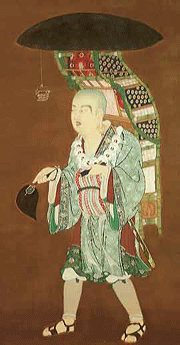
He developed a considerable reputation as a scholar in India. Much of his time there he spent studying at the Nalanda monastery, a well-known religious scholarly community. He would translate the sacred texts of Buddhism from Sanskrit into Chinese.

In the passages excerpted here, Xuanzang observes the towns, streets, customs, and behaviors of some of the sites he visited in India.

Si-Yu-Ki: Buddhist Records of the Western World, Vol 1, Samuel Beal, trans. (London, 1906), 73-74, 83, 85.

Towns and Buildings

The towns and villages have inner gates; the walls are wide and high; the streets and lanes are tortuous, and the roads winding. The thorough fares are dirty and the stalls arranged on both sides of the road with appropriate signs. Butchers, fishers, dancers, executioners, and scavengers, and so on, have their abodes without the city. In coming and going these persons are bound to keep on the left side of the road till they arrive at their homes. Their houses are surrounded by low walls, and form the suburbs. The earth being soft and muddy, the walls of the towns are mostly built of brick or tiles. The towers on the walls are constructed of wood or bamboo; the houses have balconies and belvederes, which are made of wood, with a coating of lime or mortar, and covered with tiles. The different buildings have the same form as those in China: rushes, or dry branches, or tiles, or boards are used for covering them. The walls are covered with lime and mud, mixed with cow's dung for purity. At different seasons they scatter flowers about. Such are some of their different customs. . . .

Manners, Administration of Law, Ordeals

With respect to the ordinary people, although they are naturally light-minded, yet theyare upright and honourable. In money matters they are without craft, and in administering justice they are considerate. They dread the retribution of another state of existence, and make light of the things of the present world. They are not deceitful or treacherous in their conduct, and are faithful to their oaths and promises. In their rules of government there is remarkable rectitude, whilst in their behaviour there is much gentleness and sweetness. . . .

Forms of Politeness

There are nine methods of showing outward respect— (1) by selecting words of a soothing character in making requests; (2) by bowing the head to show respect; (3) by raising the hands and bowing; (4) by joining the hands and bowing low; (5) by bending the knee; (6) by a prostration;29 (7) by a prostration on hands and knees; (8) by touching the ground with the five circles; (9) by stretching the five parts of the body on the ground.

Of these nine methods the most respectful is to make one prostration on the ground and then to kneel and laud the virtues of the one addressed. When at a distance it is usual to bow low; when near, then it is customary to kiss the feet and rub the ankles (of the person addressed).

See also, Richard Bernstein, Ultimate Journey: Retracing the Path of an Ancient Buddhist Monk Who Crossed Asia in Search of Enlightenment (Alfred A. Knopf, 2001); Sally Hovey Wriggins Xuanzang: A Buddhist Pilgrim on the Silk Road (Boulder: Westview Press, 1996); and D. Devahuti, ed, The Unknown Hsuan-Tsang (Oxford University Press, 2001).

Monday, June 21, 2010

Sailing through California History

Randall Stephens

I've taken students on the occasional field trip to Boston. I've never sailed up the coast with them. (It's hard enough for me to navigate the cow path streets of Beantown.)

Rick Kennedy, professor of history at Point Loma Nazarene University, spent ten days on a sailboat this
May, teaching California history to eight students. (I interview Kennedy in the Youtube video here. We talk about how he teaches the class, the curriculum, and the experiences of students.) The class sounds like a blast. According to Kennedy's syllabus:

The course is not like a classroom course; rather, it is an extended fieldtrip. As such it strives to enhance a student's attentiveness to surroundings and ability to see layers of history at particular sites. On walking tours we want to have a heightened awareness of human history in geography, architecture, and town planning. The sailing will encourage awareness of the wind, currents, and tides that, in the past, had much influence on human hopes, plans, and accomplishments. Fieldtrips should help us learn to see the historical evidence that surrounds us, to read the ways topography pushes people in certain directions, the ways architecture proclaims intentions, and the ways a point jutting into the Pacific draws sailors to its lee.


We read and write too. We center the class on a great classic: Two Years Before the Mast, written by a student who sailed away from college in order to go to California in 1835. The book describes California during an era of political instability when a small number of Californios were trying to figure out what to do with a hard-to-get-to but increasingly
desirable land.

The class is largely, but not exclusively, designed for those thinking about careers in
teaching or tourism (parks, museums, and historic preservation). Emphasis throughout the class is on methods of thinking about local history that help us understand larger issues of world history, European history, American history, Native American History, missionary history, and varieties of cultural history. We also look for opportunities to cross disciplines into navigation, astronomy, and cartography.

Sign me up, prof!

There's much this class can accomplish. I was particularly interested in how a course like this can get students to think about the hardships and day-to-day lives or those who have gone before us. Sailing up and down the coast was a common enough experience for Californians. Re-enacting that, I think, gives history students new insight, even empathy.

Now, if I can just master that tiny sailboat on the Charles River . . .

Wednesday, May 20, 2009

Summer Travels in Roman Western Europe

Randall Stephens

In time for the summer travel season Elaine Sciolino writes an interesting piece on "Roman France" in the NYT travel section.

Over the years, I have discovered traces of Roman civilization throughout the country, from Arras in the north to Dijon in the center and Fréjus in the south. My hunt for Roman Gaul has turned up treasures in the oddest places, including the middle of wheat fields, the foundations of churches and the basements of dusty provincial museums. . . .

If French history books tend to underplay ancient Roman rule, local politicians and entrepreneurs in the south do not. In the summer, area restaurants offer “Roman” menus with 2,000-year-old recipes: dishes prepared with cumin, coriander, mint and honey.

The article features a map with key sites marked out and a slide show. Related pieces include: "Traces from When Paris Was Roman" (May 17, 2009); and "Amid the Glory of France, the Grandeur that Was Rome" (May 17, 2009).

There's plenty to see across the channel, too. About a year ago Kevin Rushby wrote about a short trip he and his four-year-old daughter made to Hadrian's Wall and the Housteads fort, "England's Great Wall" Guardian, March 29, 2008. The serpentine wall is UN World Heritage site and a fascinating window into the distant past.

Built around AD124 in a commanding position on a swathe of the dramatic Whin Sill escarpment, Housesteads is one of the most important sites of Roman remains in Britain, in its day the last decent bath house before the great unwashed of Caledonia. . . .

Many interesting finds have come from the fort, even more from the settlement of hangers-on clustered below its walls. Two counterfeiting coin moulds from the 3rd century AD were discovered next to the remains of a house, the forger's den. Under his floor were two skeletons, one with a knife still stuck in the ribs.

Sunday, July 20, 2008

I Have My Train Tickets

Photobucket

I bought my train tickets yesterday *bites nails nervously* I guess this means I have to do it. I have to go through with it and stand up in front of all those people and act like I'm smart! LOL

In all seriousness I'm excited and scared to death all at the same time!

A lot of people have been asking me, what is the Sunstone Symposium? Here's a quote from this years program:

The Salt Lake Sunstone symposium is an annual gathering of Latter-day Saints, scholars, and others interested in the diversity and richness of Mormon thought and experience and who enjoy pondering the past, present and future of the unfolding Restoration. Hosting discussions from all disciplines and presentations of all kinds, the symposium is based upon the principles of an open forum and the trust that both the cause of truth and the society of the Saints are best served by free and frank exploration and discussion.

So I roll into SLC on Aug 7th after a 17 hour train ride from Sacramento with two kids (pray for us) and roll out of SLC on August 10th (pray for me again)

Even though it's a long ride I'm really looking forward to the train! What a way to travel!