Search This Blog

Showing posts with label Naval History. Show all posts

Thursday, November 4, 2010

An Ode to Cora F. Cressy and Her Sisters

Heather Cox Richardson

The recent effort to legalize and regulate the sale of marijuana has brought to light a number of new studies of Prohibition. They have some fascinating information in them—like the fact that booze runners started the car racing industry (a theme later picked up in The Dukes of Hazzard).
Who knew?

Another thing many of the blogs mention is equally surprising. During Prohibition, entrepreneurs outfitted ships as nightclubs and towed them three miles offshore into international waters where they could legally serve liquor. In the early morning, they towed the floating bars back to port.

While this is interesting from many perspectives, it is of interest to economic historians and those involved in maritime history because it reflected the destruction of the New England sailing fleet at the beginning of the twentieth century. Those huge wooden schooners had owned the oceans for the decades spanning the turn of the century, carrying grain to Asia, guano to Europe, and manufactured goods everywhere. By 1900, though, they had been overtaken by metal steamers and spent their last days limping to their final resting places.

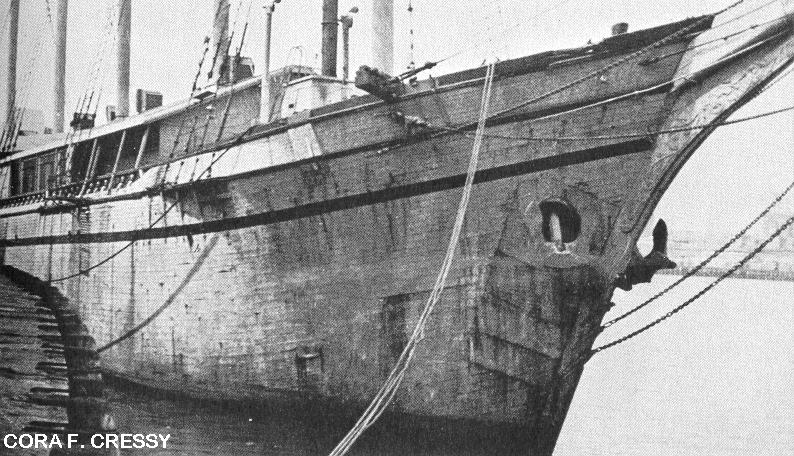
One of these schooners was the Cora F. Cressy, and her story illustrates this dramatic economic change.

The Cora Cressy was built in 1902 at the Percy & Small shipyard in Bath, Maine (now home to the wonderful Maine Maritime Museum, which has an exhibit of some of the Cora Cressy’s fittings). She was a five-masted schooner, 273 feet long and 2499 tons: a fast sailor that could carry 4000 tons of coal. She was like other schooners at the time, cheaper to replace than to repair. Owners deferred maintenance and ran her until she took great damage in a 1928 storm.

In 1929, the Cora Cressy’s owners sold her to become a Prohibition nightclub off the coast of New England, a role she held into the 1930s.

The end of Prohibition left the Cory Cressy without a career. The owner of a lobster pound in Medomak, Maine, bought her as a storage tank for lobsters, but found the old Percy & Small workers had built her too well—it was impossible to drill enough holes in her hull to enable water to circulate. She became a hulk of a breakwater, half buried in the mud, barnacles, and mussels that grew up around her. Well into the 1980s, you could peek through the Cora Cressy’s broken timbers to see the tattered maroon curtains from her nightclub days.

And there her remains sit today, a testimony to the fall of New England’s sailing fleet from economic powerhouse, to Prohibition speakeasy, to wreckage.

Tuesday, September 28, 2010

Interview with Donald Yerxa on Historically Speaking

Randall Stephens

Johns Hopkins University Press is now in the business of podcasts. You can listen to my interview with Historically Speaking senior editor Donald Yerxa here. (That page also includes interviews with Adeed Dawisha, Journal of Democracy, and Michael D. Wiatrowski and Jack A. Goldstone, Journal of Democracy.)

In the interview, I talk to Yerxa about our recent neglected fields forums, and the September naval history forum in particular. Yerxa also describes some of the ways that Historically Speaking has changed since he and senior editor Joseph Lucas came on board in fall 2001. HS aims for the general, educated reader, and tries to avoid jargon or the insider language of subfields, says Yerxa. He reflects on the niche the magazine fills and offers some examples of its success.

Monday, August 30, 2010

September issue of Historically Speaking

Randall Stephens

The September issue of Historically Speaking will be posted on Project Muse around the 15th. Before then, I thought readers might like to have a heads up on the content. This issue contains a forum on the neglected field of naval history; interviews with historians on psychology, military, and political topics; reviews essays; and articles on the South in recent history, Australian hucksters in the 19th century, and more.

I will be posting some excerpts from the September issue in the coming weeks. (Links to the full essays will be provided.)

Historically Speaking 11:4 (September 2006)

A Swindler’s Guide to the British Empire
Kirsten McKenzie

The Necessary South
James Cobb

The Neglected Field of Naval History? A Forum

Naval History: Division or Dialogue?
Andrew D. Lambert

The State of Naval History
John Beeler

Response to Andrew Lambert
Barry Strauss

The State of American Naval History in 2010
John B. Hattendorf

Reflections
Andrew D. Lambert

Remembering Nelson: A Review Essay
Donald A. Yerxa

Montesquieu, the Modern West, and Democracy’s Drift: An Interview with Paul A. Rahe
Conducted by Joseph S. Lucas

A Review of Paul A. Rahe’s Against Throne and Altar
John Dunn

Revisiting World War I: The Last Day of the Somme
William Philpott

Bloody Victory at the Somme: An Interview with William Philpott
Conducted by Donald A. Yerxa

The Myths of Gallipoli
Robin Prior

The Fall of 1941: A Meditation on History
Manfred Weidhorn

Erich Fromm and the Public Intellectual in Recent American History: An Interview with Larry Friedman
Conducted by Randall Stephens

From Custer’s Last Stand to Wounded Knee: A Review Essay
Paul Harvey