


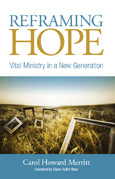
 REFRAMING HOPE: Vital Ministry in a New Generation
 . By Carol Howard Merritt. Foreword by Diana Butler Bass. Herndon, VA: Alban, 2010. x + 147 pp.
 It’s probably unnecessary for me to repeat the canard that Mainline Protestantism is an aging religious tradition. It’s true, the Mainline has been aging, and in many of our churches the elderly far outnumber the younger ones, but the Mainline isn’t simply a spiritual retirement home for hidebound traditionalists. There are many signs of renewed life, which give hope for the future. This is especially true if we pay attention to the younger adults who have either chosen to stay home in the Mainline, or found in the Mainline the spiritual home they had been seeking. The reasons for staying or joining vary. They range from the greater openness to the leadership of women to the presence of gays. It could also be the intellectual openness that is found in these traditions. And while it’s true that the preponderance of clergy is graying, there are a growing number of eloquent younger leaders whose voices have begun to ring out in the church. Among this group is the Rev. Carol Howard Merritt, a Presbyterian pastor, author, and broadcaster, who by her own self-description is a “loyal radical.” That self-description is an important note, because it signals a desire to be part of a tradition, but willing to challenge it when it becomes sedentary and moribund. There is a recognition that the church needs more than simply chaplains, but prophetic and visionary voices that point us into the future.
In this, her second book (the first being Tribal Church ), Carol Howard Merritt offers us a portal through which we can look at the church as it stands today and then begin to see a trajectory upon which a renewed and revisioned church can begin taking its journey into the future. In days of yore, we looked to the elders of the community for sage advice, but now is a time to hear valuable words of wisdom from those who are agile and adept in their participation in the turbulence that marks the present era. Leaders, like Merritt, have their finger on the pulse on the current situation and have an understanding of the way in which these changes are affecting the church as it maneuvers in the early decades of the 21st century. If we’re willing to listen, we’ll discover that these changes make for a ministry that is both more difficult and more exciting.
The world we inhabit is marked by technological, generational, environmental, and political changes and challenges, changes that affect not only the old Mainline Churches like Carol’s (PCUSA) or mine (Disciples of Christ), but also the evangelical megachurches that seemed so adept at adapting to the cultural changes just a few years ago. Alas, the tide may have turned once again, and it’s possible, though by no means assured, that the Mainline churches, many of which inhabit the old urban centers, may have a new opportunity, especially since as Merritt suggests: “worship as entertainment seems to be losing its luster” (p. 1). So perhaps it’s time to do a bit of “reframing,” so that vital ministry might take place in a new generation.
A frame allows us to focus and describe something, and as Merritt writes, “the way we frame our situation has an impact on our current attitudes, our cognitive abilities, and our future behavior” (p. 3). So, how do we go about this “reframing” project so that we might experience hope and vitality (not just among the younger set, but among all who inhabit our churches)? Merritt offers several items to consider. The first warms my heart, because I am by training a historian, and that it is impossible to ignore history. Whatever its nature, the church has a history and that history can’t be ignored, because we can’t understand the context without understanding where the church has come from. Second, as we consider our histories, we must acknowledge the dark sides of our past. Third, we must seek to understand why mistrust exists in our congregations. Fourth, if we don’t understand the past, we can’t understand the present. She writes: “we can begin to imagine vital church ministry in a new generation only by remembering that we have emerged from somewhere specific” (p. 6). Finally, it is important to recognize the strengths of our traditions. God maybe doing something new, but God hasn’t thrown out everything old (despite what we preachers quoting Paul might suggest).
By engaging in the act of reframing our world and its history we have a better opportunity to discern the meaning of the present, and Merritt notes that due to the date of her birth she has never lived in a church-centered world. She doesn’t remember when Mainline Protestantism dominated the national conversation, and change has always been part of her vocabulary, but at a time when the religious institutions continue to lose market share, an opportunity is presenting itself where hope can once again be rekindled and a new vitality can emerge within the church. This is occurring in a context where young adults are returning to the city, demonstrating concern fro social-justice issues, and looking for more meaningful and participatory forms of worship, where lay people are empowered to engage in leadership and ministry. That is, people are looking for things that may lie buried in our denominational churches.
In the course of seven chapters Merritt explores such concepts as the redistribution of authority, the re-formation of community, the reexamination of our mediums of communication (read internet, blogs, social networking sites), the retelling of the message (a new day for evangelism), the reinvention of activism (more than simply marches), engaging in the renewal of creation (a commitment to environmentalism), and a retraditioning of spirituality (rediscovering old practices and resources from the history of the church). There is a strong sense of reengaging tradition, but there is also in this discussion a strong reminder that the church today and tomorrow will be linked closely to the web, especially social networking sites, which are evolving quickly. This offers new opportunities for collaboration and accessing resources for knowledge. At the same time, there is a caution, for the virtual world is not a replacement for the flesh and blood engagement.
One of the words that sticks out in this reframing of hope for the church is that of centralization. Because of the technology that is present, we’re not nearly as dependent on centralized institutions. Indeed, many have become skeptical and distrustful of these institutions, seeing them as moribund. While there is a resistance to centralization, there remains a powerful movement toward consolidation. Thus, it seems as if there are two competing visions – one that suggests bigger is better and the other that small is good. But, while the bigger is better continues to have its say, the alternative is gaining ground. Ultimately, we must recognize that in the church vitality is not defined by brand but by what’s happening in the local community of faith.
We’ve heard it before. You need to revision for tomorrow. And that is true, but simply changing the words and the nomenclature won’t move us forward. Times have changed and a new way living together as people of faith is required. Our context is no longer culturally or ethnically homogeneous. Younger people don’t necessarily know the stories or the language of faith. Merritt writes:
She goes on to note that in our old frameworks we could depend on social conditioning and denominational loyalty to “drive people to church.” That’s no longer true. We have to be intentional, and our reach must be compassionate. The way we communicate must adapt as well. Consider Merritt reminds us that even as the younger members of our communities are fluent in social media, many of our churches struggle to put together a basic website. There is hope, nonetheless, for the Mainline church, even as it struggles to stay afloat amidst this sea of change, to be a transformative presence. If we’re to respond to the context, we need to understand that even in the midst of rampant individualism there is a crying need for community. There is a desire among the younger members of our society to communicate prayerfully, and there is a desire for social justice. Social justice has been at the core of Mainline Protestant life, and there is in this a point of connection.
Writers such as Diana Butler Bass , the author of the foreword to this book, and Eric Elnes
  (a UCC pastor in Arizona), have been reminding us that there is life in the Mainline churches. Carol Howard Merritt adds her voice to this series of testimonials, offering to us a word of hope from the younger side of our community of faith, a reminder that God is still present and at work in our midst. For this reason alone, this book is a worthy read. It is, also well written and insightful, making this another must read for the year 2010 and beyond.
In this, her second book (the first being Tribal Church
), Carol Howard Merritt offers us a portal through which we can look at the church as it stands today and then begin to see a trajectory upon which a renewed and revisioned church can begin taking its journey into the future. In days of yore, we looked to the elders of the community for sage advice, but now is a time to hear valuable words of wisdom from those who are agile and adept in their participation in the turbulence that marks the present era. Leaders, like Merritt, have their finger on the pulse on the current situation and have an understanding of the way in which these changes are affecting the church as it maneuvers in the early decades of the 21st century. If we’re willing to listen, we’ll discover that these changes make for a ministry that is both more difficult and more exciting. The world we inhabit is marked by technological, generational, environmental, and political changes and challenges, changes that affect not only the old Mainline Churches like Carol’s (PCUSA) or mine (Disciples of Christ), but also the evangelical megachurches that seemed so adept at adapting to the cultural changes just a few years ago. Alas, the tide may have turned once again, and it’s possible, though by no means assured, that the Mainline churches, many of which inhabit the old urban centers, may have a new opportunity, especially since as Merritt suggests: “worship as entertainment seems to be losing its luster” (p. 1). So perhaps it’s time to do a bit of “reframing,” so that vital ministry might take place in a new generation.
A frame allows us to focus and describe something, and as Merritt writes, “the way we frame our situation has an impact on our current attitudes, our cognitive abilities, and our future behavior” (p. 3). So, how do we go about this “reframing” project so that we might experience hope and vitality (not just among the younger set, but among all who inhabit our churches)? Merritt offers several items to consider. The first warms my heart, because I am by training a historian, and that it is impossible to ignore history. Whatever its nature, the church has a history and that history can’t be ignored, because we can’t understand the context without understanding where the church has come from. Second, as we consider our histories, we must acknowledge the dark sides of our past. Third, we must seek to understand why mistrust exists in our congregations. Fourth, if we don’t understand the past, we can’t understand the present. She writes: “we can begin to imagine vital church ministry in a new generation only by remembering that we have emerged from somewhere specific” (p. 6). Finally, it is important to recognize the strengths of our traditions. God maybe doing something new, but God hasn’t thrown out everything old (despite what we preachers quoting Paul might suggest).
By engaging in the act of reframing our world and its history we have a better opportunity to discern the meaning of the present, and Merritt notes that due to the date of her birth she has never lived in a church-centered world. She doesn’t remember when Mainline Protestantism dominated the national conversation, and change has always been part of her vocabulary, but at a time when the religious institutions continue to lose market share, an opportunity is presenting itself where hope can once again be rekindled and a new vitality can emerge within the church. This is occurring in a context where young adults are returning to the city, demonstrating concern fro social-justice issues, and looking for more meaningful and participatory forms of worship, where lay people are empowered to engage in leadership and ministry. That is, people are looking for things that may lie buried in our denominational churches.
In the course of seven chapters Merritt explores such concepts as the redistribution of authority, the re-formation of community, the reexamination of our mediums of communication (read internet, blogs, social networking sites), the retelling of the message (a new day for evangelism), the reinvention of activism (more than simply marches), engaging in the renewal of creation (a commitment to environmentalism), and a retraditioning of spirituality (rediscovering old practices and resources from the history of the church). There is a strong sense of reengaging tradition, but there is also in this discussion a strong reminder that the church today and tomorrow will be linked closely to the web, especially social networking sites, which are evolving quickly. This offers new opportunities for collaboration and accessing resources for knowledge. At the same time, there is a caution, for the virtual world is not a replacement for the flesh and blood engagement.
One of the words that sticks out in this reframing of hope for the church is that of centralization. Because of the technology that is present, we’re not nearly as dependent on centralized institutions. Indeed, many have become skeptical and distrustful of these institutions, seeing them as moribund. While there is a resistance to centralization, there remains a powerful movement toward consolidation. Thus, it seems as if there are two competing visions – one that suggests bigger is better and the other that small is good. But, while the bigger is better continues to have its say, the alternative is gaining ground. Ultimately, we must recognize that in the church vitality is not defined by brand but by what’s happening in the local community of faith.
We’ve heard it before. You need to revision for tomorrow. And that is true, but simply changing the words and the nomenclature won’t move us forward. Times have changed and a new way living together as people of faith is required. Our context is no longer culturally or ethnically homogeneous. Younger people don’t necessarily know the stories or the language of faith. Merritt writes:
Today, our neighborhoods are filled with people from a wide array of religious backgrounds and expressions. We struggle to communicate our faith in the midst of such pluralism and, in our worst expressions, we avoid or discriminate against those who are not Christians (p. 131).
She goes on to note that in our old frameworks we could depend on social conditioning and denominational loyalty to “drive people to church.” That’s no longer true. We have to be intentional, and our reach must be compassionate. The way we communicate must adapt as well. Consider Merritt reminds us that even as the younger members of our communities are fluent in social media, many of our churches struggle to put together a basic website. There is hope, nonetheless, for the Mainline church, even as it struggles to stay afloat amidst this sea of change, to be a transformative presence. If we’re to respond to the context, we need to understand that even in the midst of rampant individualism there is a crying need for community. There is a desire among the younger members of our society to communicate prayerfully, and there is a desire for social justice. Social justice has been at the core of Mainline Protestant life, and there is in this a point of connection.
Writers such as Diana Butler Bass
, the author of the foreword to this book, and Eric Elnes (a UCC pastor in Arizona), have been reminding us that there is life in the Mainline churches. Carol Howard Merritt adds her voice to this series of testimonials, offering to us a word of hope from the younger side of our community of faith, a reminder that God is still present and at work in our midst. For this reason alone, this book is a worthy read. It is, also well written and insightful, making this another must read for the year 2010 and beyond.
 , and it’s written by


