Search This Blog

Showing posts with label Love. Show all posts

Sunday, March 27, 2011

Judge Not, Lest Ye . . . 7th Sermon on the Sermon on the Mount

Matthew 7:1-14

Although many of us enjoy being judge and jury, few of us want to face judgement. We like the words “judge not, lest ye be judged,” and yet it’s almost part of human nature to judge others. Therefore, we find ourselves saying: “Can you believe the way she dresses? It’s embarrassing.” Or, “Did you hear what he said? Well, I just think that’s totally inappropriate!” Or, “Did you hear that Sam went to the casino last week, and he calls himself a Christian?” In case you believe yourself incapable of such words, Jesus has an unflattering word to describe you (and me).

As we continue our journey through the Sermon on the Mount, we come to an invitation to examine closely our lives. Instead of judging others, we hear Jesus calling on us to judge ourselves. Of course, the task of facing our own inner demons isn’t an easy task, which is why very few of us answer this call. But, if we’re going to seek first the kingdom of God, then this is the road we must take.


1. Logs and Splinters

Jesus is a master of language, and his choices in metaphors cut through the noise that surrounds our lives. In this passage from Matthew’s gospel, we hear words about splinters and logs. Although we enjoy sitting in judgment of others – admit it, you like it – we’re really not in the position to render judgment on the lives of our neighbors. That’s because we have logs in our eyes that keep us from seeing the splinter that lies in the eye of our neighbor. You simply can’t pull something out of the eye of another person, when there’s an impediment so large sitting your eye that you can’t even see the face of the other. So, take care of that impediment, before trying to do surgery on someone else.

As we contemplate these metaphors, we might benefit from hearing another story, this one being from the Gospel of John. If you look at most bibles, the story of the woman caught in adultery will be in the margins or in parentheses. That’s because there are questions about whether or not it is original to this gospel, but whether or not it originally was in John’s gospel, it speaks to an important truth.

According to this story, a group of religious leaders brings this women who had been caught in adultery and challenged Jesus to render judgment. That meant casting the first stone. Jesus puts the onus back on them, and says to the accusers – “let the one who is without sin, cast the first stone.” When no one comes forward, Jesus says to the woman, no one comes to condemn you, neither do I, but go and sin no more. If we take the biblical witness to heart, Jesus is in a position to cast that stone, but he chose not to do so. Since he chooses not to render judgement, then perhaps we shouldn’t either.


2. Proper Gifts

Of course Scripture speaks of judgment, and next Sunday’s sermon carries the title “Judgement Day.” Although there is a place for judgment, it is God and not us, to whom this task is entrusted. When we try to take on the role of judge, we’re assuming the prerogative of God. Now, the reason why we should leave the role of judge to God isn’t because God is important and we’re not, but instead it’s because of the character of God.

This is why the words that follow the word about judgment are so important. Jesus tells us that if we ask, we’ll receive; if we seek, we’ll find; and if we knock the door will be opened. This is because God is faithful to God’s promises. When it comes to the promises of God, there will be no bait and switch.

Of course, we need to understand that the promises of God are related to the kingdom of God. The promise is made to those who seek first the kingdom and place their treasure in heaven. Although, there are those who would say otherwise, Jesus isn’t promising us a Lexus or a mansion, or even a check for a million dollars, not even if you promise to donate 10% to the church. But because God, who is the giver of every good and perfect gift and who will not do evil, then we can trust God. Yes, as Jesus says, God is like a loving parent, who when a child asks for bread doesn’t give a stone instead, or when a child asks for a fish, gives a snake instead. Indeed, if you, who are evil, don’t treat your children that way, then surely God, who is righteous and loving won’t either. The reason why we should leave the task of judgment to God, is that God isn’t just good, but because God’s essence is love in all of love’s dimensions.

God is love, which doesn’t mean that God is a sentimental chap, but rather, to borrow from Tom Oord’s definition of love, God acts “intentionally in sympathetic/empathetic response to others, to promote overall well-being” (Oord, The Nature of Love, p. 17). This definition of love defines the nature of God, and it also provides the context in which God acts in judgment of the world.

3. Do unto others . . .

Instead of rendering judgments that neither you nor I are prepared to offer, “treat people in the same way that you want people to treat you; this is the Law and the Prophets.” (Mt. 7:12 CEB). These words form what we call the Golden Rule, and this rule is simply a paraphrase of the second great commandment – “love our neighbors as you love yourself.” As you consider this golden rule, remember that Jesus defined neighbor to include one’s enemies, and agape love, as Tom Oord suggests, means intentionally promoting the overall well-being of those who mean to do us evil. This is, of course, no easy task, which is why few of us heed the call to love the world as God loves the world.

But, if you love in this way, then you fulfill the Law and the Prophets. You may have thought that Jesus renders the Law and the prophets null and void, but that isn’t true. Jesus never abandons either the Law or the Prophets, because without them we won’t know how to act toward others. As Stanley Hauerwas, who is known to be a rather radical sort of character, puts it: “love is the fulfillment of the Law.” And, having said that, he goes on to say that love is “a radical politics that challenges the world’s misappropriation of God’s good gift.” Indeed, if Christ embodies God’s love, then we can’t “know love apart from loving one’s enemies.” (Mt. 22:37-40). [Stanley Hauerwas, Matthew, Brazos Press, 2006, p. 89].

If we’re going to take the journey that Jesus outlines in the Sermon on the Mount, then we’ll have to give up trying to be judge and jury. Instead, of trying to be judges of others, we can begin loving our friends and our enemies as God loves them. If we’re going to join God in the work of transforming this world in which we live, then we’ll have to take the narrow pathway, which is the road less traveled.

So how do we know which path to take? Dietrich Bonhoeffer writes in his book on discipleship that we’ll know the way if we keep our eyes focused on Jesus, who walks in front of us, leading the way. Bonhoeffer writes:

He is the narrow road and the narrow gate. The only thing that matters is finding him. If we know that, then we will walk the narrow way to life through the narrow gate of the cross of Jesus Christ, then the narrowness of the way will reassure us. [Bonhoeffer, Discipleship, (Fortress, 2001), p. 4:176].

This narrow path doesn’t take the form of legalism, with a lot of senseless rules and regulations that tell us not to do this or do that or we’ll be excluded. It’s not a matter of dress codes and good manners, or even having all the right beliefs. What it does involve is living life in a way that honors God and seeks to promote the well-being of others. That’s not an easy path to take, but this is the path way that leads from what Richard Rohr calls the first half of life to the second half of life.

If we’re going to take this path then we’ll have to “let go of our own smaller kingdoms,” which we’re not always eager to do, and instead choose union with God. That means letting God lead the way. If we choose this path, and let God both guide us and judge us, then we’ll begin to think in a way that leaves plenty of room for others to join us in communion with God. As Fr. Rohr writes: “Everyone is in heaven when he or she has plenty of room for communion and no need for exclusion. The more room you have to include, the bigger your heaven will be” (Richard Rohr, Falling Upward, p. 101).

It is my prayer that each of us will let go of the need to judge others, but instead as we recognize our own need of forgiveness and restoration, that we will commit ourselves to the way of the kingdom, and in doing so, we will promote the well-being of all those who share this world with us. In this we will know the fullness of God’s presence, and that is what it means to be in heaven!
 
Preached by:
Dr. Robert D. Cornwall
Pastor, Central Woodward Christian Church (Disciples of Christ)
Troy, Michigan
3rd Sunday in Lent
March 27, 2011

Thursday, March 24, 2011

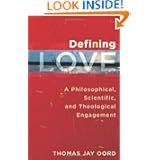
Tom Oord's "Defining Love" and "The Nature of Love" -- A Review

DEFINING LOVE: A Philosophical, Scientific, and Theological Engagement. By Thomas Jay Oord. Grand Rapids: Brazos Press, 2010. Xiii +225 pages. THE NATURE OF LOVE: A Theology. St. Louis: Chalice Press, 2010. Xii +195 pages.

Christians talk a lot about love. We affirm that God is love. We say that God loves the world enough to send into the world his Son. We treasure the words of 1 Corinthians 13, with its suggestion that while faith and hope will abide, the greatest is love. We even sing, perhaps with an uneasy conscience, “They’ll Know We Are Christians by Our Love.” But, what do we mean when we talk about love? What is our definition? How do we know to discern whether someone is acting in love? In fact, where does love come from? All of these questions are raised and addressed in these two similar, but different, books authored by Nazarene theologian Thomas Jay Oord.

Tom Oord, who is Professor of Theology and Philosophy at Northwest Nazarene University and a Ph.D. graduate of Claremont Graduate University, has an agenda. He wants to move beyond simply putting love on the theological discussion table to placing love at the very center of theology. If God not only loves, but is love, then love should be “organizing principle” of theology. Unfortunately, in Oord’s mind, this has not happened. Too often it remains behind Oz’s curtain, but “only when placed at the center can the logic of love explicitly extend to all aspects of Christian theology” (Nature, p. 4).

Oord’s agenda, it would seem, requires too very different but related books. Defining Love is in many ways the foundational text. It provides the broader outlines for placing love at the center of theological reflection, but looking at love from philosophical and scientific angles as well as theological ones. In this challenging and at times dense book Oord lays out a new field of scholarship, what he calls the “love, science, and theology symbiosis” (Defining, p. 5). In this context Oord is advocating a program of “love research,” that has at its core the belief that it is possible for the world and individuals can get better. He wants to find ways in which we can discern the virtues and practices that will enable this to happen. In other words, love just doesn’t’ happen. It requires nurture and promotion and development. This requires research into the nature of love and how it is best expressed. With this in mind, Oord lays out his understandings of science and theology, trying to clearly define where they are different and where they relate to each other.

Essential to this program is to have a firm definition of love, one that can provide a foundation for research and theological reflection. The definition that he formulates provides the basis for discussion in both of these books. That basic definition reads as follows:

To love is to act intentionally, in sympathetic response to others (including God), to promote overall well-being (Defining, p. 15).
With this basic definition in mind, Oord proceeds to explore the diverse forms of love, for not all forms of love are alike, even if they have at their base the same purpose – “promotion of overall well-being.” Thus, he looks at agape, philia, and eros. While making use of theology here, he is more intent on exploring the input of philosophy to the discussion.

Moving from definitions, Oord brings to bear the “qualitative and quantitative” insights of the social sciences, including both psychology and sociology. Key to this discussion are concepts such as altruism and empathy, along with personality types and motives. He concludes that from examining research there is a clear move away from the idea that humans are by nature “inevitably and invariably egoistic” (Defining, p. 96). If the social sciences provide one vantage point, what about biology. Assuming that evolution is true, the question concerns how evolutionary development provides the conditions for love. Again the focus is on altruism, and whether there is evidence from the study of nature of self-sacrificial action. Although the explorations are still at their early stages, the key question, concerns the evidence that nonhuman creatures express love. This may still be speculative, but there is interesting evidence to pursue. Turning from biology to cosmology, with its discussions of the formation of the universe, including the principle of creatio ex nihilo, the issue here in part concerns the possibilities of divine engagement with the universe. This is a key question for we must wrestle with the way in which God might engage us. Does God have either the power or the will to change or affect in dramatic ways nature? Or does God work in a very different fashion? Here Oord, who can be considered part of the Open Theism movement, interacts with a variety of theological and biblical perspectives, including Process Theology, which he respects but doesn’t embrace completely. The point of the chapter isn’t to provide a final understanding but to lay out the parameters and possibilities for study. Finally, he reaches theology, where he expresses his hope for a partnership between the sciences and theology so that love can find its place at the center of theology.

If Defining Love has a scientific/philosophical focus, The Nature of Love focuses on theology itself. Of the two books, this is probably the easier read and may be for many the most appropriate place to start. Although no mention is made of Defining Love many of the ideas and foundations transfer from one book to the other (I’m not sure which book was written first, though from the reader's perspective Defining Love could be considered the foundational book).

In Nature of Love Oord begins with the same definition of love as in the first book, with a focus on intentionality and end result – promotion of well-being. Whereas in the first book his conversation partners are the sciences and philosophy, here they are theologians. He wrestles with Anders Nygren over agape, St. Augustine over eros, and Clark Pinnock over philia. He finds something of value in each of these theologians and their particular definitions and perspectives on love, but he also finds them to be deficient at important points. Of the three foci, I found the engagements with Nygren and Augustine the most pertinent. In both cases, Oord redefines in important ways how we understand love.

In regard to Nygren and Nygren’s claim that agape is the definitive form of Christian love, to the exclusion of other forms, Oord challenges the idea that we are simply conduits of a love that comes from God alone without any human engagement. In his view, agape should be understood as “in spite of love.” That is, agape is that form of love that intentionally seeks to promote the well-being of the other despite the fact that the other means us harm or evil. God is definitely involved, but that doesn’t mean that we have not part to play. With regard to eros, which Augustine saw as a deficient form of love, for Augustine believed that only God could truly love, and that the object of love has no value in and of itself. Oord defines eros as being “because of love,” by which God and we seek to promote overall well-being by affirming and promoting the value that is inherent in the other. This is, I believe an important step, for too often theology starts with the premise that we are some how “totally depraved” and thus having no inherent worth or value. If Oord is correct, then we must think differently, and that means that we act differently with regard to the other. Finally, he deals with philia, and in this regard looks to his late colleague Clark Pinnock with whom he has much in common, but with whom he has what might seem to be minor differences, but which have important implications. Philia is by definition the promotion of well-being by “coming alongside.” It is that friendship, community oriented form of love, which reminds us that we need each other. It speaks of cooperation with God and with one another. Where he differs from Pinnock is in Pinnock’s concern to protect God’s reputation.

In the final chapter of The Nature of Love, Oord offers his own theological program, which he calls “essential kenosis.” This program serves as the context in which love can be brought into the center. There are similarities to Process Theology, though through the use of the idea of kenosis (self-emptying), he hopes to distinguish from his own idea of a self-limiting God with that of an inherently limited divinity, but in this understanding self-limitation isn’t voluntary, it is essential to God’s nature. What he wants the reader to understand is that God’s love is a question of necessity. Whereas in other forms of kenosis theology, God need not love outside the Trinity, in his understanding God of necessity loves the Creation. Love is not contingent. It is part of God’s nature. External forces don’t limit God, but God’s nature does. Therefore, God cannot but love.

So the question is – what does it mean for God to love, and here it’s important that all three forms of love are brought into the equation. The kind of love that forms the center of theology – our understanding of God – must be “full-orbed.” We make a mistake when we think that we can settle on one form of love and define that as Christian or divine love. We must instead bring agape, eros, and philia into our definition. If this is true of God, then it is also true for us, who are called upon as God’s creation to imitate God by expressing this full-orbed love of God in our lives. I should add that in Oord’s understanding love means that God is not coercive in any way. Thus, even creation is not a coercive act, but requires the participation of the other for creation to occur. You can see the similarities to Process Theology. The borders the two are a bit fuzzy, but there is enough of a difference to keep these two as separate understandings of the nature and purpose of God.

I believe that Tom Oord is on to something important. I have found his definitions of love to be not only helpful but have provided a new orientation for understanding the unconditional nature of love, and the full-orbed nature of love. I believe his definitions are far superior to any others I’ve seen. Thus, as a pastor and a preacher, who believes that God not only loves, but is love, these definitions and the research that help sustain these definitions will help the church move forward into the future. It will assist us in moving away from self-centeredness to others-centeredness. It will help us reorient the way we do theology and understand God and God’s relationship to Creation.

Of the two books, The Nature of Love is the easiest to work with and may be the most helpful, but for those who wish to dig deeper into the project, then Defining Love is an important read. Both are well written, but neither of these books are quick reads. They require diligent engagement and reflection. That said, Tom Oord is on to something important that the church needs to hear.

Sunday, February 27, 2011

Love Wins!

I've not seen the book yet, so I really can't say much about what's inside Rob Bell's new book entitled Love Wins:  A Book About Heaven, Hell, and the Fate of Every Person Who Ever lived (Harper One, 2011).   But, apparently, according to all the buzz, especially on Twitter (where he was trending yesterday), the Grand Rapids-area pastor has become a heretic.   Yes, because he believes that God's love wins, then he must be a universalist who doesn't believe in hell.   As I've said, I've not read the book, but likely the critics haven't either.  All we do know is that there is a video and the video, according to the critics, carries a dangerous message.

Now, being that I'm post-evangelical and don't believe in hell either, so it should come as no surprise that I enjoyed the video and found its message compelling.  In fact, I find it to be a very powerful statement about the good news we have come to know in and through the person of Jesus.  He makes the statement that "the good news is that love wins."  Why should that be controversial? 

So, for now, until I have a chance to read the book, I'll just post the video, let you watch it, and then let you comment. 


LOVE WINS. from Rob Bell on Vimeo.

The Law of Love -- 4th Sermon on the Sermon on the Mount

Matthew 5:38-48

This morning we return to our journey through Matthew’s Sermon on the Mount. One of the basic premises of this sermon is that if we want to be disciples of Jesus, then our righteousness, our sense of justice, and our character must exceed that of the Scribes and the Pharisees (Matthew 5:17). In our last installment we heard Jesus push on our understanding of the Law, by calling on the people of God to internalize God’s teachings so that not only will we live right, but our hearts will be transformed. This morning we continue what we began in the last sermon of this series by listening to Jesus’ call for us to embrace the “law of love.”

As we saw in the last leg of the journey, Jesus says to the people: “You’ve heard it said . . . But I say to you . . .” In this morning’s text Jesus does this two more times. First he speaks to retaliation and then he speaks to loving our enemies. If you look closely, you see that these are two sides of the same coin.


1. Beyond the Law of Retaliation

Let’s begin with the law of retaliation, which in Latin goes by the name Lex Talionis. It’s a principle that goes back at least as far as Hammurabi, the great lawgiver of the ancient world. When you hear the words “eye for an eye” you might think this is a bit barbaric, but the Law of Retaliation was designed to make our responses proportionate to the offense.

As I was thinking about the relationship between retaliation and loving one’s enemy, I began to think about one of the movies that is nominated for this year’s Best Picture Oscar, which is to be given tonight. If you haven’t seen the new version of True Grit, maybe you’ve seen the earlier John Wayne version.

In the new version, the movie begins with a verse of scripture that summarizes quite well the plot of the movie:

The wicked flee when no man pursueth (Prov. 28:1a).
This is a movie about the wicked fleeing and the righteous pursuing. In the movie the wicked are represented by Tom Chaney, a ranch hand who murders his employer. The righteous one, on the other hand, is fourteen-year-old Mattie Ross, who embodies the second half of this verse from Proverbs, for she is “as bold as a lion” in her righteousness and in her pursuit of justice for her father. Although she hires Marshal Rooster Cogburn, who is known for his “true grit, but not his personal righteousness, to help her pursue her enemy, Marshal Cogburn and a Texas Ranger named LeBeouf, stay in hot pursuit of the wicked because they are driven by the righteous anger of a teenage girl.

Although it’s hard not to sympathize with Mattie’s quest, Jesus calls us to move beyond mere proportionate justice. If someone slaps your cheek, give them the other. If they sue you and take your coat, give the person your cloak as well. And if someone forces you to carry their burden for one mile, volunteer to go another mile. Finally, if someone begs or borrows from you, don’t turn them down, but instead give what is asked, without expecting repayment.

To live in such a way is difficult, perhaps even impossible. If we give away our cloak as well as our coat – in that age at least – we will end up naked. None of this makes much sense, and yet Jesus says that if we live like this then we will be perfect even as God is perfect. Although this sounds like a Gandhi-esque directive to engage in nonviolent resistance, there’s nothing really practical about this word from Jesus. He’s not teaching the people how to make friends with the Romans so they’ll give them freedom. Instead, this call to abandon the Law of Retaliation is an introduction to the “Law of Love.”


2. The Law of Love

As we’ve been taught, there are two great commands: Love God with all your being, and love your neighbor as you love yourself. In these two commandments all the law and the prophets are summed up. This is a good principle to live by, but Jesus expands the definition. Remember in the Parable of the Good Samaritan, which appears in Luke’s Gospel, but not in Matthew’s, Jesus uses the parable to answer the question asked by the righteous man: But who is my neighbor? In this passage of the Sermon on the Mount, Jesus answers that same question. In defining the Law of Love, Jesus makes it clear that our distinctions between neighbor and enemy don’t count with God. Having essentially defined the Law of Retaliation out of existence, Jesus now tells us that while we’ve heard it said to that we should love our neighbors and hate our enemies, he says to us: Love your enemies and pray for those who persecute you. This is what Jesus expects of his disciples.

Again, we do this not because when all is said and done we’ll get what we want from our enemies – which is the rationale for nonviolent resistance – but because in doing this we imitate God. As Jesus points out, God pours out blessings on the righteous and the unrighteous without distinction. In loving our enemies and praying for those who persecute us, we imitate God, and by doing this, the disciple distinguishes himself or herself from the world. That is, we have been called by Jesus to be perfect, even as the heavenly Father is perfect.

To get a sense of what this means, we might look to Leviticus 19, where God says to the people through Moses, the first lawgiver: “You shall be Holy, for I the Lord your God am Holy” (Lev. 19:1-2). This holiness that the Lawgiver describes is defined in Leviticus 19 by the way we live together as neighbors. The one who is holy doesn’t steal, doesn’t deal falsely with others, doesn’t put up obstacles in the way of the blind, and judges one’s neighbors justly and impartially. Indeed, Leviticus commands that we not take vengeance or bear a grudge against the people, but instead, we are to love our neighbor as we love ourselves.

Because this word is so hard to receive, we often try to find loopholes so that we can live out the “spirit” of the command even if we don’t follow the letter of the command. But maybe. In doing this we don’t Jesus’ call to discipleship very seriously. Perhaps it’s better simply to let these words hit us with all their force and then move forward in the grace and the love of the God who is holy and just and perfect. Rather than evade the message, we move toward fulfilling the call to live fully into God’s realm. And again, it would be helpful to remember that Jesus doesn’t specifically address this sermon to individuals but to a community. There is a word from Ecclesiastes that might be helpful:

Two are better than one, because they have a good reward for their toil. For if they fall, one will lift up the other; but woe to one who is alone and falls and does not have another to help. . . . And though one might prevail against another, two will withstand one. A threefold cord is not quickly broken. (Ecclesiastes 4:9-12)
Even as Simon of Cyrene carried Jesus’ cross for him, we can carry each other’s crosses as we seek to follow Jesus’ command to love not just our neighbors and friends, but our enemies as well.

3. Defining Love

Having heard this call to love our enemies and not just our friends and neighbors, ti might be helpful to define what we mean by love. Theologian Tom Oord provides a helpful set of definitions that distinguish between the three forms of love present in Greek thought: Agape, eros, and philia. In his set of definitions, he speaks of agape as “in spite of love,” Eros as “because of love,” and philia is “alongside of love.” Each of these forms of love is present in Jesus’ command to love our enemy as well as our neighbor, but I think that his definition of agape is the most helpful in understanding this command. He defines agape as “acting intentionally, in response to God and others, to promote overall well-being in response to that which produces ill-being." [Thomas Oord, The Nature of Love, (Chalice Press, 2010), p. 56].

According to Oord, whatever form love takes, it must be intentional and aimed at “promoting overall well-being.” That is, when we love, we are offering blessings to others, with the goal being the promotion of shalom, which is peace or abundant life. Another way of saying this is that the purpose of love is promoting the common good of all creation.

When it comes to agape, Oord suggests that love takes us another step further in promoting well-being. With agape, we not only seek the well-being of the other, but we intentionally seek the well-being of the one who intends to do us evil. Instead of seeking retaliation or revenge, even if it seems to be the right thing to do, love calls us to embrace, redeem, and restore to right relationship the one who means us harm. That is the message of the cross, after all. Jesus seeks to reconcile all who would do him harm by overwhelming evil with good. If we follow in Jesus’ footsteps then we are imitating God, who is perfect and holy.

Ultimately, however, this is about the Law of Love. I heard a quote from Rob Bell, a pastor from Grand Rapids, who declares that the “Good News is that Love Wins.” Whatever else we might say about our calling to be disciples, the ultimate calling is to love not just our neighbors but even our enemies. Because, in the end, the “good news is that love wins.”
 
 
Preached by:
Dr. Robert D. Cornwall
Pastor, Central Woodward Christian Church (Disciples of Christ)
Troy, Michigan
8th Sunday after Pentecost
February 27, 2011

Saturday, February 19, 2011

Does God Love of Necessity?

When we say, with the author of 1 John, that "God is Love," what do we mean by this?  According to this text, if taken quite literally, it is not simply that God loves whom God chooses to love, but God's essence is love.  It is a divine attribute, just like omnipresence, et al.  So what does this mean, especially as it regards God's relationship with humanity?

First we start with a definition of love and I have found Tom Oord's basic definition to be quite useful in this regard. 
To love is to act intentionally, in sympathetic/empathetic response to God and others, to promote overall well-being.  (Oord, Nature of Love, p. 17).
 From this basic definition he suggests that love exists in three forms, in spite of love (agape), because of love (eros), and  alongside of love (philia).

Now the question is -- does God love us of necessity or does God chose to love?  Tom Oord suggests that if God is love, then God must love of necessity.  Now some would say, yes God loves within the Trinity (that was Augustine's view) but God does not of necessity love the creation.  Oord, however, making use of the Hebrew statements about chesed  (see Ex. 34:6; Ps. 136), God's steadfast or everlasting love, suggests that "the God whose love for creation is everlasting and endures forever must be the God who necessarily and essentially loves creatures" (Oord, p. 130).

It is in this sense that we can say that God's love is unconditional. Oord writes:

God essentially loves creation, because God's essential nature includes love for the world.  If God's nature did not include love for creation, Christian appeals to God's unconditional love would be baseless.  (Oord, p. 133).
So, my questions are, based on what Oord has written, does God love us of necessity?  And what does that mean?

Friday, February 18, 2011

God is Holy so Love Others -- A Lectionary Meditation

Leviticus 19:1-2, 98-18


1 Corinthians 3:10-11, 16-23


Matthew 5:38-48


God is Holy so Love Others


“You shall be holy, for I the Lord your God am Holy.” That is the way the passage from Leviticus 19 begins. In Matthew 5, as this week’s passage from the Sermon on the Mount concludes, we read this admonition: “Be perfect, therefore, as your heavenly Father is perfect” (vs. 48). Are these two words of admonition all that different? Indeed, if you look closely, both passages cover similar ground. Both passages speak as well to loving one’s neighbor. In fact, in Matthew, Jesus extends this beyond the neighbor to the enemy. Paul’s word to us may not seem in line with these two admonitions, but perhaps his word concerning building a proper foundation comes into play. The wisdom of God is this: God is holy, so you must love that which is by God’s decree, deemed holy. We belong to Christ, and therefore his life and his witness is our guide to living life fully in the presence of God.

Too often we separate love and holiness from each other. God is either holy or God is loving, but not both. Our problem may be that we interpret one attribute as being open and the other restrictive, but since both are lifted up in Scripture as defining God’s nature, perhaps we need to consider how they might be related. And maybe the call to be holy and perfect in imitation of God, something that may run counter to human wisdom, could be closer in spirit than we may think.

We begin with this word from Leviticus 19, a set of teachings designed to equip the people to live holy lives. This is in essence a summary of Torah, and it is rooted in the premise that since God is Holy, God’s people should be holy. So, what does it mean that we should be holy?

The lectionary drops off a section that speaks to honoring parents, keeping the Sabbath, the worship of idols, and dietary guidelines. Then the text turns to other aspects of the call to holy living that speak to the way we interact with each other. The passage begins with a word to the farmers in our midst. When you harvest your grain, leave the grain on the edges of the field alone, and don’t gather the gleanings – but leave them be. And the same goes for the vineyard, don’t strip the vines bare and don’t pick up the grapes that fall to the ground in the harvesting process. Instead, whether it’s grain or grapes – leave them for the poor and the alien (the foreigner). Why? Because “I am the Lord your God”! I need to stop for  a moment to dwell on this admonition concerning the call to provide for the alien at a time when anti-immigrant fever is running high.  God doesn't distinguish between illegal or legal, for if the foreigner/alien is in need then the God who is holy says provide for their needs.

From there the text moves to matters of theft, dealing falsely, lying, and false oaths, stay clear of these for “I am the Lord.” Yes, and don’t defraud your neighbor or keep for yourself the wages of the laborer until morning – pay them promptly. And don’t revile the deaf or put obstacles in the way of the blind (pay attention to the ADA laws!) Why? Because “I am the Lord.” The text moves on to an admonition to treat everyone equitably, whether poor or rich. So, it is with justice that you should deal with your neighbor – don’t hate your kin, take vengeance, or bear a grudge. Instead, “love your neighbor as yourself.”

Each admonition in Leviticus, including the final one concerning love of neighbor begins with God’s holiness and the call for us to imitate that holiness. And as Ron Allen and Clark Williamson note, for the Rabbi’s the holiness of God that is illustrated in this passage is defined in Exodus 34:6.

The Lord, the Lord, a God merciful and gracious, slow to anger, and abounding in steadfast love and faithfulness. . .
From this powerful reminder as to the nature of God’s holiness we move to Paul’s meditation on God’s wisdom. As we have seen in earlier chapters of 1 Corinthians, Paul is concerned about worldly wisdom. God’s wisdom is rather different, sort of like God’s sense of holiness. He begins, however, with a word about foundations. He has, he suggests, laid a foundation upon which others have built (likely those in whose name members of this congregation were setting up parties). Ultimately, however, the point isn’t the builder but the foundation, and that is Christ. Starting with this foundation, he moves to the superstructure – the Temple of God. The Temple isn’t a building, but us. I’m wondering here if the word is given to us as individuals or to us as community. It’s not that I don’t believe that God inhabits us as individuals, but Paul seems pretty clear throughout 1 Corinthians that he is speaking to the community. Thus, it’s the community of the faithful who carry within itself the Holy Spirit of God. It is the community that is holy as a result! So don’t boast in our human leaders – ancient or modern – for everything belongs to the community itself because the community belongs to Christ, who belongs to God. Let us, then, embrace the wisdom of God, a wisdom that leads to holiness and love of neighbor.

Finally we come to the words of Jesus as found in Matthew’s Sermon on the Mount. There is a certain symmetry between this passage and Leviticus, as it should be. Jesus was not rejecting Torah nor does he suggest we should reject Torah – there is but one Word of God, even if it comes in two parts (and even that might be a debatable point).

The first half of the passage deals with matters of retaliation. While it has been said that taking an eye for an eye and a tooth for a tooth is appropriate, Jesus says – no instead don’t resist the one who would treat you in this way. Indeed, if someone strikes you on the right check, then offer the left. If someone takes your coat, offer your cloak. And, if someone forces you to go one mile, then go two. Now, the reality is this – such things might occur in the life of a person, especially if they were living under an occupying army that could pretty much do as they please. But, don’t take matters into your own hands, but instead leave it all to the hands of God. Such words of teaching have never found much of a hearing in the Christian community, and it’s no wonder. If you follow Jesus’ teaching your liable to experience being run over. It is a rather radical ethic, but it is rooted in the admonitions in Leviticus – be holy as God is holy. Do what is right and good, not because it is Law but because this is the way of God.

From this set of admonitions Jesus goes to the issue of love. Love of neighbor is a good starting point, Jesus says, but it’s not the end point. Instead, love your enemies and pray for the ones who persecute you (and that doesn’t mean praying that they’ll be taken out – what some call an imprecatory prayer that is possible in certain Christian circles). After all, the hated tax collectors take care of family and friends. Jesus’ ethic pushes further and deeper. In this context he is pushing us to embrace the form of love we know as agape, a form of love that according to Tom Oord involves “intentionally respond[ing] to promote overall well being when it encounters that which produces ill-being” (Oord, Nature of Love, p. 121). But remember, as you consider the admonition to love your enemy as well as your friends that God makes the sun rise on evil and good, and sends rain upon righteous and unrighteous.

Jesus wants people to understand that the ethic that permeates the realm of God moves us beyond normal behavior – what Paul might call worldly wisdom – to something different, something transformative. And that means being holy or perfect as God is holy and perfect. Jesus is our mentor, our guide, and our model, for what life looks like in the Realm of God. So why should we be holy and loving? The answer is simple – “For I am the Lord Your God!”

Monday, February 14, 2011

Eros -- A Theological Reflection for Valentines Day

It is Valentines Day, a day to celebrate love in all of its forms.  When we think of Valentines Day we normally think of romance, and that is an appropriate way to think of the day.  Cheryl and I have been married for 27 going on 28 years now.  Like all couples we've had our ups and downs, but our love is as strong today as ever, though it has evolved with time, and that is a good thing.  As I reflect on this day and what it means -- beyond cards and flowers and expensive dinners -- I want to do so theologically.

As I've noted in my reflections on Tom Oord's book The Nature of Love, there are three primary forms of love as defined in the Greek context.  There is agape, which he defines as "in spite of love."  Now there are times when we will love the ones hold dearest in spite of what the do and say, but I'm not sure that's the love we celebrate today.  Then there is philia, which Oord defines as "alongside of love, and which we often define in terms of friendship.  And most assuredly intimate relationships, especially marriages, are rooted in such a love.  But what about eros?   

The word erotic, which derives from this word eros is completely tied up to the sexual, and sexuality is definitely part of intimate relationships such as marriages -- but Oord offers us the opportunity to deepen this concept of eros.   He speaks of this love as "because of love."  When we express this kind of love we are recognizing something of extreme value in the other.  It is that "something" that draws us into intimate relationship that is deep and abiding.  It is true that this "because of love" is shared with others beyond spouses and those with whom we have deep relationships, but Oord suggests that it is a love we can share with God and which God shares with us.  In that sense, there is nothing romantic or sexual about it.  It is instead a recognition that the other is "true, honorable, pleasing, and excellent" (p. 121).  It is a type of love that can be shared in different contexts and in different ways.

That being said, I think there is something important here that needs to be expressed.  For much of my ministry, as I've officiated at weddings, I've downplayed this form of love and lifted up agape.   I did so, because I didn't understand the full-orbed nature of love.  I saw eros as being transitory and secondary, but now I understand that God has given us this love.  In fact, God expresses this love for us.  Therefore, even as God values that which is me, I may value that which is the other, including the one with whom I share the most deep and abiding relationship in human experience -- my wife, Cheryl.  

For those who seek to celebrate this day, I invite you to affirm the value, the beauty, the grace, the giftedness of this other who inhabits your life.  For indeed, this is a gift of God.


Saturday, February 5, 2011

"Alongside of" Love -- Philia

I want to return to my conversation with Tom Oord's definitions of love, which he offers in an effort to write a theology of love.  In previous conversations we've discussed agape as "in spite of love," and eros as "because of love."  The third form of love that Oord discusses is philia, or what he calls "alongside of" love. 

He defines philia as:

Acting intentionally, in response to God and others, to promote overall well-being by seeking to establish deeper levels of cooperative friendship.  (The Nature of Love, p. 115). 
Note once again two key points to this definition -- it is intentional and it seeks to "promote overall well-being."  Love isn't accidental! 

One important point here is that he applies philia to God, that is, God is involved in intentionally creating friendships.  This is an important response to those who see God as being aloof and untouched by relationships.  Such a view of God is rooted in Greek categories that suggest that God is "impassible" -- that God is without passion and in truth unable to truly be part of relationships. 

Thus, he writes:
Philia is alongside of love.  Philia expressions require mutuality, and long lasting philia depends upon a friendship heritage.  Because the deepening of God's friendship with creatures requires a span of time, a theology envisioning God as time-full is more adequate as a theology of love than a theology considering God in all ways timeless.  (pp. 115-116).
If God is relational and engaged with us in true friendship, what does this mean for us and for our vision of God?  How do we separate out a truly relational God from a sentimentalizing of this relationship with God being a relationship of buddies?   But also think about the ways in which a relational understanding of God enhances the way we live together in community.  If God can be in relationship, then certainly we can as well.

Saturday, January 22, 2011

Eros -- the "Because of" Love

When we see the word Eros I expect what comes to mind is the "erotic" and thus the sexual.  But is it possible that there is more to this word than meets the eye?

In laying out his theology of love, Thomas Oord has defined love as "promoting the over-all well-being of others.  With this basic definition of love in mind, he defined agape, which is often believed by many Christians to be the "distinctly" Christian form of love, but Oord makes it clear that this is too restrictive.  What he does, however, is define agape as "in spite of love."  That is, agape is that type of love that seeks the well-being of the other, in spite of how they may feel about me or what they may intend for me.  Thus, the basis of Jesus' call to love one's enemies. 

If agape is "in spite of love," then we can understand eros as "because of" love.  I like this definition, because as Oord makes clear, if eros is love, then we needn't add any qualifiers, as if there are proper and improper forms.  Note his definition, which comes in the context of his reflections on Augustine's definition of love as desire.  Although Augustine's understanding of love is deficient, this idea that love is desire has its place -- and that is in the idea of eros:

I define eros as acting intentionally, in response to God and others, to promote overall well-being by affirming and/or seeking to enhance value.  To put it another way, eros affirms what is good, beautiful, and valuable and seeks to enhance it.  The value may be present in other creatures, in the lover, or in God.  Because eros promotes overall well-being, the absence of eros results in covetousness (Ex. 20:17).  To covet is to desire what is valuable but not promote overall well-being in that desiring.  (p. 83).
So, the point here is that when we see something of value, and seek to "enhance it, improve upon it, or enjoy it," we are expressing the eros form of love.   And, not only do we express eros but God does as well. 

And here is the good news -- God doesn't just love the world "in spite of" what it is, but also "because of" what it is.  What this means is that even though there is darkness and sin in the world, the created order, including humanity, is not without value and beauty.  And, God seeks to enhance this value.  Yes, this is good news!

Friday, January 21, 2011

God First Loved Us . . .

Beloved, let us love one another, because love is from God; everyone who loves is born of God and knows God. 8Whoever does not love does not know God, for God is love. 9God’s love was revealed among us in this way: God sent his only Son into the world so that we might live through him. 10In this is love, not that we loved God but that he loved us and sent his Son to be the atoning sacrifice for our sins.  . . . God is love, and those who abide in love abide in God, and God abides in them. 17Love has been perfected among us in this: that we may have boldness on the day of judgement, because as he is, so are we in this world. 18There is no fear in love, but perfect love casts out fear; for fear has to do with punishment, and whoever fears has not reached perfection in love. 19We love because he first loved us. (1 John 4:7-10, 16b-19)
Yesterday I posted a definition of love provided by theologian Thomas Oord.  Oord is at work trying to bring love into the center of Christian theological discussion.  The question is -- how do we understand love.  Oord's basic definition is:

To love is to act intentionally, in sympathetic/empathetic response to God and others, to promote overall well being. (Nature of Love, p. 17).

In offering this definition, Oord is not implying that only Christians can love or even that God alone can love, but he wants us to consider what it means to truly place love at the center of Christian theology. 

Two of the theologians that Oord responds to are Anders Nygren and St. Augustine.  Both understand love differently, but in the end they both limit human ability to love.  For Nygren, true love  is agape,   and this love comes only from God, without human involvement.  Humans -- indeed Christians -- are simply tubes through which God pours out love.  Augustine, on the other hand distinguishes between cupidity and charity.  Cupidity is desire, and it is the only form of love humans can express -- and its less than perfect.  Charity is something God alone shares, and that generally is shared with God alone.  It's all rather complicated, but suffice it to say -- we can't truly love either God or neighbor.

But Oord disputes these definitions and wants us to understand that love is central to our relationship with God and to our relationships with neighbors.  Love is at heart relational, even as it's intentional.  That said, the question is -- where does love begin?  And, writing as a theologian, Oord follows John and affirms that love is from God.  Note:
God first loving us should not refer primarily to what God has done in the distant past.  The idea God first loves should refer primarily to God acting first in any particular moment to make possible our love in response.  This idea is what theologians often call "prevenient grace."  It says God's loving action comes before and makes possible our free response.  God is a personal and causal being to whose call loving creatures can respond appropriately.  Creatures could not love if our relational God were not the Lover who initially empowers, inspires, and beckons them.  (Nature of Love, p. 21).
"We love because he first loved us."
In making this statement, when it comes to love, God does not act deistically -- planting the idea of love in the world and then backing off, letting nature take its course.  Instead, God is always involved loving us first so that we might -- if we choose to respond in that way  -- love God and neighbor, but as the letter says --

Thursday, January 20, 2011

What is Love?

I love a whole lot of things -- my wife, my son, my mother, the Giants and the Ducks.  I love pizza and burritos.  You can see where I'm going with this.  The reality is that too often we speak of love without defining it. 

For Christians, one way of defining love has been to appeal to the word agape, which is supposedly the distinctive form of Christian love.  This love is sacrificial and unconditional, and according to Anders Nygren, it is a love that comes only from God, without any human interaction (why else would it be unconditional)?  Nygren didn't believe that any other form of love, especially eros, was appropriate for Christians.  Unfortunately, this definition is very passive.  We don't enter into the equation at all?  Well, if love is to be central to our theology, we're going to have to do a better job of defining the word.

I'm reading Tom Oord's excellent book, The Nature of Love:  A Theology, (Chalice, 2010), and Oord gives a definition of love that is quite helpful.  He defines love this way:
To love is to act intentionally, in sympathetic/empathetic response to God and others, to promote overall well being. (p. 17).
Oord goes on to provide other nuances and expansions, but this is the basic definition.  It is upon this basic definition that he builds his definition of agape
Agape is "acting intentionally, in response to God and others, to promote overall well-being in response to that which produces ill-being."  (p. 56). 
He goes on to write that the easiest way to define agape is to call it "in spite of Love." 
Agape is the form of love promoting overall well-being in spite of the negativity the lover faces.  Agape does good in spite of evil previously inflicted.  Just as God loves us in spite of our rebellion, complacency, and sin, so we ought to love others and ourselves in spite of the pain, suffering, and destruction others and we have done. (p. 56).
What is love?  It has many meanings and nuances, but ultimately it is a commitment to pursuing the well-being of the other (and of ourselves).  Can we commit ourselves to this calling?  Can we put this at the center of our theology? 

Monday, January 17, 2011

Martin Luther King -- An Extremist for Love

This weekend we pause to remember the birth of one of America's great prophets, a man who spoke truth to power and pushed the American conscience.  He spoke out against discrimination and segregation.  He spoke out against injustice and poverty.  He spoke out against a war that drained the finances and the spirit of the American people. I was only ten when Martin Luther King was assassinated.  I can't say that I had any real awareness of what was happening in the world at that time, living as I did in a fairly sheltered world of small town America.  But over time I can to understand the message that Dr. King and other activists brought to the American people, a message that we must still hear.  

Last night my congregation hosted for the Michigan Disciples Black Ministers Caucus their annual Martin Luther King service.  It really was a great event, with great preaching and great music.  But it was also an opportunity to build relationships across ethnic boundaries -- something we still need to address.

This morning as I pondered what to share I went looking for quotes from Dr. King and came across this excerpt from his Letter from the Birmingham Jail.  I think this might be a statement worth reflecting upon.  Is there a place for an extremism of love and justice?  And what does that mean?   Consider therefore this statement:
  
Was not Jesus an extremist for love -- "Love your enemies, bless them that curse you, pray for them that despitefully use you." Was not Amos an extremist for justice -- "Let justice roll down like waters and righteousness like a mighty stream." Was not Paul an extremist for the gospel of Jesus Christ -- "I bear in my body the marks of the Lord Jesus." Was not Martin Luther an extremist -- "Here I stand; I can do none other so help me God." Was not John Bunyan an extremist -- "I will stay in jail to the end of my days before I make a butchery of my conscience." Was not Abraham Lincoln an extremist -- "This nation cannot survive half slave and half free." Was not Thomas Jefferson an extremist -- "We hold these truths to be self-evident, that all men are created equal." So the question is not whether we will be extremist but what kind of extremist will we be. Will we be extremists for hate or will we be extremists for love? Will we be extremists for the preservation of injustice--or will we be extremists for the cause of justice? In that dramatic scene on Calvary's hill, three men were crucified. We must not forget that all three were crucified for the same crime--the crime of extremism. Two were extremists for immorality, and thusly fell below their environment. The other, Jesus Christ, was an extremist for love, truth and goodness, and thereby rose above his environment.

Saturday, October 23, 2010

Poured Out -- A Lectionary Meditation

Joel 2:23-32

2 Timothy 4:6-18

Luke 8:9-14


Poured Out

Each week, as I sit down to write this lectionary meditation, I look at the text to see if there is something that connects them in one way or another. After all, the creators of the lectionary have tried to some extent to bring some thematic unity to their choices. It doesn’t always work, but often something sticks out, something catches the imagination. As I looked at these three texts, which in some ways are quite distinct, a phrase stood out in two of the passages – the words “pour[ed] out.” In the Joel passage, the Spirit is poured out on the whole people, empowering and equipping them to bear witness to the things of God. In the passage from 2 Timothy, the author (assumed to be Paul in the text) claims to have been “poured out as a libation.” That is, he is being offered up as an offering to God. The words don’t appear in the Lukan parable, but consider the cry of the tax collector, he pours out his heart before God, seeking forgiveness. It could be that the Spirit is being poured out upon us, or it may be that the calling of God has led to our being poured out as an offering, or perhaps it is the need to pour out the heart to God so as to receive God’s gracious offer of forgiveness. Whatever is the case, we are being called upon to rest our lives in the hands of God.

If there is this common word usage, the passages themselves take us in different directions. Each is well known to many people of faith. The Joel passage has long been familiar to me as it has been used as a basis of Pentecostal theology. The second half of the passage serves as a foundation for Peter’s sermon in Acts 2, where he interprets the events of the Pentecost experience in light of this very text. In Peter’s mind (as presented by Luke), Joel’s promises of the coming of the Spirit upon the people of God so that young and old, male and female, slave and free might bear witness to God’s grace is being fulfilled. The first half has been used by Pentecostal preachers to suggest that the renewed Pentecostal experience of the 20th century is itself a fulfillment of Joel, and thus is a sign that God is winding things down. What had been lost, as Aimee Semple McPherson, declared in a famous sermon, has now been restored. Now is the time of the Latter Rain. Whatever our sense of the Pentecostal interpretation, there is a strong promise here that God is at work restoring that which is broken.

In the letter to Timothy, the author (named here as Paul) is reflecting on his own life, and acknowledging that the end is near. He has fought the good fight and has finished the race. He did what God had called upon him to do. He has no regrets, for he now awaits the “crown of righteousness,” which awaits all those who long for the appearing of Christ Jesus. Yes, it has been difficult at times – witness the report of the opposition and even abandonment by friends and supporters. But in the end, it doesn’t matter, because even if his human friends abandoned him – I picture the author identifying himself with Jesus on the night of his betrayal – the Lord has stood with him. Yes, the Lord has stood with him so that the message of God might be proclaimed to the Gentiles. He has been rescued from attacks by those who would do him evil, but now the heavenly realm awaits him, he is content, and so he can stop and offer praise to God for his glory.

The Lukan Parable is brief, powerful, and requiring a bit of caution as we approach it. The point of the parable is to address those who put their trust in their own righteousness, and not only that but treat others with contempt. Yes, this is a parable that challenges our tendency toward self-righteousness. “But, by the grace of God, goes me,” we might like to say. We think of this sentiment as giving praise to God, but does it really? Are we not suggesting that God somehow loves us more than the other, which is why we’re not down on our luck?

The person in this passage who goes home forgiven, after going to the Temple to pray, is a Tax Collector. As we all know, tax collectors have been despised since the beginning of time. For a tax collector to refer to the self as a “miserable sinner” would be deemed appropriate by most of us. This man, who has gone to the Temple, acts in a manner appropriate to one who has sinned. He dare not look up into the heavens, for that would be the height of arrogance. No, he bowed his head low, as a sign of his contrition for his misdeeds. He beats his breast as a sign of his grief at his actions in life, and asks that God would be merciful to him for he is a mere sinner.

The moral of the story is that those who exalt themselves will be humbled, and those who humble themselves will be exalted. Or as Jesus says elsewhere, the last shall be first, and the first last. So, where is the problem?

Ah, yes, the problem with this text is that Luke contrasts the unrighteous, but forgiven Tax Collector with the self-righteous, but unforgiven, Pharisee. How often do we use the Pharisee as the example of the self-righteous, stuffed shirt, sort? Even with the best of intentions, we can slip into such usage, when in fact, despite the animus seemingly present in the gospels, the Pharisees were devout, broadminded, faithful, tithers even (who wouldn’t want a few of those in a church?). But, by focusing our attention on the “Pharisee,” as a member of a religious party, we might miss something much more important. As Ron Allen and Clark Williamson note in their lectionary commentary, this passage uncovers an attitude that is potentially present in all of us, “the ease with which we turn the love of God into self-adulation, the pride we take in our humility” (Williamson and Allen, Preaching the Gospels without Blaming the Jews, WJK, 2004, p. 243). The parable then confronts us with an attitude that marks many of us, in which we turn God’s unconditional love into “a condition apart from which God is not free to love, a condition that, presumably, we have met but others have not.” The Tax-Collector, on the other hand, had no such allusions that he was the beneficiary of God’s unconditional love, and therefore he didn’t take it for granted or assume that he was on the inside already. Jesus commends him for his willingness to honestly pour out his heart before God, making himself more receptive to God’s unconditional love. May such be true for each of us.

Republished from [D]mergent

Friday, April 16, 2010

The Language of God

The United Church of Christ, ecumencial partners to the Disciples (my denomination) have decided to forgo traditional media outlets, which don't like their add.  They have decided to go viral with social media.  As I watched the brief message that uses mostly images and music, I felt that it could speak for us as well.  I welcome your thoughts and impressions.


The Language of God from United Church of Christ on Vimeo.

Monday, June 2, 2008

The Girl Child

childpic
(This is me in 1988 in my Grandma's friends organic garden.)

I'm currenlty reading Patricia Lynn Reilly's "Imagin a Woman in Love with Herself" (among, like, 10 other books!) I love her concept of "the girl child." She often says, "In the beginning the girl child didn't know..." and then she usually goes on to say something like, she wasn't good enough, she wasn't pretty enough, or there was something wrong with her sexually - the girl child just WAS delighting in herself and her body without judgement.

This weeks RS meeting tied in with that. Our president gave a talk about how we need to love ourselves just as we are, free from judgments and then she had a great suggestion. She told us to take a picture of ourselves as a child and place it somehwere in the house where we would see it everyday. It's to remind us that our Heavenly Mother and Heavely Father (OK, she only said Heavenly Father but I can include Heavenly Mother if she wont LOL)anyhow, it's to remind us that that's how They stil see us, as that small girl child so full of love and wonder. They don't judge us for our mistakes, they don't think we are ugly or unfit. They just love us with all their hearts because we are Their children, their beloved daughters.

Ahhhh....that sits nicely on my mind.