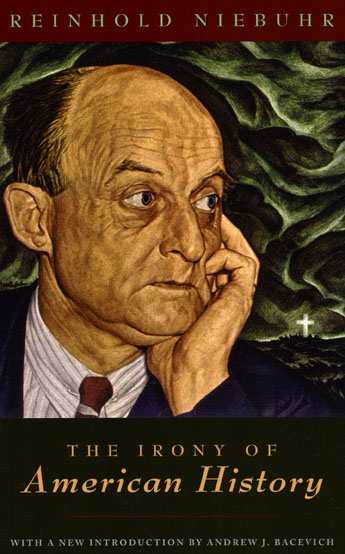
. Bacevich works with Reinhold Niebuhr's ideas, ideas that Keith reflected on in an earlier post. I hope you will engage with this piece and make Keith's blog a regular stop -- whether you're interested in history, theology, or cycling!
**************************

Theo-Politics: The Kind of Talk We Really Need
By Keith Watkins
How can religiously inspired ideas enter into political discussion so that theology transcends sectarianism and yet continues to be intellectually and emotionally potent? Often, this question has been answered by secularizing the discourse so much that theology virtually disappears, or by limiting the topics for which theology is allowed.
In The Limits of Power: The End of American Exceptionalism, Andrew J. Bacevich illustrates a better way. Using Reinhold Niebuhr’s writings as foundation, Bacevich translates a distinctively Christian theological view of reality into a public language that can be used by people who do not affirm Christian faith.
The End of American Exceptionalism, Andrew J. Bacevich illustrates a better way. Using Reinhold Niebuhr’s writings as foundation, Bacevich translates a distinctively Christian theological view of reality into a public language that can be used by people who do not affirm Christian faith.Niebuhr’s two principles were realism, which “implies an obligation to see the world as it actually is,” and humility, which includes the obligation to see ourselves “without blinders.” Hubris, realism’s enemy, “finds expression in an outsized confidence in the efficacy of American power as an instrument to reshape the global order.” Sanctimony, humility’s enemy, “gives rise to the conviction that American values and beliefs are universal and that the nation itself serves providentially assigned purposes.” Because realism and humility are in short supply today, Bacevich declares, American life and America’s role in the world are deeply flawed.
Bacevich uses the idea of freedom to explain the deep problems of American domestic affairs and world policy. Our mindless pursuit of freedom has led to its distortion and diminishment. The “central paradox of our time”—the exercise of freedom that demands that we fight around the world—undermines our capacity to fight, jeopardizes our freedom, and aggravates the disorders affecting our political freedom.
The result is that America faces crises in economic, political, and military affairs, each of which Bacevich discusses provocatively, as might be expected since he is both a retired military officer and professor at Boston University.
Half of the book analyzes political and military issues, but as a religious person I am most interested in his chapter, The Crisis of Profligacy. “For the majority of contemporary Americans, the essence of life, liberty, and the pursuit of happiness centers on a relentless personal quest to acquire, to consume, to indulge, and to shed whatever constraints might interfere with those endeavors.” In addition to its negative impacts upon personal character and well being, this quest has created a powerful and mostly negative impact upon foreign policy and American relations with the rest of the world.
Between 1979 and 1983, Bacevich writes, Americans made a fateful choice. “They could curb their appetites and learn to live within their means or deploy dwindling reserves of U.S. power in hopes of obliging others to accommodate their penchant for conspicuous consumption.” During this four-year interval, “bookended by two memorable presidential speeches,” Americans chose the latter, making these years “the true pivot of contemporary American history, far more relevant to our present predicament than supposedly decisive events like the fall of the Berlin Wall or the collapse of the Soviet Union.”
In July 1979, when many were insisting that threats to America came from external powers, President Jimmy Carter declared that “the real danger to American democracy lay within.” He identified an American “crisis of confidence” as “an outward manifestation of an underlying crisis of values.” In a speech delivered on March 23, 1983, President Ronald Reagan announced his Strategic Defense Initiative. In earlier speeches, he had countered Carter’s glum analysis, but in this one Reagan proposed that America had to become invulnerable and that technology could achieve that goal.
“Carter had portrayed quantity (the American preoccupation with what he had called ‘piling up material goods’) as fundamentally at odds with quality (authentic freedom as he defined it)…In Reagan’s view, quality (advanced technology converted to military use by talented, highly skilled soldiers) could sustain quantity (a consumer economy based on availability of cheap credit and cheap oil).” Carter lost both the presidency and the argument. Most Americans have embraced the Reagan view and since then we have moved ever deeper into a morass with no exit in sight.
In his concluding chapter, Bacevich reaffirms his thesis that power is limited and he again calls Americans to realism rather than idealism. We should turn our attention to the two meta-challenges” of our time: “nuclear weapons and climate change.”
What Bacevich is arguing makes sense to me. The world is big enough for everyone, so long as each of us lives modestly—loving our neighbor as we love ourselves, all within the larger context of loving God with heart soul, mind, and strength.