Search This Blog

Showing posts with label New Testament. Show all posts

Monday, March 14, 2011

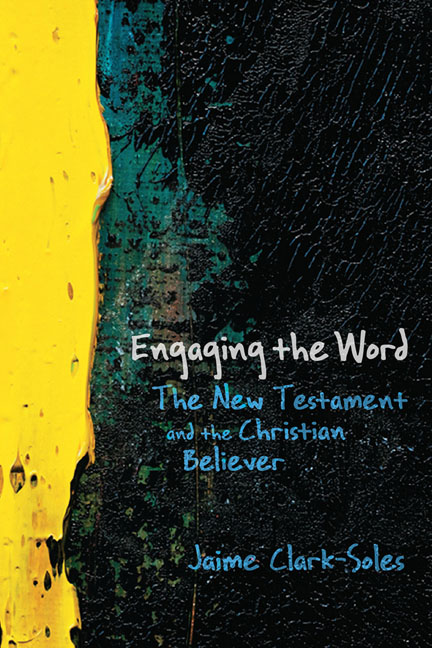
Engaging the Word -- Review

ENGAGING THE WORD: The New Testament and the Christian Believer. By Jaime Clark-Soles. Louisville: WJK Press, 2010. Xii + 154 pages.

Back in the day – when I was working for a Christian bookstore – there were quite a few options when it came to Bibles. At the time I was a devotee of the New American Standard and resisted the seductiveness of the newer New International Version (though I eventually succumbed to its smoother and clearer text). Later on, having become sensitized to the issue of inclusive language I embraced the even newer New Revised Standard Version. But despite the variety that was available then, today we that era might seem relatively impoverished when it comes to bible choices. Despite all of the new translations, and there are many more since I worked at that store in the early 1980s, and despite all the study options available, biblical illiteracy continues to plague not only the broader culture, but the church as well. The Bible remains a bestseller, but it is also the least read, most misunderstood, and possibly most misused bestseller on the market.

The question that the church must address concerns not the why but the how do we change this reality? There are a number of good translations available, which should make the Bible more accessible to people, but maybe the problem isn’t the prevalence of choices but the nature of the choices. Perhaps we have become overwhelmed by marketers who have so niched the Bible that it loses its place in the life of the church. It has become a commodity to be manipulated for better sales.

Jaime Clark-Soles, a professor of New Testament at Perkins School of Theology, has taken on the task of providing wise guidance in matters of biblical study – for lay and clergy alike. Clark-Soles understands the scholarly issues of the day, from the historical Jesus quests to biblical authorship to translation issues. She is deeply embedded in that conversation, but this book isn’t written for scholars, it’s written primarily for the lay audience. It’s written with great care and with eloquence, but without the sensationalism that so often accompanies such books. She’s not trying to convince us that she has discovered something new and unique that the scholars and the preachers have been hiding from the laity. But, she wants to make the New Testament understandable to people who may find reading the Bible a daunting task. She is a critical scholar, left of center in her commitments, but she is also committed to the faith, which may be why there is a lack of sensationalism (ala Bart Ehrman).

She begins the book in an interesting manner. She takes up the question of packaging – something that addresses the consumer-driven nature of contemporary Christianity. She does this by taking a look at the current ways in which the publishers are marketing the Bible, starting with Revolve, a New Testament based on the New Century Version that is niche-marketed to teen-aged girls. This is a bible that’s relevant – that is, it is packaged as a fashion magazine. The biblical text is surrounded by fashion tips and articles dealing with relationships. The packaging might be attractive, but what does this package do to the way we read Scripture? The author points out that situated in a sidebar next to the story of Herod’s Slaughter of the Innocents is an article about “emergency pimple repair.” And what does this beauty advice have to do with Matthew 2? Clark-Soles writes “Well, as the text says, ‘Blemishes come and go, but God’s Word remains forever.’” In this opening chapter, the author deals with a number of critical issues, including the problem of separating out the New Testament from the entire biblical text, the problem of study notes and life application notes. She raises the question that has always troubled me – how do we separate out the commentary from the text, when the commentary is printed along with the text? Of course, she raises the question of the dangers that accompany hyperindividualizing these Bibles. It might be good for sales, but is it good for understanding the text of Scripture.

In reading this opening chapter, you begin to discern an ironic twist to the religious conversations of the day. Conservative evangelicals are keen to defend biblical authority, and yet it would seem that these products that largely come from evangelical publishers and marketed to evangelicals could in the end devalue the very Scriptures that evangelicals seek to defend. Indeed, as this occurs, as we begin to treat the Bible as some kind of manual to answer our beauty and relationship questions, it loses spiritual value.

So the question is – what should we do? In answer to this question, Clark-Soles offers words of guidance, beginning with a chapter on the various ways we read Scripture, showing both the “promises and pitfalls.” She introduces the reader to premodern (uncritical), modern (critical, reasonable), and postmodern (questioning and aware of cultural influences) approaches to scripture. From there she turns to the various parts of the New Testament, beginning with the Gospels. She begins this section with a question of harmonization. Should we try to harmonize the four gospels, or let them speak for themselves? Her answer is to let them speak for themselves. In that regard she deals with some of the key issues, such as the people mentioned in the four gospels – noting that when we harmonize we tend to conflate identities – such as the various Marys and Jameses. She deals with genre – noting that the gospels aren’t biographies. They’re not eyewitness accounts and that the authors framed the story to fit their own needs. For those committed to a Modernist reading, whether conservative or liberal, this can be problematic when it comes to authority. It is in this context that the author raises the issue of the four senses of scripture – the literal, the allegorical, the tropological, and the analogical. The church has understood that there is more than one way of reading the text – that the literal may not always be the best way to read and interpret the text.

Staying with the Gospels, the author deals with the so called “Synoptic Problem,” that is the relationship of Matthew, Mark, and Luke (along with the presupposed existence of Q). She deals with all of the major theories that range from Markan priority to Matthean priority. She deals with form criticism (transmission) and redaction criticism (editing). In this chapter she deals with the current fascination with the Gospel of Thomas, which is a sayings gospel and thus quite popular with those who want to assert the priority of Q, the sayings of Jesus. She also deals with John, and its place in the conversation. She feels, rightly so, that John too often gets excluded from the conversation when matters of Jesus’ life get discussed. She believes that John may have more to offer than the reigning paradigm would allow. Her point is that we are at a point in which we need to reexamine this who “synoptic problem.”

With a new book from Bart Ehrman on authorship issues (I’ve not read the book, but the title seems to give away the intent – Forged), Clark-Soles discusses the issue of authorship, especially with regard to the Pauline texts. It’s not all that controversial to say that the gospels were written anonymously, because there is no name attached to any of them. The same can’t be said for texts such as Ephesians and Colossians, which claim Pauline authorship, as is true with the Pastorals, or with the two letters attached to Peter. The letters of John are largely anonymous, and Revelation is self-attributed to a John, but necessarily the Apostle John. She deals with all the relevant issues, including the reasons why many scholars doubt that Paul wrote the so-called “deutero-Pauline” texts, issues that range from eschatology to church offices. With regard to the question raised by folks like Ehrman, she notes the questions of whether this is “dishonest,” and whether the fact that Paul might not have written Ephesians might undermine its authority. She seeks to answer these questions by pointing us to the canonization process, and the role that this process has played in how we read and experience the text. She raises more questions than she provides answers, but that’s not a bad thing. It pushes us to dig deeper.

Finally, she looks into the Historical Jesus debate and the politics of biblical interpretation. With regard to the latter, she notes how in recent years there has arisen a plethora of differing ways of reading scripture, from Feminist to Queer, from Ethnic to Post-Colonial, each of which raises question about approach and ideology. If you think that one of these approaches is politic and yours is not, she suggests that we might need to look more deeply inside to discern our own ideologies. In other words, there is no completely “objective” way of reading the Text. We all bring something to the discussion. Even as the authors were “socially located,” so are the readers. With regard to this question of social location, she provides an inventory so that we can examine questions of authority, ethnicity, gender, theology, the translations we use and more, asking how these issues affect the way we read Scripture. And in closing she reminds us all that we all have our own “canon within a canon.” We all start somewhere. There may be no one way of reading Scripture, but as Clark-Soles reminds us - -there are responsible ways of reading Scripture, and she invites us to take up this task. Her book focuses on the New Testament, but remember that she challenged us to not separate the New from the Old. Thus, it would be helpful to read (as I’ve yet to do), her book in tandem with one written on the Hebrew Scriptures by Carolyn Sharp (Wrestling the Word, WJK, 2010).

This is with a doubt a most helpful book. It raises questions, provides resources (including questions for discussion), and pushes us to be more responsible in our reading of the text. If we will heed the wisdom present in this book (and I’m assuming present in Sharp’s book), then perhaps we can begin to overcome the prevailing biblical illiteracy within the church! Oh, and she does all of this in a 148 pages of text.

Tuesday, February 8, 2011

An Old Testament God?

I was preparing for our study of Islam, which I'll be leading tomorrow.  We're using Adam Hamilton's Christianity and World Religions (Abingdon) as our foundation (has video and leaders guide).  My point is not to talk about the series, but to raise a point (Hamilton is a centrist United Methodist in theology).

Hamilton does something -- something I hear Christians do fairly regularly -- and that is distinguish between the God of the Old Testament and the God of the New Testament (of Jesus).  In his discussion of Islam, which is really quite fair when it focuses on the teachings of Islam, he suggests that the Muslim view of God is a step backward toward the God of the Old Testament.  That is, the Old Testament portrayal of God is one that, unlike the NT, is more violent and less loving.  He uses God's command to Elijah to slaughter the priests of Baal.  Jesus doesn't do this (though Hamilton and many other Christians forget about what happens in the Book of Revelation). 

The problem here is one that has plagued Christians almost from the beginning.  We want to see ourselves improving upon Judaism.  We may not go as far as Marcion, who suggested that the Creator God was a "demiurge," a lesser God than the God of Jesus, who is the God of love.  Marcion went so far as to create a truncated canon of Scripture that would support his claims.  

But what are we who are Christians saying when we say that the God of the OT is a more violent God than the God of the NT?  Obviously there is doctrinal development in the OT and the NT.  Both testaments come out of particular contexts, but is the Christian understanding of God better than that of Judaism?  And is Muhammad's view a step backward to a Jewish view?   Or, would it not be best to say that all three religions give different perspectives on God, some more violent and some more peaceful? 

I end with this word from Disciple theologian Clark Williamson:
In their post-Shoah teaching documents, the churches affirm that the God whom Christians worship is the living God of the Bible, the God of Israel, worshiped by Jews.  They assert that Christians have come and still come to know this God in Jesus Christ -- that in, through, and by means of Jesus Christ Christians are again and again confronted with the promise and command of the God of Israel.  That the God of Israel was incarnate in Jesus Christ, the Jew from Nazareth, is a claim that further makes it clear that the God of Israel "is not an isolated God without relationships, but a God who turns toward humankind and who is affected by human destiny."  God, who dwells not only in transcendence but in the midst of God's people is subject to distress and persecution "as Lord, Father, Companion and Redeemer." The covenantally related God of Israel, whose covenant love (hesed) involves God in interacting with all God's creatures and particularly with God's people, is here asserted against the church's tradition of construing God as in all respects unrelated to and unaffected by events in the world.  (Williamson, A Guest in the House of Israel, p. 202)
The quote is to a German Roman Catholic document from 1979.  Clark Williamson asserts that the God of Jesus is the God of Israel?  If Jesus is understood as the incarnation of that God revealed in our Old Testament, how can we make such a distinction between the God of the OT and the God of the NT?

Wednesday, January 19, 2011

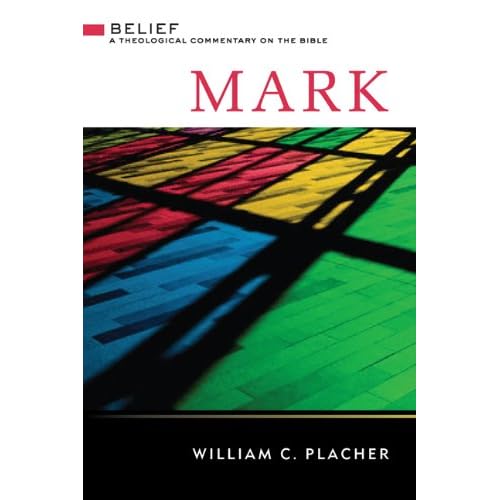
Mark (Belief) -- Review

MARK (Belief).  By William Placher.  Louisville:  WJK Press, 2010.  272 pages.

If your commentary budget has not yet run dry, check out William Placher's new book on the Gospel of Mark, the first in a new series of theological commentaries from Westminster John Knox. Placher, who died in 2008, was to be the co-editor of this series with Amy Plantinga Pauw. This volume, the last thing he wrote, is a fitting legacy.

I appreciate a commentator with deep theological sensitivity, someone who can build a bridge from the ancient text to the present faith experience. Though a theologian by training and not a biblical scholar, Placher demonstrates a keen understanding of the critical issues--but without letting this overwhelm the text's theological insights. As he notes (tipping his hat to Barth), critical scholarship is but the first step toward commentary. In Placher's hands the text comes alive as he interacts with it in the company of Augustine, Calvin and Barth.

Although Mark is the briefest teller of Jesus' story, Placher suggests that we should attend to Mark's presentation because of its historical, political, literary and theological perspectives. Mark's Gospel is closest to Jesus' own lifetime; it demonstrates awareness of the political issues of the day. While it might in some ways lack literary polish, its storytelling is sophisticated. As for theology, in the text we encounter a God who is a fellow-sufferer, one who understands our situation.

Placher takes us through Mark passage by passage, drawing from other theologians as needed and offering occasional "further reflections" on specific topics (Satan, ransom theory). The commentary begins by noting that Mark's original audience was familiar with a "book that started with archē (beginning)." Mark's opening lines suggest "a comparison between this story of a recently crucified teacher and the story of God's creation of the whole universe, the beginning of God's sacred Word." This gospel of a new beginning concludes with Mark's shorter ending (16:1-8), which leaves us at the empty tomb, hanging, needing more information.

Placher finds confirmation of the resurrection in Mark's inclusion of the women as witnesses. But the end of Mark is consistent with what Placher calls his "cryptic, dark theology"--which other gospel writers couldn't tolerate. Mark ends without appearances or commissions, offering only an ambiguity that might fit well our contemporary age, "when a Gospel that ends with Christ triumphantly present is harder to reconcile with the horrors of the world around us and doubts within us. Mark throws the ball to us, as he did to his first readers." Having heard the story, it's our responsibility to keep it alive in our lives and in our testimony.

Reposted from the Century Blog

Thursday, October 21, 2010

The New Testament and its Diversity of Voices

Although I'm not an inerrantist or an infallibist, I am one who believes that the New Testament as it stands is a distinctive and authoritative voice to which the church should give its attention.  I realize that there were other documents floating around that didn't make it into the canon, but is that necessarily a bad thing.  Perhaps what emerged as the New Testament carries with it the providence of God, and that it is this voice upon which God has breathed so that it might be "useful for teaching, for reproof, for correction, and for training in righteousness, so that everyone who belongs to God may be proficient, equipped for every good work" (2 Timothy 3:16-17).  

Now, I recognize that for this to happen, we who are the recipients of this voice must attend to it carefully.  We must be discerning readers, watching for nuances and context.  We read it not simply on the surface, but plumb its depths for meaning that can be carried forward.

As we consider this voice, it is helpful to remember that there is already, within this collection of texts, diversity.  There are four gospels, each carrying a distinctive voice.  And, it's important to realize that this recognition isn't new.  As biblical scholar Larry Hurtado notes in a blog posting, 2nd Century Christians were wrestling with this diversity.  Some of them, like Marcion decided to adopt just one voice (and a truncated version at that).  Others, like Tatian tried to weave the voices together (The Diatessaron) -- an effort that has often been imitated down through history. 

Then there are those other voices, the ones that have become so popular in recent years -- like the Gospel of Thomas.  Everyone seems to love the Gospel of Thomas and wonder why it didn't make the cut, but as Hurtado notes, the adherents of that Gospel likely wouldn't have been throwing it into the ring.  It has, as he notes an elitist tone, for only those in the know would get this gospel, so why put it into the ring with lesser messages?  Thus, he writes:

People today sometimes refer to writings “left out” of the NT or refused entry, as if there were many texts vying to be included with the writings that came to be the NT. There were a few that seem to have been considered for a while (e.g., Shepherd of Hermas, a certain “Gospel of Peter”, maybe 1 Clement). But it is unlikely that the authors of Gospel of Thomas, Gospel of Truth, Gospel of Philip, or the several apocryphal acts ever wanted their texts to be part of a NT collection. The Gospel of Thomas, for example, reflects an intense disdain for ordinary Christians, and claims to deliver a unique and secret body of teaching of which only certain believers are worthy. It’s elitist to the core, so it’s unlikely that those responsible for it ever wanted to have it treated as one text/voice among others. (As as to the mainstream Christian rejection of the stance reflected in Gospel of Thomas, I’m reminded of the quip from the American comic, Jerry Seinfeld: “Sometimes the road less taken is less taken for a reason!”)

But the church in its wisdom, as it gathered texts into an authoritative whole, chose to embrace the diversity, leaving it to our discerning eye to find the truth of the gospel for each era.  And that, my friends, is our task, discerning together the message of God for today, a message I believe should be anchored in the text of Scripture. 


Wednesday, October 6, 2010

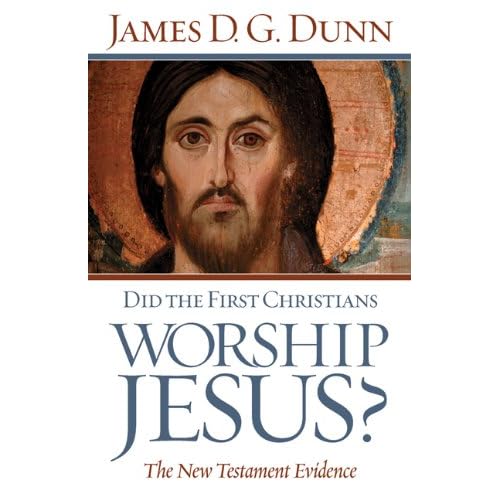
Did the First Christians Worship Jesus? -- A Review

DID THE FIRST CHRISTIANS WORSHIP JESUS?  The New Testament Evidence.  By James D. G. Dunn.  Louisville: WJK Press, 2010.  viii + 168 pp.

    If popular hymnody was to be the guide to answering the question posed in the title of this book by British New Testament scholar James Dunn, the answer would appear to be yes.  The assumptions that underlie the doctrine of the Trinity would also lead us toward a similar answer.  After all, according to the creeds Jesus is divine, and if Jesus is divine then shouldn’t we worship him?   Complicating this conversation is the assumption that the Christian faith is monotheistic, and if Judaism offers guidance as to what that involves, then doesn’t worship of Jesus distract us from the worship of God – whom many Christians name Father?   The question that Dunn seeks to answer in this relatively brief book concerns the New Testament evidence.  If one attends to this evidence, what are we to conclude? 

    Dunn notes that this discussion not only has implications for Christians, but it also has implications for interfaith dialog, especially with Jews and Muslims who have a much more straightforward monotheism. 
    To regard Jesus as divine, as worthy of worship as God, seems to them an obvious rejection of the oneness of God, more a form of polytheism than a form of monotheism (p. 1).
The doctrine of the Trinity, which is the traditional answer to this dilemma is not only baffling to our monotheist friends, but it is a bit baffling to many Christians as well.  Words like essence, substance, and even person make little sense outside their Greek philosophical foundations.  Whatever theological answers have emerged over time, as Christians have wrestled with and reflected upon the biblical witness, a satisfactory answer to the question of whether worship should be given to Jesus requires us to attend to the New Testament evidence. 

    Our ability to offer an answer to the question of whether the first Christians worshiped Jesus requires us to first define what worship is.  A basic definition assumes that reverence or praise is being given to a god or God.   Even here, however, there are complications because the word worship is often used in ways that diverge from that basic definition.  In England judges, for instance, are referred to as “Your Worship.”  Surely judges aren’t gods.  And the Book of Common Prayer uses the word worship in the context of the marriage ceremony in reference to the relationship of the husband to wife.  Being that he is a biblical scholar Dunn takes the reader on a tour through the words used for worship in the New Testament, including proskynein and its relatives.  Used to refer to deference to higher authority, submission, and worship – it is used in relationship to beings other than God.  Although used in relationship to Jesus, the number of cases are few, and the clearest use comes in Revelation.  There are a number of other terms that can mean to give praise, to worship, that have references both to God or to Jesus, but none of these usages are conclusive. 

    Dunn concludes that while there are intriguing pieces of evidence of usage that suggest worship of Jesus, these usages are limited.  When used these words most often show wonderment at the “realization that God had raised Jesus from the dead, and in some of the worship offered to the Lamb in the visions of the seer of Revelation” (p. 27).  There is no evidence at all of cultic/liturgical worship of Jesus, and the most commonly used words for praise and thanksgiving are never applied to Jesus.  Instead, thanks is given to God for what Jesus has done.

    If there is little language usage that suggests direct worship of Jesus, the accounts of religious practice of the early Christians are not suggestive of direct worship either.  As for prayer, it is almost always directed toward God, and of course, Jesus himself is depicted as praying to God.  The early Christians invoked Jesus’ name and prayed in his name, though sitting at the right hand of the Father he could be appealed to, but does this connote worship?  Dunn isn’t convinced.  As for hymns, many of the New Testament hymns focus on Christ, but they’re not directed to Christ.  Instead, they give praise to God for Christ.  Clearly Jesus is central to the early church’s self-understanding – the church is described as the body of Christ, for instance, but does that connote direct worship?  As for sacrifice, Jesus is the one who offers sacrifice and is the sacrifice, but the sacrifices are offered to God, not to him.  The conclusion?  Jesus was central to early Christian worship, was the reason why prayers were offered to God with confidence, and was the subject of Christian hymns.  They invoked his name and appealed to him for help in times of crisis.    He was the context for worship and its means, but worship was accomplished through him, but wasn’t normally directed to him.

    Dunn’s conclusion after reviewing the relevant evidence is that the question posed in the book’s title is far too narrow and thus misleading.  The better question concerns whether Christian worship was and is possible without Christ.  Therefore, we need to pursue a somewhat different question: “was earliest Christian worship so closely bound up with Jesus that inevitably he participated in the receipt of worship just as he participated in the offering of the worship?  Was earliest Christian worship in part directed to him as well as made possible and enabled by him?” (p. 58).  If we are to move toward this broader question of whether Jesus is included in the worship of God, then we must also move toward wrestling with questions about the nature of monotheism and Jewish understandings of heavenly mediators and divine agents.  When we move toward this question many new possibilities open up.  The Old Testament, for instance, doesn’t offer as strict a monotheism as modern Judaism and Islam claim for themselves, and there are references, for instance, to angels who reveal God’s presence as examples of divine immanence.  Dunn notes that ancient Jewish theologians affirmed a double aspect of God, one that is both transcendent and invisible and one that is immanent, reaching out to humanity and the created order in a variety of ways.  There is, Dunn believes the possibility of a binatarian understanding of God’s existence even prior to the emergence of Christianity, one that would prove beneficial to the early Christian theologians – references, for instance to the Wisdom of God and the Logos of God.  Thus, while there was no thought of any being other than God being worshiped, Second Testament Judaism offered a context or atmosphere in which “the question of Jesus being worshiped could arise, and arise as a natural corollary to the status attributed to him, it had provided no precedent to which the first Christians could appeal” (p. 90).     

    In a lengthy fourth chapter entitled “The Lord Jesus Christ,” Dunn wrestles with the question of Jesus’ own understanding of monotheism, which he answers in the affirmative, but with the caveat that Jesus had a sense of intimacy with God that, in Dunn’s words, “the disciples could only begin to experience as they stood with him and came to God as Father in dependence on him, as though youngsters who found it possible to stand before their father only when accompanied by their older brother” (p. 101).  From there he moves to the confession of “Jesus as Lord,” setting the confession in the context of Jewish understandings of God and the important Pauline texts.  He then moves to the use of Word (logos), Wisdom (sophia), and Spirit (pneuma), seeking to understand how these terms came to be used in expressing a developing Christology. 

    In this fourth chapter Dunn takes up what he admits is the most difficult issue in the conversation – the occasional use of the word god/God in reference to Jesus.  If this word is used in relation to Jesus, and yet we are to keep from moving in a polytheistic direction with Jesus being a second God, how should these references be interpreted?  In answer to this question, reflecting on texts in the Johnannine corpus and elsewhere, he concludes that “Jesus was God, in that he made God known, in that God made himself known in and through him, in that he was God’s effective outreach to his creation and to his people.  But he was not God in himself” (p. 135). 

    So should Jesus be worshiped?  Dunn concludes, after a lengthy conversation with such contemporary figures as Larry Hurtado, Richard Baukham, and James McGrath, that we must start from the premise of monotheism, and that if Jesus is worshiped, it is in the sense that God is worshiped in and through him, but Jesus is not worshiped directly in distinction from God.  That is, we must beware of practicing what Dunn calls “Jesus-olatry.”  Like idolatry, in which the idol absorbs the worship due God, in “Jesus-olatry,” Jesus becomes a substitute for God, and therefore absorbs the worship due God alone.  Thus, it would be better to see Jesus as an icon, a window through which the divine can be seen and experienced.  The problem with worship directed at Jesus is that worship ends there and doesn’t move onto God.  Therefore, as Christians, worship is directed not at Jesus, but we are called to worship God in and through Jesus.  If we stick with the original question posed by the title, then the answer is no – the early Christians didn’t worship Jesus.  However, if we broaden the question and ask whether Christian worship of God is defined by Jesus, then the answer is yes.  Christianity, Dunn concludes, remains monotheistic, but its worship is enabled by Jesus and God is revealed in and through Jesus. 

    James Dunn has provided the church with an important resource that will help it come to grips with the place of Jesus in worship.  It also helps us better develop a Christology that reflects the biblical witness.  Dunn’s monotheism is Trinitarian in nature, but it seeks to keep things in proper alignment.  This is not a lengthy book, but it is demanding reading – not in the sense that it is dense prose, but because it demands much of us who are Christians to examine our understandings of God and the way in which we approach God in worship.  Thus, this is a must read book for anyone wanting to understand the place of Jesus in theology and worship.

Sunday, September 27, 2009

Revelation Perseverance


NOTE: This is the continuation of the 'Sunday Sermon' series, all entries of which can be viewed by clicking that 'label' below.

The Book of Revelation is the final book of the Bible. Also known to some as 'The Apocalypse' or the 'Revelation to John', the book is filled with symbolism as it unravels the end of times for man's journey here on the planet Earth which began in the Garden of Eden.

The symbolism of the book can likely be attributed to two parts. The first part is one that I believe to be mystical revelation in which God reveals future events to John of a spiritual or heavenly nature with symbols that he can understand and which are left to our interpretation for their exact meaning and nature.

The second part is one that I believe comes from John's attempts to describe future people, places, media, weaponry, technology and events in ways that are understandable to him based on the world of his time. For instance, John describes in Revelation 9:19 what I believe to be tanks as horses. When you read the passage and a few just prior, it is easy to follow this logic.

The Book of Revelation is about two main principles. As the New American Bible describes it "the triumph of God in the world of men and women remains a mystery, to be accepted in faith and longed for in hope." This means that we need to accept with faith that God has a plan for humanity, and that the culmination of his plan for humanity is nothing to be feared, but rather to be longed for.

Many through the ages have wanted to believe that this finale for humanity was upon them and their world. They have seen the end of days, that 'apocalypse' or prophesied time of the imminent destruction of the world and salvation of the righteous, coming in their own lifetimes. Every one of these previous believers was wrong, or was rushing God's hand.

God has laid out certain key events in the text of the Bible that must occur before the events depicted in Revelation will come to pass. Among these were the spreading of the Gospel of the Truth of Jesus Christ to all corners of the world. This has only become realized in recent decades, with the final reaching of missionaries, evangelists and, frankly, the internet into the remotest sections of the planet.

Another key event that the Bible lays out as necessary before the end times fully arrive is the rebuilding of the Jewish temple on the Temple Mount in Jerusalem. This was impossible until recent decades, with the return of the Jews to power in the region, the establishment of Israel as a nation, and their subsequent control over Jerusalem itself as a result of a series of wars. Those wars will probably look like small potatoes next to what will result if they actually attempt to build that Temple.

The organization of the European Union is another clear sign that we are moving towards those end days of Revelation. Add in the circumstances of Israel in relation to its neighbors, the budding relationship between Russia and Iran, and the strengthening of China, and any serious evaluator of a Biblical end times theory has to admit that the earthly powers and circumstances are finally aligning as fully as never before in human history to those expressed as necessary by Revelation and other Biblical revelatory books.

Now there will be some who will scoff at any 'end of the world' scenario. There are many non-believers in the world today. Not just non-Christians, but people who refuse to believe in anything beyond their own worldly thoughts and desires. For these people we can do nothing but pray, and hope that as the final years play out they see the light before it is too late.

The fact is that the Bible says there will be many who see these Revelation events unfold before their very eyes, and yet continue to disbelieve. Some will do so out of a hard heart. These are the stubborn people who simply refuse to admit they were wrong, and refuse to surrender their will to that of God. Others will be seduced and misled by the forces of evil that will emerge during these end times, most especially by the anti-Christ, the world leader who will emerge.

Keep in mind the rebuilding of the Temple in Jerusalem by the Jews there. If you see that happen, you can begin the countdown. If you don't see that happen, then anything else is pure fear-mongering. But if that does happen, if you are not a believer by that point you had better start paying attention to Revelation, and in fact to the entirety of Christ's teachings and those of his Apostles in the New Testament.

The end times, whenever they occur, will not be a happy period for Christian believers here on earth. There will be wars, famine, persecution, pestilence, natural disasters, and many other heart-stopping occurrences. The anti-Christ will mislead many into thinking that these are coincidental and that he has the answers. Those of us who know the truth need not fear that time and those events, we only need do two things: remain faithful, and persevere. Remember, we know how it will all turn out in the end.

Until such time, if it even happens in our lifetimes, I would urge you to open up your Bible and read. Try to take the time to read it from front to back. If nothing else, at least start out by reading through the New Testament, from the teachings of Christ to the 'Acts of the Apostles' and on to Revelation. Give yourself a fighting chance by experiencing the ammunition of revealed Truth. And may God bless you and yours as you continue your life's journey.

Tuesday, June 30, 2009

The Substance and Evidence That is True Faith


What is faith? A direct answer has been provided for us in the 11th chapter of the book of Hebrews. This one book of the Bible provides in its forty relatively short verses an exact meaning, and some definitive examples of this often misunderstood and often undervalued spiritual principle.

Hebrews begins with the definition, that "faith is the substance of things hoped for, the evidence of things not seen." But it does not leave us there with no direction as to where this quality originated, or with no practical examples that highlight the simple definition of faith.

It is the 'substance' of things hoped, their very essence or foundation. Without a solid foundation, a structure or a system, or a person, will crumble. Faith is the substance of every good thing that we wish for ourselves and those we love. With faith, the achievement of all our dreams and goals is made possible.

It is the 'evidence' of things not seen. We cannot 'see' the being of God. We cannot look into His eyes. His arms do not wrap around us in a hug that we can feel. But when we have faith, we are actually aware of His loving presence in our daily lives. During our best of good times, our most difficult periods of challenge, and during our most awful of tragedies we experience that we are never alone.

In the book of Hebrews we receive numerous examples of men and women who entrusted their faith in God and were rewarded. Noah in preparing the ark and its inhabitants while the sun shone. Abraham in his willingness to offer up his only son as a sacrifice in the belief that God would raise him or have a greater plan. Moses in choosing the truth of his Hebrew background over an adopted Roman one when confronted with a future filled with likely persecution.

Faith, it turns out, comes directly from God. "Through faith we understand that the worlds were framed by the word of God, so that things which are seen were not made of things which do appear." God created everything that is now, ever has been, and ever will be in existence. We can know this intellectually, without recourse to blind faith. Common sense in understanding visible and theoretical science points us to the signature of our Creator. Faith helps fill in the blanks and answer the questions.

God did not leave us photographs or video of his creation, but He did inspire our ancestors' words and visions to be left to us in the Bible. He did impart in us an intellect and critical thinking ability. And more importantly, He sent His Son to us to teach us directly. Jesus Christ let us know through His teaching that we "need only have faith as small as a grain of mustard seed, and we can say to a mountain "move from here to there", and it will move."

In Romans 10:17, Paul imparts to us that "faith comes by hearing, and hearing by the word of God." This gives us practical instruction that we can gain and strengthen our faith by listening to God and the teaching of Jesus Christ, who emphasized this act of listening many times during his public ministry.

Read up on God's word, on Jesus' teachings. Perhaps just as importantly, listen to them. Go to church and hear His words spoken, His lessons taught, and share the experience with others. Remember what Jesus said, that "wherever two or more are gathered in my name, there I am in the midst of them." Your faith will be affirmed in His truth, the truth which truly shall set you free.

Sunday, March 22, 2009

Conspiracy, Betrayal, Denial

We are now just three weeks away from Easter Sunday, which along with Christmas Day is the celebration of one of the two greatest events in the history of mankind. On that day of Easter we will celebrate the great victory of Jesus Christ over death, his rising from the grave into which he entered as a repentance for the sins of man. But besides that sin for which his death was payment, there was a human process of actual conspiracy and betrayal that served as the mechanization leading to his crucifixion. And near that end there were a series of denials from his most beloved and respected friend and follower. As the Bible tells it in the New Testament gospel of Luke, with the Passover festival about to begin the chief priests and scribes were looking for a way to put him to death. They feared Jesus' popularity among the people, and that many of his teachings were outside the bounds, some directly in conflict with, the tenets of the Jewish faith. The Gospel of Matthew tells that they assembled in the palace of the high priest, Caiaphas, and consulted on how best to effect his arrest and eventual execution. Their initial plan was to have this plot carried out after the festival was over, because as both Matthew and Mark tell us, they feared "a riot among the people", such was Jesus' popularity. Their plots against him came together more suddenly than they wanted because the fact is they were not in charge of things. As Luke tells it, Satan "entered into" one of Jesus' twelve disciples, Judas Iscariot, who approached the temple guards and the chief priests with an offer to betray Jesus and turn him over to them in exchange for money. When the chief priests agreed to pay him 30 pieces of silver, the conspiracy was in place, and Judas began to seek an opportunity to lead them to Jesus when there would be no crowds around to cause a disturbance. When the time came to celebrate the Passover meal, Jesus gathered with his disciples in the large upper room at the home of a Jerusalem man who was a supporter of their group. During the meal, Jesus instituted the Sacramental expression of the sharing of His body and blood. In breaking bread and passing it among his friends he said "This is my body, which will be given for you; do this in memory of me." After they ate, the Lord then took the cup of wine and said to them "This cup is the new covenant of my blood, which will be shed for you." As they further celebrated the meal, an argument broke out among them as to who was the greatest of Jesus' followers. Rather than select anyone of them, Jesus instead told them that true greatness comes not from lording it over others, but through service, saying "I am among you as the one who serves." When his closest follower and dearest friend, Simon Peter, told Jesus that he was prepared to go to prison and die for him, Jesus replied that "Before the cock crows this day, you will deny three times that you know me." He also told the twelve friends that one of them sitting among their group would betray him saying "It would be better for that man if he had never been born." As we know through history, late that very night while his followers slept in the garden at Gethsemane at the foot of the Mount of Olives, Judas saw the opportunity to turn him over. He led a group of soldiers to that location, approached Jesus, and identified him to the soldiers by kissing Jesus on the cheek. Jesus was taken into custody and brought before the Sanhedrin, the council of elders, chief priests and scribes who would begin the process of a sham legal proceeding leading to his death. While Jesus was in custody, three different times that day his friend Peter was approached and accused of being one of Jesus' followers, and all three times Peter denied that it was so, just as Jesus had foretold. As the celebrations of Easter approach we should all be reminded of these moments when the very Savior of mankind was conspired against, betrayed, and denied by his very closest friends and followers. We need to remember that while our friends and family are important, no one is beyond Satan's grasp, and no one is beyond doing the exact same thing to each of us. In the end, we hope to count on the people in our lives at the most important moments. But the fact is that in the end the only one whom we can really count on is Jesus Christ himself. He was the one who stayed faithful to us. He is the one who went to the cross so that your sins would be forgiven. He was the one who suffered and died for each of you reading this. Do not turn your back on him as his followers did. Use the approach of this holy and blessed season to set your lives on a path that draws you closer to Jesus Christ.

Sunday, August 10, 2008

Forgive Yourself

Apparently there are many Christians out there who, even after participating in the Catholic sacramental process of confession and reconciliation, find that they continue to worry about past sins for years after they have confessed them. The fact for many people is that the Lord forgives more easily than we can forgive ourselves. In the New Testament, John 3:17 says it most completely: "God did not send the Son into the world to condemn the world, but that the world might be saved through Him." Let's start by dealing with the forgiveness of sins as the Church deals with it. God gave us two ways to be forgiven of our sin. First is the sacrament of Baptism, which I spoke more fully about last weekend at this blog. Baptism was given by God to take away the 'Original Sin' committed by Adam in the Garden of Eden, as well as to cleanse our souls of any sins committed by us prior to our baptism. At Pentecost, Peter, who Christ had left as the first steward of his Church, said: "Repent, and be baptized every one of you in the name of Jesus Christ for the forgiveness of your sins..." Of course, man is an imperfect creature, and he will sin even after being cleansed and forgiven at baptism. To help man with sins committed after baptism, another process was needed, which has been called by the names confession, penance, and reconciliation after the three main parts of this process. God sent his Son, Jesus Christ, to die for our sins and to forgive them as well. After His resurrection, He said to the apostles: "As the Father has sent me, even so I send you...If you forgive the sins of any, they are forgiven; if you retain the sins of any, they are retained." Knowing that He would not always be among men physically, Christ passed the power to forgive sins on to His followers, and instructed them to pass this along to their successors. Thus we have the formal forgiveness of sins today in the confessional. Some people are afraid to go into the confessional and face a priest to ask for forgiveness. Maybe they have been away from the Church for a time, perhaps a long time, and are embarrassed both by their sins and by their estrangement. Others are simply resentful, feeling that they should just be able to deal with God directly, and not have to use a 'middle man' like a priest. Some have especially taken this attitude with the emergence in recent years of sexual abuse scandals within the priesthood itself. "Why should I ask those pedophiles to forgive me of my sins?" is an attitude that has been expressed. The fact is, these are only excuses, not reasons, for missing out on the sin-forgiveness process. Fear needs to simply be overcome, and there is only one way: just do it. Find out when your local church holds confessions, go there during that time, sit in a pew for a few minutes praying for strength and reminding yourself of some of your more egregious sins, and then get into that confessional and lay it all out with the priest, even telling him of your fears. Pride needs to be overcome, the feeling that maybe you know better how to have your sins forgiven, and give the process a chance. Once you give up the pride, overcome the fear, and get into the confessional and begin talking to the priest, I guarantee you that the feeling you have on leaving that confessional will be uplifting and freeing. I hope and pray that more of you actually take the opportunity to get back into the formal penance process, and back into Church itself, sharing in Christ's body in the Eucharist. That said, even should you do so, you have only won half the battle. God has fully forgiven you, but you still will need to let go and forgive yourself. First, know this: Jesus loves sinners. Again in the New Testament, Mark 2:15-17 quotes Jesus Himself as saying: "People who are healthy do not need a doctor; sick people do. I have come to call sinners, not the self-righteous." In most surveys on the subject, the reason that people have left and stayed away from the Church go back to pain: the pain from sin, abuse, divorce, addiction, abandonment, betrayal, failure, poverty, loneliness, etc. One of the biggest sources of pain has always been described by respondents as guilt over past sins. This guilt has spoiled relationships, caused sleeplessness and depression, and caused many to say things to themselves such as: "God doesn't want to have anything to do with me." Fact is, nothing could be further from the truth. Sin causes these worries for a reason. Sin is evil, committed intentionally. We have taken some action, said some words, thought some idea that we absolutely know full well is wrong. It is a violation of one of God's commandments, particularly Jesus' command for us to love one another as He has loved us. William McKee has written of three ways to stop worrying about past sins. First, don't be a 'connector'. Stop thinking that bad things happen to you now because of your past sins. God doesn't work that way. Second, don't make 'comparisons'. Just because you perceive someone else to be holier or more perfect than you doesn't make it so. You have no idea what goes on in someone else mind, or behind their closed doors. You can only worry about yourself and your thoughts, words, and deeds. Finally, and perhaps most difficult, develop a 'positive self image'. It is not vanity to think well of yourself. It has often been said that you need to love yourself before you can love others, and this is very true. The roots of your past go deep, but the fact of the matter is that you are likely a much better person at heart than you give yourself credit for. One thing that is important to remember here is that self-love does not really come from ourselves 'looking in the mirror'. It comes from the reflection that we see of ourselves in others. How does our family view us? Our friends? Our peers? No matter what you currently think of yourself, start acting differently. Start treating others really well on purpose. Start talking to people in a positive tone, not using profanity, comforting and encouraging them. Do this regularly, and you will be amazed at the response that you receive from them over time, and at the improvement you will feel in your own self image. You are a child of God, and He sent his Son so that your sins might be forgiven. Don't be afraid, and don't be vain. Give the Church another chance. Go to confession, be forgiven, and then most importantly, forgive yourself. Removing the weight of your sins from your life, your thoughts, your relationships will free you to experience God's love more fully, and will indeed free you to both love yourself and others more completely. God bless you.