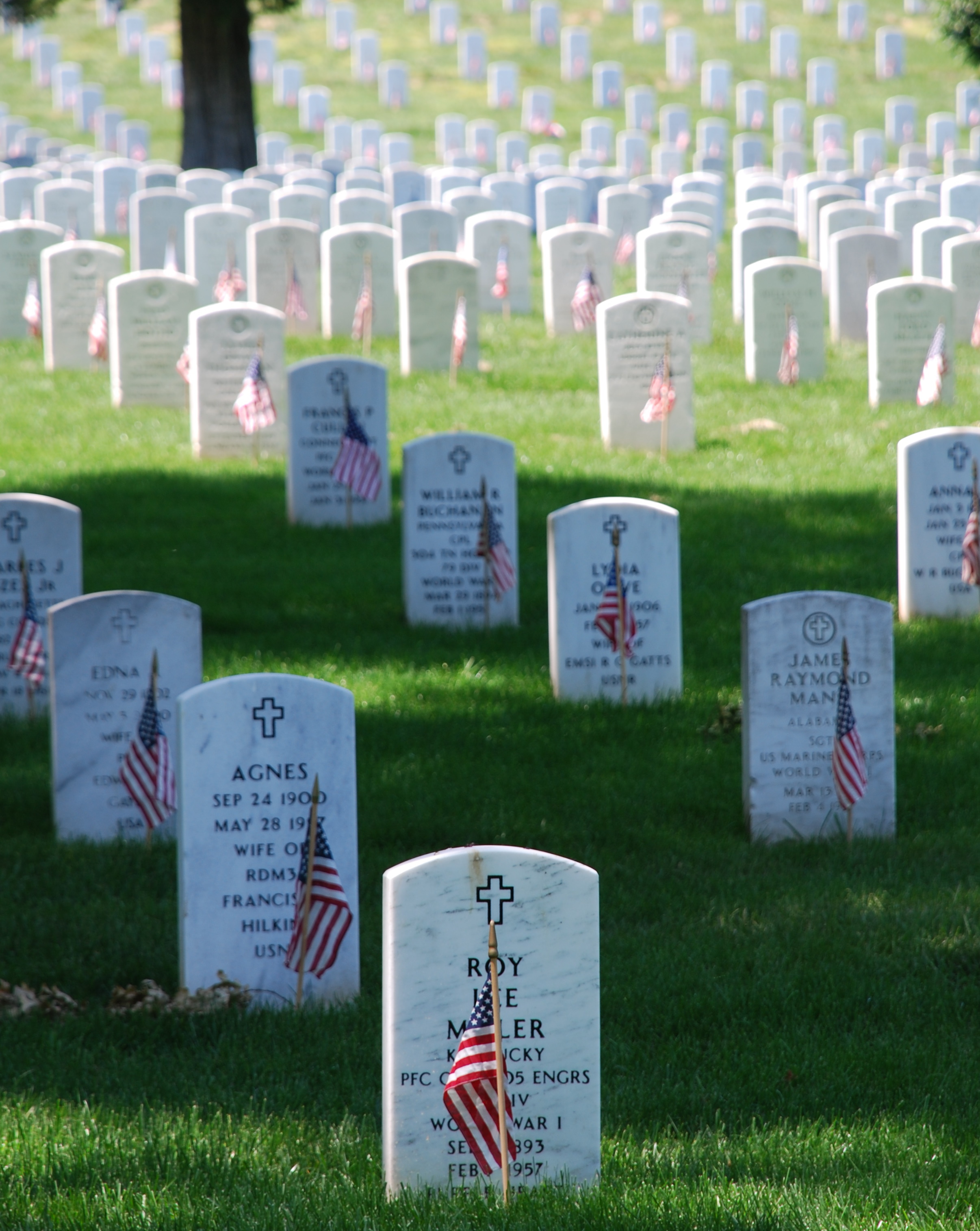
More than most nations, America has been, from its start, a hero-loving place. Maybe part of the reason is that at our founding we were a Protestant nation and not a Catholic one, and so we made "saints" of civil and political figures.
George Washington was our first national hero, known everywhere, famous to children. When he died, we had our first true national mourning, with cities and states re-enacting his funeral. There was the genius cluster that surrounded him, and invented us—Jefferson, Adams, Madison, Hamilton.
Through much of the 20th century our famous heroes were in sports (Jack Dempsey, Joe Louis, the Babe, Joltin' Joe) the arts (Clark Gable, Robert Frost) business and philanthropy (from Andrew Carnegie to Bill Gates) and religion (Billy Graham). Nobody does fame like America, and they were famous.
The category of military hero—warrior—fell off a bit, in part because of the bad reputation of war. Some emerged of heroic size — Gens. Pershing and Patton, Eisenhower and Marshall. But somewhere in the 1960s I think we decided, or the makers of our culture decided, that to celebrate great warriors was to encourage war. And we always have too much of that. So they made a lot of movies depicting soldiers as victims and officers as brutish. This was especially true in the Vietnam era and the years that followed. Maybe a correction was in order: It's good to remember war is hell. But when we removed the warrior, we removed something intensely human, something ancestral and stirring, something celebrated naturally throughout the long history of man. Also it was ungrateful: They put themselves in harm's way for us.
For Memorial Day, then, three warriors, two previously celebrated but not so known now by the young.
Alvin York was born in 1887 into a Tennessee farming family that didn't have much, but nobody else did, so it wasn't so bad. He was the third of 11 children and had an average life for that time and place. Then World War I came. He experienced a crisis of conscience over whether to fight. His mother's Evangelical church tugged him toward more or less pacifist thinking, but he got a draft notice in 1917, joined the Army, went overseas, read and reread his Bible, and concluded that warfare was sometimes justified.
In the battle of the Argonne in October 1918, the allies were attempting to break German lines when York and his men came upon well-hidden machine guns on high ground. As he later put it, "
The Germans got us, and they got us right smart . . . and I'm telling you they were shooting straight." American soldiers "
just went down like the long grass before the mowing machine at home."But Cpl. York and his men went behind the German lines, overran a unit, and captured the enemy. Suddenly there was new machine-gun fire from a ridge, and six Americans went down. York was in command, exposed but cool, and he began to shoot. "
All I could do was touch the Germans off just as fast as I could. I was sharp shooting. . . . All the time I kept yelling at them to come down. I didn't want to kill any more than I had to." A German officer tried to empty his gun into York while York fired. He failed but York succeeded, the Germans surrendered, and York and his small band marched 132 German prisoners back to the American lines.
His Medal of Honor citation called him fearless, daring and heroic.
Warriors are funny people. They're often naturally peaceable, and often do great good when they return. York went home to Tennessee, married, founded an agricultural institute (it's still operating as an award-winning public high school) and a Bible school. They made a movie about him in 1941, the great Howard Hawks film "Sergeant York." If you are in Manhattan this week, you may walk down York Avenue on the Upper East Side. It was named for him. He died in Nashville in 1964 at 77.
Once, 25 years ago, my father (U.S. Army, replacement troops, Italy, 1945) visited Washington, a town he'd never been to. There was a lot to see: the White House, the Lincoln Memorial. But he just wanted to see one thing, Audie Murphy's grave.
Audie Leon Murphy was born in 1924 or 1926 (more on that in a moment) the sixth of 12 children of a Texas sharecropper. It was all hardscrabble for him: father left, mother died, no education, working in the fields from adolescence on. He was good with a hunting rifle: he said that when he wasn't, his family didn't eat, so yeah, he had to be good. He tried to join the Army after Pearl Harbor, was turned away as underage, came back the next year claiming to be 18 (he was probably 16) and went on to a busy war, seeing action as an infantryman in Sicily, Salerno and Anzio. Then came southern France, where the Germans made the mistake of shooting Audie Murphy's best friend, Lattie Tipton. Murphy wiped out the machine gun crew that did it.
On Jan. 26, 1945, Lt. Murphy was engaged in a battle in which his unit took heavy fire and he was wounded. He ordered his men back. From his Medal of Honor citation: "Behind him . . . one of our tank destroyers received a direct hit and began to burn. Its crew withdrew to the woods. 2d Lt. Murphy continued to direct artillery fire, which killed large numbers of the advancing enemy infantry. With the enemy tanks abreast of his position, 2d Lt. Murphy climbed on the burning tank destroyer, which was in danger of blowing up at any moment, and employed its .50 caliber machine gun against the enemy. He was alone and exposed to German fire from three sides, but his deadly fire killed dozens of Germans and caused their infantry attack to waver. The enemy tanks, losing infantry support, began to fall back."
Murphy returned to Texas a legend. He was also 5-foot-7, having grown two inches while away. He became an actor (44 films, mostly Westerns) and businessman. He died in a plane crash in 1971 and was buried with full honors at Arlington, but he did a warrior-like thing. He asked that the gold leaf normally put on the gravestone of a Medal of Honor recipient not be used. He wanted a plain GI headstone. Some worried this might make his grave harder to find. My father found it, and he was not alone. Audie Murphy's grave is the most visited site at Arlington with the exception of John F. Kennedy's eternal flame.
I thought of these two men the other night after I introduced at a dinner a retired Air Force general named
Chuck Boyd. He runs Business Executives for National Security, a group whose members devote time and treasure to helping the government work through various 21st-century challenges. I mentioned that Chuck (pictured above) had been shot down over Vietnam on his 105th mission in April 1966 and was a POW for 2,488 days. He's the only former POW of the era to go on to become a four-star general.
When I said "
2,488 days," a number of people in the audience went "
Oh!" I heard it up on the podium. They didn't know because he doesn't talk about it, and when asked to, he treats it like nothing, a long night at a bad inn. Warriors always do that. They all deserve the "
Oh!"WRITTEN by Peggy Noonan originally as "Those Who Make Us Say 'Oh'!" for the Wall Street Journal on May 23rd, 2009


undertook the groundbreaking research that is changing the way this milestone is understood. He published his findings in a 2002 history, “Race and Reunion.” Even the History Channel’s current “History of Memorial Day” video ignores the stirring 1865 chapter of U.S. history that Blight finally uncovered. (Over time, scholars expect that our collective “history” will be restored to include the 1865 event. Wikipedia’s version already includes this 1865 revision. Or, really this represents a restoration of the record.)
The first Memorial Day was marked by former slaves in Charleston, South Carolina, who created proper, individual graves for fallen Union soldiers who had been buried en masse near a Confederate prison camp. For most of the 20th century, however, the “first” Decoration or Memorial Day was credited to Waterloo, New York, mainly because the freed slaves of Charleston, South Carolina, didn’t have the connective clout enjoyed by the men promoting Waterloo’s ceremonies. News of the Charleston effort never spread across the U.S. and eventually vanished from our national memory. Of course, the Waterloo effort was noble, too, but its claim as our “first” now must be qualified as perhaps a “first in the North.”According to Blight’s research: On May 1, 1865, 10,000 former slaves gathered at the cemetery site they had rebuilt and elaborately decorated in Charleston, South Carolina. Their courage is inspiring, because they were making a large-scale public demonstration of their love and respect for fallen Union soldiers—within weeks of the end of the war. Their brave actions easily could have brought their families into harm’s way from white neighbors who still strongly supported the defeated Confederacy.Preparing for that first Memorial Day was an expensive, back-breaking effort in which a proper cemetery actually was built from the ground up by African-American volunteers prior to May 1. On a spiritual level, these freed slaves were intent on starting their new lives by literally digging up and reshaping a key part of their past. The site of this first Memorial Day, once a local race course, had been a Confederate prison camp where Union soldiers’ bodies were heaped in a mass grave. Volunteers prepared for May 1, 1865, by digging up the discarded remains, burying them properly, adding a wall around the cemetery, plus a proper arched entryway for visitors. The site, today, is Hampton Park. If you know Charleston, you’ll realize there is no Civil War cemetery there now. Eventually, these remains were moved again to a new U.S. national cemetery in Georgia.