Search This Blog

Showing posts with label Homosexuality. Show all posts

Tuesday, March 1, 2011

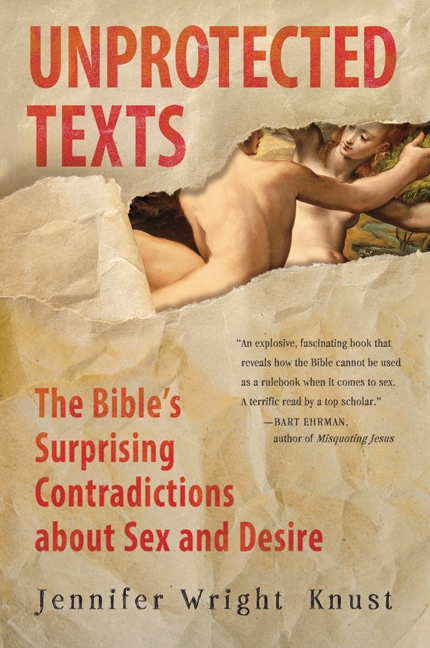
Unprotected Texts -- Review


“Family values” has long been a rallying cry of politically inclined religious conservatives, especially as the sexual mores of the American people have “loosened” since the 1960s. In the face of increasing acceptance of homosexuality, premarital sex, and divorce, “family values” push for the adoption of a “biblically based” sexual morality that includes a definition of marriage limited to one man and one woman along with sexual abstinence outside of marriage. The problem with these proposals is that it’s difficult to nail down a consistent biblically based sexual ethic. First century families, Christian or otherwise, look a lot different from contemporary family structures – even among conservative Christians, not to mention variety of family groupings and guidelines found in the Hebrew Bible/Christian Old Testament. So, whose family values should we embrace? Abraham’s, Jacob’s, David’s, Jesus’, or may be Paul’s? Once you start digging deeper into the biblical text the possibility of finding such a consistent ethic is difficult to find.

Jennifer Wright Knust has taken up the question of the bible and sexuality in her provocatively titled book Unprotected Texts: The Bible’s Surprising Contradictions about Sex and Desire. While the “contradictions” might not be all that surprising to those of us who have read the Scriptures with a critical eye, for many lay readers the questions raised by Knust might prove challenging at the very least. Since this is a book written with the educated but curious general reader in mind, one can imagine the conversations that will take place around the “new books” table at the local bookstore (if such a thing still exists in your community). That the author is not only a biblical scholar (Knust is an assistant professor of religion at Boston University), but an ordained American Baptist minister might be even more provocative to some. How does a person called to serve the church write such a book?

The answer might be found in common concern among religious leaders, including clergy and religious scholars – how do we respond to the questions being asked of us concerning religion and sexuality? For some the answer is simple – stick to “traditional values” – but for others this simply doesn’t work. As we learn more about homosexuality, for instance, it’s much harder to see same-gender relationships as sinful or unnatural. And as young adults postpone marriage, it’s harder to enforce prohibitions against pre-marital sex and living together outside marriage. It is in response to these dilemmas that Knust writes, hoping that by uncovering the complexity of understandings of sexuality in Scripture Christians and Jews might find answers to festering questions. The basic purpose in writing the book, according to the author, is to present “a detailed analysis of biblical attitudes and assumptions while exploring the reception of biblical narratives by later Christian and Jewish interpreters” (p. 16).

In taking up her quest to understand the various ways sexuality is understood in scripture, she makes it clear that in her estimation the Scriptures present conflicting perspectives on sexual morality, even though all of this is done in the name of God. As we take this trip through the Bible’s discussions of sexuality we deal with such issues as whether Jonathan and David’s relationship was homoerotic and whether the Song of Solomon envisions a premarital erotic sexual relationship. The reader will also look at the variety of ways that marriage is envisioned, from the polygamous marriages of David and Solomon, to the rather negative portrayals of marriage offered by Jesus and Paul. Then, of course there are the household codes that we find in Ephesians and Colossians. Sections of the book deal with body parts and fluids – looking into questions of menstruation, circumcision, and masturbation. Another chapter deals with the “evil impulse,” that is the sexual drive, which needed to be controlled. In this particular chapter Knust responds to the suggestion by Southern Baptist megachurch pastor Ed Young that marriages can be strengthened if partners have sex every day. Knust notes that such advice would run quite contrary to the teachings of Paul and his own interpreters, who sought to control their sexuality not free it up – whether within marriage or not.

Knust’s book is an interesting and intriguing read. She covers a lot of territory and does so provocatively. As I noted earlier for many readers much of this won’t be new, though personally I found the discussion in the chapter on “Strange Flesh” illuminating. In this chapter she deals with a number of issues that range from the Sodom Gomorrah story to the suggestion that the giants and “warriors of renown” were the children of unions between angels and human women. The latter isn’t all that new or controversial, but the suggestion that the issue in Sodom centered not on either homosexuality or hospitality, but the Sodomite’s yearning to mate with angels (that is strange flesh) was new to me and intriguing. She also deals with the question of the angels whom Paul is concerned about in 1 Corinthians 11. Paul suggests that women should be veiled “on account of the angels.” Could the issue be that the angels are watching and desiring these women? Remember too that the Corinthians were engaging in angelic speech.  Another topic that many will find intriguing and challenging is her comparison of the Jezebel and Esther stories.  One is condemned for being a foreign woman who leads her husband astray (Jezebel), while the other is a Jewish woman (Esther) who leads her foreign husband to do what is right.  Both play similar roles, but one is commended and the other is not.  It is, therefore, a matter of perspective!

The book is, as noted earlier, intriguing and at times illuminating, but it is also frustrating. At times it seems as if we’re being given only two choices when it comes to reading scripture. You have to choose between either biblical literalism or biblical minimalism. As is often true of the broadsides written by folks like John Spong and Bart Ehrman (his blurb graces the front cover) there doesn’t seem to be any middle ground. Thus, although I find the “strange flesh” explanation for the Sodom story to be intriguing, I’m not sure I’m ready to jettison the idea that the problem is one of breaking the code of hospitality. Another conversation point has to do with Paul’s attitude toward sex (pp. 81ff). Although Paul prefers celibacy, I’m not convinced that this makes him anti-sex or that marriage is the second best option for controlling sexual desire. In addition, while I’m in agreement that there isn’t a consistent sexual ethic present, I wish there was more attention given to how we might make use of the biblical story/stories to construct appropriate sexual ethics in the present age. The author herself affirms that while the Bible is not perfect it is beautiful, “particularly when we do not try to force it to mean just one thing” (p. 247).

My conclusion is that Knust’s book is far from perfect.  First, I'm not always clear who the intended audience is.  There are points at which she gives some rather remedial directives as to the context of a story, while at other points going into rather deep detail in topics that require more background.  While she raises lots of important questions about the role of sexuality and family in the biblical story, often in provocative ways, I wish she had given more guidance as to how we might make sense of this diversity in creating a sexual ethic that is appropriate for this age.  Yes, there is great variety in the text, which seems to offer permission for variety of expressions in the modern age.  But, how does one discern what is appropriate and what is not when it comes to sexuality?  Although, the book is a helpful conversation starter that may serve as necessary antidote to the proof-texting methods of the "family values" crowd, but I was left wanting more. 

Offered as part of the TLC Book Tour. 

Thursday, January 27, 2011

A Pastoral Letter on Bullying -- Sharon Watkins

I decided to share this important word to the Disciples of Christ community on the subject of bullying.  It comes in the form of a Pastoral Letter from the General Minister and President of the Christian Church (Disciples of Christ), the Rev. Dr. Sharon Watkins.  I believe it is a word we need to hear, whether we're Disciples or not.

*********************************

“How does God’s love abide in anyone who has the world’s goods and sees a brother or sister in need and yet refuses help? Little children, let us love, not in word or speech, but in truth and action.”   - I John 3:17-18

Dear Disciples,

The wave of publicity has passed regarding bullying and suicide, but the problem has not gone away. In this New Year, families and friends of those who died are feeling the loss deeply.

In my own community, two young people died last year by suicide as a result of bullying at school. These are two we know about – there may be others. Bullying involves a repeated pattern of aggressive, unwanted, negative actions and an imbalance of power. It can take place wherever people gather…. at school, church, or in the workplace.

Many whose deaths brought this issue to public attention were gay; bullied because of their sexual orientation until they thought life wasn’t worth living. Other young people are bullied because they don’t speak English well, they are from a minority or because they are smart. Sometimes it’s adults that get involved in their children’s issues and bully, anonymously via social media. Sometimes bullying is part of hazing.

Bullying is always wrong and followers of Christ should say so.

Christians who call ourselves Disciples of Christ are called to speak ‘love in truth and action” by standing up for all God’s children – especially those who attract the attention of bullies, whether they are gay or immigrants or just unpopular. Let’s be sure these children of God know they are not alone – that life is worth living.

US Department of Health and Human Services Secretary Kathleen Sebelius and US Department of Education Secretary Arne Duncan say the most promising anti-bullying approaches are those that “get entire communities involved. When principals, teachers, school nurses, pediatricians, social workers, faith leaders, law enforcement agents, and parents all have the information they need to recognize bullying and respond to it, bullies get a clear message that their behavior is unacceptable.”1 Disciples pastor, Glenn Wilkerson adds, “Most bullies ‘play the crowd,’ and if the crowd has the courage and compassion to say, ‘Stop that!’ ‘That’s not funny!’ ‘That’s cruel!’ we’ll put an end to the bulk of it.”2

Unfortunately, according to a Public Religion Research Institute poll, two thirds of Americans believe that messages coming from churches contribute to the suicide of gay teens.3 We need to convey a different message. We are Disciples of Christ, of Jesus Christ. He welcomed children, ate with tax collectors and chatted with women – shocking in his time. But Jesus came to show that God loved the world (John 3:16) – the whole world.

We are Disciples of Christ, a movement for wholeness. Our mission is to be and to share the Good News of Jesus Christ. We extend God’s wholeness by reaching out in word and deed to the bully and the bullied alike, showing God’s love.

As Christian people, let’s be clear that bullying is not ok. In your community, let’s be sure people know that Disciples of Christ “love in truth and action.” Let’s not have families mourning the loss of promising young people to tragic death. Instead, let’s help all God’s children know they are loved and valued!


Sharon E. Watkins

General Minister and President, Christian Church (Disciples of Christ)

__________________
 
1.  Kathleen Sebelius and Arne Duncan. Houston Chronicle / San Diego Union Tribune / St. Paul Pioneer Press, October 9, 2010 http://www.chron.com/disp/story.mpl/editorial/outlook/7239697.html


2. The Reverend Glenn Wilkerson, founder and President of ARK (Adults Relating to Kids) October edition of the online ARK Newsletter.

3.  http://religion.blogs.cnn.com/2010/10/21/churches-contribute-to-gay-suicides-most-americans-believe/

Monday, December 27, 2010

Public Religion Trends in 2010 -- Sightings

As we enter the final week of 2010, Martin Marty comments on the top 20 public religion trends as laid out by the Religion Newswriters Association.  Islam makes itself felt, as does homosexuality.  Anyway, I'll just let you read and comment.

*************************

Sightings 12/27/2010


Public Religion Trends in 2010
--Martin Marty


The end-of-year summaries of “public religion” draw frequently on the most extensive press survey each December, from the Religion Newswriters Association, made up of reporters and columnists in the secular media. (A ringer in the Association, I was one of some 300 respondents to a poll by Debra Mason, RNA Executive Director.) It is hard to find trends this time. Muslims and Islam do show up in four of the twenty trends on which Mason reports. First, to no one’s surprise, was the ruckus stirred up by the announcement of plans for an Islamic community center not far from Ground Zero. Feisal Abdul Rauf, who seemed to fit the bill of the often-sought “Muslim Moderate,” ironically, was attacked immoderately for his effort. The event suggested how motivated by fear, defensiveness, and exploitation of sentiment many in the United States are.

Way down the list were the other Muslim/Islam sightings: #14, the Oklahoma Constitutional Amendment, again ironic, in that it ruled out the possibility of making judicial decisions based on the Qur’an in a state with very few Muslims. William Franklin Graham made news by being disinvited from a Pentagon National Day of Prayer observance, given his anti-Muslim rhetoric and record. The President visited Indonesia, and so made the list with some references to Islam. The only other non-Christian faith, way down the list, was Hinduism, at #20, because of flaps over yoga practices and the novel Eat, Pray, Love.

The Pope was often in the headlines, but only twice did events involving him make the top twenty. One dealt with his dealings in the priestly sexual-abuse scandals, while his notable visit to the United Kingdom with his critiques of European secularism was down at #16. The Catholic bishops were part of #5, the signing of the health-care reform bill, which the American bishops had criticized because they feared it would involve tax-funds in funding abortions.

Mainline Protestantism was mentioned (#6) for its non-presence in the current US Supreme Court and for Lutheran, Presbyterian, and Episcopal denominational infighting, chiefly over homosexuality issues, which made a presence also in #8, on religion and the bullying of homosexuals.

Religion in action showed up properly in #2, on churchly response to the catastrophes in Haiti, the murders of faith-based aid workers in Pakistan and Afghanistan, while Christians continue to flee Iraq (#11). “Faith-based environment groups” also made their mark after the BP oil spill (#12). The political Right was evidently less prominent or less religious, since it showed up mainly with Glenn Beck’s presence in Tea Party stories (#4). Southern Baptist leader Richard Land pushed faith-based groups to put more energy into immigration issues.

Cross-denominational stories also included #7, on the severe effects of the economic crisis on publishing, pension plans, and the Crystal Cathedral’s economic bankruptcy. Supreme Court decisions were not as prominent and revelatory of trends as in many years. More dramatic decisions are ahead. Non-denominational news told (#9) of the Pew Forum on U.S. Religious Knowledge which showed that agnostics, Jews, and Mormons knew most about the faiths. The RNA folks, often the only religious educators of the public, have their work cut out for them, again, ironically, at a time when print media, their natural abode, are also threatened in the digital age.


Martin E. Marty's biography, current projects, publications, and contact information can be found at www.illuminos.com.

 
----------
Sightings comes from the Martin Marty Center at the University of Chicago Divinity School.

Saturday, December 18, 2010

DADT is Dead!

In a historic vote a bipartisan majority voted to end a discriminatory policy that has been in place for seventeen years.  By a 65-31 vote, that included eight Republican senators, Congress has delivered a final blow to this policy that was instituted in 1993 by Congress and President Clinton -- in many ways as an interim measure.  In the past 17 years thousands of gay and lesbian service men and women have been forced to live secret lives as they have tried to serve their country.  At the same time about 13,000 service members have been discharged from the military because their sexual identity had become known.  Among that number were numerous language experts, including many of its Arabic speaking personnel. 

Yes, there is a conservative backlash brewing, but this is a policy that was on last legs anyway.  If Congress hadn't overturned it, the Courts were about to do so, and the Courts wouldn't have given the government as much leeway in implementing the change.  So, this is actually in the better interests of an orderly transition.  My hope is that the military will see this vote and suspend all pending cases against gays and lesbians, and also begin the process of preparing the troops -- most of whom I think will be quite able to adjust, even as troops had to adjust in the 1940s to integration of the military.  Besides, President Obama campaigned on this issue, promising to see it overturned.  That promise has been kept.  Later this week, then, he will sign this bill into law as a victory for justice in this land!

Back to the reason why the conservative backlash will ultimately fall flat is that a growing majority of young adults no longer see homosexuality as a deviancy.  Even a conservative Christian analysis of this trend (the Barna sponsored book UnChristian,   makes the point that one of the key reasons why young adults are rejecting the church is that they see it as anti-gay.  Well, if they're rejecting the church for that reason, do you think they'd want to join a military that continued to embrace an archaic viewpoint? 

I think that the other reason why the protests will fall flat is that our military effectiveness won't be impaired.  We'll not see troops dying or being maimed in battle, as John McCain and the Marine Commandant claim, because of this policy (this is just pure fear-mongering).  If that happens it's because the military leadership has failed to properly implement a policy that works just fine in the militaries of most of our allies!

A Busy Senate Season

There can be no Holidays for the US Senate until they finish their business. I know that they want to get home for the Holidays, but there is still a lot of key business to get finished!

They made a good start with the extension of the so-called Bush Tax cuts, which brought about much chagrin among many Democrats, who felt with some justification that the extension of these cuts for the wealthy would broaden the deficit without bringing any real value to the economy. But, there were key benefits for middle class and those on the edge that included not only tax benefits, but also the extension of Unemployment Benefits. The economy is expanding and growing and the recession itself has been over for several months, but the unemployment rate remains stubbornly high. The President met with executives from a number of Blue Chip Companies and again encouraged them to start hiring!

With the tax issue out of the way, at least for now, this week should be a busy one. As members of Congress and their staff pine for vacation, the Senate faces several very important pieces of legislation. If Lame Duck sessions are generally pretty uneventful, you can’t say that for this time around. So, here is a lineup and my response:


  1. START Treaty: Treaties require a 2/3 majority to pass and this one faces opposition from certain Republicans – led by John McCain – though one of the biggest proponents of this treaty which would provide not only limits on the nuclear capabilities of Russia and the United States, but it allows for verification of these nuclear capabilities. Currently, without a treaty, we don’t have any way of verifying what the Russians are doing. Why does it matter? Well beyond matters of security, what matters is our leadership in stopping nuclear proliferation. If we want to have unfettered ability to build nukes, then how can we expect other nations to put a limit on themselves. Having nukes in this day and age is a sign of power, whether one intends to use them or not. My sense is that this will pass – GOP demands for more time to discuss the treaty is just stone-walling as they’ve had more than enough time to examine it. The military Brass think it’s important and if they think it’s okay, then shouldn’t we think so as well? 
  2. DREAM ACT: Although the winds seem to be blowing against passage, this Senate Bill would make it possible for those young people who came to the country illegally (with their parents) to gain a path to citizenship by either serving in the military or completing not only high school, but also college. The military strongly supports this measure, for it gives an incentive to faithful service in the military – helping recruiting. But, it also gives an incentive for those who came to the country with their parents and who know nothing but this country, a reason to work hard toward a goal that would benefit them, but also this nation. We are a nation of immigrants and a college education is the key to success. I can think of no better way of living out our original national motto – e pluribus unum – than this Act. It may not pass, in large part due to a continued anti-immigrant fervor that is present in the country, but this is a just and right act. I call on the Senate to do the right thing!
  3. REPEAL OF DADT: The “Don’t Ask, Don’t Tell” policy, which was implemented in 1993 as an interim measure, in large part because Congress wouldn’t support Bill Clinton’s call for ending this discriminatory policy. Well the interim period needs to end. DADT, which allows Gays and Lesbians to serve in the military as long as they don’t reveal their secret is unjust and really a threat to US security. The majority of American people support its repeal. The vast majority of service personnel see no problems with ending this policy – only John McCain and some of the higher Military Brass (mostly Marines) want to continue the policy. On a military side, as we have seen from a recent detailed Pentagon Study, there is no evidence that there would be much if any adverse affects on military preparedness if DADT was ended. In fact, there is a growing recognition that DADT rewards dishonesty and potentially undermines security, as gay and lesbian members of the military are susceptible to blackmail. What is more, there is much more support today for the inclusion of gays and lesbians in the military, than there was when Harry Truman ordered the desegregation of the military in 1948. Again, this is a matter of justice for all Americans. Equality denied for gays and lesbians is equality denied for all Americans, for it makes of them a separate class who are required to live surreptitiously lest they lose their jobs. And as we’ve seen in the most recent military adventures, some of the most skilled members of the military – especially linguists and translators – have turned out to be gay. Thus, the military has lost important contributors to its efforts. Ending DADT will have an impact not only on the military – and that maybe why there is resistance. Ending DADT in the military puts the lie to other elements of society that have engaged in the same practices. That includes the church. Repeal may open up the conversation in a way will be healthy for all.  The good news here is that there appears to be more than enough votes for a stand alone bill for this to pass!

Each Senate Bill is an important piece of legislation. Each will be historic if passed. Each will require at least some degree of bipartisanship. My hope and prayer is that the Senate will act in a way that is just and right. In my mind that involves passage of each piece of legislation. Then, they go home and celebrate the holidays as they see fit, knowing that they have done the right thing!

Friday, December 10, 2010

Social/Moral Views of the "Nones"

In my series of reflections on the evolution of American religious identity from the 1950s to the present, which draw upon the Putnam/Campbell book American Grace I have noted that we've seen the nation's religiosity swing back and forth, from highly religious, to not so religious and then a return back to conservative religious values.  That last more conservative era of young adults began to end early in the 1990s.  Since then we've seen the pendulum swing the other way, and it is seen expressed most clearly in the movement away from "organized religion."  

The question that lies before us is why this is happening, or more specifically -- what markers are there that suggest a trend.  Robert Putnam and David Campbell point to attitudes among the rising generation toward homosexuality and marijuana.  And, not surprising those who take a more liberal view of these two issues tend to predominate among "Nones."  That is, as the authors note:  "liberal views on sexual morality contributed to their disaffection from religion" (p. 130).  This likely isn't news to many.  In fact, while I don't care for the Kinnaman/Lyon's book UnChristian, they also demonstrate that those most disaffected by organized forms of religion find the church's views on homosexuality distasteful.    

Consider what Putnam and Campbell write:

We make no strong claims about causation here, and we do not believe that it was simply differences over public policy that weakened the ties of this generation to organized religion.  Rather, we suggest, the dramatic contrast between a young generation increasingly liberal on certain moral and lifestyle issues (though still potentially open to religious feelings and ideals) and an older generation of religious leaders who seemed consumed by the political fight against gay marriage was one important source of the second aftershock. (p. 130).
This change of attitude has led to increased unease about mixing religion and politics -- and thus engaging in culture wars.  By continuing to fight these battles the church seems likely to continue pushing younger folks away.

Do give a little context from the news to bolster this change of attitude, I'd point to the debate over abolishing "Don't Ask, Don't Tell" in the military.  According to the Pentagon Report, about 70% of rank and file military have no problem or are neutral regarding the presence of gays serving openly in the military.  Where the problem seems to lie, is among older officers and the large contingent of evangelical chaplains (and certain members of Congress). 

Whether older generations or culture warriors like it or not the times, they are a changin'."  The question is -- how will the church respond?  And if it seeks to keep gays and lesbians at bay, push the upcoming generations further away from the church?

Friday, November 5, 2010

Lt. Sulu says -- It Gets Better

The "It Gets Better" project has been sharing videos on YouTube letting young Gay and Lesbians that it will get better.  In this video by George Takei, better known to us Star Trek fans as Lt. Sulu, responds to a former Arkansas School Board Member, who apparently encouraged Gay teens to kill themselves.  Let's here it from George Takei.

Tuesday, October 26, 2010

Split Ticket -- A Review

SPLIT TICKET: Independent Faith in a Time of Partisan Politics. Edited by Amy Gopp, Christian Piatt, and Brandon Gilvin. St. Louis: Chalice Press, 2010. viii + 184 pp.


If the reports are to be believed, young adults are leaving the church, either because it has become too politicized or because institutional religion has become corrupt and moribund. They are, for instance, turned off by their perception that churches tend to be anti-homosexual. And if truth be told, they’re probably correct in this perception, for at most, a majority of churches have followed the lead of the military and have instituted a policy of “don’t ask, don’t tell.” In other words, stay in the closet.

Of course, not all young adults are leaving the church. Neither are all young adults rejecting what some would call political agendas (definitions are important here, because many consider social justice advocacy/action to be political, while others see it as a proper extension of the gospel). As is true of people of every generation, today’s young adults are not of one mind when it comes to the question of politics and religion. Things are complex!

Split Ticket, the book that is under review here, is the second book in Chalice Press’s WTF (Where’s the Faith?) Series, a series that is edited by, authored by, and intended for young adults. The first book in the series, provocatively titled O God! O God! O God!, (reviewed here) looked at the issue of sex, and this book will be just as provocative as the first. Focusing here on the relationship between faith and politics, we are presented with a series of nineteen essays that range from anarchist to prophetic to politically engaged. The theology evidenced by the writers runs from evangelical to liberationist. Authors are gay and straight, male and female, clergy and laity, and from most every ethnic community. As is true in the first volume in this series, the essays are extremely personal. These volumes are designed to start a conversation, which is why each chapter ends with three discussion questions.

This volume is divided into three sections – “From Awakenings to Activism”; “God in the Voting Booth”; and “We’ve Got Issues.” To give a flavor of the essays comprising each section, consider that the first section includes essays about connecting faith to activism, including an essay by David Ball entitled “Thy Revolution Come: An Invitation to Radical Discipleship.” Ball frames his essay with the Lord’s Prayer, and suggests that radical discipleship is best expressed through “Christian Anarchism.” Christian anarchism, as the phrase suggests, calls for radical, even revolutionary action, even against one’s own government. Amy Gopp, one of the three co-editors, on the other hand reflects back to her time spent in Bosnia, and speaks of building bridges between groups and peoples in the pursuit of peace.

In the second section the essays range from the provocative essay by John Edgerton and Vince Amlin that charges that voting itself is an act of violence and coercion, and thus as Christians they have decided not to vote. They suggest that a better way of making decisions is one of consensus-building. As one who has long believed that voting is a national responsibility, this essay was disturbing to say the least, and yet it is a view that many are considering in our day. On the other hand, others see the value of one’s faith in influencing not just voting, but political action. If there is a consensus here is that, as Gabriel Saguero writes, “the Gospel challenges all political ideologies and denounces any obedience to any Lord but Christ” (p. 113).

In the final section, the essayists reflect on the leading issues of our time, from abortion to health care reform, and the way that we deal with them from a perspective of faith. What is clear from the essays is that this isn’t a clear-cut process. There is gray area to be considered, and the role of the church needs to be weighed carefully. Christian Piatt writes an intriguing and extremely personal essay about his own struggle with the pro-life/pro-choice debate in the context of the births of his own two children. Being strongly pro-choice, he found himself equally pro-life, as he fell in love with the “it” that was the fetus being carried by his wife. Christian reminds us that personal experience is a powerful contributor to the way we look at issues. Things become much less cut and dry, once one is personally engaged. As Christian puts it:

I’m not ready to jump the pro-choice ship, but the experiences of parenthood have had a permanent change on my understanding of life, the human soul, and our responsibility as joint stewards of those lives. . . . I may wrestle with this subject until the end of my days, but one thing is for sure: I love my kids, both of them. Even if one of them had never been able to join us in the world, and had never had the opportunity of loving and being loved, I would still love “It” all the same (p. 134).

So, are young adults calling for the church to be apolitical? No, however, they want the church to deal honestly with issues such as homosexuality, abortion, justice, the environment. They decry hypocrisy and want issues to be dealt with in light of faith and not just politics as usual being baptized into the church. They are passionate, but they also seem to want to keep the bridges standing (unless you’re an anarchist and the bridges lead to injustice). Perhaps Earle Fisher states it best:


Political truths may be something we’re willing to fight for, campaign for, or give money to. But a personal, spiritual truth, truly embraced as a foundational tenet of our identity as God-created beings, is something to which we’re willing to give our entire lives to, and perhaps die for (p. 148).
In other words, for these young adults, faith is the foundation, the guide, for their political engagement, even if that means deciding not to participate in the political process, because to do so would be to participate in a coercive, and therefore violent, system.

I heartily recommend this book to anyone wishing to understand the relationship of faith and politics. These essays may be written by and for young adults, but the issues they raise, and the solutions they suggest, are as pertinent to those who are well into their retirement years as those who are just entering the adult world.

While my recommendation of this book would not be any different, I should note that the editors, all members of the Christian Church (Disciples of Christ) are people whom I know and have worked with in the past (and in the present). I have high regards for all of them as individuals and for the work that they do in the church and outside it. Two of them, Amy Gopp and Brandon Gilvin, are Disciples clergy, while the third, Christian Piatt, is married to one. They are all committed to the church and to social justice (Gopp and Gilvin are in leadership at Week of Compassion, the relief and development arm of the Disciples).

As for the authors, many of the contributors are unknown to me, and while I agree with some and not with others, each of them offered insightful and challenging words that demand my attention, and the attention of any reader. If we’re to accept the premise that young adults are tired of politicized churches, then we must first understand what they mean by their critique, and this is a good place to start!
 

Thursday, October 14, 2010

Don't Ask, Don't Tell, Closets, Gays and Suicides

Perhaps you've heard about the lawsuit filed in Virginia against the Military's "Don't Ask, Don't Tell" law.  A judge in Virginia, taking up a suit filed by two groups -- the Service Members United and the Log Cabin Democrats -- has ruled it unconstitutional because it infringes on fundamental human rights.  Now, the Obama Administration has decided to appeal it, which might seem like a bad thing for opponents of the law, but I'm not so sure.  I believe that this ruling, like the one striking down Prop 8 in California, need to be heard by the Supreme Court so that there can be no doubt left in the minds of Americans that discrimination against gays by government agencies is contrary to the Constitution.  

"Don't Ask, Don't Tell" is a policy of the closet.  It is a policy that forces men and women to keep silent about their sexual orientation in order to keep their jobs.  That is a policy encouraging dishonesty, and leaves people open to being exploited.  Ending once and for all discrimination against gays and lesbians in the military is an issue whose time has come.  Americans seem to be more and more accepting of this idea, and besides Americans when they sit down and think things through believe in fairness and equality, even if they might be uncomfortable with homosexuality. 

Closets, which is where we have forced gays and lesbians to live, are dangerous places.  Suicide is the biggest killer of gay teens, in large part because they are forced to live secretive lives, and when they emerge from the closet face tremendous pressure, discrimination, and abuse.  To be discovered -- to be outed -- by others can lead to great fear and humiliation, and as a result the decision to end their lives.  Religious folks, unfortunately, contribute to this climate of fear.  Homosexuals are denounced as sinners and deviants.  Although God many love gays, God hates their sin, and so if they don't repent they'll end up in hell.  It's not a pretty picture.  In mainline Protestant churches, where hell isn't necessarily a topic of conversation, but discomfort with the idea of homosexuality remains ever present, we have adopted the "don't ask, don't tell" principle, and so we force people into the closet.  That closet maybe a good place to pray (for a time), but it is not a good place to live, and so the spiritual lives and callings of our gay and lesbian brothers and sisters is undermined.  Indeed, many decide to leave rather than experience the humiliation and the sense of loneliness of the closet.   

We stand at a pivot point in history.  The discussions of "don't ask, don't tell," "gay marriage," and the recent string of suicides, is bringing to our awareness a critical issue.  Polls suggest that people are more and more comfortable with homosexuality -- in part because they're discovering that their neighbors, their relatives, and people in the pew are gay and lesbian.  So, the time is ripe for an open discussion of these issues -- so that the closets can be emptied, people can live without fear of discrimination and humiliation, and people can enjoy the full blessings of life in civil society and in the community of God's people.   

Tuesday, August 3, 2010

The Wickedness of Sodom and Gomorrah (Isaiah's interpretation)

I know what you're thinking -- another discussion of God's wrath against homosexuals.  Isn't that what the story of Sodom and Gomorrah is all about?  Well, I'd like to suggest a different take.

This Sunday's lectionary selection from the Hebrew Bible or Old Testament is Isaiah 1:1, 10-20.  I was looking at this passage as I began to write my lectionary meditation for [D]mergent, and the true nature of Sodom and Gomorrah's wickedness stood out clearly -- and the word found here isn't easy to run from.  

In this text Sodom and Gomorrah stand in as analogies for the two kingdoms of Israel and Judah.  The prophet, speaking in the time of Uzziah in the 8th century BCE, pronounces judgment, and in doing so roundly rejects their "worship" and "piety."  God isn't impressed with their blood sacrifices and offerings of incense.  None of this really matters because God has issues with their behavior outside the "worship places."  Yes, God is concerned about matters of JUSTICE, especially when it involves the oppressed, the orphan, and the widow.  

Consider these words from the prophet:

   10 Hear the word of the Lord, you rulers of Sodom!
Listen to the teaching of our God, you people of Gomorrah!
11 What to me is the multitude of your sacrifices? says the Lord;
I have had enough of burnt-offerings of rams and the fat of fed beasts;
I do not delight in the blood of bulls, or of lambs, or of goats.

12 When you come to appear before me,*who asked this from your hand?
Trample my courts no more;
13 bringing offerings is futile;
incense is an abomination to me.
New moon and sabbath and calling of convocation—
I cannot endure solemn assemblies with iniquity.
14 Your new moons and your appointed festivals my soul hates;
they have become a burden to me, I am weary of bearing them.

15 When you stretch out your hands, I will hide my eyes from you;
even though you make many prayers, I will not listen;
your hands are full of blood.

16 Wash yourselves; make yourselves clean;
remove the evil of your doings from before my eyes;
cease to do evil,
17 learn to do good; seek justice, rescue the oppressed, defend the orphan, plead for the widow.  (Isaiah 1:10-17 NRSV)

What is the wickedness of Sodom and Gomorrah -- it's not what we've been led to think?  But these two cities had become for Isaiah's people, a byword for wickedness. 

Anna Case-Winters writes in her theological reflection in Feasting on the Word these words:

The particular wickedness of Sodom and Gomorrah -- contrary to popular assumptions -- is a matter of their greed and injustice.  The fullest accounting of the "sin" of Sodom and Gomorrah in the Old Testament is in the book of Ezekiel:  "This was the guilt of your sister Sodom:  she and her daughters had pride, excess of food, and prosperous ease, but did not aid the poor and needy" (Ezek. 16:49).  It is not until the Hellenistic period that sexual conduct is even alluded to in connection with these cities.  As the cities of Sodom and Gomorrah became bywords for injustice and divine judgment, Isaiah implies, the southern kingdom of Judah now mirrors their condition. (Anna Case-Winters, in Feasting on the Word,  Year C, Volume 3, p. 318).
According to the prophet, the nation's civil religion, in spite of all its offerings and piety, can't cover up its neglect of justice.  Indeed, their "piety" can even be referred to as an abomination!  So, are we, as a nation, comparable to the true Sodom and Gomorrah?  Remember, when interpreting scripture it is often helpful to look at how other texts use and idea or reference point.  When it comes to the story of Sodom and Gomorrah, perhaps we should look more closely to the words of Isaiah and Ezekiel.  And if you have questions, God seems ready for an argument (Isaiah 1:18)!

Monday, July 26, 2010

Classroom Controversy -- Sightings

Having been asked to resign from a teaching position -- for doctrinal reasons -- I have some sense of the difficulties that face teachers of religon.  All of my teaching experience has been in private, Christian settings, both seminary and college levels.  As Stanley Hauerwas noted in his wonderful memoir, he had a tendency to say things in class, but especially in meetings, that ticked people off -- usually administrators.  I know the feeling!!

In today's edition of Sightings, Martin Marty picks up on the case of an adjunct professor fired from a public university for the way in which he approached the Catholic teaching on homosexuality -- he laid out the Catholic teaching and noted his support of the position.  As Marty notes, this is an intriguing case because it lays out the narrow line that teachers of religion in public universities must walk.  It raises questions of objectivity -- if such a thing can be truly attained -- and more.  It's a most interesting piece, which "demands" your response!!_________________________________________________

Sightings 7/26/10


Classroom Controversy
 Martin E. Marty


Anyone who spends over a half century at the center and the margins of higher academe, as I have, knows better than to get involved with tenure disputes or hirings and firings of faculty. The further away from the scene of conflict one is, the dimmer the vision; the closer one is, the more the dust of battle obscures vision. So while using a particular issue and university to examine some points, I won’t suggest proper outcomes. The case does help us understand why and how certain kinds of disputes are complex and sticky.

So, to a scene and event: The University of Illinois at Champaign fired adjunct professor Kenneth Howell after the friend of an “offended student” e-mailed Robert McKim, the religion department head, charging that Howell had engaged in “hate speech,” if not in class, then in an e-mail in which he contributed further to a classroom controversy. The issue was his teaching of the Roman Catholic teaching that homosexual activity is sinful, a position with which he agreed and which he propounded with his endorsement.

Step back now, during the reviewing, and let’s see. First, not to include religion studies in higher education curricula is a problem for education and for the citizenry. Religion, in the narrowest and broadest senses, informs most complex human activities, including war-making and peace-making. So include it. Second, teaching religion in tax-supported institutions often occurs at the edge of controversy and conflict, since different individuals and groups in any public will criticize almost any presentation, including the least controversial. (Teaching it in private higher education settings also can be controversial, but we can pass that by for now.)

Next, phenomena related to human sexuality inevitably come up in discussions of religion, since faith communities and their leaders care so much about it, and the general public has interests and fights about it. But it is almost impossible to discuss religion “neutrally,” meaning “fair-mindedly” in the eyes of all, including interest groups. Giving an accounting of what a particular religious community or tradition teaches about something central to a faith is necessary, even urgent, if one is to understand its many features. Had Professor Howell tried to teach about Catholicism, which was his assignment, without getting into Catholic teaching and practice dealing with sexuality, it would represent a failure to educate well.

Having a professor identify herself or himself with such a teaching becomes a matter of “how” it is done. The vast majority of religion professors know how to protect the integrity of their students, their subjects, their school. Awareness of this in a conflicted, pluralistic society should lead professors to be careful about propagandizing (which is not educating) for or against a tradition. The Illinois case is complicated by the fact the position held by Howell is, shall we say, irregular, since the Catholic diocese of Peoria funds the chair and has interests that may not match that of regularly appointed and funded members of the religion department. Step back from that fact, and you still have a good illustration of how precarious is the perch of those who teach religion in state schools.

When all is done and said, however, there is no way to assure that at all schools, in all classes, all professors will do all this well. If a student over-reacted and Howell over-acted in the case of a controversial teaching, it is important to back off and, yes, review and re-review fateful decisions about legality, propriety, fairness, and effectiveness of teaching. Don’t envy the Illinois administrators who have to review their own actions and arbitrate among conflicting interests. But also we can pause and note once again how religion, long considered marginal and irrelevant, stirs people on all sides of societal issues in the arena that is the public university. This will not be the last re-reviewing that we are likely to observe, as religious communities and their foes heat up.


Martin E. Marty's biography, current projects, publications, and contact information can be found at www.illuminos.com.

 
----------

In this month's Religion and Culture Web Forum ("The Primacy of Rhetoric"), Marty Center Senior Fellow (2009-10) W. David Hall addresses the centrality of rhetoric in the Western humanist tradition by engaging the work of Ernesto Grassi, whose commentary on the Renaissance, especially, diverged from standard Platonic models of interpretation to include arts such as rhetoric, literature, and poetry. Of especial interest for Hall is Grassi's "retrieval of the humanist tradition" during this era and the possibilities that thorough understanding of such a retrieval opens more broadly in the fields of philosophy and religious studies. With invited responses from Andrew Hass (University of Stirling), Jeff Jay (University of Chicago), Santiago Pinon (University of Chicago), Donald Phillip Verene (Emory University), and Glenn Whitehouse (Florida Gulf Coast University). http://divinity.uchicago.edu/martycenter/publications/webforum/index.shtml


----------

Sightings comes from the Martin Marty Center at the University of Chicago Divinity School.

Thursday, July 8, 2010

Modern Exorcism: Trading Autonomy for Demonology

Jesus was known to be a healer and one who dealt with demonic possession.  That is, he was a exorcist.  Exorcism has been part of Christian experience from the very beginning -- and the Catholic Church and Pentecostalism both continue in different ways to practice it today.  But, it appears that the "demons" being purged from persons differ from those of an earlier age.  Instead of the kinds of demons that Jesus removed the Gerasene Demoniac, this time it often is things that are the kinds of things we struggle with in normal human life such as addictions, but also homosexuality.  Joseph Laycock offers a look at this trend and considers what it may mean for us.  It's an intriguing piece that should serve as a useful discussion starter.  As I consider this conversation, I need to start by acknowledging that I have a Pentecostal background and I believe that God does heal, though maybe not in the way many Pentecostal evangelists suggest.  So, what do you make of this phenomenon?

********************************

Sightings 7/8/10


Modern Exorcism:
Trading Autonomy for Demonology

-- Joseph Laycock


Last month, a feature in the online magazine Details told the story of Kevin Robinson, a gay teenager from Connecticut. Brought up in a Pentecostal household, Kevin first came out to his family when he was sixteen. His mother, refusing to accept homosexuality as a natural sexual orientation, convinced Kevin to undergo a series of exorcisms to expunge the demons that church members believed were causing his homosexual desire. After the tenth exorcism – which was particularly brutal and degrading – Kevin and his mother finally came to accept his sexual orientation. Now twenty, Kevin still expresses difficulty reconciling his faith with his gay identity.

Numerous modern “deliverance ministries” perform rituals to cast demons out of homosexuals. Last June, a shocking YouTube video of such an exorcism by Manifested Glory Ministries attracted national news. In the video, charismatic prophetess Patricia McKinney discerns that a teenager has “a homosexual demon.” What ensues is a frantic twenty-minute ordeal during which the teen writhes on the floor in a near seizure. Church members eventually induce vomiting by squeezing the boy’s abdomen. Vomiting, interpreted as evil leaving the body, has become the sine qua non in the cultural “script” of modern exorcism – a practice that is, needless to say, highly controversial. Even Christian ministries who preach that homosexuality is a lifestyle choice and a sin have censured these exorcisms, arguing that they are dangerous. And the majority of gays who undergo these rites are minors, leading some to suggest that this is a form of child abuse.

But exorcism is actually on the rise and may be more common in America than ever before. In 2008 the Pew Research Center found that seventy percent of respondents believe that demons are active in the world. Similar findings have been reported by Gallup and the Baylor Religion Survey. However, this resurgence of demonology raises serious questions about where demonic influence ends and individual autonomy begins.

As evidenced in the Gospels, the casting out of demons was an important feature of the early church. In fact, pagans sometimes sought out Christians from whom they could receive exorcisms. By the early modern period, Catholic Europe had a rich culture of local exorcists. The Ritual Romanum, written in 1614 under Pope Paul V, consolidated popular forms of exorcism into a formal rite. This brought exorcism under the direct control of the church hierarchy and in the modern era the rite increasingly became a relic. However, in the 1970s, there was a resurgence of exorcism and quasi-exorcism among evangelical Protestants and charismatic Catholics. These modern practices, often called “deliverance ministries” rather than exorcism, usually occur outside of ecclesiastic authority.

Modern deliverance ministries espouse a form of demonology entirely different from that found in ancient times. Until the twentieth century, the quintessential case of possession was the Gerasenes demoniac, with an alternate personality, a total lack of socialization, and supernatural abilities. But the demons cast out by deliverance ministries are rarely alternate personalities like The Exorcist’s Pazuzu. Instead, they are usually aspects of the person’s normal personality that are deemed demonic. McKinney explained, “You have the alcohol spirit. You have the crack cocaine spirit. You have the adulterous spirit. Everything carries a spirit.” David Frankfurter describes demonology as “the mapping of misfortune onto the environment.” Any trait or behavior including homosexuality, eating disorders, and infidelity can now be attributed to demons rather than natural proclivities or rational choice. Indeed, this seems to be the most appealing aspect of deliverance ministries: When all behavior is ascribed to the influence of demons, there is no one who cannot be exonerated.

Pigs in the Parlor (1973), a seminal text for the movement, offers an elaborate taxonomy of possessing demons. Here, demons of homosexuality appear as part of a larger family of demons responsible for sexual impurity. Other families include the demons of rebellion (where resides “the demon of self-will”) and the demons of false religion (including the demons of Islam, Buddhism, and other world religions). While researching his book American Exorcism, Michael Cuneo encountered women whose husbands had diagnosed them as having “a demon of willfulness.” He was even diagnosed as harboring demons himself. Within this system, humans seem to lose all autonomy; instead, individuality is entirely the product of the various demons possessing us.

Ministries that exorcise gay teens are quick to argue that the teens come to them. Modern demonology effectively allows individuals to alienate any part of themselves that they are uncomfortable with. This is no doubt appealing to a variety of people who are conflicted over their desires – whether they are gay teens, guilt-ridden adulterers, or people who cheat on their diets. But “outsourcing” our inner struggles to exorcists comes with a cost. By forfeiting responsibility for our behavior, we also forfeit our right to define ourselves as individuals, and we become vulnerable to the abuse doled out by Kevin’s last exorcist. Perhaps this exchange, in which both responsibility and autonomy are forfeited, is the true “deal with devil.”


References:


Matt McAllester, “Deliverance: The True Story of a Gay Exorcism,” Details.com, June 2010. Available online at: < http://www.details.com/culture-trends/critical-eye/201006/gay-exorcism>


Michael Cuneo, American Exorcism: Expelling Demons in the Land of Plenty, (Broadway Books, 2001).

David Frankfurter, Evil Incarnate: Rumors of Demonic Conspiracy and Satanic Abuse in History, (Princeton University Press, 2006).

Pew Research Center, U.S. Religious Landscape Survey: June 2008, (Pew Forum on Religion and Public Life, 2008).

Joseph Laycock is is a PhD student in religion and society at Boston University, and the author of Vampires Today: The Truth About Modern Vampires (Praeger Publishers, 2009).


----------

In this month's Religion and Culture Web Forum ("The Primacy of Rhetoric"), Marty Center Senior Fellow (2009-10) W. David Hall addresses the centrality of rhetoric in the Western humanist tradition by engaging the work of Ernesto Grassi, whose commentary on the Renaissance, especially, diverged from standard Platonic models of interpretation to include arts such as rhetoric, literature, and poetry. Of especial interest for Hall is Grassi's "retrieval of the humanist tradition" during this era and the possibilities that thorough understanding of such a retrieval opens more broadly in the fields of philosophy and religious studies. With invited responses by Jeffrey Jay (University of Chicago), Santiago Pinon (University of Chicago), Donald Phillip Verene (Emory University), and Glenn Whitehouse (Florida Gulf Coast University).
http://divinity.uchicago.edu/martycenter/publications/webforum/index.shtml


----------


Sightings comes from the Martin Marty Center at the University of Chicago Divinity School.

Thursday, April 29, 2010

Genesis for Everyone Parts One and Two -- Review

GENESIS FOR EVERYONE: Part One, Chapters 1-16. By John Goldingay. Louisville: Westminster John Knox Press, 2010. 197 pp. GENESIS FOR EVERYONE: Part Two, Chapters 17-50. By John Goldingay. Louisville: Westminster John Knox Press. 186 pp.

Genesis is the beginning of the story, starting creation and moving toward the creation of a people called Israel. Adam and Eve, Cain and Abel, Noah, Abraham and Sarah, Isaac and Rebekah, Jacob and Leah and Rachel, and Joseph and brothers, these are the foundational stories, but the distance between that book and our day is quite wide and thus we need good and helpful guides. John Goldingay, David Hubbard Professor of Old Testament at Fuller Theological Seminary, seeks to offer us that guide.

The title of the book defines the audience quite well. This a set of commentaries – two in all – that focus on Genesis, written with a broad set of readers in mind. It doesn’t presuppose any expertise in the Bible, even providing at the end of each volume a glossary of words that might need some defining. A similar set of commentaries on the New Testament is being written by N.T. Wright, Bishop of Durham.

In style and scope these commentaries remind this reader of William Barclay’s Daily Bible Study series that Westminster Press published a generation earlier. The difference in these two approaches is that while Barclay tended toward historical and cultural analogies, Goldingay largely integrates his commentary with stories from his life – family, friends, students. Each set of passages is usually introduced with a story from life, drawing the reader into the ancient story through the modern one. Whether that is helpful, only the reader can decide.

In terms of approach to the text, Goldingay is a scholarly British evangelical. He views the text as divinely inspired and guided, but that doesn’t mean that he takes the text with wooden literalness. He recognizes that the text Genesis came into existence over time, at the hand of multiple authors, though he doesn’t go into any detail as to the nature of that process. Indeed, he doesn’t deal with traditional authorship questions – JEDP. One would assume that the author doesn’t believe that such a discussion would further the conversation about interpreting the text at hand. Suffice it to say that God was involved and that the number of authors was several.

Goldingay sees history in the Genesis account, but he also sees parables. He likes the word parable rather than myth, due to the way many use the word myth (in a negative fashion). As he reads the text, he’ll suggest where the story is moving into the realm of history or the realm of parables, recognizing that often there is a gray area. Genesis 1 and 2 and the story of Noah, they are much more likely to be parabolic, stories that teach us about God and our relationship to God. As we get toward Abraham and the stories that follow, they are more in the realm of history, though even here there is some room to maneuver.

With regard to Genesis 1, which is often at the center of debate, he writes:


God did not design Genesis 1 to tell us what a camera would have caught if it had been present to film creation. Faulting it for failing to do so misses the point, and defending it to show that it does do so also misses the point. We have no need to try to show that science is wrong and that actually the world was created in six days, just a few thousand years ago. Equally we have no need to try to conform the "facts" of Genesis with science, for instance, by suggesting that a "day" in Genesis need not mean twenty-four hours but could cover a longer period (1:27-28).
To try to make the biblical text conform to science, or the reverse, simply misses the point that the text (and God) intend to make. The point he wants to get across is that this text has meaning for us, in our day.

If we needn’t be concerned about history and science in Genesis 1 and 2, which he sees as being a historical parable. To say this doesn’t mean that it’s not true, only that the truth is carried in a picture. But as we move along there is a movement, around Genesis 11 and 12, where parable begins to merge and then give way to history. But again, the point is not the historicity, but the story of God’s desire to reconcile and bless the world that God created (and recreated after the days of Noah). Of Abraham, he writes that here the story becomes more about real people and real places. He notes that the scholarly consensus has moved back and forth as to whether Abraham existed, so it’s wise he says, not to “hitch one’s wagon too firmly to whatever is the current scholarly consensus. Ultimately, he suggested that there will never be the kind of historical evidence that can make for “definitive judgments” (1:141). But, Goldingay sees in the way the story progresses signs that it is more than a parable.

Goldingay is open and yet cautious. Yes, I would use the word cautious rather than conservative. He seeks to anchor his commentary in the scholarly mainstream, but doesn’t push the envelope too far. There are not many surprises to be found here, but then this is written not for scholars but for lay people seeking to understand an ancient text so that they might find instruction for the faith.

On a personal level, I was interested in seeing how he handled the Sodom and Gomorrah story. He starts out his comments with an acknowledgment that this text stands at the center of contemporary debates. He writes about friendships with homosexuals, and recognizes their humanity and decency. As to where he stands on the issue, he writes:

I don’t take the view that same-sex relationships are just as valid as heterosexual relationships, but neither do I think they are inherently more terrible than various other ways of falling short of God’s vision for sexual relationships (2:27).
With that introduction to his own sensibilities, he goes on to say that this passage doesn’t speak to the nature of same-sex relationships that are under discussion today. The outcry that reaches God’s ears, that leads to judgment isn’t the sexual behavior of the people of Sodom, but rather “the violent way weak people are being treated by powerful people. The implication is that the issue in Sodom is the affliction of the powerless by the powerful” (2:28). The attempted rape of Lot’s visitors is just one more example of the violence and faithlessness of this city.

The book of Genesis is central to the Jewish and the Christian faith traditions. In it we find the roots of our faith. We hear of creation and covenant. We receive our commissionings from God and yet we see the ways in which we can be faithless. Goldingay, is in the end, a trustworthy guide. One need not agree at all points, to find in these two volumes a lively and instructive commentary on this most important text of scripture.

Friday, April 23, 2010

Shame, Honor, Homsexuality, and Romans 1

My recent posting of an interview I did with Steve Kindle a few years back generated quite a few comments.  Indeed, this is a topic that always engenders conversation, which probably stems from the fact that it is one of the political dividing points in modern society.  It divides the body politic and the faith communities.  In most of our conversations, we end up with questions of the Bible and its interpretation and application.  Those taking the conservative position on the issue, will tell you that the Bible is very clear -- Homosexuality is contrary to God's law (usually pointing to Leviticus) and contrary to nature (references to Romans 1).  I'll not take up the issue of law in this post, but the issue of nature is an intriguing one. 

In Romans 1, Paul is setting out his understanding of the human condition, suggesting that God's wrath is revealed against the wicked who suppress the truth.  He is arguing that the Gentile world, though bereft of the revealed truth, have sufficient revelation in nature.  Unfortunately, the Gentile world has chosen to ignore this testimony, and have created idols rather than worship the true God.  As an example of this renunciation of truth, they have engaged in sexual behavior that is contrary to nature.  It is this passage, that ultimately stands as the foundation for most Christian opposition to same-gender relationships. 

This is the foundational passage for some Christians who would be otherwise open to full inclusion of homosexuals into the church (this is the view of Richard B. Hays).

24Therefore God gave them up in the lusts of their hearts to impurity, to the degrading of their bodies among themselves, 25because they exchanged the truth about God for a lie and worshipped and served the creature rather than the Creator, who is blessed for ever! Amen.


26 For this reason God gave them up to degrading passions. Their women exchanged natural intercourse for unnatural, 27and in the same way also the men, giving up natural intercourse with women, were consumed with passion for one another. Men committed shameless acts with men and received in their own persons the due penalty for their error.  (Romans 1:24-27 NRSV).
The question is, what does Paul mean here?  And is this passage the key to our understanding of this issue? 

One of the problems that faces us today, is that there is this gulf of cultural experience that separates us from the 1st century.  What was considered "natural" 2000 years ago may not be so now, or at least what was contrary to nature was different.  In this regard, I appreciate the thoughts of James McGrath.  James is a bible scholar and knows his way around the text better than I do.  He makes this point about shame and honor as it relates to the issue of same gender relationships.  His interpretation makes a lot of sense to me.  He writes:

If we look carefully at the language Paul uses, we notice that the terminology Paul uses for such intercourse not that of sin but that of shame and dishonor. Looking at the background to this language may help us understand why Paul could think of homosexuality as a punishment from God. Paul's viewpoint appears to be that homosexual intercourse is shameful and contrary to nature, and it is important to look to Paul's ancient historical-cultural context in determining what such language would mean to him and his readers. Our idea of "natural" intercourse more often has to do with "tab A fitting into slot B." In Paul's time, the thinking about nature, gender and intercourse was that men are by nature active and women by nature passive. What would seemed shameful in this ancient honor-shame cultural context was the transgressing of such gender roles, with men demeaning themselves by taking the passive female role, and conversely women taking on the active role which is by nature male.

In other words, if James is correct, Paul is working off the assumption that same gender sexual activity isn't sin, but it is a sign of punishment, for they are acting shamefully and dishonoring their bodies, by doing what is contrary to nature.  What is contrary to nature is, according to this view, taking on sexual roles inappropriate to one's gender.    Beyond that, as James points out the most common form of same-gender relationship in that era was pederasty -- as is depicted in the picture I took from his site.  Note one person is bearded, the other is not.