Search This Blog

Showing posts with label Emergent Christianity. Show all posts

Wednesday, February 2, 2011

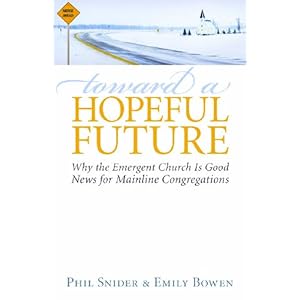
Toward a Hopeful Future -- Review

TOWARD A HOPEFUL FUTURE: Why the Emergent Church is Good News for Mainline Congregations. By Phil Snider and Emily Bowen. Cleveland: Pilgrim Press, 2010. X +290 pages.

Emergent, emerging, postmodern – these are all terms that are bandied about in certain circles, but they may not carry meaning for many people in Mainline Protestant circles. This is unfortunate because many of those who fit under these rather loose labels share much in common with Mainliners. A majority of emergent and emerging Christians are evangelicals or post-evangelicals who share with progressive Christians concerns for social justice and societal transformation. They’re concerned about poverty, the environment, and whether or not they believe in an inerrant bible, they’re more concerned about living out the faith than defending it.

It is true that there are many definitions of what it means to be emergent, emerging, post-evangelical, or postmodern. But what these definitions share in common is a growing dissatisfaction with the status quo. The Enlightenment has made its mark, but it has left many with a sense of great emptiness. Church growth, seeker services, mega-churches, conservative politics, have had an unsettling impact on many of these mostly younger Christians. They have much in common with Mainline Protestants, but they are also disenchanted with what they perceive to be a hidebound institutionalism and rationalism. And yet, with the right bridge builders, the two groups could come together, providing a natural home for Emergents and hope for the Mainline. At least, that is the belief shared by Phil Snider and Emily Bowen, two Disciples of Christ pastors who have embraced the Emergent movement and want to introduce skeptical and suspicious Mainliners to this movement.

The emergent church movement is rather diverse, though it is often linked to such people as Tony Jones, Doug Pagitt, Brian McLaren, and Rob Bell (with a nod to the much more conservative Mark Driscoll). Jones and Pagitt have, for their part, been key leaders in a movement that continually challenges the status quo in both evangelical and Mainline communities. McLaren has made a name for himself by trying to define what he calls a generous orthodoxy. All of these figures, with the exception of Driscoll, can be called post-evangelicals. I personally resonate with this group because I am myself a post-evangelical, though I began my journey outward from evangelicalism before I ever heard of any of these figures. Like them I found the evangelicalism of my earlier years to be too constrictive both theologically and socially. One of the reasons why this group needs an introduction to Mainliners is that many in the Mainline community are suspicious of evangelicals. I experienced this reality, being that I was a graduate of Fuller Seminary. Fortunately this has long since dissipated. Still, the bridge that Snider and Bowen seek to build between progressives and Emergents should prove beneficial to the Mainline Church.

The book begins by offering introductions and definitions. The authors point to several definitions, including that of Tony Jones, the former national coordinator of Emergent Village, who defines the Emergent movement as essentially a friendship or network of missional Christians. He notes that Scot McKnight, a friendly observer of things Emergent, suggests that emerging churches are prophetic, postmodern, praxis-oriented, post-evangelical, and political (that is, they are generally politically liberal evangelicals). Others would point to worship styles that seek to be both ancient and modern. There are in fact a wide variety of emergent types, which range from extremely conservative to relatively liberal. So, any definition is going to rely on adjectives. The version of the emergent church that Snider and Bowen link into is one that is open to progressive understandings. It’s one that seeks to listen for postmodern voices, is committed to social justice, is progressive in theology and expression. Snider and Bowen are attracted to the emergent perspective because it is organic and grass roots. It allows for freedom and nuance. Of course, being progressive Mainliners, the authors are very aware that most of the emergent voices are white and male. Of course, the charge of whiteness can be laid at the feet of most mainline Protestant churches.

The book is divided into three parts – Emergent Background, Emergent Ethos, and Emerging Worship. Through these three sections the authors introduce mainline progressives to the emergent movement and offer suggestions as to how this movement can enhance and empower and give hope to mainline churches. They do a good job of telling stories of people who have felt disenfranchised by both evangelicalism and Mainline Protestantism, suggesting that this movement can provide resources to transcend these difficulties. In part two the sections on justice and hospitality should prove especially helpful.

The final section deals with worship, which seems to be an ongoing point of dispute and discussion within mainline churches. Evangelicals may be conservative in their theology, but many of them have come to terms with the realities of style and technology much quicker than Mainliners. The “ancient-future” worship style that predominates among Emergents might offer some help in adapting to the needs and concerns of new generations of people who don’t connect with the traditional worship styles found in many Mainline Churches. That being said, the authors make it clear that they’re not simply adding one more voice to those that claim that simply adopting contemporary praise services will bring in hordes of young people. Snider and Bowen write:

Emerging forms of worship are much more concerned with grounding worship experiences that reflect specific contexts and theological convictions than they are with any specific style. (pp. 139-140).

That is, the question isn’t whether we should have old hymns or praise songs, organs or guitars, debates that have colored the so-called worship wars. But, the authors remind us that younger adults are more visual and kinesthetic in their orientation to worship. This is why many forms of emergent worship include candles and icons. In reaction to the seeker movement that removed Christian symbols from the worship space, Emergents have not only brought back the cross, but other visual forms – including icons that derive from the Eastern Church. Technology helps in all of this, but isn’t essential or normative.

In terms of worship, the authors make it clear that language, especially regarding gender, is important. They note the problem that exists in Mainline and Evangelical (including Emergent Churches) congregations is that the language is exclusive and patriarchal. For progressives there is the problem of hymns and songs that don’t fit their theology. This is especially true in relationship to references to the atonement and patriarchal references to God. Here is their set of guidelines relating to their choices in music at their emergent service:

[W]e hold fast to progressive approaches in general by making sure the music is grounded in nonviolence, justice, hospitality, and mutuality, and we try our best not to lose sight of the mystery and wonder of God. Like emergents in general, we focus on music that is neither highly individualistic nor concerned with pie in the sky. In short, we try to make sure that every element of the liturgy – especially our music – reflects the theology held dear by progressives and emergents so that they can joyfully sing their faith without sensing a bunch of disconnects in the process. More than anything else, it is the music that stays with the people, it is music that seeps into their bones and reimagines their world. (p. 172).

In two appendices, the authors offer more guidelines and examples of how one might construct an emergent worship experience. Being that they are Disciples of Christ, they place the celebration of the Lord’s Supper at the center of this worship, and they make a point of the fact that Disciples do not limit the celebration of the Eucharist to clergy.

Bowen and Snider have written an important introduction to emergent Christianity for progessive Mainliners. They create a bridge that will help the skeptical or suspicions deal with qualms and questions. The emergent movement isn’t a perfect vehicle, but it does offer hope to the mainline church with its deemphasis on institution and structure, while emphasizing tradition, justice, scripture, hospitality, and adaptability. The emergent movement isn’t the end all for mainline renewal; any more than was true of the seeker movement or the megachurch movement. The danger here is that a tradition that is experiencing both decline and an inability to reach younger generations will simply jump headfirst without truly understanding the ramifications. The reality is that even if the emergent movement offers a word of hope, each church will have to adapt itself in a way that is authentic to its own context and history. That being said, this book, and this movement, does offer a pointer toward a hopeful future.

Wednesday, December 22, 2010

Church in the Inventive Age -- Review

CHURCH IN THE INVENTIVE AGE. By Doug Pagitt. Minneapolis: Sparkhouse Press, 2010. 114 pages.


Whether we’re ready or not, we have entered the “inventive age,” so says Doug Pagitt, pastor of Solomon’s Porch in Minneapolis. Of course, other writers have suggested other names for this new age that we’ve entered. Consider that Harvey Cox has called this the Age of the Spirit,” and Phyllis Tickle speaks of the “Great Emergence.” Whatever you want to call it, the world is changing and we can embrace the changes, resist them, or adapt as best we can – sort of survive. Doug puts it this way:

We live in the midst of inescapable change. Maybe this thrills you. Maybe this scares you. Regardless, the changes happening right now in American society mean every cultural institution, every community, every individual has a choice to make: We can either be in on the change or we can be left behind. (p. 3).
The choice is rather stark, but real.

Church in the Inventive Age is a rather brief and even breezy book. As Doug notes early on the focus is on the big idea and not necessarily the details – like you’ll find in a book such as American Grace by Robert Putnam and David Campbell. The first three ages will be familiar to most readers – the Agrarian Age, the Industrial Age, and then the Information Age. There are churches that still exist, and may even thrive that represent each of these patterns, but even the information age is giving way to something new, something that will focus on collaboration and creativity. But, in focusing on the future and on change, Pagitt doesn’t want us to jettison the path, but rather to make sure we don’t get stuck in the past

So, what are the first three ages and how does the church exist in them? The first age is the Agrarian Age, and interestingly this was the age into which the American Republic was born. This was an age in which the people were dependent on the land and on each other. In this age the church was often structured around the parish – that is, it was geographically defined. You didn’t go looking for something different, at least not very often. Besides, most communities were mono-cultural, and churches were defined by those cultures. And for the most part the churches themselves, as buildings, were fairly simple structures. . And the dominant image of minister/church leader was that of pastor or shepherd, who was charged with caring for the flock. I’m assuming that this image is deeply ingrained in the psyche’s of many, even in this age of massive change.

The second age, the Industrial Age, emerged on the American scene in the 19th century, taking hold first in the north and then later making headway in the south. This is the age of urbanization and massive immigration. Here the farm is replaced by the factory as the primary social/cultural image. Instead of dependence the metaphor of the age might be that of repeatability – Henry Ford! The church of this age, as it tried to respond to the changes remained ethnically monocultural, even if the community itself was diverse. And the simple structures of the past gave way to what Pagitt refers to as “fortresses with smokestack-like steeples and red brick facades" (in his presentation at Theology after Google, Doug showed us a slide of the former Methodist Church that Solomon’s Porch took over that looks very much like the one in this metaphor). This is also the age in which denominations began to gain strength, and the pastor was called to teach the denomination’s theology, and so we shouldn’t be surprised to see the expansion of seminaries.

Finally we come to the Information Age. You may be wondering – isn’t that the age we’re in currently? Well, apparently not. This is the age of the suburb and the megachurch. With few exceptions, those who are by definition Caucasian can mix and be Americanized. Schools and Education are emphasized, and thus not only in the public field but Christian education has its hey day. Churches become learning centers, and the pastor is teacher/CEO. Of course in this era, bigger is better! Or is it?

The Information Age, which emerged just yesterday, or so it seems, has begun to lose its hold on the populace, which is increasingly disenchanted by the way things are going. It’s not that mega-churches are going away, but more and more people are looking for alternatives. In the Inventive Age the focus is on creativity in a context where the future remains unknown. There is a great lack of certainty, which makes long term planning difficult! This is the age of more dynamic forms of media, such as blogs and social media (Facebook and Twitter), which allows for much more creativity and collaboration across vast spaces in the world. Pagitt writes: “The Inventive Age is one in which inclusion, participation, collaboration, and beauty are essential values. The values of the previous age still exist, but in different, even subservient, roles” (p. 30). In this new age size might not matter all that much, with focus being placed on participation. The pastor, while still teaching, preaching, and leading, will put her or his focus on creating space for “open-source faith experiences.” That is, making a place for the people be spiritually creative.

If we’re to understand these different ages, we must understand what makes for culture and cultural change. Pagitt uses four images – head (thinking), heart (values), gut (aesthetics), and hands (tools). In each age these cultural components exist, but in different ways, and with different components having greater sway. What is true of previous ages is true of the Inventive Age, which must concern itself with each aspect of culture. And to survive in this age there must be collaboration between those who emphasize different aspects – and thus there is need for collaboration between evangelical and mainline (that word should get the attention of those in both camps that would rather not engage the other). So what must the church be doing in this new age? According to Pagitt, it must be engaged in remaking the culture. That is, even as we adapt to culture, we must be engaged in its creation – lest we be left behind.

So, what shall we do? That may depend on where we find ourselves – we have, according to Pagitt, three options. We can exist for, with or as the Inventive Age. To live for the Inventive Age is to take what we have and bring it to bear on and in the new age. As I read the book, I saw my own church in this position. We’re keeping alive an older – industrial age – model in many ways, but there is something valuable to bring to the table, even as the church makes room for new things. The key here is being authentic to yourself. I appreciated this word from Doug because some in the Emergent Movement give off the vibe that the older Mainline churches are essentially old hat. Doug seems, at least here, to give room for older traditional churches to play a significant role in the future.

Perhaps the most difficult situation to be in is to live with the Inventive Age. In essence this stature means being a church within a church. Many churches have tried to have both traditional and contemporary styles, though this doesn’t often work easily. But the point is finding ways to make room within the structure for younger generations. Success here requires being willing to walk alongside each other as equal partners and learn from each other. That requires incredible trust, which isn’t easy to build. It also means being loose with the furniture! I’ll leave that one to your imagination. And as Doug points out, “churches that do the ‘with’ relationship well often end up becoming separate congregations for all the right reasons” (p. 94).

Finally there is the church that lives “as the Inventive Age.” This is the church that’s being born now. It may be, like Doug’s one that lives within a building, or it could be one like Koinonia, a church launched and led by Kimberly Knight that exists in Second Life, a virtual reality. Such realities exist in what Doug calls “perpetual beta.” They’re always changing and adapting – much like Facebook, which never goes down completely, but recreates itself on the fly. It may be multilingual in that it brings together ancient and modern symbols and realities. It is an age of “coulds,” where the past is curated for service to the future and meaning is central. And its not simply creating meaningful spiritual experiences for the individual – so that the focus gets put on personal salvation. No, what the Inventives long for are “spiritual communities in which their faith matters – not only to them, but to the world around them” (p. 102). In this movement forward, there is no “target audience,” so don’t think this is just about 20-somethings!

So, what should we expect about the future church? We can’t really know all the particulars, we must be ready to adapt and grow with the changing times. Instead of using the metaphor of a road, Pagitt suggests that of flight. A road moves from one location to another, with flight the space is open. What we must do in setting the flight plan is account for the variables and risks that we will encounter, and then head out!

As I noted at the beginning of the review. This is a fast reading book that is big on big ideas and not on details. As a historian I could get picky on the time lines, but that’s not the point. Key here is getting the sense that our churches represent different ages, and that all four ages are existing simultaneously. It’s also key to know that the faith structures of the past ages aren’t bad or wrong, but they don’t work for everyone, including a growing number of younger people. There are other places to go for deeper analysis, but what I find useful here is that it can open us up to a conversation about the world that we inhabit and the tools and experiences that we all bring to the conversation. Pick up and read Church in the Inventive Age and begin the conversation.


Tuesday, November 23, 2010

Adventurous Theology #10: A Never Ending Story (Bruce Epperly)

The journey through Acts is nearing its end -- that is, the exploration of the adventurous spirit that pervades Luke's description of the early church's journey comes to an end in this posting.  Bruce Epperly has taken us from Ascension to Paul's prison cell, noting here in the end that "God is still speaking."  There is one last post to consider -- next week -- that reflects on Acts 29, our continued writing of the story of this faith journey.  I invite you to consider with Bruce what the Spirit is doing in the world and in the church as, to quote (as Bruce does) Doug Pagitt, we live out a "Christianity Worth Believing."


************************

 
Adventurous Theology #10:
A Never Ending Story
Acts, Chapters 21-28
Bruce G. Epperly


Acts of the Apostles comes to an end with a travelogue descriptive of Paul’s journey to Rome. But, the final words, describing Paul’s preaching from prison in terms of “boldness and without hindrance,” suggest that Acts is but the beginning of a spiritual adventure that shapes us today. What’s to hinder us from embracing God’s world of wonders, unity with strangers, mystical experiences, and unexpected power and energy in our time? Open to God’s spirit, we have everything we need to be God’s ambassadors and healers in our time.

Paul’s future, even in prison, and our own is open and undecided. We are making it up as we go along, beneficiaries of Paul’s innovative ministry to the non-Jewish world. Signs and wonders abound when we commit ourselves to going deeper in our experience of God and God’s mission in the world. God is alive, doing a new thing, and inviting us to be creative as well.

The final chapters of Acts could be described as “ponderings on a faith journey.” Paul travels from place to place, sharing the good news of the new beginnings, inspired and energized by the living presence of the Risen One. Christ’s resurrection is not only a past event to Paul, but the source of confidence and spiritual power in the present moment. Christ has brought a new energy and new possibilities into the world, spiritually, metaphysically, and physically. While we cannot fully assess the power of the resurrection, its impact on Jesus’ first followers was holistic; it created a new vision of reality that encompassed every aspect of life. Just as the enlightenment of Buddha injected new spiritual possibilities, the life, teaching, death, and resurrection of Jesus changed the course of history and God’s relationship to the world. God’s attitude toward the world did not change – as John 3:16 notes, the coming of Christ is the manifestation of God’s love, not its cause or inspiration. Rather, Jesus’ life opens the door for new divine possibilities in our world.

The final chapters of Acts join action and testimony. Paul’s theology is holistic: the author of Acts records Paul’s narrative of his encounter with the living Christ in these final eight chapters. Paul’s theology encompasses his whole being: it creatively synthesizes the Jewish tradition, his mystical encounter with the living Christ, and the emerging Christian understanding of the meaning of Jesus in light of God’s revelation in Judaism and in the wider world. Paul’s own synthetic faith encompasses body, mind, spirit, and relationships. It is far from being purely cerebral or intellectual, but integrates his Damascus Road experience with the ongoing movements of the Spirit in his life. This is the way good theology should be – the isolated academic discipline of theology would have been an anomaly to Paul and the Parents of Christian theology. For them, theology was rooted in and connected to vital Christian experience. Theology, indeed, gave meaning and context to experience, shaped experience, and was shaped by experience – personal and communal.

Today’s emerging Christianity is seeking to replicate this same theological-experiential dynamic in its quest to join “ancient” and “future” in an evolving “now.” Like the first Christians, many emergents are seeking to create a theology that gives meaning and provides an evolving context for their current faith experiences. Such a theology must include reflections on “a Christianity worth believing” (Pagitt) in light of the end of the American empire, the internet and beyond, and global spiritualities. This is theology in the making – highly experiential, yet in need of enough tradition and enough imagination to provide an evolving spiritual home for seekers within and beyond the church.

At times, Paul must have been astounded by his own journey – inspired at every step by a living Spirit, pushing the boundaries of past belief systems, and learning to adapt to the Gentile world. Paul brilliantly joined order and novelty in the creation a good enough theology for the Gentile world. Belief in the living Christ along with a handful of foundational Jewish behaviors was “good enough” to insure the well-being of new Christians and their communities. While he may not have intended it, Paul laid the groundwork for theological, liturgical, ecclesiastical, and experiential diversity by his innovative synthesis of tradition and novelty. Christianity no longer could be identified with a few sacred spaces and holy lands, now all lands could be holy and all spaces sacred. Accordingly, indigenous faiths of all kinds could emerge and have emerged throughout Christian history. Hardly a fundamentalist, Paul laid the foundations for the evolution of Christianity, emerging in time and place and embracing the Living Christ, the God of Christ, and the victory over death in dialogue with culture and community.

The final words of this “unhindered” gospel remind us that we are part of this story. As the United Church of Christ proclaims, “God is still speaking.” When we understand the word “speaking” holistically, we see God’s voice as more than a matter of word and doctrine, but an energy and vibration, creatively and intentionally moving through all things, personal and global, touching each thing in light of its responsibility to the whole. Many voices compose the chorus of revelation. But, the many are inspired by a personal voice that honors uniqueness yet pushes us toward community.

As we conclude our journey through the Acts of the Apostles, it is clear that God’s call is global as well as intimate. Paul goes out into the world; and faithfulness challenges us to be world-oriented as well. Just as Paul did not fully know where he was going, we must look in a mirror dimly as we consider the future of Christianity. We know that the future of our faith must be global, for the earth and humankind are in jeopardy. Salvation must heed the cries of creation (Romans 8) as well as our own inner urgings. Honoring one another, we must find our pathways into the world – pathways that join personal experience, encounters with the holy, agile theological reflection, and commitment to strangers, neighbors, and the good earth – as we seek to share life-transforming words of God in our time and place. We are God’s partners in a never-ending journey.


Bruce Epperly is Professor of Practical Theology and Director of Continuing Education at Lancaster Theological Seminary. He is the author of 17 books, including Holy Adventure: 41 Days of Audacious Living and Tending to the Holy: The Practice of the Presence of God in Ministry.