Search This Blog

Showing posts with label colonial history. Show all posts

Wednesday, February 16, 2011

Chris Beneke on The First Prejudice

Randall Stephens

[From Religion in American History]

About a week ago over at Religion in American History Paul Harvey posted on Chris Beneke and Christopher S. Grenda's, The First Prejudice: Religious Tolerance and Intolerance in Early America (Univ. Pennsylvania Press, 2011). The edited volume, "presents a revealing portrait of the rhetoric, regulations, and customs that shaped the relationships between people of different faiths in seventeenth- and eighteenth-century America. It relates changes in law and language to the lived experience of religious conflict and religious cooperation, highlighting the crucial ways in which they molded U.S. culture and politics." I recently caught up with Beneke, a Historical Society board member, by email and asked him some questions about the project and the work being down on tolerance/intolerance.

Randall Stephens: What is the unifying theme of The First Prejudice: Religious Tolerance and Intolerance in Early America?

Chris Beneke: Our title, The First Prejudice, plays on the popular understanding of religious liberty as the nation’s “First Freedom.” It also draws on the proposition that religion was initially the source of the deepest prejudice to afflict early Americans and the object of the first large-scale efforts to mitigate prejudice. We asked our contributors to be attentive to the distinguished and extensive historiography on church and state, but not beholden to it. The idea was to create a history of religious tolerance and intolerance that took into account a broader range of religious and cultural interaction than histories of religious liberty have traditionally done. For us, it presented an opportunity both to build a compelling new narrative of early American religious history-where religious differences are at center stage-and to develop a common set of reference points and questions that would frame more useful conversations about tolerance and intolerance in America.

Stephens: Why did religious tolerance develop in the West when and where it did?

Beneke: In a sense, it depends on what you mean by tolerance (I know it’s annoying when historians say that, but there, I’ve gone and done it). If you mean what Willem Frijhoff calls “everyday ecumenism,” or at least everyday cooperation and non-violence, then it’s very old indeed. Historians have been hard at work in the archives over the past two-plus decades, discovering that sort of tolerance in surprising places across medieval and early modern Europe. But as a commonly accepted ideal, as a stated commitment to some form of equality, and a legal practice that guaranteed a modicum of protection, tolerance is something that developed in the intellectual capitals of northern Europe during the late seventeenth and eighteenth centuries. And though I risk irritating my intrepid co-editor and some contributors by saying this, I think that it took hold in a much more fundamental and irrevocable way in the early national United States.

Stephens: When it comes to religious tolerance did the early United States differ all that much from Great Britain and western Europe?

Beneke: Here's the very short answer: official church establishments persisted across most of Europe into and beyond the twentieth century. In the United States, they did not. The U.S. may have maintained an unofficial Protestant establishment for many decades (via instruments such as the common law, public education, state religious tests.), but the fact that it was un-official and the fact that it was accompanied by substantive protections for free exercise, was critically important. For all the disingenuity involved, an un-official establishment was surely more hospitable toward religious minorities than almost any official establishment might have been. Maybe just as importantly, the commitment to disestablishment and religious liberty meant that the religiously intolerant had to explain themselves and find ways to wrap bigotry in the mantle of tolerance.

These factors have always kept American religious intolerance in check.>>>

Tuesday, November 30, 2010

The Generalist

Chris Beneke

Gordon Wood’s favorable review (“The Real Washington at Last”) of Ron Chernow’s massive new biography of George Washington appears in the latest New York Review of Books.* For a man who said so little and wrote so economically, Washington has inspired an avalanche of words. As Wood notes:

[W]e now have assessments of Washington’s political philosophy, his constitutionalism, his religion, his private life, his portraits, his leadership, his physical appearance, his interest in the Virginia backcountry, his concern for the decorative arts, his enlightenment, his place in popular culture, his view of the Union, and his relations with his wife Martha, Lafayette, James Madison, Henry Knox, Nathanael Greene, Benedict Arnold, his other generals, and various other revolutionaries. There are studies of Washington as a president, as a slaveholder, as a man of the West, as a general, as a partisan fighter, as an American symbol, as the modern Cincinnatus, as a Freemason, as a young man, as a patriarch, as a visionary, as a spymaster, as the architect and owner of Mount Vernon, as the designer of the nation’s capital, as the French saw him, and as the master manipulator of public opinion.

Wood’s title isn’t ironic. He contends that Chernow gets us closer to the “real Washington” than any of the legions of earlier biographers. Chernow is the beneficiary of a series of herculean archival efforts, including the ongoing project at the University of Virginia to publish all of Washington’s papers, which will eventually consist of ninety volumes.

Chernow benefits from another fortuitous circumstance, according to Wood—he’s not an academic. It isn’t that academic historians write especially bad. By comparison with other fields, our prose is not wholly dull, nor completely impenetrable. The problem lies, says Wood, in our tendency to write for one another and to publish books on “specialized problems” that few readers outside of History Departments will ever comprehend, never mind enjoy at the beach.

As Wood notes, we share this internal orientation with chemists and literary theorists alike. Like theirs, ours is an “accumulative science.” We are sunk in its immensity. “[T]he monographs have become so numerous and so refined and so specialized that most academic historians have tended to throw up their hands at the possibility of synthesizing all these studies, of bringing them together in comprehensive narratives. Thus the academics have generally left narrative history-writing to the nonacademic historians and independent scholars who unfortunately often write without much concern for or much knowledge of the extensive monographic literature that exists.”

Not Chernow. Wood says that he writes well and knows the secondary literature. The result is a very big and illuminating portrait of our national icon of sincerity, the general who always managed to elude his pursuers.**

******

* Barnet Schecter’s book, George Washington’s America: A Biography Through His Maps is also reviewed here. But the focus is on Chernow.

** For a sharp and less reverent account of both Chernow’s book and Washington’s life, see Jill Lepore’s “His Highness” in The New Yorker (September 27). Lepore isn’t persuaded that Chernow has made Washington more comprehensible.

Thursday, November 18, 2010

Jill Lepore to Lecture Tonight at 7:00pm, Eastern Nazarene College

.
The Eastern Nazarene College History Department will present a lecture by Harvard University historian Jill Lepore at 7 p.m., Thursday, November 18, in Shrader Lecture Hall
(23 East Elm Ave, Quincy, Mass). The lecture is free and the public is invited to attend.

Titled “Poor Richard’s Poor Jane,” Lepore’s talk will be based on her forthcoming biography of Benjamin Franklin and his sister, Jane Mecom.

Lepore is the author of New York Burning: Liberty and Slavery in an Eighteenth-Century City, The Name of War: King Philip’s War and the Origins of American Identity, which won the Bancroft Prize, A is for American: Letters and Other Characters in the Newly United States and, most recently, The Whites of Their Eyes: The Tea Party’s Revolution and the Battle over American History. Lepore has written for the New York Times, the Washington Post, the New Yorker, and the Los Angeles Times.

The ENC History Department Public Lecture Series is made possible by the support of ENC alumni.

Monday, October 25, 2010

King George II & III, Colonial News, and a Royal Autopsy

Randall Stephens

On October 25, 1760 George III became King of Great Britain. News traveled slow, of course, and New Englanders didn't know about George II's (b. 1683) death or their new monarch for weeks.

Just how slow did people and information cross the Atlantic? In 1750 the school master and organist Gottlieb Mittelberger made the voyage from England to Philadelphia. He later wrote: "When the ships have for the last time weighed their anchors near the city of Kaupp [Cowes] in Old England, the real misery begins with the long voyage. For from there the ships, unless they have good wind, must often sail 8, 9, 10 to 12 weeks before they reach Philadelphia. But even with the best wind the voyage lasts 7 weeks."* Sailing technology had greatly improved in the 18th century. Still, slow transatlantic journeys and poor roads hindered the speed of information for decades. (See the map showing travel times circa. 1800.)

So, finally, in late December Bostonians read of the King's demise in the Boston Post: "Saturday arrived here Capt Partridge in about 6 weeks from London by whom we have the melancholly News of the Death of the most high, most mighty, and most excellent Monarch, GEORGE the Second, King of Great Britain . . . Defender of the Faith . . . . GEORGE the Third was proclaimed KING. . ." ("Partridge; Weeks; London; News; Death; Monarch; George," Boston Post-Boy, December 29, 1760, 2.)

The British American loyalty to King and Country sometimes gets lost in our popular view of colonials as patriots in the making. But as Brendan McConville writes in his The King's Three Faces: The Rise and Fall of Royal America, 1688-1776, "British North Americans championed their British king with emotional intensity in print, during public political rites, and in private conversation" (9).

Yet, before Americans pulled out the bunting and uncorked bottles to celebrate their new King, they had a bit of morbid curiosity to satisfy. How did George II die?

Fortunately, newspaper editors, keen to print what the people wanted, had the scoop on the Royal Autopsy. The Boston Post relayed the news from London: "In obedience to the order transmitted to us by the Right Hon. Vice-Chamberlain, We the under-signed have this day opened and examined the body of his Majesty . . ." They found "all parts contained in a natural and healthy state, except only the surface of each kidney there were some hydrides, or watery bladders, which however, we determined could not have been at this time of any material consequence." The regal heart, though, did not look so well. Among other abnormalities, they observed "a rupture in the right venticle." ("London, November 4," Boston Post-Boy, December 29, 1760, 2.) (For what passed as medicine in that day, see the amusing film The Madness of King George. The physicians in the movie are a hoot!)

Certainly, the 18th century is culturally distant from us today. This past is definitely a foreign country. Today, we travel at breakneck speeds and communicate across space and time with ease. Still, reading newspaper accounts like the above, makes the celebrity mongering of today and news as infotainment seem not entirely new.

Sunday, October 3, 2010

Some Films I Use for My Colonial American History Course

Randall Stephens

I've mentioned on the blog before that I like to use short film clips (10-15 minutes) for many of the classes I teach. I suppose it works better for some courses--America in the 1960s--than others--History Methodology. But thanks to long-running programs like American Experience, Nova, POV, History Detectives, etc, there's much, much out there.

You just have to be willing to do some hunting, inter-library loaning, and some screening. Below are documentaries and features I've found useful for my Colonial America course. Browse the list and I'm sure you'll think of others that could be included. (In the future, I'll post a list from my class on The West in the World since 1500.)

Films for the Colonial American History Course

The Mystery of Chaco Canyon (1999) (Narrated by Robert Redford. Though a more interesting, up-to-date take on Chaco is in the 2010 nat geo adaptation of Jared Diamond's Collapse.)

Native Land: Nomads of the Dawn (1996)

We Shall Remain, Episode 1 (WGBH, 2009) (Contains great material on the first contact between English settlers and Indians. Also includes a good overview of King Philip's War. I combined it with a reading from Jill Lepore's Name of War. Watch the full program on-line.)

The Magnificent Voyage of Christopher Columbus (WGBH, 2007)

Surviving Columbus: The Story of the Pueblo People (KNME, 1992)

Luther (2003) (A good feature film to teach students a bit about the Reformation.)

The New World (2006) (I can think of no other film that more beautifully, graphically presents the Jamestown story. One reviewer called it a visual poem. Good description.)

Nova: Pocahontas Revealed (WGBH, 2007)

Desperate Crossing: The Untold Story of the Mayflower (2006)

The Story of English: Muse of Fire (WGBH, 1986) (One of my favorite documentaries from PBS. Excellent summary of the development of the southern accent [West Country] and the Boston, dropped-r accent [East Anglia].)

American Visions: The Republic of Virtue and The Promised Land (1996) (This is the crusty Aussie art critic Robert Hughes's epic series on American art. Contains a discussion with David Hackett Fischer on Old Ship Church in Hingham and an examination of 17th-century decorative art and architecture. Goes along very well with Fischer's Albion's Seed.)

Colonial House (2004) (How well would the typical college student fare in a 17th-century setting? One word, bathroom.)

God in America, Episodes 1 and 2 (WGBH, 2010) (Will be using this when it comes out. Have seen the pre-release version of the first two episodes. Tremendous. Includes accounts of the Pueblo Revolt, the trial of Anne Hutchinson, George Whitefield and the GA, and more. When this airs on PBS Oct 11-13 the full program will be available on-line.)

500 Nations: Cauldron of War (1994)

Slavery and the Making of America (WNET, 2004) (I use episodes 1 and 2: The Downward Spiral and Liberty in the Air for the colonial course.)

Tom Standage interview on his History of the World in Six Glasses: CBS Sunday Morning (2005)

The War that Made America (WQED, 2006) (French and Indian War series.)

Scientific American Frontiers: Unearthing Secret America (Alan Alda's tour of Jamestown and Jefferson's Monticello. Great perspective on how archeology informs history.)

New York: The Country and the City, Episode 1, 1609-1825 (1999)

Benjamin Franklin (2002)

Thomas Jefferson (1997) (Ken Burns's doc.)

John Adams (HBO, 2008)

Liberty! The American Revolution (KTCA, 2004)

Founding Brothers (2002)

Monday, September 27, 2010

Slavery in New England

.
The Sunday Ideas section of the Boston Globe features an interesting essay on slavery in New England. Francie Latour lays bare some of the myths related to regionalism and slavery.

Francie Latour, "New England’s Hidden History," Boston Globe, September 26, 2010.

"When it comes to slavery, the story that New England has long told itself goes like this: Slavery happened in the South, and it ended thanks to the North. Maybe we had a little slavery, early on. But it wasn’t real slavery. We never had many slaves, and the ones we did have were practically family. . . .

As the nation prepares to mark the 150th anniversary of the American Civil War in 2011, with commemorations that reinforce the North/South divide, researchers are offering uncomfortable answers to that question, unearthing more and more of the hidden stories of New England slavery — its brutality, its staying power, and its silent presence in the very places that have become synonymous with freedom." >>>

Saturday, September 11, 2010

Free History Lectures in Quincy, Mass

Randall Stephens

For those who live in the Boston area, my department and college are hosting several history lectures in the fall. Our history and English departments are exploring Boston and New England themes from the colonial era to the period of the Early Republic. Plenty of early American action in this neck of the woods. (For example, check out the fall activities at the Paul Revere House and the series of lectures at Old South Church, the Harvard Book Store, and the Massachusetts Historical Society.)

In the past, with the aid of an assistant, I've created a list of area lectures in history, religion, the arts, and more. I require students to get plugged into the cultural opportunities of the city. It's a nice way to broaden out the curriculum. It's almost always a plus for students, who remark favorably about it on course evaluations.

Eastern Nazarene College, Fall 2010:

FRIDAY, OCTOBER 15, at 3:00pm: Thomas S. Kidd (Baylor University), “God of Liberty: A Religious History of the American Revolution.” The Donald S. Metz Lecture in American Christian History.

THURSDAY, NOVEMBER 4, at 7:00pm: Gordon Wood (Brown University), "Empire of Liberty: A History of the Early Republic, 1789-1815." The Donald A. Yerxa Lecture in History.

THURSDAY, NOVEMBER 18, AT 7:00PM: Jill Lepore (Harvard University), "Poor Richard's Poor Jane."

Wednesday, July 7, 2010

Lowenthal, "The Past WAS a Foreign Country," HNN

Randall Stephens

Over at HNN David Lowenthal responds to my piece, "The Past Is No Foreign Country." He uses it as a launching point for a larger discussion about the ways presentism continues to plague our culture. (He also describes the revised version of his classic book.) Lowenthal points out, as John Fea did too, that "flagrant presentism is no right-wing monopoly." Right on. I put too fine a rhetorical point on that in my essay.

"The Past WAS a Foreign Country"
By David Lowenthal

David Lowenthal is Professor Emeritus of Geography at University College London

Randall Stephens [The Past Is No Foreign Country, HNN, June 28, 2010] commends my The Past Is a Foreign Country (Cambridge, 1985) for tracing post-Renaissance awareness of the past’s difference. He chides Glenn Beck and likeminded conservative ideologues "incapable of coming to terms with change over time" for ignoring that difference. But flagrant presentism is no right-wing monopoly; it now suffuses all popular culture, from evangelical biblical literalists and strict constitutional constructionists to bleeding-heart apologists for ancestral iniquities from slavery to sexism to class hierarchy. In appropriating the past, partisan heritage domesticates it by purging or bowdlerizing its unpalatable oddness. Discussing the Victorians in Virginia Woolf’s Between the Acts, old Mrs Swithin says, "I don’t believe that there ever were such people, only you and me and William dressed differently." Like Mrs. Swithin, we don’t believe in history.>>>

Thursday, July 1, 2010

July 4, 1826

Randall Stephens

It was fifty years to the day after the 13 colonies declared independence from Great Britain.

President John Quincy Adams wrote in his diary about the festivities in Washington. "The volunteer companies assembled on the square," he observed, "fronting the house and paid the passing salute by marching through the yard."

Arriving at the door of the Capitol, I was there met by Mr. Anderson, the Comptroller, with whom we entered the hall of the House of Representatives. The Reverend Mr. Ryland made an introductory prayer.

Joseph Anderson, the Comptroller, read the Declaration of Independence; Walter Jones delivered an oration commemorative of the fiftieth anniversary; the Reverend Mr. Post, Chaplain of H. R. U. S., made a concluding prayer.


After which, Governor Barbour delivered an address to the citizens assembled, soliciting subscriptions for the relief of Mr. Jefferson. . .

News traveled slowly over bad roads. Members of congress knew of Jefferson's troubles, but the severity of his situation was unclear. Few could have guessed that Jefferson's one-time rival and on-again/off-again friend John Adams was also in his last throes. Thomas Jefferson and John Adams died on that hot July day.

Four days later John Quincy received a batch of letters. One brought bad news. A missive "from my brother, written on the morning of the 4th, announcing that, in the opinion of those who surrounded my father's couch, he was rapidly sinking; that they were sending an express for my son in Boston, who might perhaps arrive in time to receive his last breath. The third was from my brother's wife to her daughter Elizabeth to the same purport, and written in much distress." On his way north to Boston, while in Waterloo, MD, he heard that his father had died. It was July 9th. He was stricken with grief. "My father had nearly closed the ninety-first year of his life," he confided to his diary, "a life illustrious in the annals of his country and of the world."

He had served to great and useful purpose his nation, his age, and his God. He is gone, and may the blessing of Almighty Grace have attended him to his account! I say not, May my last end be like his!—it were presumptuous. The time, the manner, the coincidence with the decease of Jefferson, are visible and palpable marks of Divine favor, for which I would humble myself in grateful and silent adoration before the Ruler of the Universe. For myself, all that I dare to ask is, that I may live the remnant of my days in a manner worthy of him from whom I came, and, at the appointed hour of my Maker, die as my father has died, in peace with God and man, sped to the regions of futurity with the blessings of my fellow-men.

Plenty of Americans in 1826 had something to say about the death of two lions of the Revolution. Prone to view the world through the eyes of faith, and to read signs in the sky and on the ground, newspaper editors, clergy, and laypeople were astounded. On July 11 the Massachusetts Salem Gazette lamented "We know not in what language to express ourselves in announcing . . . another event which has transpired to render the late glorious anniversary, the national jubilee, in some respects the most memorable day in the history of our country." That was no hollow encomium. It rang true across the young nation. The New York Commercial Advertiser rhapsodized: "it seems as though Divine Providence had determined that the spirits of these great men, which were kindled at the same altar, and glowed with the same patriotic fervor . . . should be united in death, and travel into the unknown regions of eternity together!"

Some years back Margaret P. Battin wrote in Historically Speaking about the strange coincidence of Jefferson's and Adam's deaths on the same day. "Although the fact that Adams and Jefferson died the same day is taught to practically every schoolchild, asking why is not," Battin noted. "What could explain this? There are at least six principal avenues to explore, but all of them raise further issues." She then offered some of the explanations given over the ages for their demise on that same anniversary.

It makes me wonder about the comparison and contrast between our age and the beginning of the Jacksonian era. Do Americans now have similar ideas linking nation, patriotism, and providence? Do Americans esteem their leaders and the political giants of our day in any way like they did 184 years ago? How have citizens understood God and country from one era to the next?

Monday, June 14, 2010

Follow up on Josiah Quincy House Class Project

Randall Stephens

About a month back I posted here on a fruitful class project I undertook with undergraduates. Since then the local paper, the Patriot Ledger, has done two stories on the resource website we created for the Josiah Quincy House. (As we worked on the JQ House website we tracked down loads of digital sources, included an extensive bibliography, along with photos, maps, illustrations, and a video interview.) Jack Encarnacao, a reporter for the paper, met with me, museums operations manager Leah Walczak, and the students at the Quincy home. A photographer snapped some shots as well. Fun stuff. I post here excerpts from the Ledger articles:

Jack Encarnacao, "Josiah Quincy House Comes to Life on Eastern Nazarene College Class Website," Patriot Ledger, June 3, 2010.

QUINCY — Professor Randall Stephens' class at Eastern Nazarene College studied the Josiah Quincy House in Wollaston, one of the city’s lower-key but significant historic sites. The home was built in 1770 by Revolutionary War colonel Josiah Quincy, son of Col. John Quincy, after whom the city is named.

The fruit of the class’s research – skimmed from Library of Congress archives, journals and maps – is on display at a Web site the students created: enc.edu/history/jq.

Stephens said he was pleasantly surprised at how evocative the house was to students, and the extent to which they were motivated to dig for nuggets of interesting Quincy history. Much of the historical information about the house comes from Eliza Susan Quincy, who in the 1880s kept journals, inventoried the contents of the house and commissioned photographs of its interior. She wrote about how Josiah Quincy had stood on the
residence’s roof to monitor troop movements in Boston Harbor early in the American Revolution. >>>

Jack Encarnacao, "Renewed Interest in Josiah Quincy House Prompts More Tours," Patriot Ledger, June 13, 2010.

QUINCY — After a larger than expected turnout for last Saturday’s tour of the Josiah Quincy House, Historic New England is offering several more opportunities for the public to check out the historic home in Wollaston.

More than 100 people showed up for the free tours last week. The house is at 20 Muirhead St. and is usually open to the public only once or twice a year. . . .

Leah Walczak, Historic New England’s museum operations manager, said tours were added because of renewed interest in the site tied to recent publicity of a class project website built by students at Eastern Nazarene College which is also in the Wollaston section of Quincy. >>>

Monday, May 10, 2010

Roanoke Roundup

Randall Stephens

William Stith, History of the Firft Discovery and Settlement of Virginia (Williamsburg, 1747).
This Colony chofe Roanoke, an Ifland at the Mouth of Albermarle Sound, for the Place of their Habitation; and their chief Employment was to reconnoitre and view the Country. Their fartheft Difcovery to the Southward was Seeotan, an Indian Town, by their Reckoning, eighty Leagues from Roanoke, lying up between the Rivers Pampticoe and Neus, in North-Carolina. To the Northward they went an hundred and thirty Miles to the Chefapeaks, a Nation of Indians, feared on a fmall River, to the South of our Bay, now cabled Elfabeth River, from whom, as thefe firft Difcoverers tell us, the Bay itfelf took its Name. >>>

Steven Morris, "Bideford Mayor Hunts US 'Lost Colony' Clues," Guardian, May 6, 2010.
A mayor in north Devon is attempting to help rewrite American history by proving that people from his small port town settled in the US 30 years before the Pilgrim Fathers set sail. Andy Powell hopes to find funds for DNA tests that might help demonstrate Bideford's "pivotal" role in the history of modern America. If he can find the proof, the town might find itself at the centre of a tourism boom. >>>

"Local Legacies: The Lost Colony," Library of Congress.
The mystery of the lost colony of Roanoke Island has been passed down from generation to generation since their discovered disappearance in 1590-three years after the settlers from England landed. Did the 120 men, women, and children assimilate with the friendly Croatoan natives or the Chesapeake tribe? Or were they massacred by the unfriendly Wanchese tribe? This legend gains more poignancy when you consider that Virginia Dare, the first child born of English parentage in America, was among these brave pioneers. >>>

Drew DeSilver, "A Kingdom Strange: A new look at the Lost Colony of Roanoke" (a review of James Horn's new book), Seattle Times, May 1, 2010.
For a people who celebrate success as much as Americans do, we have something of a romantic affinity for failure. The Confederacy may have fallen, but as the Lost Cause it inspired, among other things, "Gone With the Wind." The Chicago Cubs have legions of fans who've never set foot inside Wrigley Field; they love the team not despite its decades of futility but largely because of them. More than 400 years after it disappeared, the Lost Colony of Roanoke, in what is now North Carolina's Outer Banks, continues to fascinate. >>>

Greg Schneider, "Book review: 'A Kingdom Strange,' by James Horn," Washington Post, April 25, 2010.
In 1587, 20 years before Jamestown, English settlers founded a colony on Roanoke Island in the Outer Banks of North Carolina. This wasn't some hardened outpost of soldiers. It was families, husbands with pregnant wives, fathers with young sons -- 118 people in all. They built a fort, befriended some of the natives and produced the first English baby born in the New World: Virginia Dare. And within three years, they all disappeared. The fate of the Lost Colony is a mystery at the heart of the nation's founding, chock full of odd characters, conspiracy theories, strange turns of events -- even enigmatic carvings left behind on tree trunks. >>>

Monday, February 15, 2010

Disappearing History, Reappearing History

Randall Stephens

A recent TNR review, NYT essay, and a piece in the Chronicle shed light on the contested nature of history and memory here and across the pond. Mostly dark business. On the bright side, long-lost reels from the dark classic Metropolis are finally being shown. Der Spiegel reports on the recovery of the reels from the 1927 Fritz Lang film. Berliners recently previewed the restored classic. Turns out that this more than 20 minutes of extra material alters the story. (Hat tip to my wife Beth on the latter.)

Mark Mazower, "History's Isle," The New Republic, February 3, 2010

Cosmopolitan Islanders: British Historians and the European Continent
by Richard J. Evans

The effects of a great financial crisis ripple in many directions and last long. After a decade of expansion, for example, austere times lie ahead for British universities, with deep cuts on the horizon. There will be consequences for British scholarship and British culture. Richard Evans’s new study of the historical profession in Britain serves as a timely reminder both of what Britain’s historians have achieved over the past half-century, and what may be lost if their legacy is squandered. In particular, Evans celebrates his colleagues’ outward-looking mindset and their love-affairs with Europe, an engagement that is striking when compared to the introversion of their peers across the Channel, and—though he does not come out and say so—with the parochialism of contemporary British political and cultural life. read on >>>

Russell Shorto, "How Christian Were the Founders?" New York Times, February 11, 2010

The Christian “truth” about America’s founding has long been taught in Christian schools, but not beyond. Recently, however — perhaps out of ire at what they see as an aggressive, secular, liberal agenda in Washington and perhaps also because they sense an opening in the battle, a sudden weakness in the lines of the secularists — some activists decided that the time was right to try to reshape the history that children in public schools study. Succeeding at this would help them toward their ultimate goal of reshaping American society. As Cynthia Dunbar, another Christian activist on the Texas board, put it, “The philosophy of the classroom in one generation will be the philosophy of the government in the next.” read on >>>

John Castellucci, "The Night They Burned Ranum's Papers," Chronicle Review, February 14, 2010

At about 2:30 a.m. on May 22, 1968, as New York City police entered Hamilton Hall, on Columbia University's Morningside Heights campus, to clear it of demonstrators, files belonging to Orest A. Ranum, an associate professor of history, were ransacked, and papers documenting more than 10 years of research were burned. . . .

The papers were irreplaceable. They dated back to Ranum's time as a student at the University of Minnesota, where he got his Ph.D. in history. The notes were going to lay the basis for a textbook on early modern European history that he had been commissioned to write for a series edited by the British historian Sir John Plumb. read on >>>

Siobhán Dowling, "Back to the Future in Berlin: Restored 'Metropolis' Comes Home," Der Spiegel, February 13, 2010

After 83 years, Fritz Lang's Sci-Fi classic "Metropolis" has returned to Berlin in its full glory. On Friday night 2,000 fans braved the snowy weather to watch the restored classic at the Brandenburg Gate. It took restorers a year to repair the damage to the newly discovered scenes. They say the original film was much more complex and interesting than just a sci-fi cult classic. read on >>>

See Roger Ebert on streaming the restored version.

Tuesday, November 24, 2009

Rebunking the Pilgrims?

[crossposted at Religion in American History]
Randall Stephens

As Americans prepare to stuff their faces with turkey, pie, turkey pie, and all manner of bread-related foods, and clock in millions of hours of TV football viewing, it’s worth considering the Pilgrims, originators of America's holiday. (I was just thinking that a Martian would have a very hard time understanding how football and overeating are linked to an otherworldly religious sect.) How do Pilgrims fit into American history and religious history in general?

How low the founders of our national myth have fallen. Nineteenth-century Protestants celebrated the Pilgrims as hearty, pure-of-heart forbearers. Yet even in the 19th century Pilgrims had their share of detractors. Eli Thayer, the Kansas prophet, and the Unitarian minister Edward Everett Hale fussed about the place of Pilgrims in American history. Every lowly Kansan (which I proudly count myself among) had more grit and determination and was more deserving of panegyrics than were the not-all-that-great Pilgrims.

In 1881, Mark Twain delivered an uproarious address, in the form of a plea, to the New England Society of Philadelphia. Why all this “laudation and hosannaing” about the Pilgrims? he asked his audience. “The Pilgrims were a simple and ignorant race. They never had seen any good rocks before, or at least any that were not watched, and so they were excusable for hopping ashore in frantic delight and clapping an iron fence around this one.” “Plymouth Rock and the Pilgrims” was a classic piece of Sam Clemens’ contrarianism. As the whole country went mad with Pilgrim fever, Twain shouted, “Humbug!”

Good fun. But did Twain’s comic take on those “ignorant,” “narrow” Pilgrims win the day in the 20th century? And did it win the day minus the comedy? Historian Jeremy Bangs thinks so. In 2004, he wrote:

Those inspiring Pilgrims of my youth have taken a beating! According to today’s historians, the Pilgrims were among the least significant of England’s American colonists. Their tiny Plymouth Colony was soon absorbed by the larger and more prosperous Massachussets Bay. The Pilgrims were no friendlier to Indians than other Europeans in the Americas—which is to say, they were greedy, duplicitous purveyors of genocide. Nor did they invent democracy: the Mayflower Compact was just an expedient means of maintaining order in a new environment. And their first “Thanksgiving” was nothing more than a replica of a traditional, secular English harvest feast. The Pilgrims didn’t even call themselves Pilgrims, a term coined by the 19th-century Americans who invented these virtuous forbears out of thin air in an effort to grace the relatively new United States with a glorious past. Indeed, about the only aspect of my schoolboy Pilgrims that has survived this assault is their poverty.

The truth about the Pilgrims—and yes, I do still call them Pilgrims—is perhaps closer to the “myth” than to what we can learn from today’s textbooks.

So Bangs offers an erudite rebuttal to the Pilgrim’s modern-day cultured despisers. His Strangers and Pilgrims, Travellers and Sojourners (General Society of Mayflower Descendants, 2009) sets the Pilgrims in their thick historical context. His well-written scholarly account has no rival as far as scope and detail goes. The book has a whopping 894 pages and by my reckoning weighs nearly 4lbs. As a bonus, it's richly illustrated with a variety of prints and photographs (Bangs has spent much time working on the material culture of English separatists.)

Bangs writes that Samuel Elliot Morrison, Darret Rutman, and Theodre Dwight Bozeman dismissed the Plymouth colony as insignificant, a backwater. Add to that Malcolm X’s turn of phrase: “We didn't land on Plymouth Rock, my brothers and sisters—Plymouth Rock landed on us!” (I'm not sure if Brian Wilson's immortal words count as a critique or a drug-related bit of wordplay: "Rock, rock, roll, Plymouth Rock roll over . . .") Since the 1970s, a simple formula has guided much wisdom on the Pilgrims: Indians = good; Pilgrims = bad.

Why do the Pilgrims deserve a new look? Their lives and the record they left tell us something basic about the European roots and the hot Protestant context of America’s first English settlers. The Pilgrims later significance, Bangs notes, also reveals a great deal about what future generations wanted to remember (and one might add, forget) about early colonial America. Bangs argues: “No history of the Plymouth Colony, no history of Leiden, no history of the Netherlands so far explains adequately the Pilgrims' defining experience in exile.” Travellers and Sojourners “undertakes the necessary task of starting over, not simply to add incrementally to what is already known about the Pilgrims in Leiden but instead to reconceive the question of who the Pilgrims were and what contributed to the choices that make them interesting historically.”

Monday, July 20, 2009

Working with the Papers of Thomas Jefferson and TJ as a Window into the Varieties of Early American Experience

Bland Whitley

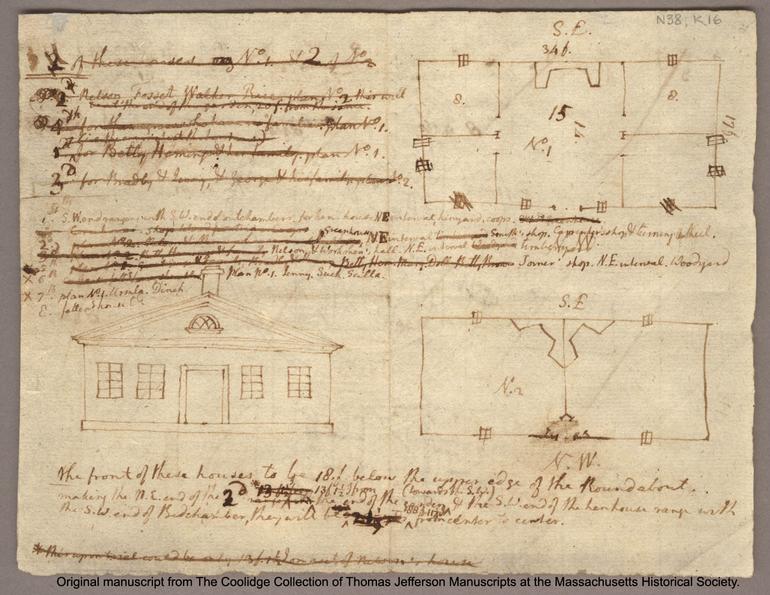
Given that I’m new to both historical editing and the intensive study of Thomas Jefferson (about eight months on the job), I feel a bit unqualified to write about the work of the Papers of Thomas Jefferson. So what follows is something of a hybrid between the perspective of an outlier and that of an insider. The Papers, as some may know, consist of correspondence (incoming and outgoing) and other writings of our nation’s much celebrated and much deprecated third president and polymath. The project has made the lives of researchers easier by collecting all of Jefferson’s known papers, which are scattered among many archives and private collectors, into carefully annotated chronological volumes. Volume 36, which covers the months from December 1801 to March 1802, is now in press, while the first 33 volumes are now available online through UVA Press’s Rotunda imprint.

In researching and annotating documents, precision is essential. Transcriptions are verified against the originals to ensure accuracy. Supporting evidence is assessed carefully—if we are not reasonably certain of a given fact’s accuracy, it will not appear. If an interesting point or idea is not relevant to the document in question, we have to ignore it and move on. It’s not for nothing that documentary editing has been characterized as nuts-and-bolts, or blue-collar history. As much care and hard research goes into providing the context of particular documents, the goal always remains making Jefferson’s papers readily available and comprehensible to readers and researchers. Although like all documentary editors we must be engaged with the latest historiography, not just on Jefferson, but on seemingly the entire range of early American history, it is not necessarily our role to participate in the historiographical debates that tend to define the parameters of contemporary scholarship.

And there can be little doubt that Jefferson, or TJ as we know him, inspires more impassioned debates than any other founder. From reveries spun from his soaring rhetoric to anguish over his failure to extend the ideals embedded in his singular prose (a sub-genre that seemingly demands pairing with the adjective “Jeffersonian”) to anyone other than white men, he has become the catalyst of our own musings about America’s founding contradictions. That he likely carried on a long-term relationship with Sally Hemings, one of his slaves and quite possibly the half-sister of his dead wife, has only added to this racial (and now gendered) dramaturgy. Of course, fascination with TJ goes beyond these ideological concerns. As anyone who visits Monticello can attest, Jefferson the tinkerer and inventor (and he was certainly more the former than the latter) may be his most enduring image. His technical prowess only reinforces a sense that TJ can serve as a stand-in for the early American character—he is at once egalitarian and racist, nationalistic and provincial, visionary and practical (thus the constant tinkering). Presenting TJ, the binary code of early America.

That’s something of my outlier’s perspective but one to which I still partially subscribe. I say partially because although working on the Papers has deepened my appreciation of TJ’s multi-faceted nature, it has made me more leery of the ideological work that his image continues to allow commentators of all stripes to perform. One of the real virtues of a comprehensive documentary edition is that it places us students of history in the flow of events. It’s as close to a real time presentation of early American history as one can probably achieve. For this student, that heightens the sense that the set of wise men at the center of our story (TJ, Albert Gallatin, James Madison—our current volumes cover the presidency) had both a clear mission and understanding of what they wanted to accomplish but also had to muddle along, responding to contingencies as anyone else might. They appear as both the authors and subjects of events. One could certainly use the documents in our volumes to explore the binary TJ of the previous paragraph: the idealistic republican v. the hard-nosed, partisan Republican, the advocate for yeoman farmers v. the defender of planter slaveholders, and so on. But it’s even more evident to me, now, that laying all of these weighty themes at TJ’s feet and presenting him as either the hero of democracy or as America’s original sinner can be counter-productive. Nor does it represent the work that the Papers project performs.

Julian P. Boyd the founding editor of the TJ Papers, might have disagreed. The last five volumes that he produced served as platforms for his original and highly partisan analyses of TJ’s place in early America (central and exalted, one might say). And while the end of Boyd’s tenure became notorious for the slow pace of publication that his mini-monograph explications mandated (a pace I’ll point out is no longer a characteristic), it is the aggressive analytical posture that seems to me most problematic. With so many documents to and from Jefferson, which can and do speak for themselves (often with a push from the project editors’ annotations), there is little need to use the Papers as a platform to defend or attack Jefferson. The documents will naturally inform the more pointed analyses of other scholars, but in our work here we neither damn nor praise the man. Rather, it seems more appropriate to use TJ as a window into the varieties of early American experience.

And what a window! I won’t claim TJ as some kind of magic key, but I know of no other early American figure who can put a student into contact with so many different aspects of that period. During my short tenure, I have helped research and annotate documents concerning such topics as improvements in steel-yards, or weight balances, the efforts of Quakers to provide education for African-American children, the late career of English scientist and religious dissenter Joseph Priestley, some of Jefferson’s slaves, smallpox vaccination, tobacco marketing, the variable quality of Virginia hams, the invention of the lifeboat, and the early American publishing and bookselling industry. Even while president when he was often consumed by party-building, patronage requests, and foreign policy, Jefferson retained his diverse interests. And because people recognized him as a man of science and learning, he attracted correspondence on an enormous range of subjects.

It is this variety that keeps me excited throughout the workday. And it also points out the irony of this project. Jefferson is absolutely at the center of our little scholarly kingdom (er, I mean republic). The project is defined by documents that emanated from his pen or passed through his hands. Yet, for me its greatest value is the light it casts on the various people, objects, ideas, and events with which TJ engaged. Perhaps that merely reflects my training during a period that prized decentering and debunking the “great white men.” I’ll own up to that. But it also seems to me that the vastness of documentary projects such as ours precludes (or at least should) the kind of narrative coherence that a tight analysis requires. What such editions achieve is not a biography in documents. Rather, they foster multifaceted, sometimes chaotic, portraits of the social milieus in which the primary subjects and their peers acted.

For students of Jefferson (detractors, boosters, and others) the Papers project remains an unparalleled resource. Yet anyone interested in some small corner of the early republic can profitably consult its volumes. And the same might be said for documentary projects of all stripes. Don’t think of them as limited by their primary subjects, however rich and contentious.

Tuesday, May 26, 2009

The New History of Toleration

Chris Beneke

The latest issue of the William and Mary Quarterly includes a forum on Stuart Schwartz’s groundbreaking
All Can Be Saved: Religious Tolerance and Salvation in the Iberian Atlantic World (2008), which argues that a surprisingly large proportion of ordinary people within the early modern Spanish and Portuguese empires maintained that salvation was available to a wide range of believers. Drawing on his extensive archival work on both sides of the Atlantic, Schwartz contends that these two Catholic regimes, famous for their religious exclusivity, actually harbored a substantial number of religious relativists. Schwartz’s book is distinctive in another way: its subject, he notes, “is not the history of religious toleration, by which is usually meant state or community policy, but rather of tolerance, by which I mean attitudes or sentiments.” (6)

The WMQ comments are generally positive. Lu Ann Homza does find fault with Schwartz’s heavy reliance on statements drawn from inquisitorial tribunals and suggests that when “Schwartz found over and over again the phrase that ‘each could be saved in his own law,’ we must ask whether Inquisition notaries were fitting defense testimony into rhetorical formulas.” David D. Hall sets Schwarz’s book within the new, non-linear and anti-triumphalist historiography of toleration in early modern Europe, specifically Alexandra Walsham’s Charitable Hatred: Tolerance and Intolerance in England, 1500-1700 and Benjamin J. Kaplan’s Divided by Faith: Religious Conflict and the Practice of Toleration in Early Modern Europe. Hall suggests that Schwartz’s universalist-minded subjects might be evidence of “the persistence of tensions within any strong cultural system.” Marcy Norton expresses her wish that Schwartz had given more weight to the impact of religious and ethnic diversity in prompting tolerant attitudes. And Andrew R. Murphy argues that we need to devote more attention to the “borderland between attitudes and political practices” than Schwartz does in All Can Be Saved.

As engaging as it is for specialists, this WMQ forum might seem a bit esoteric to the un-initiated. Fortunately, Murphy summarizes recent historiographical developments in his conclusion. The new literature on toleration in the early modern (Anglo-American) world, he writes, is characterized by four “corollaries”:

* Intolerance was—theoretically, conceptually, and theologically speaking—as robust as tolerance.

* Elites often had “good,” or at least comprehensible, reasons for persecuting religious dissenters.

* Toleration often resulted from the intentional plans of tolerationist elites but as an unintended consequence of actions growing out of complex motivations (economic, political, strategic).

* Toleration, when it happened, was due as much to exclusionary impulses and intolerance (separatism, anti-Catholicism) as to humanistic and skeptical ideals.

The WMQ forum on All Be Saved falls on the heels of a fascinating September 2008 conference organized by Evan Haefeli, Brendan McConville, and Owen Stanwood on “Anti-popery” in the Protestant Atlantic world from 1530 to 1850, which also offered a generally non-triumphalist and socially grounded take on the extent of early modern toleration across the Atlantic world.

Beneke's essay, "America’s Whiggish Religious Revolution: An Instance in the Progress of History," will appear in the June 2009 issue of Historically Speaking.

Friday, March 27, 2009

The Importance of Studying Ordinary Lives: An Interview with Laurel Thatcher Ulrich

The forthcoming issue of Historically Speaking (April 2009) includes an interview with Laurel Thatcher Ulrich, 300th Anniversary University Professor at Harvard University and president of the American Historical Association. Ulrich is the author of a number of influential books and essays on colonial history, material culture, social history, and women’s history. Her Well-Behaved Women Seldom Make History (Random House, 2007) examines the appeal of that phrase and describes the life and work of women who “turned to history as a way of making sense of their own lives.” The following is brief excerpt from the interview.

Randall Stephens: In Well-Behaved Women Seldom Make History you write: “History is a conversation and sometimes a shouting match between present and past, though often the voices we most want to hear are barely audible.” What have those barely audible voices said to us, and why do they matter?

Laurel Thatcher Ulrich: What does Martha Ballard’s diary tell us that the papers of George Washington don’t about the same historical period? In my view, plenty. For instance, Martha Ballard’s diary turns on its head the conventional narrative of the rise of modern medicine, which charts the progress from primitive lay healers to scientific healers, championing the superiority of the latter. But when you compare Martha Ballard’s diary with the records of 19th-century physicians, you get two different pictures of childbirth. The physicians’ account books reveal a succession of dangerous cases. Yet when I go to Martha Ballard’s diary, I realize that dangerous cases were rare. Doctors and their tools were making childbirth more dangerous, not less so.

Another example: economic history. The conventional narrative says that late 18th- and early 19th-century America was in the throes of a consumer revolution. And, indeed, storekeepers’ accounts from Martha Ballard’s time and place portray an economy in which local inhabitants exchanged lumber for the manufactured goods brought in on ships. But Martha’s diary reveals that she and others were constantly spinning and weaving, making their own clothes. According to storekeepers’ accounts, a consumer revolution wiped out local production. Yet an ordinary woman’s diary shows that local production was still very important, as well as interwoven with the commercial marketplace. By studying Martha Ballard’s diary, you can understand the difference between a calico dress, which Martha’s daughter had, and all the other clothing and bedding that was made at home.

One more example: If you studied that period through legal records, you would think that the society has gone from policing private behavior, à la Puritan New England, to dealing only with economic behavior. That is the classic picture we got from historians who worked on court records. But go through Martha Ballard’s diary and you’ll see in action the old 1680 law about the midwife taking testimony at the height of labor in order to hold someone accountable for paternity. So I don’t think anonymous people need to be included in the historical record just because of fairness or justice. Studying them carefully makes for more accurate history.