


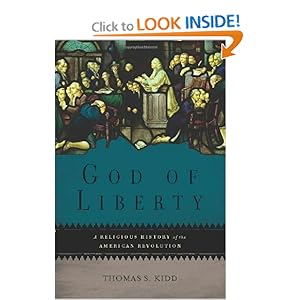
 By Thomas S. Kidd. New York: Basic Books, 2010. 298 pages.
It seems as if the debate over whether the Founders of the American Republic were secular Deists or Evangelical Christians will never end. Both sides marshal “evidence” to support their contentions, but reality might be much more complex than the partisans would have us believe, with early Americans ranging from strict separationists to advocates of state establishment. Thomas Paine, who had been an important publicist for the Revolution, wrote strongly worded denunciations of Christianity, while Patrick Henry and Samuel Adams defended the primacy of traditional Christian piety and practice. In God of Liberty, historian Thomas Kidd helps us sort out the complexities so that we can enter the contemporary debate on firmer ground.
A professor at Baptist-sponsored Baylor University, Kidd is sympathetic to the religious voices present at the time, as the blurbs by leading Evangelical historians Mark Noll, Harry Stout, and George Marsden, affirm. Like these esteemed historians, Kidd believes that religion played an important role in the nation’s founding, but they also are in agreement that there were a variety of voices and concerns present in the founding era, and therefore it is important to get the story right.
Kidd covers a period that stretches from the French and Indian War to the early decades of the 19th century, a period in which the last established faiths were disestablished. Standing at the center of this presentation is Kidd’s contention that Enlightenment Rationalists such as Thomas Jefferson and evangelicals such as John Leland believed that every citizen is entitled to religious liberty. The two parties may have had differing reasons for their espousal of religious liberty, but their shared belief that that a government established religion inappropriately impinged on one’s freedom of conscience proved to be foundational to the American experiment.
It was a common belief that religion played an essential role in defining the moral foundation of society. John Adams and George Washington, neither of whom was especially orthodox, believed that religion played an essential role in preserving moral virtue and respect for authority. We sometimes think of the Enlightenment providing a rather optimistic view of humanity, but the Founders were not sure that their fellow citizens were ready for self-government, so they took steps to keep a balance of power between the Federal branches of government and between states and the Federal government. There was the belief that no one entity should be given too much power. It is in light of this fear of human avarice that we need to hear the debate over disestablishment. Advocates of establishment, such as Samuel Adams (Congregationalist) and Patrick Henry (Episcopalian), believed that disestablishment would lead to societal disintegration, and therefore fought to uphold the status quo. Jefferson and Leland on the other hand believed that religion played a central role in upholding the moral foundations of society, but they believed that religious establishments were by nature coercive and ultimately corrupted both religion and government.
The First Amendment, therefore, emerged as a means by which the twin concerns for promoting virtue and liberty could be sustained. Kidd suggests that this Amendment was a “triumph for both the dissenting evangelicals and the Enlightenment Rationalists.” He goes on to say that these “two socially and theologically disparate groups each did its part to prevent America’s national government from practicing religious persecution or giving preference to one religious group at the expense of others” (p. 225). Interestingly, the chief opponents of the Constitution and the First Amendment were people who feared that the new system might “prove hostile to the interests of Christianity” (p. 226).
The history of the nation’s founding demonstrates that even if religion wasn’t the driving force of the revolutionary era, religion still played an extremely important role in the developments of the era. Some of the decisions were pragmatic in nature, so that disestablishment may have occurred at the federal level, but it took considerable time before the states were completely disestablished. In addition to acknowledging the pragmatism of many of the Founders, we must also acknowledge the presence of anti-Catholicism in this era. Another factor that we often miss in our debates is that disestablishment occurred in the South before it occurred in New England. This was due in part to the tenuous hold of Anglicanism on this region. Congregationalism faced fewer rivals in New England and so the process took longer, but even there the movement toward disestablishment couldn’t be halted.
Although defenders of establishment feared that disestablishment would prove hostile to Christianity, in the end they discovered that it encouraged religious practice and even reinforced public virtue. There seemed to be a common belief that a divine hand was involved in the nation’s founding, even if not everyone agreed as to the full identity of the God who ruled providentially over the land. Unfortunately, providentialism had a dark side, because “if God is on your side, then how can you be wrong?” (p. 251).
Although providentialism -- including it's dark-side -- marked American self-understanding, there was, according to Kidd, another key driver in the American self-understanding. He believes this idea was even more powerful in the development of American ideals than providentialism, but it too was rooted in the nexus of faith and freedom. This idea is "equality by creation." This belief first undermined the ideas of aristocracy and hierarchy, opening up new vistas for everyone, but it also proved to be damaging to institutions such as slavery.
With a century of political philosophy crystallized in the Declaration of Independence's soaring claim of human equality, revolutionary Americans came to the conviction that because God created everyone, all persons were fundamentally equal before him. This belief immediately threw the legitimacy of slavery into a state of profound moral doubt. (p. 252).
Change didn't happen overnight, and it would take a war to rid the nation of slavery, the seeds of its destruction were planted in this belief that equality is rooted in creation. Of course, this discovery led some, including Jefferson to ponder whether or not Africans were of the same created order. Still in the end the seed was planted.
Although many political progressives would like to hang on to the idea that the Founders were, with a few exceptions, secularists and at most Deists, this book can help those of us who believe in the importance of recognizing the value of religious pluralism engage in a more nuanced and effective conversation about the role of religion in the public square. Perhaps the most helpful aspect of the discussion is Kidd’s reminder that the religious freedoms we have today come to us because of an unlikely partnership between Enlightenment rationalists like Jefferson and dissenting evangelicals such as John Leland. Understanding this partnership may help change the tone of the debate, and it’s for this very reason that this is an important book for Progressives to read.
A slightly expanded version of review posted at The Progressive Christian


