Search This Blog

Showing posts with label Higher Education. Show all posts

Friday, January 14, 2011

Rarely is the Question Asked: Is Our Professors Teaching? Part II

Heather Cox Richardson

Randall asked a good question in his post wondering whether or not college and university professors are encouraged to improve their teaching. He has inspired me to blog about teaching issues in a more systematic way than I have before.

Today the topic that is consuming me is assessment. This is not a new obsession, either on my part or on that of the profession. We’ve talked about assessment for years. . . but what have we learned?

What, exactly, do we want our students to learn in our classes? Long ago, I figured out I should design my courses backward, identifying one key theme and several key developments that were students’ “takeaway” from a course. That seems to have worked (and I’ll write more on it in future).

But I’m still trying to figure out how to use assessments, especially exams, more intelligently that I do now. My brother, himself an educator who specializes in assessments, recently showed me this video (below), which—aside from being entertaining—tears apart the idea that traditional midterms and finals do anything useful in today’s world.

Shortly after watching the video, I happened to talk separately with two professors who use collaborative assignments and collaborative, open-book, take-home exams. They do this to emphasize that students should be learning the real-world skills of research and cooperation just as much—or more—than they learn facts. As one said,
facts in today’s world are at anyone’s fingertips . . . but people must know how to find them, and to use them intelligently. This is a skill we can teach more deliberately than we currently do.

These two people are from different universities and are in different fields, but both thought their experiment had generally worked well. One pointed out—as the video does—that the real world is not about isolation and memorization; it’s about cooperation to achieve a good result.

The other said she had had doubts about the exercise because she had worried that all the students would get an “A.” Then she realized that it would, in fact, be excellent news if all her students had mastered the skills she thought were important. When she actually gave the take-home, collaborative assignment, though, she was surprised—and chagrined—to discover the same grade spread she had always seen on traditional exams. She also saw that some of her student groups had no idea how to answer some very basic questions, and that she would have to go back over the idea that history was not just dates, but was about significance and change.

And that is maybe the most important lesson. The collaborative exam revealed that there were major concepts that a number of students simply weren’t getting. So she can now go back and reiterate them.

I’m still mulling this over, but I do think I’ll experiment with collaborative assessment techniques. Historians have some advantages doing this that teachers in other fields don’t. We can ask students to identify the significance of certain events, to write essays, and to analyze problems. With the huge amount of good—and bad—information on the web in our field, though, we could also ask students to research a topic, then judge their ability to distinguish between legitimate and illegitimate sources (something that might have helped Joy Masoff when she was writing her Virginia history textbook).

As I’ve been thinking this over, a third colleague has inadvertently weighed in on it. He discovered students had cheated on a take-home exam, working together and then slightly changing each essay to make them look original. At least an assigned collaboration would eliminate the problem of unapproved collaboration!

Tuesday, October 5, 2010

Blogging in the Academy

.
Thanks to Ed Blum (History, San Diego State Univ.) for letting us cross-post his comments on blogging. Blum points out some concerns he and others share about writing for a popular audience in a non-peer review context. The post originally appeared at
Religion in American History.

"Academic Blogging: Some Reservations and Lessons"
by Edward J. Blum

Last summer, I was chatting with a collection of amazingly talented graduate students and newly minted PhDs in American religious history about the role of blogging. They all agreed that blogging was a godsend for those new to the profession, for it let them “be known.” Blogging offered an instant opportunity to present ideas, critique other works, and sound off publicly on any number of issues. Time and again, these brilliant scholars expressed their belief in the blogosphere: that it was the place to gain recognition.

I was worried. I wondered if the perils outweighed the possibilities. Paul Harvey’s American Religious History blog was created after I was finished with graduate school and had two monographs published. I was just at that moment becoming an associate professor and so “making a name for myself” had less immediate importance. I saw his blog and others as a place to promote and to play – not a place to stake a reputation.

I’ve been thinking long and hard about the academic turn to the blog, and my gravest concern is for junior scholars – knowing full well that by avoiding blogs, junior scholars may be missing out on many important opportunities. But here are my reservations and lessons:

1) Why would you give away for free the primary commodity you create? Your ideas are your intellectual property; when you publish them in a book, you and the press own them. You can make money off of them (sure, not a lot, but sometimes a nice chunk of change). You can receive credentials from them that include a job, promotion, and tenure. Just as much as publishers may benefit from a blog-inspired recognition, they may also not want to print concepts that can be found already on websites. I haven’t asked, but I wonder.

2) Peer review matters. Academic disciplines will lose all credibility without peer review; it is essential to what we do – as protection for the author and publisher, and as a way to get the best out of your work. When the five or ten or twenty reviewers (I can’t remember) for the Journal of American History sounded off on one of my dissertation chapters, I was shell-shocked. I could never have imagined there were so many problems with my essay. But those criticisms made it a better chapter, and my dissertation a stronger book. The JAH didn’t publish my essay, but the reviews transformed my approach to the topic. After graduate school, the number of people available to read your work may shrink. My experience is that there are fewer and fewer people who have the time to read my ramblings. Peer review allows the geniuses in our fields to challenge us, push us to new sources, and help with our prose. I’m grateful to have friends like Katie Lofton, who will read my essays and tell me what’s wrong with them – but it’s hard to make friends that brilliant and as the years pass on, we all seem to have less time for it. Blogs do not, as of yet, offer such a system of peer review and hence do not aid in that capacity in our development as scholars.

3) Post-publication review matters. Blog posts don’t get reviewed in the Journal of American History or the Journal of Southern History – books do. They are reviewed there and in other journals as another stage of peer review. It’s where we sound off – not just to say that this or that book “makes a significant contribution to” … whatever topic the book is on. It’s a place where real debates and real problems can be addressed. Comment sections in blogs aren’t the same, and they probably can’t go in your tenure file. Professional book reviews can and do.

4) Blog posts could hurt your reputation just as much (if not more) than help it. Fascinating blog posts probably won’t get you an interview or a job, although they may make your name noteworthy enough so the committee looks at your application (although I doubt this for most positions). Articles will, solid dissertations will, fantastic conference papers will. Blog posts are far more likely to hurt you in any number of ways: perhaps you write something that is too outlandish; perhaps you come off as too political (guess what, not all academics vote Democrat – some are more leftist, some are to the right – I learned this when one colleague of mine explained to me that even though I study and teach African American history, he hoped I didn’t vote as “they” did – an odd thing to say to a new colleague, but whatever). I’ve written a number of posts that I wish I could take back (usually the ones praising Matt Sutton’s work – and this, right here, is a joke, that could backfire if I didn’t point out it was a joke. And by this point, the joke is dead because I had to explain it so no one is even grinning). More honestly, I have in blog posts been rough and curt with some essential and important works (namely Barbara Dianne Savage’s very interesting Your Spirits Walk Beside Us), and I was wrong. I should have been more careful and thoughtful. Could that hurt me professionally – you betcha!

5) Blogs often function like the current American media: extreme, partisan, and amnesiac. Jon Stewart recently told Bill O’Reilly that all the messianic love for President Obama in 2008 set Americans up for heartache. Guess who said this in a Religion Dispatches blog essay in 2008? I did. Guess who remembers? Only me. As I see it, the current media is in the business of producing ideas each and every minute and there can be no regard for past claims, words, or interests. Stories and sound bites must be made new constantly. This is not how the scholarly world has functioned or should. We must take the time to think ideas through, to hash them out, to consider alternatives, and to weigh various other texts. Reacting to every new media story is not the path of most scholarly work; it’s the domain of the journalist.

6) Finally, and this is most apropos for our blog – this is a blog about religion and religions, the most powerful ideas, rituals, concepts, and communities that exist. As I understand the spiritual, it is the deepest core of people, ideas, organizations, and communities. Writing about it flippantly or without review or without consideration can be extremely damaging. I have done my fair share of rough handling with religion in these blogs, and I wonder at what cost. More and more, I think Robert Orsi is right when he calls us to be worry about our presentations of religion, especially of how those presentations get into the mass media. We’re observant to religious damages of the past, and certainly do not want to perpetuate them in the present and future (at least I do not).

So those are my concerns. I recognize the incredible work that blogs have done in American religious history. The Juvenile Instructor gang is amazing. The essays here are fantastic. Religion Dispatches is entertaining, insightful, and provocative. It’s not that we shouldn’t keep taking blog and technological leaps: it’s that, I think, we should look first.

Tuesday, September 21, 2010

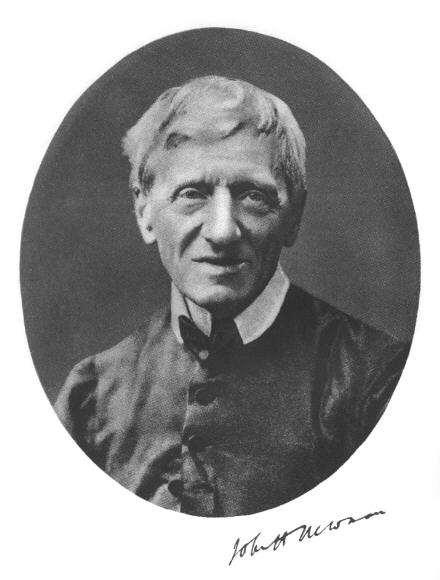
From John Henry Newman's Era to Our's

Randall Stephens

Today I spoke to students in my civ class about the historic significance of the Pope Benedict's visit to England. (It helped that we had gone over the reformations of the 16th century in previous weeks.) While in England--along with facing the largest protest of a papal visit in history--the Pope beatified John Henry Newman on September 19. Newman achieved fame in the 19th century as one of the most critical thinkers of his age, a leader of the Oxford Movement, and a convert from Anglicanism to Catholicism.

English philosopher and public intellectual Roger Scruton seizes on the moment to write about Newman's views on higher education. Oh how things have declined, laments Scruton in the American Spectator. "What is expected of the student in many courses in the humanities and social sciences is ideological conformity, rather than critical appraisal," he writes, "and censorship has become accepted as a legitimate part of the academic way of life." He ventures into choppy political waters and makes some sweeping indictments of the new American system. Seems overdone to me. Don't think hyper-political correctness is the problem.

Still, Newman's eloquent summary of the mission of the university and his ode to the life of the mind is well worth revisiting.

Excerpt: John Henry Newman, The Idea of a University (reprint: 1852, London, 1899), ix, 101-102.

THE view taken of a University in these Discourses is the following: — That it is a place of teaching universal knowledge. This implies that its object is, on the one hand, intellectual, not moral; and, on the other, that it is the diffusion and extension of knowledge rather than the advancement. If its object were scientific and philosophical discovery, I do not see why a University should have students; if religious training, I do not see how it can be the seat of literature and science.

Such is a University in its essence, and independently of its relation to the Church. But, practically speaking, it cannot fulfil its object duly, such as I have described it, without the Church's assistance; or, to use the theological term, the Church is necessary for its integrity. Not that its main characters are changed by this incorporation: it still has the office of intellectual education; but the Church steadies it in the performance of that office. . . .

It is a great point then to enlarge the range of studies, which a University professes, even for the sake of the students; and, though they cannot pursue every subject which is open to them, they will be the gainers by living among those and under those who represent the whole circle. This I conceive to be the advantage of a seat of universal learning, considered as a place of education. An assemblage of learned men, zealous for their own sciences, and rivals of each other, are brought, by familiar intercourse and for the sake of intellectual peace, to adjust together the claims and relations of their respective subjects of investigation. They learn to respect, to consult, to aid each other. Thus is created a pure and clear atmosphere of thought, which the student also breathes, though in his own case he only pursues a few sciences out of the multitude. He profits by an intellectual tradition, which is independent of particular teachers, which guides him in his choice of subjects, and duly interprets for him those which he chooses. He apprehends the great outlines of knowledge, the principles on which it rests, the scale of its parts, its lights and its shades, its great points and its little, as he otherwise cannot apprehend them. Hence it is that his education is called "Liberal." A habit of mind is formed which lasts through life, of which the attributes are, freedom, equitableness, calmness, moderation, and wisdom; or what in a former Discourse I have ventured to call a philosophical haunt. This then I would assign as the special fruit of the education furnished at a University as contrasted with other places of teaching or modes of teaching. This is the main purpose of a University in its treatment of its students.

Sunday, September 5, 2010

Higher Ed Jeremiads

Randall Stephens

Read Christopher Shea's review essay in the NYT: "The End of Tenure?" Quite a few American's outside the academy are mad as hell, and not going to take it anymore. Rumors of pampered academics tooling around their college towns in Maseratis are utterly cartoonish. But, something like that vision dominates popular thinking about the professor as aristocrat. (Anyone know how many, say, history professors actually work at schools with a 2-2 load? I'd bet money they're in the smallish minority.)

Should academics be accountable to the broader public for the writing and teaching that they do? Perhaps something like the UK's Research Assessment Exercise could be in American higher ed's future.

Anyhow, Shea considers several books that offer up nightmare scenarios of privilege or offer some suggestions for reform.

"The higher-ed jeremiads of the last generation came mainly from the right," says Shea. "But this time, it’s the tenured radicals — or at least the tenured liberals — who are leading the charge. [Andrew] Hacker is a longtime contributor to The New York Review of Books and the author of the acclaimed study 'Two Nations: Black and White, Separate, Hostile, Unequal,' while [Mark] Taylor, a religion scholar who recently moved to Columbia from Williams College, has taught courses that Allan Bloom would have gagged on ('Imagologies: Media Philosophy'). And these two books arrive at a time, unlike the early 1990s, when universities are, like many students, backed into a fiscal corner. Taylor writes of walking into a meeting one day and learning that Columbia’s endowment had dropped by 'at least' 30 percent. Simply brushing off calls for reform, however strident and scattershot, may no longer be an option.">>>

Friday, September 3, 2010

"I can't read this book . . . it's long and boring"

Randall Stephens

Are we awash in a rising sea of idiocracy? Or, are things just different today; no better, no worse than yesterday? Is short always sweet? Perhaps anything worth saying can be pared down to 140 characters (twitter) or 160 characters (SMS). I don't believe that. And I think that "pithy" and "tweet" probably shouldn't go in the same sentence.

Still I'm not above assigning portions of a longer book. Maybe students do get less from the whole. I know that some students are paralyzed with fear at the thought of reading a 250-page work of non fiction. It's like asking them to scale a mountain and then paraglide down into a briar patch.

So, I was intrigued by Carlin Romano's sign-of-the-times essay in the August 29th Chronicle: "Will the Book Survive Generation Text?" (It's part of a series of essays on what the future of the profession holds.) He summarizes the work of academic forecasters and doomsayers--Derek Bok, Jennifer Washburn, Frank Donoghue, Mary Burgan, Louis Menand. Romano proposes a funny sort of idea, "extreme academe," to sum up what might take place in our near future. "Extreme academe, as a vision, ups the ante of such concerns. It adds flash and cynicism to mere trepidation," says Romano. "According to it, college students in 2020 will use plastic cards to open the glass security doors installed at each entrance to campus. On special occasions, the sole tenured faculty member at every institution will be wheeled out, like the stuffed remains of Jeremy Bentham at University College London, for receptions."

Romano worries that, "Destructive cultural trends lurk behind the decline of readerly ambition and student stamina. One is the expanding cultural bias in all writerly media toward clipped, hit-friendly brevity—no longer the soul of wit, but metric-driven pith in lieu of wit. Everywhere they turn, but particularly in mainstream, sophisticated venues—where middle-aged fogies desperately seek to stay ahead of the tech curve—young people hear, through the apotheosis of tweets, blog posts, Facebook updates, and sound bites as the core of communication, that short is always smarter and better than long, even though most everyone knows it's usually dumber and worse."

He also takes aim at a kind of cult of "interactivity.": "Another cultural trend propelling the possible death of the whole book as assigned reading is the pressurized hawking of interactivity, brought to us by the same media panderers to limited attention spans. It's no longer acceptable for A to listen to B for more than a few minutes before A gets his or her right to respond."

Not so encouraging. Certainly worth considering as the job market continues to shrink and as the culture of the academy undergoes radical change.

Saturday, May 15, 2010

Pomp and Circumstance

Randall Stephens

It's that time of year. Seniors are practicing their graduation cap toss. Parents are wondering how long their sons and daughters will grown under a burden of enormous debt. Will they get jobs? Did those courses in "Script Writing," "Daytime Serials: Family and Social Roles," or "Exopedagogies and Diacritical Phallocentric Imaginations" equip them for our new economy?

All are preparing for a long, long day. Plenty of time for daydreaming. Garry Trudeau once quipped, "Commencement speeches were invented largely in the belief that outgoing college students should never be released into the world until they have been properly sedated."

Here in Boston today the weather is beautiful: 63 degrees and sunny. Today and in the next two weeks a series of glittery celebs and pointy-headed public intellectuals will be lined up to fill the podiums at areas schools. (See Tracy Jan, "Big Names at the Podium," Boston Globe, 14 May 2010.) A sampling:

ABC News correspondent Lynn Sherr, Wellesley College

US Attorney General Eric Holder, Boston University

US Secretary of Education Arne Duncan, Lesley University

Rachel Maddow, Smith College

Former Supreme Court justice David H. Souter, Harvard University

Governor Deval Patrick, Framingham State College

A few who took the dais in 1950:

Harvard University: Dean Gooderham Acheson, U.S. Secretary of State

Northeastern University: Frank W. Abrams, Standard Oil Company of New Jersey

Wheaton College: Erwin D. Canham, Editor, The Christian Science Monitor

Few speeches are memorable. Many are like long, de-deified, boring sermons. (Sometimes academics get the worst rap. W. H. Auden snarked: "A professor is someone who talks in someone else's sleep.") Seldom do addresses rise to the level of oratorical art as did Ralph Waldo Emerson's famous "Address Delivered before the Senior Class in Divinity College, Cambridge, Sunday Evening, July 15, 1838":

In this refulgent summer, it has been a luxury to draw the breath of life. The grass grows, the buds burst, the meadow is spotted with fire and gold in the tint of flowers. The air is full of birds, and sweet with the breath of the pine, the balm-of-Gilead, and the new hay. Night brings no gloom to the heart with its welcome shade. Through the transparent darkness the stars pour their almost spiritual rays. Man under them seems a young child, and his huge globe a toy. The cool night bathes the world as with a river, and prepares his eyes again for the crimson dawn. The mystery of nature was never displayed more happily. The corn and the wine have been freely dealt to all creatures, and the never-broken silence with which the old bounty goes forward, has not yielded yet one word of explanation. One is constrained to respect the perfection of this world, in which our senses converse. How wide; how rich; what invitation from every property it gives to every faculty of man! In its fruitful soils; in its navigable sea; in its mountains of metal and stone; in its forests of all woods; in its animals; in its chemical ingredients; in the powers and path of light, heat, attraction, and life, it is well worth the pith and heart of great men to subdue and enjoy it. The planters, the mechanics, the inventors, the astronomers, the builders of cities, and the captains, history delights to honor. . . .

And now let us do what we can to rekindle the smouldering, nigh quenched fire on the altar. The evils of the church that now is are manifest. The question returns, What shall we do? I confess, all attempts to project and establish a Cultus with new rites and forms, seem to me vain. Faith makes us, and not we it, and faith makes its own forms. All attempts to contrive a system are as cold as the new worship introduced by the French to the goddess of Reason, to-day, pasteboard and fillagree, and ending to-morrow in madness and murder. Rather let the breath of new life be breathed by you through the forms already existing. For, if once you are alive, you shall find they shall become plastic and new. The remedy to their deformity is, first, soul, and second, soul, and evermore, soul. A whole popedom of forms, one pulsation of virtue can uplift and vivify. Two inestimable advantages Christianity has given us; first; the Sabbath, the jubilee of the whole world; whose light dawns welcome alike into the closet of the philosopher, into the garret of toil, and into prison cells, and everywhere suggests, even to the vile, the dignity of spiritual being. Let it stand forevermore, a temple, which new love, new faith, new sight shall restore to more than its first splendor to mankind. And secondly, the institution of preaching, the speech of man to men, essentially the most flexible of all organs, of all forms. What hinders that now, everywhere, in pulpits, in lecture-rooms, in houses, in fields, wherever the invitation of men or your own occasions lead you, you speak the very truth, as your life and conscience teach it, and cheer the waiting, fainting hearts of men with new hope and new revelation?

I look for the hour when that supreme Beauty, which ravished the souls of those eastern men, and chiefly of those Hebrews, and through their lips spoke oracles to all time, shall speak in the West also. The Hebrew and Greek Scriptures contain immortal sentences, that have been bread of life to millions. But they have no epical integrity; are fragmentary; are not shown in their order to the intellect. I look for the new Teacher, that shall follow so far those shining laws, that he shall see them come full circle; shall see their rounding complete grace; shall see the world to be the mirror of the soul; shall see the identity of the law of gravitation with purity of heart; and shall show that the Ought, that Duty, is one thing with Science, with Beauty, and with Joy.