Search This Blog

Showing posts with label Interviews. Show all posts

Monday, March 14, 2011

An Interview with Robert Darnton on the Digital Public Library of America

Randall Stephens

"Google demonstrated the possibility of transforming the intellectual riches of our libraries, books lying inert and underused on shelves, into an electronic database that could be tapped by anyone anywhere at any time," wrote Robert Darton several months back in the New York Review of Books. "Why not adapt its formula for success to the public good," he asked, "a digital library composed of virtually all the books in our greatest research libraries available free of charge to the entire citizenry, in fact, to everyone in the world?"

Creating a Digital Public Library of America would be no easy task. Certainly there are major obstacles
to overcome. The legal matters of copyright and what to do about so-called orphan books would be daunting. Cost, as well, would pose a problem. Yet, says Darnton:

If [other] countries can create national digital libraries, why can’t the United States? Because of the cost, some would argue. Far more works exist in English than in Dutch or Japanese, and the Library of Congress alone contains 30 million volumes. Estimates of the cost of digitizing one page vary enormously, from ten cents (the figure cited by Brewster Kahle, who has digitized over a million books for the Internet Archive) to ten dollars, depending on the technology and the required quality. But it should be possible to digitize everything in the Library of Congress for less than Sarkozy’s €750 million—and the cost could be spread out over a decade.

A little over a week ago I sat down with Darntonaward-winning historian, Carl H. Pforzheimer University Professor at Harvard, and director of the Harvard University Libraryto discuss
plans underway for a Digital Public Library of America (DPLA). Sitting in Darnton's office right next to Harvard Square we discussed the nettlesome issues surrounding the DPLA, what the massive on-line collection might offer, and how such a virtual repository could serve the public. In the two videos embedded here Darnton also considers what this proposed library would mean for scholars in the humanities and history in particular.

The project has deep intellectual roots in American soil. In another essay that Darnton wrote for the New York Review, he reflected on the long history of the idea. "The ambition behind this project goes back to the founding of this country," he remarks. "Thomas Jefferson formulated it succinctly: 'Knowledge is the common property of mankind.' He was right—in principle. But in practice, most of humanity has been cut off from the accumulated wisdom of the ages. In Jefferson’s day, only a tiny elite had access to the world of learning. Today, thanks to the Internet, we can open up that world to all of our fellow citizens. We have the technical means to make Jefferson’s dream come true, but do we have the will?" In the video interview Darnton ponders what is possible now that has never been possible before. The dreams of the Founders, spun out of Enlightenment optimism, could, at least in some ways, be realized today.

Few early Americans spelled out a plan for a "publick" Library as did Benjamin Franklin. His ideals of thrift, self-improvement, volunteerism, access, and the public good are apparent in passages like the following from his Autobiography:

At the time I establish'd myself in Pennsylvania, there was not a good bookseller's shop in any of the colonies to the southward of Boston. In New York and Philad'a the printers were indeed stationers; they sold only paper, etc., almanacs, ballads, and a few common school-books. Those who lov'd reading were oblig'd to send for their books from England; the members of the Junto had each a few. We had left the alehouse, where we first met, and hired a room to hold our club in. I propos'd that we should all of us bring our books to that room, where they would not only be ready to consult in our conferences, but become a common benefit, each of us being at liberty to borrow such as he wish'd to read at home. This was accordingly done, and for some time contented us.

Finding the advantage of this little collection, I propos'd to render the benefit from books more common, by commencing a public subscription library. I drew a sketch of the plan and rules that would be necessary, and got a skilful conveyancer, Mr Charles Brockden, to put the whole in form of articles of agreement to be subscribed, by which each subscriber engag'd to pay a certain sum down for the first purchase of books, and an annual contribution for increasing them. So few were the readers at that time in Philadelphia, and the majority of us so poor, that I was not able, with great industry, to find more than fifty persons, mostly young tradesmen, willing to pay down for this purpose forty shillings each, and ten shillings per annum. On this little fund we began. The books were imported; the library was opened one day in the week for lending to the subscribers, on their promissory notes to pay double the value if not duly returned. The institution soon manifested its utility, was imitated by other towns, and in other provinces. The libraries were augmented by donations; reading became fashionable; and our people, having no publick amusements to divert their attention from study, became better acquainted with books, and in a few years were observ'd by strangers to be better instructed and more intelligent than people of the same rank generally are in other countries.

There were critics in Franklin's day and there are critics of the DPLA now. But, it's encouraging that conversations/debates and planning have begun in earnest!

Friday, March 11, 2011

In Praise of Oral History: A Dispatch from Fulton, Missouri

Philip White

In a 1940s-style coffee stand in the middle of a drug store, six grey-haired gentlemen sit around a long, light-wood table sipping coffee and swapping stories. They’re here at 10am six days a week (Sunday is a church day, and the drug store, as with many businesses in the town, is closed then), and the proprietor holds the same table for his most consistent patrons, who have gathered in this manner for over 25 years.

Today’s topic of conversation is the day Winston Churchill came to tiny Fulton, MO, 65 years ago to the day. Fulton mayoral candidate Bob Craghead recalls his father charging out-of-towners a whopping 25 cents a pop to park at his farm just outside the city limits. O.T. Harris, whose family is a part owner of the Callaway County Bank across Court Street, is laughing as he recollects the bank’s CFO Tom Van Sant (a frequent visitor at Truman’s White House, and the man who encouraged Westminster College president Franc McCluer in his unlikely bid to bring Churchill to town) reputation as what Jerry Seinfeld called a “close talker.”

My pen is working overtime to scribble down these priceless recollections, in case the batteries in the voice recorder on the table betray me. In the weeks before my Fulton visit, I’ve had similar conversations, albeit by phone, with half a dozen Fultonians. One gentleman was so eager to share his memories that the aforementioned recorder ran to more than 90 minutes. Then he called back the next day with another half hour’s worth of vivid descriptions of the Missouri town as it was in the mid-1940s. I relished each word.

Certainly, oral histories can be distorted by forgetfulness, romanticism and exaggeration, but they remain an indispensable way for a historian (or any writer, for that matter) to add color and personality to his or her work. It is simple (and, sadly, the modus operandi for writers of history that’s as dry as a pile of October leaves) to read a couple of written sources and apply their second-hand generalizations to a time and place. But to talk to people who were in the moment is to see what they saw, hear what they heard, touch what they touched. Such accounts also serve the purpose of putting events that fall into so-called “Great Man” history (in this case, Truman and Churchill parading through town and the latter then delivering his “Iron Curtain” speech) in the context of “regular” folks’ lives. It’s also all too easy to reflect on the impact of such an occurrence through other world leaders’ perspectives or with the benefit of hindsight, but to obtain the real reactions of people who were there adds a new dimension.

Perhaps one reason certain writers avoid oral history is because it requires a different sort of effort. It can take weeks to track down people who were present at a particular event. Some writers surely think “who can effectively describe a bygone era.” You can have 10 conversations before you get one piece of usable information. In addition to prepping for the interview, jotting notes and/or recording, and transcribing, you need to cross-reference certain facts to verify authenticity, and to compare testimonies to establish sources.

And yet, even if it takes 10 hours of panning for every gold nugget minute, such treasures are hidden in the memories of people everywhere. Beyond the benefits of oral history for your project, there is the immeasurable value of creating connections and, if you’re fortunate, new friendships with your interviewees.

Then there is the time capsule bonus of recording first-person impressions for posterity. Recently, Frank W. Buckles, the last surviving American World War I veteran, passed away, marking the end for new oral histories of the Great War. The same will be true in just a few years for World War II, the Great Depression, and all sorts of other 20th-century subjects.

I feel fortunate to be speaking with these fine, 80-something individuals from Fulton while time remains.

Wednesday, March 2, 2011

Religion and American Prisons in the Antebellum Era: An Interview with Jennifer Graber

Randall Stephens

"Americans incarcerate," writes Jennifer Graber in her new engaging book The Furnace of Affliction: Prisons and Religion in Antebellum America (University of North Carolina Press, 2011). "Though the United States has less than 5 percent of the world's population," she writes, "it has almost a quarter of its prisoners." Such facts make the long history of American prisons and their maintenance all the more interesting. Graber, an assistant professor in the department of religious studies at the College of Wooster, analyzes the "intersection of Christianity and politics in the American penitentiary system."* Her interesting account also looks at the religious dimensions of discipline and the ideas that undergirded punishment from the 1790s to the 1950s.

Randall Stephens: You write that antebellum Americans disagreed on much when it came to prisons, but most “affirmed religion's central importance” to prisons and reform. How was criminal justice “religious” in this era?

Jennifer Graber: If you were concerned about criminal punishment in the early republic, there were lots of things to fight about. Once the states began to build prisons, the big debate was between a discipline out of Pennsylvania that featured total solitary confinement and one out of New York that combined labor in workshops during the day with solitary confinement at night. Partisans for these two systems called the other side un-American and un-Christian. Beyond the rival disciplines, people debated the best way to reform inmates. They argued about what was more important: a good Sunday School teacher in Sing Sing or clean water and decent food in Sing Sing? Without fail, everyone interested in the debate claimed that “religion”—and they used the word “religion” even though they meant variations of evangelical Protestantism—was central to inmate reformation and the overall health of American prisons as strong institutions. What they didn't realize is that their common evocation of “religion” masked significant differences. For instance, they all thought that prison chaplains were necessary, but disagreed—sometimes violently—over the role these ministers should play inside institutions. Or, they all assumed that God ordained the civil authorities to punish lawbreakers, but varied on the question of that punishment’s severity.

Stephens: What kinds of problems did evangelicals target in the prison system? What can we learn about them by the sort of reforms they pursued?

Graber: Their first target was colonial-era punishments, whether it was steep fines, corporal punishments such as whipping or branding, or the gallows. They joined a trans-Atlantic movement to reform punishment and were active in the construction and administration of the first prisons. Protestant evangelicals—and I include many Quakers in this group, which might ruffle some historians’ feathers—envisioned the prison as an ideal site for prompting criminals’ conversion and reformation. Because these reformers had the new nation’s urban slums in mind, they emphasized the need for a decent physical environment, steady labor, education, and worship. Once the prisons were off the ground and running, reformers also had to take a stand on the reemergence of corporal punishment.

What can we learn about these evangelicals? Unfortunately, I think we see their utter inability to countenance cultural patterns and systems of meaning outside their own. Many of them were certain that criminals from poor neighborhoods would welcome the opportunity to go to prison. Despite the rising number of Irish inmates in the 1830s and 40s, it never occurred to them that it might be a good idea to have a Roman Catholic priest visit inmates on their deathbeds. Ultimately, for evangelicals the prison was one site for making the America they wanted. They had a vision in which all newcomers—as well as slaves and American Indians—would become like them. Of course, this perspective was shared by the broader upper and middle classes. It would have been strange for these reformers to see things otherwise. I mention it because this worldview helps explain how they approached criminal justice and why they failed to see that their prison experiments weren’t working.

Stephens: When it came to prisons, how did Alexis de Tocqueville, Gustave de Beamont, and other observers understand the American difference?
Graber: Tocqueville and Beaumont were coming from France, where there had been no substantial criminal justice reform. Other interested onlookers came from England, where most of the reform ideas came from, but had never been realized. For these folk interested in prisons, then, America was a blank slate, a place where something new and revolutionary could be attempted. Touring these facilities, however, brought many visitors out of abstract considerations and back to the difficulties of organizing an ethnically and religiously diverse population. Just because Americans could try something new did not mean that they could achieve the perfect institution. Slavery also cast a shadow over these tours of facilities where people labored against their will and could be whipped for disobeying. Foreign tourists struggled with the resemblance between prisons and slavery. In this way, America’s prisons both fascinated and repelled them.

Wednesday, February 16, 2011

Chris Beneke on The First Prejudice

Randall Stephens

[From Religion in American History]

About a week ago over at Religion in American History Paul Harvey posted on Chris Beneke and Christopher S. Grenda's, The First Prejudice: Religious Tolerance and Intolerance in Early America (Univ. Pennsylvania Press, 2011). The edited volume, "presents a revealing portrait of the rhetoric, regulations, and customs that shaped the relationships between people of different faiths in seventeenth- and eighteenth-century America. It relates changes in law and language to the lived experience of religious conflict and religious cooperation, highlighting the crucial ways in which they molded U.S. culture and politics." I recently caught up with Beneke, a Historical Society board member, by email and asked him some questions about the project and the work being down on tolerance/intolerance.

Randall Stephens: What is the unifying theme of The First Prejudice: Religious Tolerance and Intolerance in Early America?

Chris Beneke: Our title, The First Prejudice, plays on the popular understanding of religious liberty as the nation’s “First Freedom.” It also draws on the proposition that religion was initially the source of the deepest prejudice to afflict early Americans and the object of the first large-scale efforts to mitigate prejudice. We asked our contributors to be attentive to the distinguished and extensive historiography on church and state, but not beholden to it. The idea was to create a history of religious tolerance and intolerance that took into account a broader range of religious and cultural interaction than histories of religious liberty have traditionally done. For us, it presented an opportunity both to build a compelling new narrative of early American religious history-where religious differences are at center stage-and to develop a common set of reference points and questions that would frame more useful conversations about tolerance and intolerance in America.

Stephens: Why did religious tolerance develop in the West when and where it did?

Beneke: In a sense, it depends on what you mean by tolerance (I know it’s annoying when historians say that, but there, I’ve gone and done it). If you mean what Willem Frijhoff calls “everyday ecumenism,” or at least everyday cooperation and non-violence, then it’s very old indeed. Historians have been hard at work in the archives over the past two-plus decades, discovering that sort of tolerance in surprising places across medieval and early modern Europe. But as a commonly accepted ideal, as a stated commitment to some form of equality, and a legal practice that guaranteed a modicum of protection, tolerance is something that developed in the intellectual capitals of northern Europe during the late seventeenth and eighteenth centuries. And though I risk irritating my intrepid co-editor and some contributors by saying this, I think that it took hold in a much more fundamental and irrevocable way in the early national United States.

Stephens: When it comes to religious tolerance did the early United States differ all that much from Great Britain and western Europe?

Beneke: Here's the very short answer: official church establishments persisted across most of Europe into and beyond the twentieth century. In the United States, they did not. The U.S. may have maintained an unofficial Protestant establishment for many decades (via instruments such as the common law, public education, state religious tests.), but the fact that it was un-official and the fact that it was accompanied by substantive protections for free exercise, was critically important. For all the disingenuity involved, an un-official establishment was surely more hospitable toward religious minorities than almost any official establishment might have been. Maybe just as importantly, the commitment to disestablishment and religious liberty meant that the religiously intolerant had to explain themselves and find ways to wrap bigotry in the mantle of tolerance.

These factors have always kept American religious intolerance in check.>>>

Monday, January 24, 2011

An Interview with Jacqueline Riding on Mid-Georgian Britain

Randall Stephens

Jacqueline Riding is a historian and consultant who is completing her PhD in 18th-century British art and culture. She served as the curator at the Theatre Museum, the Guards Museum, the Tate, the Palace of Westminster, and was founding Director of the Handel House Museum in London. Her Mid-Georgian Britain, “the latest addition to the growing Living Histories series, charts the growth of the empire and looks at the growing importance of London as a capital city where the rich and poor rubbed shoulders. Jacqueline Riding creates a vivid portrait of the daily reality of life for a middle-class family in this age of growing affluence.”* Ever wonder what life was like in an 18th-century city? How did people eat, work, and play? What did they think about the world around them? Riding's concise, immensely entertaining book gives a snapshot of an amazing, vanished world.

Randall Stephens: Your book, Mid-Georgian Britain is a readable, fascinating account of life in the 18th century. Did your own work as a curator and scholar of art and culture influence how you composed the book?

Jacqueline Riding: Thank you very much. The basic chapter structure and length were set out by the publishers, although I did change a few of the headings. For example I think “Charity and Citizenship” is a key theme of the period and I have done a lot of work on the Foundling Hospital (my PhD is on an artist, Joseph Highmore, who donated a history painting to the charity). So I changed the chapter heading accordingly. The tight word length meant I had to be disciplined and the text feels pithy and quite fast-paced, which I like. It was important to stop worrying that so much inevitably gets left out. Even so, some of the themes were out of my comfort zone (dental pelicans anyone?!). So I learned something new too. Word length permitting, I was keen to show contrasts and find unusual facts or opinions rather than trot out the usual Georgian suspects. Having said that I could not resist Dr. Johnson. I think my background in curatorship means I think of an historical period in 3D—a case in point was recreating Handel’s house in Mayfair. I believe it is important not to be confined by a particular academic discipline, to study an historical period in the round. One of the benefits of being an art historian is that you know your way around a picture library, so I was very eager to get really good quality images. Ultimately, if I gave an interesting snap shot of the period, which encourages people to look further and even visit some of the locations mentioned, then I've done my job.

Stephens: Could you say something about how the London of the early 21st century differs from the London of, say, the 1750s?

Riding: Well, if they thought it was big in the mid-eighteenth century, they should see it now . . .

Stephens: Throughout Mid-Georgian Britain you quote a host of contemporary authors. Do you have a favorite character/author from that period?

Riding: It would have to be William Hogarth. He’s quite simply a hero, a real London bruiser with a heart made of putty.

Stephens: You include sections in the book on “Love and Sex, Marriage and Family,” “Home and Neighbourhood,” “Work,” “Food and Drink,” and more. What did you find most interesting to research and write about?

Riding: As I say, most of the headings were provided by the publisher although “Love and Sex . . .” was one of my modifications—partly so I had the excuse to illustrate the syphilitic skull and condom. When you are asked to rattle through a thirty-year period covering as many bases as possible you start to realize how little you know or at least how relatively limited your expertise is. No one is an expert on “the eighteenth century”—it’s just not possible. Humbling but true.

Stephens: Are you working on any projects now that you can tell us about?

Riding: I am indeed. For anyone interested in mid-Georgian art and charity I have an article in Art History Journal titled “The mere relation of the suffering of others’: Joseph Highmore, History Painting and Charity.” I have an article coming out in April’s History Today on Charles Edward Stuart and I am also writing a narrative history on the Jacobite Rebellion of 1745 for Bloomsbury Publishing (eta 2013).

Wednesday, December 1, 2010

Counting Flowers on the Wall

Randall Stephens

The Associated Press site has a "Today in History" page. History Today regularly features it-happened-on-this-day posts on its blog. The History Channel, the purveyor of pop and trivia history for the masses, has something similar. (I wonder if they feature the days on which ancient aliens completed the construction of pyramids or the dates on which Nostradamus's predictions came true.)

A fun twist on the theme comes from a computer scientist trained at the University of Cambridge. In an interview, William Tunstall-Pedoe tells All Things Considered that after he had run 300 millions facts through a program he had come to the conclusion that April 11, 1954, was "extremely notable for having almost nothing happen."

A little from the transcript of the interview:

Mr. TUNSTALL-PEDOE: It's not that nothing happened. It's that it was spectacularly unnotable in terms of the events that happened that day. So it was the most boring day in recent history.

SIEGEL: Well, perhaps someone in our audience knows of something that happened on April 11th, 1954, that might lead some revision of this judgment.

Mr. TUNSTALL-PEDOE: I'm totally up to the challenge.

SIEGEL: You're up to the challenge.

Mr. TUNSTALL-PEDOE: Up to the challenge, yeah. A lot of people have tried already in the last few days. So but yes, absolutely.

SIEGEL: There was, I think, an exhibition baseball game between the then-New York Giants and Cleveland Indians, who would go on to play in the World Series later that year.

Mr. TUNSTALL-PEDOE: And you think that counts as...

Listen to the full story here.

Wednesday, October 13, 2010

Leigh Eric Schmidt on Ida C. Craddock and Late-Victorian America

(Cross-post from Religion in American History)
Randall Stephens

On October 18, 1902, the New York Times ran this curious obituary. Readers must have done a morning coffee spit-take:

"Chose Death Before Prison. Ida C. Craddock 'High Priestess,' Was to Have Been Sentenced for Circulating Improper Books"

Ida C. Craddock, 'High Priestess of the
Church of Yoga' in Chicago, and an exponent also of Spiritualism, Theosophy, and other creeds, committed suicide in her room, on the top floor of 134 West Twenty-third Street, yesterday, by inhaling illuminating gas and slashing her wrist. It was the day upon which she was to be sentenced again, as she had been several times before, for circulating books and pamphlets explaining her peculiar beliefs, built up from a conglomeration of Oriental religions. . . . Miss or Mrs. Craddock was forty-five years old. She was rather handsome, and was usually well gowned. She was born in Philadelphia, her parents being Quakers.

Leigh Eric Schmidt takes up Craddock's strange, fascinating story in his forthcoming Heaven's Bride: The Unprintable Life of Ida C. Craddock, American Mystic, Scholar, Sexologist, Martyr, and Madwoman (Basic Books). Much of it is startling, to say the least. In an era of buttoned down formality and Protestant prudery Craddock broke more rules than one could shake a ruler at. She dabbled in all manner of fringe-ish religion. The one-time Methodist moved with some ease into Quaker circles, Spiritualism, Free Thought, Eastern Mysticism, amateur biblical studies, Sexology . . . .
For some time she lectured as a self-proclaimed expert on phallic cults. Not a typical Chautauqua circuit subject.

Schmidt, with narrative skill and analytical insight, draws on Craddock's life to tell a broader tale of American religion in this age as well. (It's made me wonder about what we can learn about the whole from unusual subjects.) Says Schmidt: "The retrieval of Craddock's life from the vaults of vice suppression offers an entryway into major social and political issues of her day--and, often enough, of our own as well" (xi). She tested the country's Christian identity and it's moral certainty. In small ways, her exotic religious and secular outlook foreshadowed later developments: religious seeking, experimentation, new age dabbling, secular crusading. ". . . Craddoock floats only occasionally into view as a feminist," precursor, Schmidt observes, "a tragic free-speech martyr, a steamy occultist, or a sexologist ahead of her time. The diaphanous quality of those memories should not dissolve the grainy roughness of her life, the audacity and disrepute of it" (273-74).

In the interviews embedded here, I ask Schmidt about Craddock's career and her higgledy-piggledy path from Methodist to sexologist. Schmidt reflects on the larger meaning of religious dissent in these years and discusses the shape of American religion in the late-Victorian age. In part two of the interview he also comments on a couple of his current projects.

Tuesday, September 28, 2010

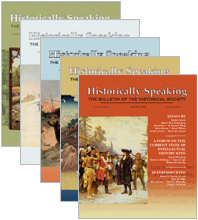
Interview with Donald Yerxa on Historically Speaking

Randall Stephens

Johns Hopkins University Press is now in the business of podcasts. You can listen to my interview with Historically Speaking senior editor Donald Yerxa here. (That page also includes interviews with Adeed Dawisha, Journal of Democracy, and Michael D. Wiatrowski and Jack A. Goldstone, Journal of Democracy.)

In the interview, I talk to Yerxa about our recent neglected fields forums, and the September naval history forum in particular. Yerxa also describes some of the ways that Historically Speaking has changed since he and senior editor Joseph Lucas came on board in fall 2001. HS aims for the general, educated reader, and tries to avoid jargon or the insider language of subfields, says Yerxa. He reflects on the niche the magazine fills and offers some examples of its success.

Monday, August 30, 2010

September issue of Historically Speaking

Randall Stephens

The September issue of Historically Speaking will be posted on Project Muse around the 15th. Before then, I thought readers might like to have a heads up on the content. This issue contains a forum on the neglected field of naval history; interviews with historians on psychology, military, and political topics; reviews essays; and articles on the South in recent history, Australian hucksters in the 19th century, and more.

I will be posting some excerpts from the September issue in the coming weeks. (Links to the full essays will be provided.)

Historically Speaking 11:4 (September 2006)

A Swindler’s Guide to the British Empire
Kirsten McKenzie

The Necessary South
James Cobb

The Neglected Field of Naval History? A Forum

Naval History: Division or Dialogue?
Andrew D. Lambert

The State of Naval History
John Beeler

Response to Andrew Lambert
Barry Strauss

The State of American Naval History in 2010
John B. Hattendorf

Reflections
Andrew D. Lambert

Remembering Nelson: A Review Essay
Donald A. Yerxa

Montesquieu, the Modern West, and Democracy’s Drift: An Interview with Paul A. Rahe
Conducted by Joseph S. Lucas

A Review of Paul A. Rahe’s Against Throne and Altar
John Dunn

Revisiting World War I: The Last Day of the Somme
William Philpott

Bloody Victory at the Somme: An Interview with William Philpott
Conducted by Donald A. Yerxa

The Myths of Gallipoli
Robin Prior

The Fall of 1941: A Meditation on History
Manfred Weidhorn

Erich Fromm and the Public Intellectual in Recent American History: An Interview with Larry Friedman
Conducted by Randall Stephens

From Custer’s Last Stand to Wounded Knee: A Review Essay
Paul Harvey

Tuesday, June 29, 2010

Interview with George Huppert, Editor of the Journal of the Historical Society

Randall Stephens

Earlier in the month I spoke to George Huppert (University of Illinois at Chicago) about editing the Journal of the Historical Society. Huppert and associate
editor Scott Hovey aim to reach specialists and nonspecialists alike. The journal "presents fresh historical research in a non-pedantic way and provides a genuine opening to worldwide trends in historical research."

In the video embedded here I ask Huppert about the kinds of articles he seeks out and the models he looks to for the journal. He describes the ways in which the historian Lucien Febvre has informed his work and he notes the influence of the journal Annales d'histoire économique et sociale.

Huppert is a social historian of early modern Europe. He has written extensively on the Renaissance, humanism, the history of philosophy, and the annales school. He is the author of a variety of articles and books, including The Idea of Perfect History: Historical Erudition and Historical Philosophy in Renaissance France (Urbana and Chicago: University of Illinois Press, 1970); Les Bourgeois Gentilshommes: An Essay on the Definition of Elites in Renaissance France (Chicago: University of Chicago Press, 1977); Public Schools in Renaissance France (Urbana and Chicago: University of Illinois Press, 1984); After the Black Death: A Social History of Early Modern Europe (Bloomington: Indiana University Press, 1986); and The Style of Paris: Renaissance Origins of the French Enlightenment (Bloomington: Indiana University Press, 1999).

Monday, June 21, 2010

Sailing through California History

Randall Stephens

I've taken students on the occasional field trip to Boston. I've never sailed up the coast with them. (It's hard enough for me to navigate the cow path streets of Beantown.)

Rick Kennedy, professor of history at Point Loma Nazarene University, spent ten days on a sailboat this
May, teaching California history to eight students. (I interview Kennedy in the Youtube video here. We talk about how he teaches the class, the curriculum, and the experiences of students.) The class sounds like a blast. According to Kennedy's syllabus:

The course is not like a classroom course; rather, it is an extended fieldtrip. As such it strives to enhance a student's attentiveness to surroundings and ability to see layers of history at particular sites. On walking tours we want to have a heightened awareness of human history in geography, architecture, and town planning. The sailing will encourage awareness of the wind, currents, and tides that, in the past, had much influence on human hopes, plans, and accomplishments. Fieldtrips should help us learn to see the historical evidence that surrounds us, to read the ways topography pushes people in certain directions, the ways architecture proclaims intentions, and the ways a point jutting into the Pacific draws sailors to its lee.


We read and write too. We center the class on a great classic: Two Years Before the Mast, written by a student who sailed away from college in order to go to California in 1835. The book describes California during an era of political instability when a small number of Californios were trying to figure out what to do with a hard-to-get-to but increasingly
desirable land.

The class is largely, but not exclusively, designed for those thinking about careers in
teaching or tourism (parks, museums, and historic preservation). Emphasis throughout the class is on methods of thinking about local history that help us understand larger issues of world history, European history, American history, Native American History, missionary history, and varieties of cultural history. We also look for opportunities to cross disciplines into navigation, astronomy, and cartography.

Sign me up, prof!

There's much this class can accomplish. I was particularly interested in how a course like this can get students to think about the hardships and day-to-day lives or those who have gone before us. Sailing up and down the coast was a common enough experience for Californians. Re-enacting that, I think, gives history students new insight, even empathy.

Now, if I can just master that tiny sailboat on the Charles River . . .

Friday, April 9, 2010

The Future of Islam -- David Crumm interviews John Esposito

The Future of IslamJohn Esposito is one of the premier interpreters of Islam.  A professor at Georgetown University, he has written a new book called theFuture of Islam (which I need to get my hands on).   David Crumm interviews Esposito at his blog Explore the Spirit.    I am reposting that interview (David permits it through the Creative Commons license), so you can get a sense of Esposito's perspective -- one that I find helpful.

*****************************************

Interview with Dr. John Esposito,
noted expert on "The Future of Islam"


In the nearly 30 years I've been reporting on religion, one name always leads lists of American experts on Islam: Dr. John Esposito of Georgetown University.

A good friend of mine who is a Muslim writer stopped by Washington D.C. a few years ago for business on Capitol Hill. Even though John Esposito wasn't in D.C. that week—this writer swung by Georgetown and sat for a while in John's offices.

Why? She said, "I just get inspiration being near where Dr. Esposito works."

That's a true story. He inspires that kind of admiration.

At the moment, in the rough-and-tumble, life-and-death debates over the influence of Islam in global politics, John has taken a few blows. Some activists who prefer to cast Islam as America's Enemy Du Jour don't like John's pragmatic and balanced view of the Muslim world. Some call him an apologist for Islam, although he's not Muslim himself and a careful reading of his many books shows a realistic understanding of the good as well as the evil potential within this faith.

After my own decades of reporting on Islam and my own travels not only to the Middle East but to Asian nations where the majority of the world's Muslims live, I can say: I trust his work and his judgment.

Whatever your viewpoint on his work, it's important to know what he's saying now—because many leading figures follow his conclusions.

Want a quick summary of his latest conclusions? See Monday's Part 1 of our 2-part series on "The Future of Islam." In Part 1, we published several paragraphs from the end of this new book.

Click Here to visit Amazon to order a copy of "The Future of Islam" now.

And, here is, Part 2 ...

Indonesian Mosque
Highlights of Our Conversation with John L. Esposito on "The Future of Islam"

DAVID: When we publish this interview, I will recommend your new book to our readers myself. But I want to start our interview by mentioning that glowing review your new book received from the Financial Times.

These are sharp-edged skeptics and they called your new book, “the handbook for this new age of engagement. Intolerant of the extremists bent on provoking a clash of civilizations—Western Islamophobes and violent Islamists alike—Esposito’s book is a calculated appeal to the moderate middle ground.”

Did they get your message?

JOHN: They did. I was very pleased with what they wrote. I heard from a number of people who regularly read the Financial Times and they said they were surprised the Financial Times would publish this kind of review. Yes, I think they did “get” the book—and it made me feel good, because frankly this was the toughest book I’ve had to write.

DAVID: Why so tough? You’ve written dozens of books.

JOHN: This book was supposed to have been finished before 9/11 and then it was put on the back burner after 9/11, because we wanted to do other books first, like “What Everyone Needs to Know About Islam.” Right after 9/11, it seemed that everything we knew about Islam was turned on its head.

The Financial Times really put its finger on what I wanted this new book to be about. This book is a bit of a capstone experience for me. I felt I had written so much about the issues within Islam—and engagement with Muslims—in other books and articles that I really wanted to pull it all together in one place. When I was finished wit this, I said: This is my last book.

DAVID: Hmmm. Perhaps not really your last book, but it does feel like a summation of where the Western world stands with Islam, at this moment in this new century.

JOHN: It is a summation in that sense. I did try to bring many things together. If you want to write a book for a broad audience, including policy makers and educated folks, you can’t assume that everyone already has read your stuff. I felt I had to set the context for people who come to this and have no background—but I also wanted to reset the context, for example, by using new Gallup data concerning American Muslims and Muslims in Europe and so on. There is important new material here.

I wanted this guidebook to be rooted not just in my own “take” on things, but also in new data like the Gallup data that give us a much more realistic view of these issues.

DAVID: Give us an example of something you really hope comes through to readers in this new book.

JOHN: One thing I try to hammer home is: We really have to get to a point where, when we look at Islam and Muslims as Westerners, we operate on a level playing field. If we want to talk about religious ideals, then we need to compare our ideal with someone else’s ideal—not our ideal to the more tragic realities that can turn up in someone else’s religion.

Number 2, if we realize that it’s a tiny fraction of a percent of Muslims in the world who engage in acts of terrorism, then we need to understand the context. We need to look at acting out in other religions like Christianity and Judaism—like Christian attacks on abortion providers or other violent and criminal acts from Christian groups that break out into the news from time to time. If we fairly compare religious experience, we’ll find that extremism is going to show up in every religious tradition over time.

DAVID: It’s pretty amazing to be talking about these issues nearly a decade after 9/11. I can’t begin to estimate how many times I’ve written and published passages like the exchange we just had.

JOHN: It’s very funny, David, or actually it’s not funny because I find this upsetting as someone who has been working in this field for 30 years or more: People always ask me the same questions.

The problem is—there’s not much learning curve! People always ask me: Is Islam compatible with modernity and with democracy? And I always say: We need to realize that the primary drivers in foreign policy are not religion—but political policies on the ground.

DAVID: We should make it clear, by the way, that you’re not Muslim yourself. So you’re not in the position of defending your own personal faith in this work.

JOHN: That’s right. I am Roman Catholic. I was with the Capuchin Franciscans for roughly 10 years, many years ago. My first degree was in Catholic theology, which I taught for some years before I moved on and did my PhD and Islam became the major focus of my work.

DAVID: Let’s give readers of this interview some examples of misconceptions that need to be cleared up. Obviously, some of these may seem basic to people who know a lot about Islam—but a surprisingly large portion of readers don’t know things as basic as this: Most Muslims aren’t Arab. In fact, most Muslims don’t live in the Middle East.

When we publish this interview, to underline that point, I think we’ll publish some images from Indonesia and Bangladesh—two very important Muslim nations that don’t show up much on the American radar screen.

JOHN: When I was starting out studying in this field, I wasn’t aware of this fact, either. If you studied Islam back then, it was assumed that you would focus on Arabs. When I had an opportunity to travel around the world, someone said: “Of course you’ll come to southeast Asia.”

That hadn’t even been on my map! The academic training I’d received was so Arab-centered.

In the West, we know that there are various forms of Christianity and Judaism—forms with very different cultures. But most people don’t know this about Islam. African Islam vs. Asian Islam vs. Islam in a country like Saudi Arabia are big differences in many ways.

But think about the way American media show Islam. If there’s a story about Muslim women, it’s likely you’ll see a Saudi woman who is fully covered. But the truth is, for example, in one country, women can’t drive a car. In another Muslim country, they’re out in the streets driving motorcycles! The implications of this diversity are quite large.

DAVID: Here's another major misconception that you debunk in your book—the idea that Muslims hate the West in general or that Muslims hate Christianity or democracy. We've heard that kind of claim thrown around by TV preachers and political activists.

You actually dig into Gallup data from a whole range of countries around the world and you make the case that Muslim populations actually are fairly nuanced in their viewpoints. Generally, their attitudes are shaped by political policies, you write.

Here are a couple of lines from your book: "Majorities of Muslims globally clearly do not see conflict with the West as primarily religious or civilizational. Rather, they distinguish Western powers by their policies.”

JOHN: I'm glad you asked about this. Yes, this is very interesting—and it's one reason I'm so glad we have this Gallup data. You don't have to take my viewpoint on this—or the viewpoint of someone opposed to what I'm saying. We can actually look at the Gallup data on what's happening in many different countries.

What you find is that Muslims distinguish very carefully on these government policies. The majorities of Muslims clearly judge countries in the West individually. The data show, for example, that Muslims gave very poor marks to policies of Bush and Blair—in contrast to the marks they gave to other European rulers.

Or, you can see this in Muslim attitudes toward Canada. In terms of culture, we might call Canada—America without the foreign policy. What attitudes do we find among Muslims about Canada? For example, in one Muslim country only 3 percent of people were critical of Canada, while 60-some percent were critical of the U.S. Why? The cultures are quite similar. The reason is: They were making a distinction based on foreign policy. Muslims do make these distinctions and the data show this.

DAVID: I don't think we can describe your book as rosy about the future. You describe a sort of global crossroads—and you do outline some nuanced policies that could make a positive difference in the future. But how do you feel yourself at the moment: Hopeful?

JOHN: That’s hard to answer. Most of us like to see things done, like, yesterday. I can appreciate that because my own personality type is not always: Ready, aim, fire. Sometimes, it’s: Ready, fire—aim. So, I do feel a little down right now because of my sense of immediacy. I want to see things improve. But, if one has the patience to think in terms of historical cycles, then I do think positive changes will unfold.

It’s going to take several decades. There are all kinds of powerful, entrenched forces—forces of resistance to change, resistance to moderation. But there are people around the world who are doing some creative new thinking.

In terms of the immediate future of Islam and the West, I think the jury is still out on where our relationships are headed. I think Obama does have a shot at improving these relationships. Brown in Britain hasn’t done well, though. And even with Obama, I think the jury’s still out on how he will be regarded worldwide by Muslims. It’s too early to tell whether Obama will have the grit and take the risks to do some of the stuff he needs to do to strengthen relationships in the Muslim world.

We’re living in an extraordinarily fluid and difficult time. Overall, things are moving forward, but we live in a world in which the actions of a minority—even the actions of an individual—can become a major setback.

This is why we need to know so much more about these forces unfolding all around us. Most Americans still are asking the same questions we were asking after 9/11. It’s time to learn more and look deeper.


This work by David Crumm Media LLC is licensed under a Creative Commons Attribution 3.0 License.  David Crumm is the proprietor of ReadtheSpirit.com

Wednesday, January 6, 2010

John Fea on Interviewing for that History Job

Over at The Way of Imrpovement Leads Home, John Fea offers hints for all those individuals interviewing for history jobs at the AHA, ASCH, and, or, just over the phone. Along with giving general tips, Fea provides more specific advice for candidates who are interviewing for jobs at teaching institutions, research universities, and church-related schools.

Here's a particular useful bit:

Once you find out who will be doing the interview, start researching. By this point you should have already familiarized yourself with the department web site, but now you want to go a bit deeper. Find out as much as you can about the people who will be seated on the other side of the table. What courses do they teach? (You do not want to propose a course that gets too close to the "turf" of another professor in the department). What are their research interests? (You may want to mention how your work has some theoretical connections to the work of a particular interviewer). All of this stuff is pretty straightforward and most good candidates do not need to be told any of this, but you might be surprised to learn just how many people come to an interview unprepared.

Read more here.