Search This Blog

Showing posts with label Primarcy Sources. Show all posts

Thursday, February 3, 2011

Primary Sources: Actual Books

Dan Allosso

Project Gutenberg, Google Books and the Internet Archive have been incredibly valuable to historians. I’ve personally downloaded hundreds of old books in pdf form, that I’ve been able to read, highlight, annotate, and link to my own documents, to enrich my research and improve my understanding of the past. Google's team has been places I can’t afford to go, and has scanned books that 25 years ago I probably wouldn’t have known existed. And the ability to “mine” all these old texts with keyword searches means that I can use a wide variety of sources for a project like my search for all the Massachusetts Darwins, that I’d never have had the time to look at one by one for each individual.

But sometimes there’s no substitute for seeing and touching the actual book. In addition to the antiquarian coolness of handling something old, the physical properties of old books are sometimes very meaningful. I learned this lesson well when I saw a little book recently at the American Antiquarian Society.

I’ve been interested in Dr. Charles Knowlton (1800-1850) for a couple of years. A lifelong resident of western Massachusetts, he is famous for publishing The Fruits of Philosophy, the first American book on birth control. Between 1832 and 1835, Knowlton was fined in Taunton, imprisoned in Cambridge, and then dragged into court again in Greenfield. A further illustratation of the radical nature of Knowlton’s birth control message and the social forces that opposed it: Over fifty years later Londoners Charles Bradlaugh and Annie Besant were tried by the Queen’s Bench for republishing Knowlton’s book!

There’s a full text copy of The Fruits of Philosophy available on Google. Printed in San Francisco, it’s an 1891 edition of Bradlaugh and Besant’s reprint, suggesting that Knowlton’s material remained interesting for generations after its initial publication. I thought this text had already told me all I needed to know about Knowlton’s book, so I asked to see the originals at the American Antiquarian Society out of a purely geeky desire to hold something that Knowlton might have once handled himself.

The Society’s two copies of The Fruits of Philosophy arrived at the librarian’s table in small cardboard boxes. As I carried them back to my desk, I thought they might contain fragments of the books or torn pages. When I opened the first box, I was surprised to find inside it a complete, palm-sized book in a blue cloth hard cover. In an “aha” moment of clarity, I remembered that when Knowlton was released from prison in Cambridge in 1833, he made a speech in which he referred to the Fruits as his “little book.” Later, in his 1835 article on the “Excitement in Ashfield,” he again said he had been persecuted for publishing a “little book.” It had never occurred to me that he was speaking literally.

The Fruits of Philosophy was contraband when it was published. Knowlton was fined, imprisoned, and continually harassed for several years after its printing. Abner Kneeland was tried and imprisoned for blasphemy, but people familiar with his case at the time understood he had been targeted for his role in publishing of the 1834 edition of the Fruits, and for advertising it constantly in The Investigator, his free-thought newspaper. It is completely obvious, in this context, why buyers of the book would have wanted it to be little, pocket-sized, easily concealable. But that obvious fact had never occurred to me, looking at the Google scan of the 1891 reprint.

The threadbare blue cover of the Society’s 1832 edition, and the low production quality (the title page has a faint double-strike) also tell us about the way the first edition of the The Fruits of Philosophy was produced, and about how it was probably passed from hand to hand secretly, by women who had decided by the 1830s that they ought to have some say in their reproductive lives. It’s easy to imagine women (and sometimes maybe their husbands) palming the little book, and handing it off literally under the noses of church and civil authorities who sought to suppress it. The 1834 “Kneeland” edition used higher quality type, paper, and binding, but it significantly retained the tiny dimensions of the original.

We’re very lucky that a few of these books have survived, to tell the story that surrounds, but is not included in the printed words.

Wednesday, January 19, 2011

Reading Primary Sources: Estate Inventories

Dan Allosso

One of the things that fascinates me about doing historical research, is that it doesn’t always involve long trips to exotic archives or well-known historical sites. For example, wills and estate inventories going all the way back to the earliest days of settlement are often kept in the county records office. Whether you are trying to find information on a particular family or individual, or looking for background material to help you rebuild the world your subjects lived in, probate documents can be a really interesting window into the material culture of the past, and into the attitudes and values of people long ago.

I went to the western Massachusetts town of Northampton a while back, to look at estate information for the town of Ashfield. Hampshire County encompassed the area which is now Franklin County until 1811, so I went to Northampton expecting to find Ashfield documents up to that time. In fact, I found several later than 1811, suggesting that people in the habit of going down to the Northampton Courthouse to conduct their business were not turned away. Sometime soon, I’ll make a similar trip to Greenfield, and see what they have in their files.

Wills are public records, so you don’t have to provide any credentials to look at them—but I don’t imagine they get a lot of use. In Northampton, there’s an old-fashioned card catalog where you can find the names you want to ask for, and a simple form you hand to the records clerk. The January 3, 1811 will and April 10, 1811 inventory of Joseph Clark is typical of what I found. Most of the old documents are folded into palm-sized packages, often bound with string. The inventory, taken by Clark’s executor Japhet Chapin, lists everything of value that Clark owned. First and most important, of course, are “Fifty acres of land including the buildings valued at $800.” Everything else Clark owned was worth about $159, including six cups and saucers valued at 12 cents, a vest worth 42 cents, and seven sheep and two lambs whose $13.50 value suggests they may have been newly introduced Spanish Merinos.

In his will, which Clark executed four months before his death, he first specifies “I would have all my just debt paid.” Next, Clark orders the division of his remaining assets. He specifies cash settlements to be paid “within one year after my decease” to his five daughters; fifty-five dollars to each of the unmarried, and five dollars to the married woman, who had probably received the fifty when she wed. He gives fifty dollars to his son Otis, and “to my dearly beloved wife” Clark orders “she should have a comfortable maintenance out of my estate so long as she remains my widow then the income of one third of my estate during her natural life.”

Clark’s widow’s income and maintenance would come out of the balance of his $959 estate after the $275 in cash bequests and whatever went to pay his debts. This balance was to be split equally between his two remaining sons, Joseph and Loring, who would presumably either work the farm together, split it into reasonably equal halves, or find a way for one to buy out the other’s equity. There was a practical limit to how small a farm could be and remain viable; if all fifty acres were “improved” cropland, they may just have been able to split the property. On the other hand, one or both of the brothers may already have owned other property, before their father’s death.

The will and inventory raises several questions that can help direct my further investigation. I can check the town’s Vital Records book (there’s one for every town in Massachusetts, covering births, deaths, and marriages up to 1850), to determine the ages of the family members in 1811. Town “valuations” (tax lists) will tell me what land the sons may have owned already, if they lived in town, and possibly whether either of them had cash on hand to meet the “within one year” requirement of the cash bequests. Since Clark left no cash and I believe he had no large sums owed him (I don’t know for sure, but I assume there are none because the two notes he held were crossed out at the bottom of the inventory list, suggesting they had been settled), the brothers would have needed to raise over three hundred dollars relatively quickly, to satisfy their siblings’ and provide for their mother.

In addition to these particulars of the Clark family, the documents tell me several things about Ashfield, that I can check against historians’ understanding of similar places at this time, to get a better sense of the town. Clark writes affectionately of his wife and leaves her not only a widow’s maintenance, but a third of the income of his estate, suggesting that he valued her contribution to the family's fortunes. The inventory is witnessed by Ebenezer Smith Jr., son of the Baptist minister and grandson of the town’s first settler, suggesting Clark (who was a member of the Congregational Society) was on good terms with neighbors outside his denomination. The will itself is witnessed by Polly Chapin and Margaret Wood, who signed their own names, suggesting that among Clark’s friends, both men and women were relatively well educated. It would be interesting to know exactly where the farm was, what type of land it was on, and how many buildings were on it; since the $800 valuation makes up the majority of Clark’s estate and seems a little high for the times. Finally, the list of items Clark owned is very valuable, not only for the relative values of the items, but as an inventory of the items that surrounded him during his life. The combination of indoor and outdoor tools, the three cows and three heifers, four dining chairs and four pewter plates, all help set the scene and give us clues about Clark’s life. They also suggest ways he may have been connected to extended family and neighbors. Ten “cyder barrels” but no press: so who pressed his apples? No plow and team: did one of his sons have one? One axe: how much of Clark’s land was cleared? This will and inventory give a fascinating glimpse into both the physical and social world in which Joseph Clark lived and died in 1811.

Monday, December 20, 2010

The New York Sun and other Newspapers at the Library of Congress

Heather Cox Richardson

Source material is springing up on the web so quickly that I find I miss important things. Still, how I missed this one is beyond me.

The Chronicling America project at the Library of Congress is putting American newspapers on-line. The collection so far has clearly been determined by something other than historical significance, but its quirks will be godsends for some historians. There are a host of papers from Arizona, for example, as well as Kentucky. Sadly, there are currently no newspapers from Maine—a pet peeve of mine, since Maine was a pretty crucial state for nineteenth-century politics, and the Kennebec Journal was an important newspaper that tends not to show up in libraries outside of Maine.

Anyway, some of these papers may not get much traffic, but there is at least one major draw. The project has put up much of the New York Sun. Edited by Charles A. Dana in the late nineteenth century, this paper was enormously important, but has been quite hard to find, at least on the East Coast.

The website is: http://chroniclingamerica.loc.gov/newspapers/

It’s worth a look.

Monday, December 13, 2010

The Original Live-Blogging: On the Ground with Antinuclear Activists in 1979

Morgan Hubbard

Professionals of all stripes know that some workdays are better than others. Much of the historian's task is tedious and thankless—slogging through reams of records that may or may not be important for the puzzle she's looking to solve, or the argument she's looking to build. Some days end up being totally useless.

Some days, though, are windfalls.

The Alternative Energy Coalition was an alliance of anti-nuclear and environmental activists in New England in the late 1970s. The AEC, together with the better-known Clamshell Alliance, staged a series of “actions” against the Seabrook Station Nuclear Power Plant in eastern New Hampshire. Some were more intense than others, and a few made national headlines. When the AEC dissolved in the early 1980s—members moved to affiliated groups or dispersed—the organization's papers lay fallow. In the 2000s, they were given to the University of Massachusetts-Amherst Special Collections.

Many of the AEC's records are run-of-the mill: mostly catalogs, routine correspondence, heaps of newspaper clippings. But tucked into one folder, fastened unceremoniously with a single staple, was something remarkable, a historian's goldmine: a sheaf of papers on which AEC protesters had logged, hour by hour, the events of a massive blockade action at the Seabrook plant in October 1979. (Click on the image of the log to enlarge.) The document is special not only for the intensity of its scribbled notes (“8:30 a.m., police dogs and water hoses are visible. Action before noon.” “10:00. Verified macing and clubbing.”) It's special because it's a step closer to historical reality than historians can usually get.

Most of the time, we have to reconstruct the past obliquely. But documents like this allow us to witness the past almost as its participants did, play-by-play, on the ground. Obviously, there's much missing from a written account: the smell of teargas, the overhead chop-chop-chop of police helicopters, the fervency of a protest at the height of the anti-nuclear movement's momentum. But documents like this—a live-blogging before there was such a thing—demonstrate that with the right sources, we can recapture some of the potency and urgency of the past.

Tuesday, September 14, 2010

History and the Common Core Standards

Heather Cox Richardson

In early June, the National Governors’ Association and the Council of Chief State School Officers released the Common Core School Standards. Alaska and Texas opted out of the project, but officers of the other forty-eight states (plus two Territories and Washington D.C.) came together to design standards they hoped would provide uniformity and high standards to K-12 teaching across the nation.

While news reports have focused almost exclusively on the English and Mathematics standards in the CCSS, there are also suggested history standards. What is in them is significant.

The history standards are very short. Unlike many state curriculum standards, they do not specify content. Rather, they call for the development of critical thinking. They establish that students in middle school should be taught to distinguish the information in a primary source from opinions in secondary sources. They should also learn to “distinguish among fact, opinion, and reasoned judgment in a text.” In the first two years of high school, they should learn to identify key arguments in secondary texts, and be able to compare and evaluate the arguments of different authors by examining supporting primary evidence. A student leaving high school should be able to identify the central ideas of primary and secondary texts, compare them, and evaluate different arguments about the same historical event “by assessing the authors’ claims, reasoning, and evidence.”

It’s easy to see why Texas, with its politically charged State Board of Education, opted out. These standards are not so much bipartisan as nonpartisan.

But the CCSS also challenge Texas—and any states similarly inclined to skew history—by embracing another dramatic pedagogical change. The new emphasis on the use of primary documents in the teaching of K-12 history will drastically reduce the ability of any state to develop its own version of history. The rising cost of textbooks and the ubiquity of the internet mean that it is growing far easier and cheaper now to teach history directly from primary sources than from textbooks. This emphasis on primary sources shows up in the CCSS.

Indeed, the focus on primary sources, embraced by the CCSS, has already been a driving factor in the Texas curriculum debates. Late last year, the Texas legislature changed the way the state funds classroom materials. No longer are schools tied to the choices of the Texas Board of Education, the body that wrote the widely-castigated curriculum). Instead, while schools are obliged to buy at least a few of the books selected by the Board, they can use any allotted funds to buy digital material, or to gather material provided free on the internet to create a long-term stockpile of information for students.

For history teachers, this means the ability to use primary sources in their classrooms, just as the CCSS recommends.

This pedagogical change has the potential to restore open inquiry to history. It is no accident that the Texas Board of Education fervently opposed the laws that set this change in motion, complaining that standards would slip if it could no longer regulate the curriculum that Texas schools could teach.

The states have steadily adopted the CCSS over the past two months. How the standards will be implemented—or even if they will survive in states that have not won Race to the Top grants—remains to be seen. But historians interested in the way schools teach history should probably be paying attention.

Sunday, August 8, 2010

History through the Eyes of . . . Jean de Venette: Paris and the Black Death, 14th Century, #2

Randall Stephens

Jean de Venette (ca. 1308-ca. 1369), a Carmelite friar in Paris, wrote about the horrifying devastation brought on by the Black Death. Venette came from peasant stock and sympathized with the lower orders. No hauler of water was he, though. He was master of theology at the University of Paris. His historically valuable Chronicle dealt with the years 1340-1368. His commentary, say historians, is fairly unique. Reflecting on the plague, Venette offered a personal portrait. He speculates on the causes of the pandemic, which wrecked so much havoc on Europe, and records the results with stunning detail.

Little in recorded history did as much to change society as the plague did. England's population in 1400 may have been half of what it was a century before. It is possible that one-third of Europe's population died from the Black Death. (Click on map from Bedford's Mapcentral.)

Jean de Venette, Chronicle (1340-1368).

In 1348 C.E., the people of France and of almost the whole world were struck by a blow other than war. For in addition to the famine which I described in the beginning and to the wars which I described in the course of this narrative, pestilence and its attendant tribulations appeared again in various parts of the world. In the month of August,1348, after Vespers when the sun was beginning to set, a big and very bright star appeared above Paris, toward the west. It did not seem, as stars usually do, to be very high above our hemisphere but rather very near. As the sun set and night came on, this star did not seem to me or to many other friars who were watching it to move from one place. At length, when night had come, this big star, to the amazement of all of us who were watching, broke into many different rays and, as it shed these rays over Paris toward the east, totally disappeared and was completely annihilated. Whether it was a comet or not, whether it was composed of airy exhalations and was finally resolved into vapor, I leave to the decision of astronomers. It is, however, possible that it was a presage of the amazing pestilence to come, which, in fact, followed very shortly in Paris and throughout France and elsewhere, as I shall tell. All this year and the next, the mortality of men and women, of the young even more than of the old, in Paris and in the kingdom of France, and also, it is said, in other parts of the world, was so great that it was almost impossible to bury the dead. People lay ill little more than two or three days and died suddenly .... He who was well one day was dead the next and being carried to his grave. Swellings appeared suddenly in the armpit or in the groin-in many cases both-and they were infallible signs of death. This sickness or pestilence was called an epidemic by the doctors. Nothing like the great numbers who died in the years 1348 and 1349 had been heard of or seen or read of in times past. This plague and disease came from . . . association and contagion, for if a well man visited the sick he only rarely evaded the risk of death. Wherefore in many towns timid priests withdrew, leaving the exercise of their ministry to such of the religious as were more daring. In many places not two out of twenty remained alive. So high was the mortality at the Hotel-Dieu in Paris that for a long time, more than five hundred dead were carried daily with great devotion in carts to the cemetery of the Holy Innocents in Paris for burial. A very great number of the saintly sisters of the Hotel-Dieu who, not fearing to die, nursed the sick in all sweetness and humility, rest in peace with Christ, as we may piously believe.

This plague, it is said, began among the unbelievers, came to Italy, and then crossing the Alps reached Avignon, where it attacked several cardinals and took from them their whole household. Then it spread, unforeseen, to France, through Gascony and Spain, little by little, from town to town, from village to village, from house to house, and finally from
person to person. It even crossed over to Germany, though it was not so bad there as with us. During the epidemic, God of His accustomed goodness deigned to grant this grace, that however suddenly men died, almost all awaited death joyfully. Nor was there anyone who died without confessing his sins and receiving the holy viaticum. To the even greater benefit of the dying, Pope Clement VI through their confessors mercifully gave and granted absolution from penalty to the dying in many cities and fortified towns. Men died the more willingly for this and left many inheritances and temporal goods to churches and monastic orders, for in many cases they had seen their close heirs and children die before them.

Some said that this pestilence was caused by infection of the air and waters, since there was at this time no famine nor lack of food supplies, but on the contrary great abundance. As a result of this theory of infected water and air as the source of the plague, the Jews were suddenly and violently charged with infecting wells and water and corrupting the air. The whole world rose up against them cruelly on this account. In Germany and other parts of
the world where Jews lived, they were massacred and slaughtered by Christians, and many thousands were burned everywhere, indiscriminately. The unshaken . . . constancy of the men and their wives was remarkable. For mothers hurled their children first into the fire that they might not be baptized and then leaped in after them to burn with their husbands and children. It is said that many bad Christians were found who in a like manner put poison into wells. But in truth, such poisonings, granted that they actually were perpetrated, could not have caused so great a plague nor have infected so many people. There were other causes; for example, the will of God and the corrupt humors and evil inherent in air and earth. Perhaps the poisonings, if they actually took place in some localities, re-enforced these causes. The plague lasted in France for the greater part of the years 1348 and 1349 and then ceased. Many country villages and many houses in good towns remained empty and deserted. Many houses, including some splendid dwellings, very soon fell into ruins. Even in Paris several houses were thus ruined, though fewer here than elsewhere.

Saturday, August 7, 2010

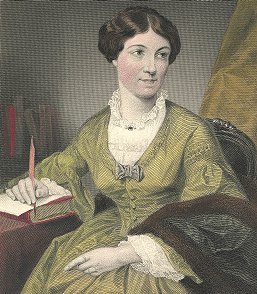
History through the Eyes of . . . Harriet Martineau: Washington, D.C., 1835, #1

Randall Stephens

In a post a few weeks ago, I asked what an American city might have looked like in 1848. An amazingly detailed daguerreotype of a booming Cincinnati gives us a good idea. It's a tremendous resource.

That got me thinking about a new series for the blog. The idea is to post a portion of a primary source from that offers an insightful, evocative portrait of a place, a time, a people. Some questions that sources might answer: What was it like to live in Paris as the Black Death decimated the city? What might it have been like to walk down Cheapside in Dickensian London? How did it feel to live in Pompeii on the eve of the city's destruction? What was it like to be a 16th-century Jesuit missionary in Japan? (Please pass along your favorite primary sources.)

For the first installment I've chosen Harriet Martineau's (1802-1876) interesting portrait of Washington, DC, (1835) populated as it was by oddballs from the sticks, society ladies, gabbing politicians, and some giants of the day. (A came across this in Allan Nevins, ed., American Through British Eyes [Oxford University Press, 1948].) Martineau was an English journalist, novelist, and essayist from Norwich. Her family's falling fortunes in her youth are worthy of a Jane Austen novel. Luckily, she made a tidy living off her writing.

Martineau circulated among the leading movers and shakers of her era. She developed keen observational abilities and could make even complex subjects accessible to a wide audience. She wrote about the development of religions and penned essays on new economic theories. Her abolitionism and unorthodox take on religion stirred controversy in the United States and made her an infamous character for many. (See her comments below about Northerners and Southerners.)

Martineau's American travel writings--though not as well know as those by De Tocqueville, Dickens, and the Trollopes--shed light on customs, sectional differences, and the boisterous Waking Giant of America in the Age of Jackson. (Her unflinching portrait of cast-iron Calhoun, as someone who has come unhinged, or unbolted, is, pardon the pun, riveting.)

Harriet Martineau, Retrospect of Western Travel, Volume 1 (London, 1838).

In Philadelphia, I had found perpetual difficulty in remembering that I was in a foreign country. The pronunciation of a few words by our host and hostess, the dinner table, and the inquiries of visiters were almost all that occurred to remind me that I was not in a brother's house. At Washington, it was very different. The city itself is unlike any other that ever was seen,—straggling out hither and thither,—with a small house or two, a quarter of a mile from any other; so that in making calls "in the city," we had to cross ditches and stiles, and walk alternately on grass and pave menu, and strike across a field to reach a street.—Then the weather was so strange; sometimes so cold that the only way I could get any comfort was by stretching on the sofa drawn before the fire, up to the very fender; (on which days, every person who went in and out of the house was sure to leave the front door wide open:) then the next morning, perhaps, if we went out muffled in furs, we had to turn back, and exchange our wraps for a light shawl. Then, we were waited upon by a slave, appointed for the exclusive service of our party during our stay. Then, there were canvas-back ducks, and all manner of other ducks on the table, in greater profusion than any single article of food, except turkeys, that I ever saw. Then, there was the society, singularly compounded from the largest variety of elements— foreign ambassadors, the American government, members of Congress, from Clay and Webster down to Davy Crockett, Benton from Missouri, and Cuthbert, with the freshest Irish brogue, from Georgia; flippant young belles, "pious" wives, dutifully attending their husbands, and groaning over the frivolities of the place; grave judges, saucy travellers, pert newspaper reporters, melancholy Indian chiefs, and timid New England ladies, trembling on the verge of the vortex,—all this was wholly unlike any thing that is to be seen in any other city in the world; for all these are mixed up together in daily intercourse, like the higher circle of a little village, and there is nothing else. You have this or nothing; you pass your days among these people, or you spend them alone. It is in Washington that varieties of manners are conspicuous. There the Southerners appear to the most advantage, and the New Englanders to the least: the ease and frank courtesy of the gentry of the south, (with an occasional touch of arrogance, however,) contrasting favourably with the cautious, somewhat gauche, and too deferential air of the members from the north. One fancies one can tell a New England member in the open air by his deprecatory walk. He seems to bear in mind perpetually that he cannot fight a duel, while other people can. The odd mortals that wander in from the western border cannot be described as a class ; for no one is like anybody else. One has a neck like a crane, making an interval of inches between stock and chin. Another wears no cravat, apparently because there is no room for one. A third has his lank black hair parted accurately down the middle, and disposed in bands in front, so that he is taken for a woman when only the head is seen in a crowd. A fourth puts an arm round the neck of a neighbour on either side as he stands, seeming afraid of his tall wire-hung frame dropping to pieces if he tries to stand alone: a fifth makes something between a bow and a curtsey to every body who comes near, and proses with a knowing air:—all having shrewd faces, and being probably very fit for the business they come upon. . . . (237-239)

Our pleasantest evenings were some spent at home in a society of the highest order. Ladies, literary, fashionable, or domestic, would spend an hour with us on their way from a dinner, or to a ball. Members of Congress would repose themselves by our fire side. Mr. Clay, sitting upright on the sofa, with his snuff-box ever in his hand, would discourse for many an hour, in his even, soft, deliberate tone, on any one of the great subjects of American policy which we might happen to start, always amazing us with the moderation of estimate and speech
which so impetuous a nature has been able to attain. Mr. Webster, leaning back at his ease, telling stories, cracking jokes, shaking the sofa with burst after burst of laughter, or smoothly discoursing to the perfect felicity of the logical part of one's constitution, would illuminate an evening now and then. Mr. Calhoun, the cast-iron man, who looks as if he had never been born, and never could be extinguished, would come in sometimes to keep our understandings upon a painful stretch for a short while, and leave us to take to pieces his close, rapid, theoretical, illustrated talk, and see what we could make of it. We found it usually more worth retaining as a curiosity than as either very just or useful. His speech abounds in figures, truly illustrative, if that which they illustrate were but true also. But his theories of government, (almost the only subject on which his thoughts are employed,) the squarest and compactest theories that ever were made, are composed out of limited elements, and are not therefore likely to stand service very well. It is at first extremely interesting to hear Mr. Calhoun talk; and there is a never-failing evidence of power in all he says and does, which commands intellectual reverence: but the admiration is too soon turned into regret,—into absolute melancholy. It is impossible to resist the conviction that all this force can be at best but useless, and is but too likely to be very mischievous. His mind has long lost all power of communicating with any other. I know no man who lives in such utter intellectual solitude. He meets men and harangues them, by the fire-side, as in the Senate: he is wrought, like a piece of machinery, set a-going vehemently by a weight, and stops while you answer: he either passes by what you say, or twists it into a suitability with what is in his head, and begins to lecture again. Of course, a mind like this can have little influence in the Senate, except by virtue, perpetually wearing out, of what it did in its less eccentric days: but its influence at home is to be dreaded. There is no hope that an intellect so cast in narrow theories will accommodate itself to varying circumstances: and there is every danger that it will break up all that it can, in order to remould the materials in its own way. (242-244)

For more:

"Miss Martineau's Retrospect of American Travel," Tait's Edinburgh Magazine (April 1838).

Harriet Martineau, Maria Weston Chapman, Harriet Martineau's Autobiography, Volume 1 (London, 1877).

Harriet Martineau, The Martyr Age of the United States: An Appeal on Behalf of the Oberlin Institute in Aid of the Abolition of Slavery (Newcastle Upon Tyne, 1840).

Wednesday, June 23, 2010

London Calling Librarians

This guest post comes from Dana Goblaskas a former student of mine who works at the MIT library. Dana stuck out to me from the start because of her intellectual curiosity and because she was into pop music history, punk, and indie rock. Pluses in my book. Here she tells of her two-week trip across the water as a participant in University College London’s Librarianship Summer School.

Dana Goblaskas

As a self-proclaimed history nerd and an Anglophile, it’s hard for me to be giddier than when I’m immersed in the tangible history of England. And if I can earn credits toward my degree for that immersion, well, let’s just say the happy dances abound.

Last month, I took part in the inaugural session of University College London’s Librarianship Summer School, co-sponsored by the University of North Carolina’s School of Information and Library Studies. The two-week seminar examined the past, present, and future of Britain’s libraries and the field of librarianship, and featured daily field trips to museums, libraries, and archives throughout the city and beyond. Lectures by librarians, historians, and UCL faculty provided background for what my classmates and I saw during tours, and behind-the-scenes peeks into the workings of such places as the British Library and Bodleian Library at Oxford set our future-librarians’ hearts a-racing.

For the history nerd in me, there was plenty of “past” to learn about and see firsthand. Lectures about medieval manuscripts and eccentric pioneers of cataloging were coupled with glimpses inside Wren’s Library at Trinity College Cambridge (built in 1695), the Natural History Museum, and viewings of treasures like the Domesday Book at the National Archives.

Perhaps even more exciting than getting to drink all that in was seeing how much effort these institutions are presently putting into making their historical collections available to the world. With help from foundations like JISC (Joint Information Systems Committee), many of the places I visited were in the midst of massive digitization, indexing, or retrospective cataloging projects. Inspired by the popularity of the BBC’s Who Do You Think You Are? TV program, several libraries and archives were focusing on increasing public accessibility to the parts of their collections that could be used for genealogical research.

As for the future of Britain’s libraries, I think they’re heading in the right direction. Facing questions about libraries’ continuing relevance to society head-on, they are adapting to the communities around them and showing that they’re in it for the long run. A new “chain” of libraries called Idea Store is springing up around London, abandoning confusing catalog classifications and offering a wide variety of classes to support continuing education in their neighborhoods. The libraries in the London borough of Haringey recently won a grant that placed free medical clinics and wellness centers alongside their book stacks.

And in addition to focusing on expanding digital content and accessibility, some institutions are appealing to the public to help develop their collections. Projects such as Transcribe Bentham at UCL and Oxford’s First World War Poetry Archive rely on crowd-sourcing to create and identify materials, as well as on social networking tools like Twitter and Flickr to get the word out to wider circles of volunteers.

Coming back down to reality after two weeks spent doing not much more than hanging around inside and gawking at cool old libraries—or cool new libraries—was a little difficult. But coming back with great experiences, thousands of pictures, and a head full of ideas lessened the blow of the transition. And I’m excited by the prospect of so much more incredible content being made widely available. Now I just have to finish my research paper to earn those credits, and I think the happy dances will abound once again.

Monday, March 15, 2010

“I am almost coming to the conclusion that all histories are bad"

Randall Stephens

What's not to like a about collections of private letters? (Well lots, if you think they are boring, tedious, self-serving, etc.) I almost always enjoy reading the letters of novelists, historians, critics. Collections of letters, like memoirs, make for good reading. You can tell a great deal about an author’s opinions by reading his/her intimate thoughts on all manner of subjects. Often, the more unrestrained the letter writer is, the more interesting the letter.

I recently came across passages on history in the collected letters of two of the most famous authors of the 20th century. Flannery O’Connor makes a passing reference to C. Vann Woodward, while disparaging much of southern historical writing. High praise, indeed, to have O’Connor’s stamp of approval.

Flannery O’Connor to "A," May 25, 1963, Sally Fitzgerald, ed., The Habit of Being: Letters of Flannery O'Connor, pp. 521-22.

I have taken up with reading C. Vann Woodward. Have you ever read this gentleman—Burden of Southern History is what I have but I intend to order off after more. Southern history usually gives me pain, but this man knows how to write English.

C. S. Lewis is far more pessimistic about the history trade. A young fellow of Magdalen College, Oxford, Lewis, at least in this 1927 letter to his brother, has little patience for historians. Historians, he laments, typically fail to capture the truth of experience. Lewis’s meditation on “fact” sounds a little like E. H. Carr on the same. Though Lewis is here writing more than three decades before Carr.

Letters like this, though, often reflect the thoughts of a writer in the moment. They are like a snapshot, not a meticulously painted landscape.

C. S. Lewis to his brother, December 12, 1927, in Walter Hooper, ed., The Collected Letters of C. S. Lewis: Family Letters, 1905-1931, 741.

I am almost coming to the conclusion that all histories are bad. Whenever one turns from the historian to the writings of the people he deals with there is always such a difference. What is in my mind at present is (on the one hand) Beowulf and Alfred and the Sagas, and (on the other) Gibbon and Oman about 'the barbarians'. What common measure is there between 'Odoacer had alienated the sympathies of his Italian subjects by seizing a third of the land to reward his veterans' and 'Oft Scyld Scefing overthrew the mead benches of many a kindred. The dwellers round had to obey him across the whale's way. That was a good king . . . So shall a young hero do good and give lordly gifts, that his retainers may repay him when war comes.’ The implication (always present) in the first version that Odoacer oughtn't to have given the land to his men, or that any choice in the matter could have occurred to him, as against the perfectly untroubled sincerity with which the other describes the hero as 'doing good' in scattering the 'lordly gifts' (acquired no doubt at the cost of 'alienating the sympathy' of someone) makes one despair. Then 'his veterans’—memories of Chelsea Hospital! Of course one can see in some sense that the two passages refer to the same sort of fact. But what is left of the 'fact' if you take away both its two 'appearances'? And if you plump for one of them, is that historical truth?

See also these collections in full at Google Books: