Search This Blog

Showing posts with label Christology. Show all posts

Thursday, December 16, 2010

God is with Us -- A Lectionary Meditation

Isaiah 7:10-16


Romans 1:1-7


Matthew 1:18-25


God is with Us!

Every year we hear cries from the populace demanding that Christ be put back into Christmas. In the minds of many there is a conspiracy, perhaps by a cadre of elite secularists, who are intent upon stripping Christ out of Christmas. But if Christ is at risk being removed from Christmas then it’s like that the culprit is the very ones who are making the demand. That is, our participation in the commercialization of this sacred feast of the incarnation is what is pushing the true message of Christmas out of the picture.

If we would attend to the voice of Scripture we would hear a message that is summed up in a name – Emmanuel, which is translated “God with Us.” The prophet told the king that God would provide a sign – a young woman would bear a child and she would call this child Emmanuel. And many centuries later, a gospel writer picked upon this prophetic word and reads the story of Jesus in light of it. The one, who, according to Matthew, is named Jesus because he will save his people, fulfills the promise that God would be with us. Therefore, as we watch the blue and the purple of Advent give way to the liturgical white and gold of the Christmas season, and as the hymns transition from a message of expectation to one of fulfillment, the message of God’s presence begins to make itself felt.

This message that God is with us permeates the three texts for the Fourth Sunday of Advent. Two of them speak of a young woman/virgin who bears a child as a sign that God is in our midst. Paul doesn’t speak of the birth of this child but does affirm the gospel message that comes down from the prophets of old, that God’s Son, who is descended according to the flesh from David, has been declared the Son of God through the resurrection. Before I engage more fully these three texts I’d like to add into the mix a statement made by Dietrich Bonhoeffer in his lectures on Christology given in Berlin during the 1930s. He notes that the two stories of Jesus birth and baptism stand together, with one concerning itself with the presence of the Word of God in Jesus, while the other is focused in the coming of the Word of God upon Jesus. He writes that “the manger directs our attention to the man, who is God; the baptism directs our attention, as we look at Jesus, to the God who calls.” He then goes on to say:

If we speak of Jesus Christ as God, we may not say of him that he is the representative of an idea of God, which possesses the characteristics of omniscience and omnipotence (there is no such thing as this abstract divine nature!); rather, we must speak of his weakness, his manger, his cross. This man is no abstract God. (John De Gruchy, Dietrich Bonhoeffer: Witness to Jesus Christ, pp. 116-117).
The texts for this Sunday take us directly into the Christmas story, and they remind us that the Christmas story, indeed the gospel story, isn’t the story of an abstract God-man.

The first word comes to Isaiah and is delivered to King Ahaz of Judah, who is told that God will give him a sign, but the king in a bit of false modesty declines the opportunity to test God’s faithfulness. But the prophet will not be put off, and so God will give him a sign anyway, and the sign will be this. A young woman will bear a son, and she will name him Emmanuel, which means “God with Us.” And before this child reaches the age of understanding good and evil, the land controlled by the kings whom Ahaz dreads will be deserted. In context, this is a word of hope to the people of Judah. The young woman could be Ahaz’s wife, and thus the mother of Hezekiah, or she could be Isaiah’s wife, for Isaiah speaks of his own children as “signs . . . from the Lord” (Is. 8:1). Although it’s easy to get caught up in the debate over whether Isaiah 7:14 is speaking of a virgin or simply a young woman without any reference to her sexual experience, if we do this we miss the point – God has offered a sign in the person of a child, a sign that reminds us that God is with us.

Before we move to the gospel lesson that builds upon Isaiah’s word of promise about God’s faithfulness in dealing with Judah’s enemies, we must stop and attend to Romans 1:1-7. Here in this opening section of Paul’s great letter to the Romans, in which he affirms his own call to be an apostle so that he might deliver the gospel that had been promised ages before through the prophets. This gospel concerns God’s son, who though descended from David in the flesh (note there is nothing here about an extraordinary birth), but who is then declared Son of God through the Resurrection from the dead. And the calling to which Paul has been called is to bring the Gentiles into a position of obedience “for the sake of his name,” for they belong to Jesus Christ. Again the text lends itself to debate. One wonders whether this emphasis on the resurrection being the point at which the Son of David becomes Son of God could signal an adoptionist Christology. That is, God chooses to adopt Jesus as his son – either at baptism or in the resurrection. But as Bonhoeffer reminds us these events are all connected and thus fighting over whether this is an adoptionist perspective again misses the point – God us chosen to be present in Christ.

And so we come to the gospel lesson, wherein Isaiah’s “young woman” gives way to the Septuagint’s translation of the Hebrew almah into the Greek parthenos (virgin). The message is this. Joseph was going to put away his betrothed because she was pregnant, and apparently he was the father. He was a kind and gentle man so he didn’t take the option of putting her away publicly. But as he contemplated this action, an angel appears in a dream and tells him: “fear not,” go ahead and get married to Mary, just as you planned, for this child is from the Holy Spirit. The focus isn’t on the how, but on the sign. This young woman, not yet fully married, and probably very young is pregnant, and that means she has broken her vows (or, more likely had been raped, perhaps by a Roman soldier). Joseph was fully in his rights to set her aside, but he was a good and gentle man and so he chose not to do so, and now the angel gives him further instructions. Get married, have the baby, and name him Jesus (Yeshua), for he will save the people from their sins. He will do this to fulfill the word of Isaiah, that a “virgin shall conceive and bear a son, and they will name him Emmanuel.” And so it happened, and Joseph refrained from engaging in sexual relations with his wife until the son was born, and they named him Jesus. The message once again is this: “God is with us.”  And because God is with us, there is hope, even a world full of darkness -- as Matthew's gospel quickly reminds us in the story of the slaughter of the Innocents.  But that text is still ahead of us.  Now, the message is this:  Fear Not!

There is much going on in these texts that require our careful attention. They have a powerful message of God’s abiding presence, not in abstract form or in typical human power relationships, but rather in weakness, as Bonhoeffer points out in a manger and on a cross.

Thursday, October 7, 2010

The Human Face of God

Many years ago Karl Barth wrote an essay on "the humanity of God."  In that essay he wrote about the paradox of bringing together the deity and the humanity of God.  Of course, for Barth this is a question that involves Christology.  He writes:

In Jesus Christ there is no isolation of man from God or of God from man.  Rather, in Him we encounter the history the dialogue, in which God and man meet together and are together, the reality of the covenant mutually  contracted, preserved, and fulfilled by them.  Jesus Christ is in His one Person, as true God, man's loyal partner, and has true man, God's.  He is the Lord humbled for communion with man and likewise the Servant exalted to communion with God.  He is the Word spoken from the loftiest, most luminous transcendence, and likewise the Word heard in the deepest, darkest immanence.  He is both, without their being confused but also without their being divided; He is wholly the one and wholly the other.  Thus in his oneness Jesus Christ is the Mediator, the Reconciler, between God and man.  Thus He comes forward to man on behalf of God calling for and awakening faith, love, and hope, and to Godon behalf of man, representing man, making satisfaction and interceding.  Thus he attests to man God's free grace  and at the same time attests and guarantees to God man's free gratitude.  (Barth, Humanity of God, p. 46-47) 
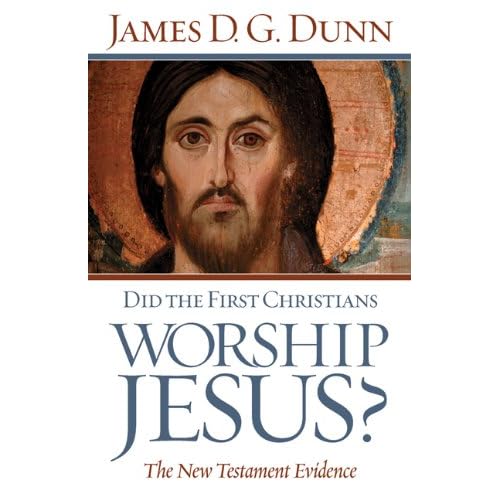
James Dunn, in his book Did the First Christians Worship Jesus? (see review here), comes at the question from a somewhat different angle, but he too posits the idea that Jesus is the "human face of God."  This is, he believes the confession of John's Gospel.  Jesus is the "one who made the unseen God known and known more clearly and more fully than he had ever been known before.  In  a real sense that the first Christians could only explain inadequately, to be in the presence of Jesus was to be in the presence of God -- not, be it noted in the presence of a god, but in the presence of God" (Dunn, Did the First Christians Worship Jesus?, p. 122-123).   

Although the confession that Jesus is the human face of God affirms that when we approach Jesus, see Jesus, experience Jesus, we are in the presence of God, that doesn't mean that we are to worship Jesus as a substitute for God.  He is, as both Barth and Dunn seem to suggest, the mediator, the point of contact with God, in which and through which we are invited to worship the living God.  Jesus is the definitive Word (Logos) of God, but Jesus is not the Father -- the one who ultimately deserves our worship and adoration. 

Does that mean we can't have a conversation with Jesus?  No, that's not the idea -- but if that conversation doesn't lead us through Jesus to God the Father then the ultimate conversation has been short-circuited.  But as Dunn is very clear in his book, even if we do not worship Jesus directly, Jesus defines what it means for to worship as Christians. 

Wednesday, October 6, 2010

Did the First Christians Worship Jesus? -- A Review

DID THE FIRST CHRISTIANS WORSHIP JESUS?  The New Testament Evidence.  By James D. G. Dunn.  Louisville: WJK Press, 2010.  viii + 168 pp.

    If popular hymnody was to be the guide to answering the question posed in the title of this book by British New Testament scholar James Dunn, the answer would appear to be yes.  The assumptions that underlie the doctrine of the Trinity would also lead us toward a similar answer.  After all, according to the creeds Jesus is divine, and if Jesus is divine then shouldn’t we worship him?   Complicating this conversation is the assumption that the Christian faith is monotheistic, and if Judaism offers guidance as to what that involves, then doesn’t worship of Jesus distract us from the worship of God – whom many Christians name Father?   The question that Dunn seeks to answer in this relatively brief book concerns the New Testament evidence.  If one attends to this evidence, what are we to conclude? 

    Dunn notes that this discussion not only has implications for Christians, but it also has implications for interfaith dialog, especially with Jews and Muslims who have a much more straightforward monotheism. 
    To regard Jesus as divine, as worthy of worship as God, seems to them an obvious rejection of the oneness of God, more a form of polytheism than a form of monotheism (p. 1).
The doctrine of the Trinity, which is the traditional answer to this dilemma is not only baffling to our monotheist friends, but it is a bit baffling to many Christians as well.  Words like essence, substance, and even person make little sense outside their Greek philosophical foundations.  Whatever theological answers have emerged over time, as Christians have wrestled with and reflected upon the biblical witness, a satisfactory answer to the question of whether worship should be given to Jesus requires us to attend to the New Testament evidence. 

    Our ability to offer an answer to the question of whether the first Christians worshiped Jesus requires us to first define what worship is.  A basic definition assumes that reverence or praise is being given to a god or God.   Even here, however, there are complications because the word worship is often used in ways that diverge from that basic definition.  In England judges, for instance, are referred to as “Your Worship.”  Surely judges aren’t gods.  And the Book of Common Prayer uses the word worship in the context of the marriage ceremony in reference to the relationship of the husband to wife.  Being that he is a biblical scholar Dunn takes the reader on a tour through the words used for worship in the New Testament, including proskynein and its relatives.  Used to refer to deference to higher authority, submission, and worship – it is used in relationship to beings other than God.  Although used in relationship to Jesus, the number of cases are few, and the clearest use comes in Revelation.  There are a number of other terms that can mean to give praise, to worship, that have references both to God or to Jesus, but none of these usages are conclusive. 

    Dunn concludes that while there are intriguing pieces of evidence of usage that suggest worship of Jesus, these usages are limited.  When used these words most often show wonderment at the “realization that God had raised Jesus from the dead, and in some of the worship offered to the Lamb in the visions of the seer of Revelation” (p. 27).  There is no evidence at all of cultic/liturgical worship of Jesus, and the most commonly used words for praise and thanksgiving are never applied to Jesus.  Instead, thanks is given to God for what Jesus has done.

    If there is little language usage that suggests direct worship of Jesus, the accounts of religious practice of the early Christians are not suggestive of direct worship either.  As for prayer, it is almost always directed toward God, and of course, Jesus himself is depicted as praying to God.  The early Christians invoked Jesus’ name and prayed in his name, though sitting at the right hand of the Father he could be appealed to, but does this connote worship?  Dunn isn’t convinced.  As for hymns, many of the New Testament hymns focus on Christ, but they’re not directed to Christ.  Instead, they give praise to God for Christ.  Clearly Jesus is central to the early church’s self-understanding – the church is described as the body of Christ, for instance, but does that connote direct worship?  As for sacrifice, Jesus is the one who offers sacrifice and is the sacrifice, but the sacrifices are offered to God, not to him.  The conclusion?  Jesus was central to early Christian worship, was the reason why prayers were offered to God with confidence, and was the subject of Christian hymns.  They invoked his name and appealed to him for help in times of crisis.    He was the context for worship and its means, but worship was accomplished through him, but wasn’t normally directed to him.

    Dunn’s conclusion after reviewing the relevant evidence is that the question posed in the book’s title is far too narrow and thus misleading.  The better question concerns whether Christian worship was and is possible without Christ.  Therefore, we need to pursue a somewhat different question: “was earliest Christian worship so closely bound up with Jesus that inevitably he participated in the receipt of worship just as he participated in the offering of the worship?  Was earliest Christian worship in part directed to him as well as made possible and enabled by him?” (p. 58).  If we are to move toward this broader question of whether Jesus is included in the worship of God, then we must also move toward wrestling with questions about the nature of monotheism and Jewish understandings of heavenly mediators and divine agents.  When we move toward this question many new possibilities open up.  The Old Testament, for instance, doesn’t offer as strict a monotheism as modern Judaism and Islam claim for themselves, and there are references, for instance, to angels who reveal God’s presence as examples of divine immanence.  Dunn notes that ancient Jewish theologians affirmed a double aspect of God, one that is both transcendent and invisible and one that is immanent, reaching out to humanity and the created order in a variety of ways.  There is, Dunn believes the possibility of a binatarian understanding of God’s existence even prior to the emergence of Christianity, one that would prove beneficial to the early Christian theologians – references, for instance to the Wisdom of God and the Logos of God.  Thus, while there was no thought of any being other than God being worshiped, Second Testament Judaism offered a context or atmosphere in which “the question of Jesus being worshiped could arise, and arise as a natural corollary to the status attributed to him, it had provided no precedent to which the first Christians could appeal” (p. 90).     

    In a lengthy fourth chapter entitled “The Lord Jesus Christ,” Dunn wrestles with the question of Jesus’ own understanding of monotheism, which he answers in the affirmative, but with the caveat that Jesus had a sense of intimacy with God that, in Dunn’s words, “the disciples could only begin to experience as they stood with him and came to God as Father in dependence on him, as though youngsters who found it possible to stand before their father only when accompanied by their older brother” (p. 101).  From there he moves to the confession of “Jesus as Lord,” setting the confession in the context of Jewish understandings of God and the important Pauline texts.  He then moves to the use of Word (logos), Wisdom (sophia), and Spirit (pneuma), seeking to understand how these terms came to be used in expressing a developing Christology. 

    In this fourth chapter Dunn takes up what he admits is the most difficult issue in the conversation – the occasional use of the word god/God in reference to Jesus.  If this word is used in relation to Jesus, and yet we are to keep from moving in a polytheistic direction with Jesus being a second God, how should these references be interpreted?  In answer to this question, reflecting on texts in the Johnannine corpus and elsewhere, he concludes that “Jesus was God, in that he made God known, in that God made himself known in and through him, in that he was God’s effective outreach to his creation and to his people.  But he was not God in himself” (p. 135). 

    So should Jesus be worshiped?  Dunn concludes, after a lengthy conversation with such contemporary figures as Larry Hurtado, Richard Baukham, and James McGrath, that we must start from the premise of monotheism, and that if Jesus is worshiped, it is in the sense that God is worshiped in and through him, but Jesus is not worshiped directly in distinction from God.  That is, we must beware of practicing what Dunn calls “Jesus-olatry.”  Like idolatry, in which the idol absorbs the worship due God, in “Jesus-olatry,” Jesus becomes a substitute for God, and therefore absorbs the worship due God alone.  Thus, it would be better to see Jesus as an icon, a window through which the divine can be seen and experienced.  The problem with worship directed at Jesus is that worship ends there and doesn’t move onto God.  Therefore, as Christians, worship is directed not at Jesus, but we are called to worship God in and through Jesus.  If we stick with the original question posed by the title, then the answer is no – the early Christians didn’t worship Jesus.  However, if we broaden the question and ask whether Christian worship of God is defined by Jesus, then the answer is yes.  Christianity, Dunn concludes, remains monotheistic, but its worship is enabled by Jesus and God is revealed in and through Jesus. 

    James Dunn has provided the church with an important resource that will help it come to grips with the place of Jesus in worship.  It also helps us better develop a Christology that reflects the biblical witness.  Dunn’s monotheism is Trinitarian in nature, but it seeks to keep things in proper alignment.  This is not a lengthy book, but it is demanding reading – not in the sense that it is dense prose, but because it demands much of us who are Christians to examine our understandings of God and the way in which we approach God in worship.  Thus, this is a must read book for anyone wanting to understand the place of Jesus in theology and worship.

Monday, May 31, 2010

Jesus Manifesto -- Who is Jesus?

Jesus Manifesto: Restoring the Supremacy and Sovereignty of Jesus Christ
Leonard Sweet and Frank Viola have published a new book entitled the Jesus Manifesto: Restoring the Supremacy and Sovereignty of Jesus Christ.  (Nelson, 2010).  I received an advance copy, with the proviso that I would, at the very least, on this day, put up their statement about the book's release (see the bottom of the page).

I have yet to read the book, beyond the Introduction, so a review is not yet available from my pen.  But, from that introduction, I deduce that the authors, one a Methodist Historian and Professor of Evangelism at Drew University and the other a conference speaker and author, wish to reclaim the centrality of Christ to the message of the Christian faith.

In the introduction they note that there was a time when the church failed to take seriously the humanity of Jesus, but now in many sectors it is the opposite.  They seek to offer a third way, between left and right poles.  They call for a new engagement with Christology The degree to which they succeed remains to be seen (as I've not read the book to its conclusion). 

I offer a few excerpts from the intro to get a conversation going:

Christians have made the gospel about so many things -- things other than Christ.  But Jesus Christ is the gravitational pull that brings everything together and gives it meaning.  Without him, all things lose their value.  They are but detached pieces floating around in space.  That includes your life. (p. xxi).
And then they write:

So what is Christianity?  It is Christ.  Nothing more.  Nothing less. Christianity is not an ideology or a philosophy.  Neither is it a new type of morality, social ethic, or worldview.  Christianity is the "good news" that beauty, truth, and goodness are found in a person.  And true humanity and community are founded on and experienced by connection to that person. (p. xxii). 
The authors claim that the church suffers from a Jesus Deficit Disorder, so that other items and terms have replaced Jesus at the center of the conversation.  And so, they suggest that we return to the question Jesus posed to the disciples:  "Who do you say that I am?"  

As I said, I've not read the book so I can't comment on their positions, though from the endorsements by and large they come from evangelicals of some stripe or another.  But I think the question warrants a discussion -- who is Jesus for the church today?  Who is Christ for you?  Is he the center or is he not?  

 
Thomas Nelson is releasing a new book called Jesus Manifesto: Restoring the Supremacy and Sovereignty of Jesus Christ by Leonard Sweet and Frank Viola. This book will be on special discount from Amazon.com on June 1st, the date of the release. You can learn more by going to www.theJesusManifesto.com. Endorsements by Rowan Williams, Matt Chandler, Calvin Miller, Ed Young, Jack Hayford, Shane Claiborne, Ed Stetzer, Reggie McNeal, Mark Batterson, Gregory Boyd, David Fitch, Steve Brown, Dan Kimball, Margaret Feinberg, Mark Chironna, Francis Frangipane, Todd Hunter, Alan Hirsch, Chris Seay, Jonathan Wilson-Hartgrove, Anne Jackson, Craig Keener, Ken Ulmer, Tommy Barnett, Sally Morgenthaler, and others.