Search This Blog

Showing posts with label 20th Century. Show all posts

Tuesday, March 22, 2011

Jeremy Bangs's Experience with Sundown Towns

Randall Stephens

Americans born after the 1950s may not know that there ever were such things as sundown towns. James W. Loewen writes about them in Sundown Towns: A Hidden Dimension of American Racism (New Press, 2005). "'Don’t let the sun go down on you in this town.' We equate these words with the Jim Crow South," summarizes the book's website, "but, in a sweeping analysis of American residential patterns, award-winning and bestselling author James W. Loewen demonstrates that strict racial exclusion was the norm in American towns and villages from sea to shining sea for much of the twentieth century."

Jeremy Bangs emailed me the other day about his experience of growing up in Illinois and Kansas and being all-too aware of such villages and hamlets that dotted the midwest. Bangs is the founder of the Leiden American Pilgrim Museum in Leiden and the author of Strangers and Pilgrims, Travellers and Sojourners (General Society of Mayflower Descendants, 2009). Jeremy's father, Carl Bangs, was a leading authority on the life and theology of Jacobus Arminius. (I read his biography of Arminius when I first launched into grad school. I was hooked on history.) With Jeremy's permission, I include below his reminiscence about sundown towns.

When my father moved ca. 1952-53 from Chicago to Bourbonnais, IL, to teach religion and philosophy at Olivet Nazarene College, he first heard about the existence of such towns, including some in the immediate area. Like others on the faculty who were ordained, he sometimes was invited to preach, and, as director of the college's brass choir (which he started), he sometimes was asked to take students to perform in Sunday morning services in Nazarene churches in Illinois as fundraisers for the college.

He refused to accept invitations in towns that were known as sundown towns. He always explained that he would be happy to accept the church's invitation once the village or town had reversed its policy. He was not alone in this vocal opposition to the racist custom, and I think that he and his colleagues made this an issue that was discussed (and officially opposed) by area councils of churches. Further, we did not drive through such towns, taking the long way around, whatever that might be, when going somewhere farther away. Since most roads there were laid out in square patterns, there was always a way to drive around. I think that at least one town officially changed their policy, after being shamed from the pulpits. As I recall, that must have been Manteno, IL, because I know that it was once a sundown town but in later years we did drive through Manteno. (We moved to Kansas City in 1961.)

In Kansas City, looking for a house to buy, my parents were shocked to find out that certain suburbs excluded blacks as well as Jews. This was possible with so-called covenants in the deeds, by which a buyer obliged himself to refuse to sell to blacks or Jews. The suburbs were among those developed and operated by the J. C. Nichols Company, who also built Kansas City's Plaza. My parents refused to buy in such restricted areas and refused to buy from that company. My father also instigated legal action on this point against the J. C. Nichols Company, which led to some retaliation, although I've forgotten what form that took. I think that eventually this action resulted in the company's being forced to drop the policy and restrictive covenants, even before legal changes made them explicitly illegal. As in Illinois, my father was one among numerous clergymen who tried to bring an end to these restrictions.

Thursday, January 6, 2011

An Interview with Hilary Spurling on Pearl Buck

Randall Stephens

The January issue of Historically Speaking will soon be up on the Project Muse site. In the meantime, here's a selection from my interview with Hilary Spurling, which appears in the issue.

In 1932 Pearl S. Buck, daughter of American missionaries in China, won the Pulitzer Prize for her novel The Good Earth (John Day, 1931). Set in rural China, the book chronicles the struggles of a peasant and his slave-wife. In 1937 the novel was adapted into a Hollywood film. One year later Buck was awarded the Nobel Prize for Literature.

The British biographer Hilary Spurling—Ivy: The Life of I. Compton-Burnett (Knopf, 1984); The Girl from the Fiction Department: A Portrait of Sonia Orwell (Counterpoint, 2004); Matisse the Master: A Life of Henri Matisse: The Conquest of Colour, 1909-1954 (Knopf, 2007), winner of the Whitbread Book of the Year Award and the Los Angeles Times Biography prize—takes up Buck’s story in Pearl Buck in China: Journey to The Good Earth (Simon & Schuster, 2010). Focusing on Buck’s first four decades, Spurling stresses the American author’s intimate familiarity with China. Historically Speaking editor Randall Stephens recently spoke to Spurling about her study of Buck.


Randall Stephens: Why has Pearl Buck’s reputation suffered in recent years?

Hilary Spurling: She had many critics in her own day, too. Her success was so sudden and so enormous, and she was a complete outsider. She was a nobody. She had no contacts, no backup and no track record. When The Good Earth was published at the beginning of the 1930s by a publisher about to go bankrupt, it immediately became not just an American best seller but a global best seller. She won a Pulitzer Prize right away, and a few years later she won the Nobel Prize. Literary critics said, what is The Good Earth? An agricultural history of China? They couldn’t make heads or tails of it.

She had lived in China all her life. Buck never felt at home in America, in the 1930s or afterward. Brought up in China, she spoke Chinese fluently and her childhood friends were Chinese. When she was young, she didn’t know any other Westerners. She imagined she would spend her whole life in China.

When she lived in the United States, Buck was alienated by American politics. She knew and loved China so well that she became in a certain sense an apologist for China, trying to explain China to the West. As America moved sharply to the right in the 1950s, Buck was branded as a communist sympathizer. In communist China, however, she was a public enemy, and her books were forbidden. People were punished and humiliated if they’d even heard of her, let alone met her. She got flack from all sides throughout the second half of her life.

I wrote the biography partly because I wanted to write about China. I wanted to explore China and how it reached the state it is in now. In addition, I think that Pearl Buck is one of the great Americans of the 20th century, and I hope that Americans might look at her again and recognize her achievements as quite extraordinary.

Stephens: How would you sum up her relevance today?

Spurling: Think of how Western attitudes toward China have changed in the last four or five years. When I wrote the proposal for this book four years ago, publishers both in American and in England weren’t very interested. They saw no trace of the shock and awe I think we all feel now on both sides of the Atlantic about China. We understand now that China is a very large part of the future for all of us. And I think it no exaggeration to say that Buck was initially responsible for the West’s change in outlook. Nobody since Marco Polo in the 13th century has opened up the East to the West as much as Buck did. We can see the seeds of our attitudes toward China now in what she wrote so long ago. She was the first to foresee China’s future as a superpower. She was a young woman then. It’s extraordinary to see that as early as 1925 she understood that China would become the leader of Asia and that America needed to cultivate its relationship with China.

Stephens: Has she been reassessed in China today?

Spurling: Yes, she is being reassessed again on quite a large scale. In my lifetime she was officially regarded as a public enemy of the whole Chinese nation. Schoolchildren were told to denounce her. One of them was the Chinese novelist Anchee Min, who told me that as a student she was chosen to denounce Pearl Buck. She asked her teachers if she could read The Good Earth because she said it would give her more grounds. They said no Chinese citizen could read it because it was too toxic.

I finished my book last November, and that very month Buck was named on Chinese state radio—which of course is an official voice of the Chinese state—as one of the top ten international friends of China. I see that as a measure of the rate at which China and China’s opinions are changing. People now want to read Buck. The Good Earth was her farewell to China, the last thing she wrote before she left that country for good. No one else in the West was in a position to write such a book, and no Chinese person either. The Chinese writers who were Pearl’s contemporaries—young intellectuals, many of whom she knew and whose battles she fought—shaped and trained her far more than any American writers would. But the last thing such Chinese writers wanted to do was write about the village life they had struggled so hard to escape from. Roughly 85% of Chinese people were illiterate peasants. Chinese intellectuals at the time yearned to go to Beijing or Shanghai and to write about Eugene O’Neill.

Wednesday, December 22, 2010

Elvis and the American Dream

Heather Cox Richardson

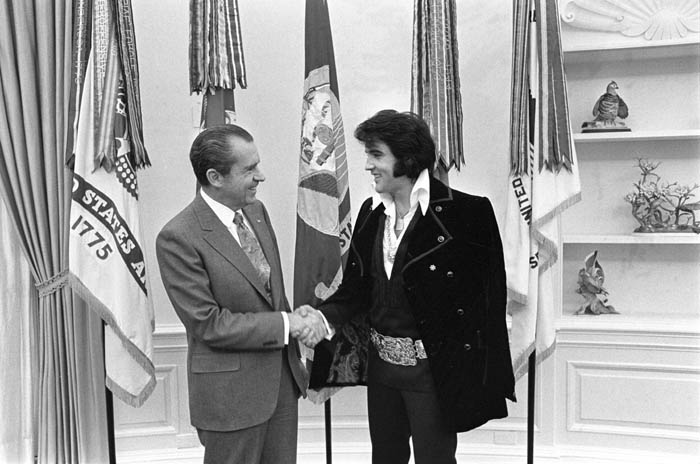
Forty years ago today, Elvis Presley showed up at the gates of the White House with two bodyguards and handed the guards a letter addressed to President Nixon. He said he knew the president was busy, but was hoping he could say a quick hello and present the president with a gift.

One can only imagine the flurry of astonished commentary in the White House when news arrived that Elvis wanted to drop in for a chat. An aide skimmed Elvis’s letter and sent a quick memo to Chief of Staff H. R. Haldeman. “The thrust of Presley’s letter is that he wants to become a ‘Federal agent at large’ to work against the drug problem. . . . Drug culture types, the hippie elements, the SDS, and the Black Panthers are people with whom he can communicate since he is not part of the establishment.” The aide warned that it would be a bad idea to push Elvis off on the Vice President, since “it will take very little of the President’s time and it can be extremely beneficial for the President to build some rapport with Presley.”

While the aide was right that Presley wanted a federal badge, the thrust of his letter was not that he could talk to members of the counterculture. The gist of his note was that, more than anything, he wanted legitimacy. Elvis wanted to achieve the American Dream—not to be rich and famous (although he certainly was), but to be respectable.

Elvis had been an enormously talented young man with pretty moderate ambitions, in part because his horizons were so limited that he couldn’t see beyond stability and respectability. He wanted to take care of his parents; he wanted a job and a nice house. When his career took off, he bought Graceland, and decorated it in the fanciest way he could imagine—not with fine antiques and expensive art, but with a wall of mirrors and a carpeted ceiling.

Elvis seemed to be the epitome of the American dream. And perhaps he was, but not in the way that concept is usually used. As Elvis’s career went upward, his control over his success sloped inversely downward. Elvis’s life made it clear that even a man with such superlative talent could never rise to security without an education and connections. He took his financial advice from his father, a man who went to jail for altering a $4 check. He took career advice from a manager who was taking 50% of his earnings by the time the singer died (the going rate was 10%) and who pushed him constantly to make more and more money. By 1970, Elvis’s talent had become a commodity over which he had little control. Rather than enabling him to achieve the American dream, his ability was destroying him. His grueling schedule had him increasingly dependent on prescription drugs, and his marriage was falling apart.

What Elvis wrote to Nixon was that he craved solid middle-class respectability. “I . . . admire you and have great respect for your office,” he wrote. Countercultural figures might call the president and his advisors “the establishment,” but “I call it American and I love it.” “I can and I will be of any service that I can to help the country out,” Elvis wrote. He and President Nixon had something in common, and the singer made sure to point it out: “I was nominated this coming year one of America’s Ten Most Outstanding Young Men,” “I believe that you, Sir, were one of the Top Ten Outstanding Men of America also.”

Well over a hundred of Elvis’s records had gone gold, platinum, or multi-platinum, but when Elvis met with President Nixon at 12:30, he felt obliged to explain to the president who he was. And he didn’t focus on his music; he focused on the law, respectability, family, government. The first thing the singer did was to show the president his collection of police badges. He gave President Nixon some Presley family photos and a commemorative WWII Colt 45, and warned him that the Beatles had been fomenting anti-Americanism.

Then, as the White House notes from the meeting relate:

“Presley indicated to the President in a very emotional manner that he was ‘on your side.’ Presley kept repeating that he wanted to be helpful, that he wanted to restore some respect for the flag which was being lost. He mentioned that he was just a poor boy from Tennessee who had gotten a lot from his country, which in some way he wanted repay. . . . At the conclusion of the meeting, Presley again told the President how much he supported him, and then, in a surprising, spontaneous gesture, put his left arm around the President and hugged him.”

Nixon’s people managed to get Presley a special badge from the Bureau of Narcotics and Dangerous Drugs. The badge was a symbol of what Elvis wanted, but it couldn’t give him the middle-class respectability that was at the center of his American dream. It couldn’t buy him the economic understanding that would enable him to rearrange his business affairs, or admission to a professional culture of lawyers and agents whose knowledge would protect him from his parasitic manager.

Ironically, it also couldn’t stop Elvis from dying of drugs only seven years later, sad proof that all the talent in the world could not produce success if it were not protected by education and connections.

Monday, December 13, 2010

The Original Live-Blogging: On the Ground with Antinuclear Activists in 1979

Morgan Hubbard

Professionals of all stripes know that some workdays are better than others. Much of the historian's task is tedious and thankless—slogging through reams of records that may or may not be important for the puzzle she's looking to solve, or the argument she's looking to build. Some days end up being totally useless.

Some days, though, are windfalls.

The Alternative Energy Coalition was an alliance of anti-nuclear and environmental activists in New England in the late 1970s. The AEC, together with the better-known Clamshell Alliance, staged a series of “actions” against the Seabrook Station Nuclear Power Plant in eastern New Hampshire. Some were more intense than others, and a few made national headlines. When the AEC dissolved in the early 1980s—members moved to affiliated groups or dispersed—the organization's papers lay fallow. In the 2000s, they were given to the University of Massachusetts-Amherst Special Collections.

Many of the AEC's records are run-of-the mill: mostly catalogs, routine correspondence, heaps of newspaper clippings. But tucked into one folder, fastened unceremoniously with a single staple, was something remarkable, a historian's goldmine: a sheaf of papers on which AEC protesters had logged, hour by hour, the events of a massive blockade action at the Seabrook plant in October 1979. (Click on the image of the log to enlarge.) The document is special not only for the intensity of its scribbled notes (“8:30 a.m., police dogs and water hoses are visible. Action before noon.” “10:00. Verified macing and clubbing.”) It's special because it's a step closer to historical reality than historians can usually get.

Most of the time, we have to reconstruct the past obliquely. But documents like this allow us to witness the past almost as its participants did, play-by-play, on the ground. Obviously, there's much missing from a written account: the smell of teargas, the overhead chop-chop-chop of police helicopters, the fervency of a protest at the height of the anti-nuclear movement's momentum. But documents like this—a live-blogging before there was such a thing—demonstrate that with the right sources, we can recapture some of the potency and urgency of the past.

Wednesday, December 8, 2010

Whiteness and WASPishness

Randall Stephens

Race in America has had a complicated history, to say the least. And in the 20th and 21st centuries, historians have grappled with the subject in a variety of ways. Scholars have analyzed the economic and social underpinnings of race and racism. They've scrutinized the power of race as a social construction. They've looked into how race and racism have changed over decades and centuries. They've examined the long-term effects of race-based slavery . . And they've looked into how "whiteness" developed as a counter to blackness and as a marker distinguishing whites from non-whites.

In 2001 Eric Arnesen wrote a piece on "Whiteness and the Historians’ Imagination" for International Labor and Working-Class History. Historically Speaking published the essay in modified form in 2002. (I remember that this essay was quite useful for me as I slogged my way through historiography in grad school. And it's still a great read today.)

"The weaknesses of whiteness scholarship," observed Arnesen, "are particularly evident in its treatment of a subject that historians of the United States have chronicled for decades—the hostile encounter between Irish immigrants and African-Americans in the antebellum North."

Arnesen continued:

Attempting nothing short of a paradigmatic revolution, whiteness scholars suggest that the necessarily prior question, is 'how did the Irish become white?' To pose this question is to assert that 19th-century Irish immigrants to the United States were not white upon their arrival—that is, they were not seen as white by the larger American society and did not see themselves as white. Over time, whiteness scholars argue, they became white. Yet early and mid-19th-century commentators on the Irish did not speak of whiteness per se but invoked a more diverse discursive apparatus, weaving considerations of religion (which virtually vanish in the considerations of the whiteness scholars), notions of innate and observed character and behavior, and yes, race too into their anti-Irish commentaries. Therefore whiteness historians must assume the role of interpreter, translating the 19th-century vernacular of race and group inferiority into the late 20th-century idiom of whiteness.>>>

In the November 2010 issue of Historically Speaking, Kevin Schultz casts a similarly critical eye on the neologism WASP. In "The Waspish Hetero-Patriarchy: Locating Power in Recent American History," Schultz traces the term's origins and later ubiquity. Some excerpts from his illuminating essay:

According to the Oxford English Dictionary, the term WASP was coined only in 1962, when the civil rights movement required an oppositional force against which it could protest. Rather than simply choose “white” (which would come later, and subsequently destroy much of our historical memory), the social landscape of the early 1960s demanded a more inclusive term. WASP is what social scientists came up with.

What came before WASP as a descriptive term for the dominant American social and cultural presence? During the first three decades of the 20th century, the term “Anglo- Saxon” took on importance as a national social identity. The term has deep roots; the Anglo-Saxons are famed for a 5th-century invasion of the British Isles. But at the beginning of the 20th century there was a need in America for a term that would differentiate the social elite from all others. Anglo-Saxon
served that need. . . .

Today, at the beginning of the 21st century, historians have shown that it has been politically, socially, and economically useful in our society to be seen as white, to possess an identity affiliated with whiteness.9 But for the first three or four decades of the 20th century, whiteness was not enough. One had to be considered Anglo-Saxon to achieve this status. And, like today’s “whiteness,” the phrase “Anglo-Saxon” lost any specific meaning once it be- came a social necessity. Everyone tried to claim it, and it lost all coherence. Webster’s Revised Unabridged Dictionary of 1913, for instance, defined Anglo- Saxon as “a person of English descent in its broad- est sense.” In 1925 Sinclair Lewis described his hero Martin Arrowsmith as “a Typical Pure-bred Anglo- Saxon American, which means that he was a union of German, French, Scotch, Irish, perhaps a little Spanish, conceivably a little of the strains lumped together as ‘Jewish,’ and a great deal of English, which is itself a combination of primitive Briton, Celt, Phoenician, Roman, German, Dane and Swede.” Clearly the definition of Anglo-Saxon had become diffuse, even if the term’s importance had not.

Nevertheless, the abbreviated construction WASP picked up steam in 1963 as the civil rights movement progressed, appearing in that year in the New York Times and the New Statesman, although in each case the editors required a definition of the term to ensure that readers understood what it meant. Daniel Bell also paused to define WASP in his 1964 review of Nathan Glazer and Daniel Moynihan’s Beyond the Melting Pot. By the middle of the 1960s, though, WASP no longer needed an accompanying definition. After just a few years in circulation, everyone knew what it meant. Baltzell himself did a good deal to popularize the term in his 1964 book The Protestant Establishment: Aristocracy and Caste in America.

And we’ve been stuck with WASP ever since. Interestingly, the term became calcified as a permanent part of the American lexicon even as its sociological and historical accuracy demanded further refinement. Instead of continuing to be sociologically useful, it became a type, often to be castigated and derided. One reason for this might be that the sociological utility of all the markers inherent in the word WASP declined precipitously in the middle 1960s. . . .

And yet despite the rise and fall of the recognized power holders, the term WASP has remained calcified in its mid-century conception. Today, it typifies a stuffy type, someone in the cultural and social elite who disdains things popular and dresses preppy. It’s a much-maligned class identity more than it is a sociological descriptor. Indeed, the distinctions marked out by being a WASP are not necessarily bound by whiteness, Anglo-Saxonism, or Protestantism anymore. They signify an attitude and a manner of living. They have become commodified as “preppy” or what used to be called “Ivy League.” Today, it signifies an elitist snoot, a highbrow more than an actual white Anglo-Saxon Protestant. For example, it’s not hard to imagine someone describing the manner of, say, W.E.B. Du Bois—who wasn’t white, Anglo-Saxon, or technically Protestant—as being WASPish.

Read more of Schultz's interesting critique here.

Thursday, August 12, 2010

Roundup: Historians

Neal Ascherson, "Liquidator," London Review of Books, August 19, 2010.

Seven years after his death, Hugh Trevor-Roper’s reputation is still a cauldron of discord. He would have enjoyed that. Steaming in the mix are the resentments of those he expertly wounded, the awe of colleagues at the breadth and depth of his learning, dismay at his serial failures to complete a full-length work of history, delight in the Gibbonian wit and elegance of his writing and – still a major ingredient – Schadenfreude over his awful humiliation in the matter of the Hitler diaries. >>>

"Cambridge University connects communities with Domesday," news.bbc.co.uk, August 10, 2010.

When William the Conqueror wanted to consolidate his power over his new English subjects he created the Domesday Book.

It was a comprehensive list of who owned all property and livestock.

Now Cambridge University historians have digitised the information in an interactive website.

"It's possible for anyone to do in a few seconds what it has taken scholars weeks to achieve," said Dr Stephen Baxter, a co-director of the project.

PASE Domesday was launched on 10 August 2010 and is the result of collaboration between scholars from Cambridge University and King's College, London.

Tax collection?

The Domesday Book was collated between 1085 and 1086.

Most historians believe it is some sort of tax book for raising revenue.

Dr Baxter, a medieval historian from King's College, London, has a different theory.

He argues its real purpose was to confer revolutionary new powers on King William.

"The inquest generated some pretty useful tax schedules," he explained. "But the book gave him something altogether more powerful." >>>

Daniel Hernandez, "Mayas protest monument to Spanish conquistadors," La Plaza, LA Times blogs, August 11, 2010.

The city of Merida on Mexico's Yucatan peninsula is reviewing a petition to remove a recently built public monument to the city's colonial founder, a figure whom some indigenous Mayas regard as a violent conquistador. The municipal government accepted the petition from a coalition of Mayan organizations to reconsider the monument and statues depicting Francisco de Montejo, known as "El Adelantado," and his son, also named Francisco and known as "El Mozo." The younger Montejo established Merida in 1542, on the site of the former Maya city of T'ho. >>>

"Tony Judt, Historian And Author, Dies At 62," NPR, August 8, 2010.

Much to his presumed irritation, historian Tony Judt, who died on Friday, might be remembered for one word: anachronism.

That's what he called the idea of a Jewish state in Israel in a widely read essay in the New York Review of Books. But Tony Judt was, first and foremost, an intellectual historian.

His book Postwar, about the history of Europe after 1945, became an instant classic. And he made it his mission to try to unpack the nuances of 20th-century history. >>>

Faye Fiore, "Guardians of the nation's attic," Los Angeles Times, August 8, 2010.

When Paul Brachfeld took over as inspector general of the National Archives, guardian of the country's most beloved treasures, he discovered the American people were being stolen blind.

The Wright Brothers 1903 Flying Machine patent application? Gone.

A copy of the Dec. 8, 1941 "Day of Infamy" speech autographed by Franklin D. Roosevelt and tied with a purple ribbon? Gone. >>>

Monday, June 7, 2010

Dispatches from the Historical Society Conference, Day 3: Plenary Session on America's Enduring Two-Party System

Randall Stephens

The Historical Society's 2010 conference came to a close at George Washington University with a final plenary session on Saturday night dealing with the nature of America's two-party system. (Listen to the audio file embedded below. It will take a moment to load. The quality is not the greatest, but the words can be made out OK.) Heather Cox Richardson (University of Massachusetts Amherst) introduced Michael Barone (American Enterprise Institute), who spoke on “The Enduring Character of America’s Political Parties in Times of Continual Change.” These two parties, ancient in the world of modern politics, have long diverged sharply, said Barone. Some deeply consistent themes have defined the Democratic and Republican parties since the mid-19th century. The two distinct parties represent very different constituencies and have, since the 19th-century, upheld rather distinct political ideas. For instance, Barone described the outsider aspect of the Democratic Party, which tended to represent immigrants, saloon keepers, and many on the margins. The party of Roosevelt, populated by interest groups and factions, Barone remarked, lacked the cohesion of the Republican Party.


Commenters Sean Wilentz (Princeton University) and Leo Ribuffo (George Washington University) both praised Barone's extensive knowledge of political history, but each had serious critiques of Barone's key arguments. Ribuffo thought Barone overemphasized the differences between the parties. The two parties were, argued Ribuffo, less like a donkey and an elephant and more like kissing cousins, even incestuous cousins at times. Wilentz argued that Barone had not paid appropriate attention to class. Wilentz and Ribuffo also questioned Barone's insider-outsider thesis. The white democracy of the South hardly fit that pattern. At other points the commenters took issue with the continuities Barone saw.

The lively discussion was a fitting end to an intellectually engaging, vibrant conference that gave attendees much to ponder about the state of the profession and the future of historical inquiry.