Search This Blog

Showing posts with label church and state. Show all posts

Saturday, March 5, 2011

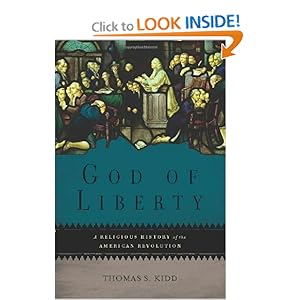
God of Liberty -- Review

GOD OF LIBERTY: A Religious History of the American Revolution.  By Thomas S. Kidd.  New York:  Basic Books, 2010. 298 pages.


It seems as if the debate over whether the Founders of the American Republic were secular Deists or Evangelical Christians will never end. Both sides marshal “evidence” to support their contentions, but reality might be much more complex than the partisans would have us believe, with early Americans ranging from strict separationists to advocates of state establishment. Thomas Paine, who had been an important publicist for the Revolution, wrote strongly worded denunciations of Christianity, while Patrick Henry and Samuel Adams defended the primacy of traditional Christian piety and practice. In God of Liberty, historian Thomas Kidd helps us sort out the complexities so that we can enter the contemporary debate on firmer ground.

A professor at Baptist-sponsored Baylor University, Kidd is sympathetic to the religious voices present at the time, as the blurbs by leading Evangelical historians Mark Noll, Harry Stout, and George Marsden, affirm. Like these esteemed historians, Kidd believes that religion played an important role in the nation’s founding, but they also are in agreement that there were a variety of voices and concerns present in the founding era, and therefore it is important to get the story right.

Kidd covers a period that stretches from the French and Indian War to the early decades of the 19th century, a period in which the last established faiths were disestablished. Standing at the center of this presentation is Kidd’s contention that Enlightenment Rationalists such as Thomas Jefferson and evangelicals such as John Leland believed that every citizen is entitled to religious liberty. The two parties may have had differing reasons for their espousal of religious liberty, but their shared belief that that a government established religion inappropriately impinged on one’s freedom of conscience proved to be foundational to the American experiment.

It was a common belief that religion played an essential role in defining the moral foundation of society. John Adams and George Washington, neither of whom was especially orthodox, believed that religion played an essential role in preserving moral virtue and respect for authority. We sometimes think of the Enlightenment providing a rather optimistic view of humanity, but the Founders were not sure that their fellow citizens were ready for self-government, so they took steps to keep a balance of power between the Federal branches of government and between states and the Federal government. There was the belief that no one entity should be given too much power. It is in light of this fear of human avarice that we need to hear the debate over disestablishment. Advocates of establishment, such as Samuel Adams (Congregationalist) and Patrick Henry (Episcopalian), believed that disestablishment would lead to societal disintegration, and therefore fought to uphold the status quo. Jefferson and Leland on the other hand believed that religion played a central role in upholding the moral foundations of society, but they believed that religious establishments were by nature coercive and ultimately corrupted both religion and government.

The First Amendment, therefore, emerged as a means by which the twin concerns for promoting virtue and liberty could be sustained. Kidd suggests that this Amendment was a “triumph for both the dissenting evangelicals and the Enlightenment Rationalists.” He goes on to say that these “two socially and theologically disparate groups each did its part to prevent America’s national government from practicing religious persecution or giving preference to one religious group at the expense of others” (p. 225). Interestingly, the chief opponents of the Constitution and the First Amendment were people who feared that the new system might “prove hostile to the interests of Christianity” (p. 226).

The history of the nation’s founding demonstrates that even if religion wasn’t the driving force of the revolutionary era, religion still played an extremely important role in the developments of the era. Some of the decisions were pragmatic in nature, so that disestablishment may have occurred at the federal level, but it took considerable time before the states were completely disestablished. In addition to acknowledging the pragmatism of many of the Founders, we must also acknowledge the presence of anti-Catholicism in this era. Another factor that we often miss in our debates is that disestablishment occurred in the South before it occurred in New England. This was due in part to the tenuous hold of Anglicanism on this region. Congregationalism faced fewer rivals in New England and so the process took longer, but even there the movement toward disestablishment couldn’t be halted.

Although defenders of establishment feared that disestablishment would prove hostile to Christianity, in the end they discovered that it encouraged religious practice and even reinforced public virtue. There seemed to be a common belief that a divine hand was involved in the nation’s founding, even if not everyone agreed as to the full identity of the God who ruled providentially over the land. Unfortunately, providentialism had a dark side, because “if God is on your side, then how can you be wrong?” (p. 251).

Although providentialism -- including it's dark-side -- marked American self-understanding, there was, according to Kidd, another key driver in the American self-understanding.  He believes this idea was even more powerful in the development of American ideals than providentialism, but it too was rooted in the nexus of faith and freedom.  This idea is "equality by creation."  This belief first undermined the ideas of aristocracy and hierarchy, opening up new vistas for everyone, but it also proved to be damaging to institutions such as slavery. 
With a century of political philosophy crystallized in the Declaration of Independence's soaring claim of human equality, revolutionary Americans came to the conviction that because God created everyone, all persons were fundamentally equal before him.  This belief immediately threw the legitimacy of slavery into a state of profound moral doubt. (p. 252).
Change didn't happen overnight, and it would take a war to rid the nation of slavery, the seeds of its destruction were planted in this belief that equality is rooted in creation.  Of course, this discovery led some, including Jefferson to ponder whether or not Africans were of the same created order.  Still in the end the seed was planted.
Although many political progressives would like to hang on to the idea that the Founders were, with a few exceptions, secularists and at most Deists, this book can help those of us who believe in the importance of recognizing the value of religious pluralism engage in a more nuanced and effective conversation about the role of religion in the public square. Perhaps the most helpful aspect of the discussion is Kidd’s reminder that the religious freedoms we have today come to us because of an unlikely partnership between Enlightenment rationalists like Jefferson and dissenting evangelicals such as John Leland. Understanding this partnership may help change the tone of the debate, and it’s for this very reason that this is an important book for Progressives to read.


A slightly expanded version of review posted at The Progressive Christian


Wednesday, September 15, 2010

Using and Abusing History for Political Gain

When people don't know their history, it's easy for others to twist it to their own ends.  And twisting of history is done across the board, from left to right.  But at this point in "history" the most egregious abuses of history are coming from the right, especially the Christian Right. 

People like David Barton make a living taking truths and facts and twisting them to suit their own needs.  At the same time, on the left, there are those who in answer swing the pendulum to the other side. 

History gets twisted for two reasons -- most Americans don't know much about history.  History is considered passe and boring -- and truth be told many history teachers, especially in high school, tend to be boring.  In part that's because schools don't value history, since it's not on the standardized tests, so why hire the brightest and best historians, when you have a coach needing to fill time (a pet peeve of mine -- though by and large my HS history teachers were pretty good, even if they were coaches).  

Well, as many of you may know, Glen Beck has stepped into the Christian Nation arena -- though his "orthodoxy" should be suspect to many of his followers.  At his recent rally he announced the formation of a "Black Robe Brigade," a reference to a term used by British soldiers for clergy who backed the American Revolution.  Well, now that we're to embrace all things patriot, let's get the clergy involved.  And so, Beck announced that he had recruited an ecumenical band of clergy in support of his cause to take back America -- something that sounds strangely familiar to campaigns of the 1970s. 

So, what should we make of all of this?  I appreciate Scot McKnight giving his Jesus Creed column over to historian John Fea of Messiah College.  Fea who has a new book out, one that I've just learned about, which deals with the Christian America phenomena.  Entitled Was America Founded as a Christian Nation: A Historical Introduction, it should help answer some of the continuing misinformation. 

In this essay, Fea offers a cogent response to the ruckus, noting that there is truth to some of the statements, but they're half-truths since they don't deal with the other side of the question.  He notes for instance that few of the Founders were pure Deists, but many were Unitarians.  Just because Washington uses God in speeches doesn't mean that Washington believed that the United States was a Christian Nation, and just because Woodrow Wilson declared America a Christian Nation, doesn't mean that he is correct in his assessment -- at least theologically.

John Fea writes:

There is a lot of misinformation out there.  Not everything Barton, or Peter Marshall, or the Genesis of America people say is wrong, but it is twisted and presented in such a way that does not account for the complexity and fullness of the past.  Historians concerned with the integrity of the past and the integrity of their work must also note that John Adams rejected the doctrine of the Trinity.  They should mention that George Washington deliberately avoided taking communion.  They must also tell the whole truth about the so-called “Black Regiment.” Most of these clergymen were blatantly anti-Catholic.  Others blurred Biblical teachings on freedom (from sin) with political teachings on freedom (from George III).  These Christian America pundits tell just one side of the story because the so-called “rest of the story” does not suit their political needs in the present.  This is what I mean by indoctrination by historian example.  This is history at its worst!
We who are historians and we who are clergy need to know our history, and be able to help our people understand the nuances of history.  America at its founding was neither as secular as some on the left would have us believe, nor as evangelical Christian as others on the right would have us believe.  It's likely that many of the Founders would be quite happy to worship in our more liberal churches, but that's really not the point.  What is most important is that we must not allow history to be left to the hands who would use it simply for purposes of indoctrination!

Monday, July 12, 2010

Reporting on the God Gap -- Sightings

Whatever you may think of the relationship between religion and politics, there has always been a conversation between the two sectors of society.  Politicians and people concerned about public policy are always looking for allies in the religious community, and religious folk have often sought to influence public policy.   Martin Marty, who has devoted a lifetime to exploring this relationship, comments on a new study of this relationship, one that focuses on Catholic and Protestant faith traditions, a study that notes the complexity of these two faith traditions.  I think you'll find this interesting, as the public square isn't nearly as naked as some would think, and the Christian vote isn't as monolithic as some would want us to think!  

**************************************

Sightings 7/12/10


Reporting on the God Gap
-- Martin E. Marty


“A New Roadmap for Reaching Religious Americans on Public Policy Issues” is the subtitle for Beyond the God Gap, a 49-page report and chart for those who are trying to find their way among religious groups as they show up in politics and culture. The co-agents are think tank Third Way and the Public Religion Research Institute, whose regular issuances are useful for those who would “reach” and also those who “observe” religious Americans. The authors of Beyond the God Gap do know that there are non-religious folk and forces out there, but in their minds they cannot be “reached” efficiently on public issues. Forget the “new atheists” then, for a moment, as the authors of this report do.

What is more, while both of the sponsors of this project have interests in all religions, Beyond the God Gap deals only with Christians. The surveyors know that the varieties of Jews and Muslims are also reaching and being reached on public policy issues, but the topic for the Third Way and PRRI is “Catholics” and “Protestants.” What is clear from this and countless other opinion surveys is that the old standard typified by Will Herberg’s 1955 classic, Protestant, Catholic, and Jew, would be almost useless in changed America. What Herberg called “Protestant” stood for “White Mainline Protestants” (WMPs). He hardly noticed what today are termed “White Evangelical Protestants” (WEPs) or “African American Protestants” (AAPs). These are the two groups where the “reaching from and to” is most strenuous, effective, and controversial today.

Quick, now: Think of the few times when cable news dealt with “White Mainline Protestants” on public issues. We can foresee one, as the Presbyterian General Assembly soon will debate topics relating to Palestinians and Israelis. Another has to do with conflict over gay marriage and ordaining homosexuals. For the rest, dealings with WMPs are mainly diversions as politicians and public figures court or avoid WEPs and AAPs, who encamp in sufficiently definable identity sectors to warrant attention. Even here, Beyond the God Gap has to parse things somewhat more finely – for example, where they find substantial differences between young versus middle-aged WEPs on homosexuality and other such fronts of controversy. It is also clear that there is no simple “Roman Catholics” group, since left and right factions there differ so much from each other that politicians using this road map might well drive into the ditch, and certainly will hit potholes. AAPs are somewhat more predictable when it comes to addressing public issues, or being reached. Most still vote Democratic and get cast as “liberal,” but their part of the map is also increasingly diverse.

The authors of this report say they set out to shatter stereotypes simply by interviewing citizens and finding where their loyalties and goals may be. Add up these diverse groups, and it is easy to see why three-fourths of the road-mapped groups resent it when some WEPs claim that theirs is “The Christian vote,” and when mass communicators sleepily suggest that when polled majorities among white evangelicals are interviewed as they exit voting booths, they should have a monopoly on the term “Christian,” as in “the Christian vote.” They are claiming too much, and the members of the media who grant them a monopoly do the surveys, the faiths, and social scientists a disservice. Beyond the God Gap will help with more accurate reporting, and give the public a better picture of how the religious groups line up at the polling places. The old model won’t work. A significant power shift has already occurred.

Martin E. Marty's biography, current projects, publications, and contact information can be found at http://www.illuminos.com/.


----------

In this month's Religion and Culture Web Forum ("The Primacy of Rhetoric"), Marty Center Senior Fellow (2009-10) W. David Hall addresses the centrality of rhetoric in the Western humanist tradition by engaging the work of Ernesto Grassi, whose commentary on the Renaissance, especially, diverged from standard Platonic models of interpretation to include arts such as rhetoric, literature, and poetry. Of especial interest for Hall is Grassi's "retrieval of the humanist tradition" during this era and the possibilities that thorough understanding of such a retrieval opens more broadly in the fields of philosophy and religious studies. With invited responses from Andrew Hass (University of Stirling), Jeff Jay (University of Chicago), Santiago Pinon (University of Chicago), Donald Phillip Verene (Emory University), and Glenn Whitehouse (Florida Gulf Coast University).


----------

Sightings comes from the Martin Marty Center at the University of Chicago Divinity School.

Saturday, May 29, 2010

The Faith Based Initiative and Congregations

I remember back when President George W. Bush proposed and saw implemented his Faith Based Initiative.  At the heart of this proposal was that the government would open up funds to be used by faith-based institutions, including local congregations, so that they could be alternative deliverers of social services.  I remember that our clergy group in Santa Barbara, made this a focus of conversation, dedicating one meeting to exploring it.  I went out and got as much information as I could (I was the President of the Greater Santa Barbara Clergy Association at the time) to distribute.  We had a guest presenter who was working with faith based initiatives come and speak to us.  We batted it around, wondering what it would mean for us and the communities.  We were in agreement that congregations should be involved in social service, but we were not all certain as to the implications of the project.

Well, it's been nearly a decade since that Office of Faith-Based  and Community Initiatives was formed.  Over the course of time, a number of the people brought in to lead it left their positions, discouraged at the way in which the Administration wanted to use it for political gain.  When President Obama came into office, he kept the office, but sought to reform it some and provide more funds for the initiative.  But while faith communities remain committed (or at least a good portion) to social service, the question remains -- what impact did it have? 

Yesterday, my copy of the Christian Century arrived in the mail, and the cover story is entitled:  "Thanks, but No Thanks:  Congregations and government funding."  The article, which is written by Duke Divinity School's Mark Chaves, offers an assessment.  His assessment from studying the data -- he's a sociologist of religion who conducted a major survey of US congregations -- is that it didn't really change the habits and activities of local congregations.  The program did raise the levels of conversation about such funding, but didn't actually eventuate into much in the way of increased activity.  

As Chaves examines the data, he concludes that the formulators of this project started with certain flawed assumptions.  What they misunderstood was the nature of involvement of congregations in social service.  They assumed that congregations could be alternative deliverers of service, and that all they needed was a bit of help in getting grants.  The problem is that there really isn't any congregation based alternative system of social welfare.  Most congregations participate in already existing networks of providers.  A good example would be our congregation's involvement annually in a local homeless shelter.  For one week each year we partner with another congregation to host or assist in hosting a rotating shelter.  It services about 30-50 people.  We provide a place to sleep and meals.  But we participate in a larger project that has no religious ties, and we only serve a small portion of the county's homeless population.  Consider Chaves's comment:

The faith-based initiative failed to change congregations in part because it tried to bypass existing networks and support systems in favor of putting resources into one small part of those systems.  Congregations are usually a part of these networks and systems; they rarely stand separate from them.  A better informed faith-based initiative would focus on building up the social service delivery network as a whole. (Chaves, Christian Century, June 1, 2010, p. 24).
 
The second mistaken assumption was the belief that congregations "represent a vast reservoir of volunteer labor."   Chaves writes that congregations are good at mobilizing people, but only if the tasks are well defined and on a periodic basis (like our involvement in the homeless shelter).  He writes

Congregations are good at mobilizing 15 people to spend several weekends renovating a house, or getting five people to cook dinner at a homeless shelter one night a week, or organizing ten young people to spend two weeks painting a school in a poor community. (Chaves, Christian Century, June 1, 2010, p. 24) 
The key is well-defined and short periodic efforts.  Asking congregations to organize and staff long term, ill-defined projects doesn't work so well.  Thus, we're great at working with Habitat for Humanity or providing relief support as with Katrina or Haiti.  Even if every church truly understood itself to be missional and devoted considerable effort and expenditure to outreach efforts, it's likely that they would become true alternatives.  What we're able to do is help support and extend those broader efforts provided by nonprofits and governments.  If people really want to get churches involved, then it's probably best to find ways of using their resources well -- and that means finding ways to mobilize small groups of volunteers for specific tasks.  It might be less exciting and less headline grabbing than trying to create an alternative mode of social service delivery, but it's likely to be more successful.

Wednesday, May 5, 2010

Harry Truman's National Day of Prayer Proclamation

In the 1950s America was gripped by fear that Communism might take over the world.  The world was divided into two and a Cold War began.  What had been allies were now bitter enemies, seeking to carve up the world between them.  On one side stood the godly folk and on the other the ungodly.  During this era the words "under God" were added to the pledge of allegiance, and the first annual proclamations of a National Day of Prayer were established.  The first came from the pen of Harry Truman.  Note that while there are statements that reflect the fact that Christians are the majority ("year of our Lord" and "churches" there is nothing explicitly Christian about this proclamation.  Note too that it was made at the direction of Congress.  Note as well that nothing is said here about gathering at government buildings or sites for observances -- but rather in  churches, in homes, and in hearts.  Pray as you deem fitting.  

**********************************  


June 17, 1952

By the President of the United States of America
A Proclamation

Whereas from the earliest days of our history our people have been accustomed to turn to Almighty God for help and guidance; and

Whereas in times of national crisis when we are striving to strengthen the foundations of peace and security we stand in special need of divine support; and

Whereas the Congress, by a joint resolution approved on April 17, 1952 (66 Stat. 64), has provided that the President “shall set aside and proclaim a suitable day each year, other than a Sunday, as a National Day of Prayer, on which the people of the United States may turn to God in prayer and meditation”; and

Whereas I deem it fitting that this Day of Prayer coincide with the anniversary of the adoption of the Declaration of Independence, which published to the world this Nation’s “firm reliance on the protection of Divine Providence”:

Now, Therefore, I, Harry S. Truman, President of the United States of America, do hereby proclaim Friday, July 4, 1952, as a National Day of Prayer, on which all of us, in our churches, in our homes, and in our hearts, may beseech God to grant us wisdom to know the course which we should follow, and strength and patience to pursue that course steadfastly. May we also give thanks to Him for His constant watchfulness over us in every hour of national prosperity and national peril.

In Witness Whereof, I have hereunto set my hand and caused the Seal of the United States of America to be affixed.

Done at the City of Washington this 17th day of June in the year of our Lord nineteen hundred and fifty-two, and of the Independence of the United States of America the one hundred and seventy-sixth.

How Will You Observe the National Day of Prayer Tomorrow?

From the Detroit Free Press -- William Archie
There is an article in the Detroit Free Press today that discusses the National Day of Prayer.  It asks the question of whether the US is a Christian nation and what that means.  I have one quote and a picture in the article -- in which I note that I'll be observing it in interfaith fashion, as should be true of a pluralistic nation. 

It is interesting that Sarah Palin gets major billing, but then she was up north of here speaking to an ultra-conservative Christian gathering.  But, the article ends with a quote from a local rabbi, and I think he gets it just about right:

"Of course America is not a Christian nation," said Rabbi Daniel Syme of Temple Beth El in Bloomfield Hills. "The founding fathers created a wall of separation of church and state. Not just a curtain -- a wall. And why? Because they were wise enough to know that if they were creating a country that would be... open to the dreams of people throughout the world, then those individuals had to be free to pursue their own faith."
I will be posting more today and tomorrow about this.  I will be sharing in an interfaith service sponsored by the Troy Interfaith Group  -- at First Presbyterian Church on Livernois Street, here in Troy.