Search This Blog

Showing posts with label Call to Ministry. Show all posts

Wednesday, March 16, 2011

What is your Calling?

What is your calling?  How did you receive your calling?  If you look in the Hebrew Bible, more often than not, when God called, the people at first said -- send someone else.  Moses said -- I can't speak well, so God said -- take along Aaron, he can talk for you.  Jonah receives the call and runs the other way.  Jeremiah said -- I'm but a boy.  In every case God seems to have an answer to the attempt to put off the call.

But how does a call come?  I didn't hear an audible voice, but I think I knew from early on a direction (though I framed it differently than time would reveal).  I can say with some surety that when I decided to pursue the M.Div. and ordination I didn't have parish ministry in mind.  I was going to be a theological educator.  That was my calling!  And yet, here I am, in my 26th year of ordination and in my 13th year as pastor of a congregation. 

All of this leads to my sharing of a video of Martin Marty sharing his sense of what it means to receive a call to ministry in the Christian community.  He notes that traditionally it has been assumed that God calls through the community (the church), but in his conversations with people entering ministry, it would be better to say that God calls "through billions of particulars."  I think he may be right.  I invite you to watch, consider, and add your own sense of what it means to be called.  The video comes from the What's Your Calling? -- a movement/organization inspired by a PBS miniseries -- The Calling


Thursday, March 10, 2011

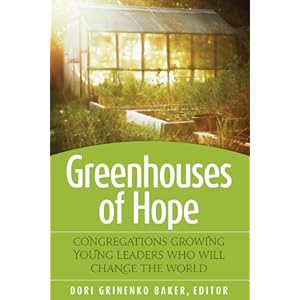
Greenhouses of Hope -- Review


From where will the leaders of the church tomorrow emerge? More specifically, in what context will the gifts and callings to ministry of the church’s future leaders be nurtured? The answers will be found in local congregations, both large and small, where seeds of faith are planted and visions of service are nurtured. Although there are many cases of this happening without intentionality – with young people catch a vision and pursue a calling, even if the local congregation and its clergy are uninvolved and unaware of their callings – there will be greater benefits to the church and to the world at large if congregations intentionally commit themselves to discerning and supporting calls to ministry. These kinds of communities are, as the title of this book suggests, “greenhouses of hope.” These are places where young leaders emerge, desiring to join with God in changing the world.

Dori Baker, the editor of this collection of essays, defines a “greenhouse of hope” as a “Christian congregation freeing itself to experiment with both newly imagined and time-honored ways of following the path of Jesus.” These congregations seek to “embrace the gifts of youth and young adults,” with the view toward young leaders emerging from their midst (p. 2). The book – Greenhouses of Hope – is the culmination of Baker’s quest to discover vital congregations committed to this cause of raising up the next generation of leaders. In the course of her studies of congregations she was looking for the diverse ways in which congregations take up this calling of nurturing a vision of ministry. What results from this work is a series of ethnographic studies, some of which Baker wrote, and some that other scholar/practitioners offered. What we see are “detailed observations of the ways of life of a particular people in order to learn about them, from them, and with them” (p. 3).

Baker is a United Methodist who serves as scholar-in-residence to the Calling Congregations initiative of the Fund for Theological Education. The other contributors to the book are primarily United Methodist, but there are also Presbyterian and AME Zion representatives as well. These other contributors help provide a broader ethnographic picture of congregational practices that nurture faith and visions of service. What we see in these studies is the way in which mission trips, youth mentoring younger children, interfaith engagement, close community that provides a safe place for youth to ask questions and explore vocations, providing a strong sense of empowerment with accompanying opportunities to share in leadership in a particular cultural context (African American), and interestingly enough, even in the midst of conflict. What one finds in common to all of these communities is that they are with some degree of intentionality giving young people opportunities to take leadership, explore their gifts and callings, and affirming them in the process – even if the congregation itself is struggling with conflict.

In laying out this study, according to Dori Baker, the authors sought to keep in balance two seemingly paradoxical perspectives. First, they were interested in young people who were inclined to answer a call to professional ministry, believing that the church has something to offer to the world. She writes:

We want to see bright, creative, innovative young people answering a call to be pastors and preachers who will, in turn, help shape the imaginations and vocations of others. (p. 6).

At the same time the authors of these studies were convinced that “Greenhouses of Hope” could and should nurture callings to purposeful lives among all the young people. That is, through their baptism, all Christians are called to lives of ministry. Therefore, the expectation is that the imaginations and callings of all the people would be stirred and nurtured, even if only some of this number answered the call to professional ministry. The belief is that “People formed by congregations that care about vocation learn to find ways that all of their work in the world can be connected to their call as Christians” (p. 7).

In the opening chapter of the book, Baker explores the image of the greenhouse. The image emerged from a set of abandoned greenhouses that a neighborhood group purchased and renovated. These greenhouses had been built to house roses, but now the new owners pulled out the debris, put in new soil, and planted new flowers, fruits, and vegetables. One of the greenhouses was even renovated to raise a special rose that was found still living within the old greenhouse. What an image that is – something old and now wild was nurtured to health and productivity. There was, however, one greenhouse that didn’t get renovated. Roses still grew there, without fertilizer or care, its only nourishment being water seeping through cracks. These roses continued to grow, bursting through the ceiling of the old greenhouse. But, this happens in spite of many obstacles. And here is the metaphor, the image that drives the conversation. Baker writes that “God will call young lives, with or without the help of congregations.” God will not be left without a witness, but how much better it is when congregations cease being obstacles, and instead commit themselves to being places of nurture and hope, so that young people needn’t be “left to eke out their calling solo, but rather were given the best of their community’s resources of attention, love and nourishment toward their vocational flourishing?” (P. 11). And yes, even “old growth” churches, churches that have been around for generations can and should be places where this nurturing process takes place.

Throughout the book, the authors align their observations around four practices, which carry the acronym CARE. Greenhouses of Hope “Create hospitable space to explore Christian Vocation; Ask self-awakening questions; Reflect theologically on self and community; and Explore, enact, and establish ministry opportunities (p. 30). Each of these practices is important and even essential to the effective nurturing of calls to service.

Each of the chapters offers a look at a specific form of space or action, but one that I found especially intriguing, in large part because it’s culturally different, but maybe very culturally relevant for many of our smaller churches. Sinai Chung writes of a Korean Presbyterian Church that engages in what the author calls mozying. This practice is named after the Korean word for older siblings. The concept that has taken root in this particular congregation is that the older children/youth/young people help care for the younger ones. That is, the older ones mentor the younger ones. The need emerged from the transition from first to second generation Koreans, and the need to help second generation Koreans engage in congregational life. This practice is characterized by a belief in “intensive and genuine sibling love.” It is rooted in an intimacy between the younger and the older. Second, unlike most other mentoring relationships, both benefit. Finally, the practice is “highly contagious.” That is, it leads to chain reactions among all age groups. Although this particular practice has its own cultural roots, it has great potential as a model of making a space for ministry practice and spiritual growth.

In her concluding essay, Melissa Wigington summarizes the various models that had been explored earlier, and offers important reflections. She warns, rightly against the tendency to tokenism – something that occurs in every church. We try to get young people on boards and committees, just to say we’ve done it, without any real thought about the spiritual welfare and development of these young people. She notes as well three common themes that emerge from these ethnographic studies – in each context intergenerational relationships are valued and nurtured, young adults and youth are given authentic roles in the life of the church, and present in each are “embodied spiritual practices that connect lived experience with the holy” (p. 195).

The greenhouse is a safe place to grow and experience life in ministry, but as Wigington points out, eventually these plants have to take root outside the safety of the greenhouse. Issues such as delayed adulthood and the economic realities of the day affect the way in which young adults are able to navigate their world. They face the prospects of burnout, not being able to find themselves, and sometimes having too narrow a vision of the world, and thus feeling trapped by these commitments. What these greenhouses must do is help prepare young adults to be resourceful and open to new opportunities so that they can navigate the world that they inhabit. And their ability to do so will be rooted in those four practices that carry the acronym – CARE.

This is a most helpful and encouraging book, especially for churches that are willing to embrace a call to nurture the ministry gifts of their children and young people. It is a good reminder that congregations can either be obstacles or encouragers. Each of the studies opens vistas that might prove helpful in a particular context. The chapter on churches in conflict allows us to see that even when churches are not healthy, they can still be places where callings are intentionally nurtured, even if difficult to maintain. Dori Baker is to be commended for drawing together a team that can provide Mainline churches seeds of hope for the future.

Wednesday, January 19, 2011

Freedom from Darkness -- A Lectionary Meditation

Isaiah 9:1-4


1 Corinthians 1:10-18

Matthew 4:12-23

Freedom from Darkness

Christina Rosseti’s hymn of Christmas(1872) describes the feeling that many have at this moment of time – it might be winter blues, but it’s more than that. There is a cloud that hangs over the globe. Economic disarray, warring parties, weather-related disasters, and of course the-all-to-fresh memories of the tragedy in Tucson, all are on our minds and hearts. 
In the bleak midwinter, frosty wind made moan,
Earth stood hard as iron, water like a stone;
Snow had fallen, snow on snow, snow on snow,
In the bleak midwinter, long ago.

The promise of the hymn is this:

Our God, Heaven cannot hold Him, nor earth sustain;
Heaven and earth shall flee away when He comes to reign.
In the bleak midwinter a stable place sufficed
The Lord God Almighty, Jesus Christ.
Although we may experience darkness, the promise of Epiphany continues to speak to us, offering us a word of hope. That word of hope is this – the light that is God’s presence in the person of Jesus the Christ is shining in the darkness. Yes, the clouds are lifting, and hope is returning. This is a message that lies before us, one that beckons us to pick up and share – God’s realm is breaking into our world, bringing freedom from darkness and oppression. Will we then join with God in making God’s reign visible on earth as it is visible in heaven?

Of the three texts that the lectionary provides for this week, two are directly linked. Matthew reflects upon Isaiah’s prophetic word to provide context for Jesus’ own ministry. His decision to move from Nazareth to Capernaum, along the Sea of Galilee, after the arrest of the John the Baptist, is linked directly to Isaiah’s word of hope to the land of land of Naphtali and Zebulun, in the Galilee of the Gentiles.

Isaiah’s word of hope, a word that we last heard in an extended passage on Christmas Eve, says to the people of Jerusalem, who in the 8th Century B.C.E., suffered under the oppressive rule of the northern kingdom of Israel, who in turn faced harassment from Damascus because Israel and its client in Judah chose not to participate in an alliance against a weakened Assyria. The word that comes from the prophet speaks of light shining in the dankness, and as a result the people of the nation of Judah can now rejoice as if they are at a Harvest Festival or perhaps better (in this context) sharing in the plunder of their enemies. Yes, God has reached out and expanded the nation, lifting the yoke of oppression from their shoulders, even as Gideon broke the hold of Israel’s earlier enemies (Judges 7:19-25).

Matthew sets Jesus’ decision to move to Capernaum in this earlier historical context. John has been arrested and so his voice that prepared the way for the reign of God had been silenced. Jesus, who seems to have returned from the Jordan and his temptation in the wilderness to his home in Nazareth goes to the sea and takes up John’s mantle, and begins proclaiming a message of repentance, for the kingdom of heaven is near. Or, as it reads in the Common English Bible – “Change your hearts and lives! Here comes the kingdom of heaven!”

This is the message that light – God’s realm – is about to make itself felt in a world that is enshrouded in darkness. Therefore, where once the people stumbled around in the dark, unsure of where they were going or what they should be doing, now they can walk along a pathway light by the light that is Christ. As we consider this word, it’s appropriate to note that in Matthew’s quotation from Isaiah, he makes it plain that the message is to reach the Gentiles of Galilee. Thus, we’re reminded that God was and is expanding the borders of the realm of God – just as Isaiah suggested centuries earlier!

The passage from Matthew closes, much as the passage a week earlier from John 1 closed, by describing the call of Jesus’ first disciples. In this case Jesus finds Simon and Andrew casting their nets in the lake, and he calls on them, inviting to “follow me, and I will make you fish for people.” Then, he spies James and John, sitting in a boat with their father Zebedee, mending nets, and Jesus calls them. In both cases the two pairs of brothers jump up immediately, drop what they were doing and they follow Jesus. Unlike the Andrew in John’s gospel, no one asks Jesus where’s he’s going or where he’s staying – they just go with him. I’m always amazed at the way this text is constructed. No thought, no consideration, no planning, just going and doing. It’s so unlike me. I need at least a few weeks to get ready. But, they go and they accompany Jesus as he traveled through Galilee, teaching in the synagogues, proclaiming the good news of the Kingdom of God, and curing every disease and sickness. In this we see described the very essence of Jesus’s ministry – that of itinerant evangelist and healer. He could easily become Elmer Gantry, and yet he doesn’t.

Finally we come to Paul’s words to the Corinthian Church. I left this passage to the last for a reason. In Isaiah and Matthew we see the foundations laid for Jesus’ ministry of proclaiming and living the reign of God. I’m not saying that Isaiah understood that this was the intent of his words, but Matthew used them for this purpose, to underline the connection between Jesus’ message of the kingdom and Isaiah’s promise that hope would prevail. In this chapter of 1 Corinthians, we see the dark side of the church. We are called to live and proclaim the good news, and yet it’s so easy to lose focus, to start choosing sides and pulling power plays.

Paul’s word to the church that is experiencing deep divisions is that they should “all be in agreement and that there be no divisions among you, but that you be united in the same mind and the same purpose.” This is a most difficult request to live out. Being of the same mind and purpose, I’ve rarely seen this occur in the church. We bring so many different ideas and experiences to the table, and we all want to be heard, and we want our ideas to be enacted, so being of one mind and purpose as difficult. And yet Paul understands that if the message of God’s reign is to be heard and accepted and lived out, then this is required of us. We can’t say – I belong to Luther or to Calvin, to Barth or to Ruether, to Cone or to Borg. Indeed, we can’t even say – I belong to Christ, because if we do so, are we not pretending to be purer than we really are? I say this with a bit of fear and trembling, because I belong to a movement that declared itself to be Christians Only, not the Only Christians! But the point is this – when we’re divided the cross and its message loses its power. And that is not good. So let us join together and embrace the call!

Monday, May 24, 2010

Supply and Demand of Professional Ministers -- Sightings

It was a quarter century ago that I walked across the podium and received that diploma cover that carried the words (or something close) -- as soon as all fees are paid and grades recorded you will have earned the M.Div. from Fuller Seminary.  A day later, Temple City Christian Church and the Pacific Southwest Region of the Christian Church took it by faith that I had completed the necessary requirements and laid hands on me.  I did not, as some of my fellow graduates, head off to pastorates.  No, I headed off for more schooling at the University of Oregon, because I didn't intend to be a pastor.  I hoped to be Professor Bob not Pastor Bob.  Over the next few weeks, however, other men and women will walk across podiums and receive the same diploma cover and congregations and denominations will ordain them to professional ministry.  Considering that there are a growing number of churches that can't afford to call a full time professional, prospects for a call can be daunting.  But there's always hope.  Such is the issue that Martin Marty mulls over today in his weekly column.

************************************


Sightings 5/24/10


Supply and Demand of Professional Ministers
-- Martin E. Marty


Public prayer, the kind Americans fight over a good deal, was not on the favorite “to-do” list of the Jesus of the Gospels. Just the opposite. He is heard saying: Don’t call attention to your praying in public. Go home and shut the door. Public action and teaching were a different matter. The King James Version of the Bible on which we teethed when young ran italicized summary capsules atop the pages. I was always stirred by one: “Here Jesus beginneth his public ministry.” He did not desert temple or synagogue or congregating, but ministry was for him a public affair, in marketplace, field, or wedding party.

It still is. I am not sure that “the public” is always aware of the public roles of the hundreds of thousands of men and women called to and being professionals in exercises of ministry. Most are in congregational service, but chaplaincies and agencies, attractive to so many, would not thrive or even exist were it not for the sustaining role of parishes and congregations. In all cases, the graduating seminarians of this season could merit the caption: “Here beginneth the public ministry of…” When ministry goes well, much else goes well, and when it suffers or causes suffering, much else goes ill.

This year national and local papers alike have been discussing the supply and demand of professional ministers. The general word is that – some sectors of evangelicalism aside – most graduates have to scramble and hope and wait for positions in church and synagogue alike. (The exception is Roman Catholicism, which experiences an almost catastrophic shortage of priests, but that is a different story.) As I write, I head off to speak at a Lutheran synodical assembly in downstate Illinois and a commencement at Louisville Presbyterian Seminary. There I will get close-up and personal impressions of how things are going with placement of long-term ministers and newcomers.

Don’t envy seminary leaders and placement people who have to calibrate and calculate and monitor supply and demand. The subtle word gets out that there’s a shortage, as there sometimes is, and by the time the fresh candidates graduate, there is an oversupply. And vice versa. To anticipate this month and this column, I have kept on file last Fall’s Colloquy, published by The Association of Theological Schools. It leads off with frank language which almost summarizes the current situation:

“Current prospects for theological school graduates are defined by several trends. * The job openings available to graduates have been steadily declining in number for the past four years. * Increasing numbers of MDiv graduates are undecided about full-time positions expected after graduation. * Those expecting parish ministry positions have declined. * In response to the economic depression, many retirement age pastors are choosing to postpone retirement. * The annual income required for servicing educational debt may limit job options for new graduates. * Placement and vocational counseling services consistently rank low among measures of student satisfaction.” There it is.

Many factors play their part. Plenty of young and mid-career people who seek meaning and are ready to serve are out there, finding their own way this side of professional ministry. Demography, geography, dual careers of married clergy, graduate school debt, declining rural and often inner-city churches, scandal that hits and hurts religious institutions, are all part of the mixture. Such institutions, such communities, are going through “a period of adjustment,” whose outcome is still uncertain. Seminary leaders and placement people, needless to say, are themselves scrambling and hoping.


Reference:

Colloquy and other ATS resources are online at http://www.ats.edu/Resources/Publications/Pages/Colloquy.aspx


Martin E. Marty's biography, current projects, publications, and contact information can be found at http://www.illuminos.com./


----------


On April 6, 2010 Richard Land, president of the Southern Baptist Convention’s Ethics and Religious Liberty Commission, spoke at the University of Chicago Divinity School in an event sponsored by the university’s Theology Workshop. This month’s Religion and Culture Web Forum brings audio from Land’s discussion, titled “Christians, Public Policy, and Church and State Separation,” and offers reflections on the event in an introduction by David Newheiser, Ph.D. student and coordinator of the Theology Workshop at the University of Chicago. http://divinity.uchicago.edu/martycenter/publications/webforum/index.shtml


----------

Sightings comes from the Martin Marty Center at the University of Chicago Divinity School

Thursday, April 8, 2010

Churches Facing Minister Shortages -- Sightings

There is a crisis brewing in the churches.  It is a shortage of men and women hearing and following a call into congregational ministry.  Once upon a time, young men (yes it was young men primarily) would be groomed for ministry as they grew up -- such as is described by Fred Craddock in his memoir of a call.  But, the number of clergy who are under 35 is dwindling.  If it weren't for an increase in numbers of women (many of whom are second career) and along with second career males, the churches would not find pastors.  There are a number of reasons for that, some of which are listed in the article below by James L. Evans.

This June, I will celebrate the 25th anniversary of my ordination to ministry.  When I was ordained, however, I didn't seem my ministry happening in the parish.  I fully intended to pursue a ministry of teaching.  It was 13 years after I was ordained that I took up my first full-time pastoral duties, and even then I thought that this was temporary.  It's been 12 years and I'm still in parish ministry.  But, I understand why so many might feel the call to serve God in ministry, but not see the church as a viable place to do ministry.  The institutional church has many problems, many of which hinder ministry.  It's easier to bypass the church.  And yet . . .

I invite you to consider this issue though the words of James Evans.

******************************

Sightings 4/8/10


Churches Facing Minister Shortages
-- James L. Evans


A study completed a few ago back by Auburn Theological Seminary in New York study suggests that churches in America may be facing a dramatic shortage of ministers in the coming years. According to the study, less than a third of students now attending seminary intend to minister to congregations. These students profess a sense of calling, and their purpose in attending seminary is to answer that calling. They just don’t see themselves serving local churches, and churches are finding their young and faithful leaving the church in order to fulfill their callings.

The effects of this trend may already be at work. According to a survey of denominations conducted by the Alban Institute, the number of ministers under thirty-five has dropped off dramatically since the 1970’s, in some instances dropping more than half. As baby boomers continue to retire, a real crisis in ministerial leadership is beginning to take shape for congregations.

Why is this happening? Studies conducted around the issue of calling reveal that the apparent lack of interest in congregational work stems from an array of issues. One issue, for instance, is low pay. Although clergy salaries have been rising steadily over the past twenty-five years, they have not kept pace with other professionals with comparable training and experience. Added to this are long hours and exhausting job demands imposed by local church work. Young seminarians also point to a loss of social respect as a factor in turning them away from church work. Scandals among clergy and the priesthood in recent years have certainly taken a toll on the way society views the ministry.

Maybe the young and the faithful are weary of the power struggles that have characterized denominational life for the last half century. Christians have fought over the Bible, over gays and lesbians, over marriage and divorce, even over Jesus. Or maybe the young and called are sensing a loss of spirit as churches become more and more politicized. In many congregations it is hard to tell where the church stops and political parties begin. In some services there is as much emphasis on party platform issues as there is on the liturgy.

The young people interviewed in these studies gave evidence of a vibrant faith and a genuine sense of calling. They care about people and see themselves working in their communities to help people in need. Apparently they don’t see their churches as a place where this kind of work can be adequately done, and the reasons why may be helpful in directing out attention to current trends and dynamics within those churches.

James L. Evans is pastor of Auburn First Baptist Church in Auburn, Alabama.

----------

In this month’s Religion and Culture Web Forum, Web Forum editor emeritus Spencer Dew explores the relationship between Jack Kerouac’s religious thought and its expressive practice in the act of writing: “Indeed, his entire oeuvre can be read as an expression of his personal religious stance, a kind of ‘fusion’ of Catholic theology with notions taken from Buddhist philosophy and practice.”

Through a close reading of Kerouac’s novella Tristessa, Dew suggests that such a fusion—despite exemplifying Kerouac at his writerly best—leads to a solipsism that is ethically troubling, and likely reflective of Kerouac’s personal and professional shortcomings—especially later in his life. “Devotion to Solipsism: Religious Thought and Practice in Jack Kerouac’s

Tristessa,” with invited responses from Benedict Giamo (University of Notre Dame), Nancy Grace (College of Wooster), Sarah Haynes (University of Western Illinois), Kurt Hemmer (Harper College), Amy Hungerford (Yale University), Omar

Swartz (University of Colorado, Denver), Matt Theado (Gardner-Webb University), and Eric Ziolkowski (Lafayette College). http://divinity.uchicago.edu/martycenter/publications/webforum/index.shtml


----------

Sightings comes from the Martin Marty Center at the University of Chicago Divinity School.