Search This Blog

Showing posts with label Evangelicalism. Show all posts

Tuesday, March 8, 2011

Hell's Bell -- Sightings

For the past week or so we've been talking a lot about hell and Rob Bell's still unrevealed views on the subject.  There are many assumptions and presumptions, but until the book arrives in our hands, we'll not know for sure!  What we can comment on is the conversation that has been engendered by the publicity releases for the book.  In yesterday's Sightings post, which I'm posting today, so I could post Bruce Epperly's piece yesterday, Martin Marty takes a look at the gap that is emerging within evangelicalism between those who feel it incumbent upon them to preach hell while a growing number of others simply don't find it compelling any longer.  I'll invite your reading and further comments.

******************************

Sightings 3/7/2011


Hell’s Bell
-- Martin E. Marty

Americans may have thought that cracks in the façade and framework of evangelicalism would show up most visibly when serious evangelicals argued whether Sarah Palin or Mike Huckabee would be the better presidential candidate. But now we have a chance to see that other divisive issues among evangelicals beg for attention. When one of these, a theological argument, no less, makes its way to the New York Times and other papers plus many blogs, it’s time to pay attention. Bystanders who think they have nothing at stake in the non-political arguments, and who have never heard of Pastor Rob Bell of Grand Rapids, Michigan, or his critic, neo-Calvinist John Piper, may stand by in fascination, but they are likely to be reached this time. The topic? Hell, and a punishing God’s use thereof.

Bell, featured in the Times story, is a star of the emergent middle among evangelicals. He is seen by his enemies as baiting those to his right by writing too kindly about God and the many mortals destined for hell, and they insist that softness has to stop. Pastor Bell is soon to publish Love Wins: A Book About Heaven, Hell, and the Fate of Every Person Who Ever Lived. His publisher and others have tantalized the public with clips from the book, but the critics did not need to have read it and do not need to know more than that Bell is not so sure that a God of love will condemn those billions who never heard of Jesus Christ, or those millions who have heard but did not recognize him as their Savior, in order for them to fire up their own condemnations of Bell.

The Michigan pastor-author is not alone; Bell’s hell is paralleled in treatments of a whole wing of evangelicals. Some of this group "out” themselves, while others are in a kind of purgatory of inference that they are not quite orthodox on the subject. What this second wing keeps pondering and sometimes proclaiming is that there are ways to witness to the fact that God is holy and just, other than saying that he takes delight in punishing those ignorant of the stakes or those who are players of other salvation games. It is one thing to agree with sophisticated evangelical theologians and their artful articulators who semi-dodge the issue by saying that no one is ever sent to hell and suggesting that she or he chooses to go there.

Publics, including those serious about the Bible, doctrine, and church tradition, have not found ways to accept the teaching which they cannot square with witness to the God of love, so Bell and company would witness positively to them. Formal theologians in the evangelical camp are bemused by the consistent polls in which only a small percent of the clergy are ready to affirm and preach doctrines and threats of hell and the large percent of their followers who are not. They know of the gap, and feel they must close it. Otherwise orthodoxy will disappear and relativism or universalism will win. The evangelical parents whose teenage “good kid” son who has not made a formal profession of faith in Christ and thus will be condemned to hell if he dies, need better reasoning than the dogmatic professors of hell give them.

Otherwise this latest fissure in evangelicalism will grow, and arguments will distract preachers of hell from their tasks and opportunities to win people from its brink, thus swelling its population in the interest of saying the right thing about this form of a holy and just God’s mode of everlasting punishment. Why are they writing editorials and condemnations and attending conferences on hell when they could be out on the street corners, passing tracts and witnessing to hell—and divine love? Bell asks for answers.


References

Erik Eckholm, "Pastor Stirs Wrath With His Views on Old Question," New York Times, March 4, 2011.


Martin E. Marty's biography, current projects, publications, and contact information can be found at http://www.illuminos.com/.

----------

This month’s Religion and Culture Web Forum is written by D. Max Moerman and entitled “The Death of the Dharma: Buddhist Sutra Burials in Early Medieval Japan.” In eleventh-century Japan, Buddhists fearing the arrival of the "Final Dharma"--an age of religious decline--began to bury sutras in sometimes-elaborate reliquaries. Why entomb a text, making it impossible for anyone to see or read it? And what do such practices teach us about the meaning and purpose of texts in Buddhism and other religions? Max Moerman of Barnard College takes up these questions with responses from Jeff Wilson (Renison University College), James W. Watts (Syracuse University) and Vincent Wimbush (Claremont Graduate University). Visit the RCWF at: http://divinity.uchicago.edu/martycenter/publications/webforum/


----------

Sightings comes from the Martin Marty Center at the University of Chicago Divinity School.

Monday, February 7, 2011

Christian Evolutions -- Sightings

Charles Darwin's birthday is on the near horizon, which means that this will be Evolution Weekend.  I'm of the opinion that one can be a good Christian and accept evolution as the scientific description of how things have come to be.  But, is this type of evolution the same thing as doctrinal development? 

Martin Marty takes a look at a debate going on within evangelicalism that involves Brian McLaren.  Marty thinks that McLaren may be unhelpfully mixing the two categories.  Both might be true, but can we merge them into a common framework?  Take a look at what Marty suggests and then offer your thoughts, especially if you're familiar with this conversation.

****************************

Sightings 2/7/2011


Christian Evolutions
-- Martin E. Marty


Ever since 1859 anyone could start fights by breathing a single word: “evolution,” on which Charles Darwin held the patent. The conflicts were billed as “science vs. religion,” but it has been clear for 152 years that some schools of scientists opposed other schools in science and some schools of religion opposed others in religion. The “moderns” advocated syntheses of “science” and “religion,” while conservatives, some of them fundamentalist, opposed them. New controversies keep developing.

If I read the reports accurately, there is one brewing within the ranks of Christians often tabbed as evangelicals. For example, witness a project that brings together leaders in various camps under the rubric “The Advent of Evolutionary Christianity.” As Katherine T. Phan reports in the Christian Post, these leaders are trying to change the rules of the game and the contending expectations as to how it is played and who wins.

All this could be easily overlooked or bypassed did it not create shock waves within evangelicalism in the United States and Canada and also did it not involve Brian McLaren. Never heard of him? You had if you tracked trends in the Christian avant-garde; he was named one of the “25 Most Influential Evangelicals in America” by Time magazine in 2005. McLaren’s mark has been in what he and colleagues call “The Emergent Church,” a hard-to-define, dynamic, fluid movement. McLaren now stepped into it, as they used to say down on the farm, by connecting Darwinian scientific evolution with evolution-as-development in many forms barely related to scientific issues.

McLaren: “Evolutionary Christianity is a fact of history about which a lot of Christians are in deep denial.” He included Darwinian evolution under the Evolutionary Christianity tent, and thus roused suspicion and attracted attacks from anti-Darwinian Protestant conservatives. He described his perspective, which blends two categories of evolution as being a liberator for Christian thought and church forms. Brought up a conservative evangelical, he has now broken from that past. One might ask: could there be a problem here that can fancily be described as ignoratio elenchi, a category error?

When McLaren describes the values in his “Evolutionary Christianity” he is often talking about doctrinal “development,” which he finds even in Catholicism (as did John Henry Newman in the nineteenth century). But the issues raised in the “evolution” in doctrine or in church forms prompts quite different, or wholly different, questions than does standard-brand scientific evolution. His critics think that McLaren has gone over the hill or slid down the slippery slope of “development” into relativism and the abyss of heresy. If he and other panelists on TV and in conferences on Evolutionary Christianity would disentangle one kind of evolution from another, or regard the crossovers as metaphoric, matters would become more clear. He can continue his fight over whether church doctrine and practice have developed in one set of categories, while his openness to scientific, as in biological, evolution could make it easier for others to participate in ways that could be helpful in the academy, the church, and the larger culture.

Otherwise or until then, he’ll be a poster-boy for the heirs of old-school anti-evolutionism to banish. Their heritage dates from 1859 and they now offer little new. The Christian Post is reporting on a conflict whose emergent outlines and battle lines are fuzzy, and often have no use for or bearing on scientific evolutionary thought.


References


R. Albert Mohler, Jr, “Why the Creation-Evolution Debate is So Important,” Southern Seminary Magazine, January 4, 2011.

Katherine T. Phan, “Brian McLaren: Christians in Denial Over Evolution of Faith,” Christian Post, January 27, 2011.

Martin E. Marty's biography, current projects, publications, and contact information can be found at www.illuminos.com.

----------

In this month's Religion and Culture Web Forum, Jessica DeCou offers a comic interpretation of the theology of Karl Barth, bringing his work into a surprising and fruitful dialogue with the comedy of Craig Ferguson. Both men, she contends, “employ similar forms of humor in their efforts to unmask the absurdity and irrationality of our submission to arbitrary human powers.” The humor of Barth and Ferguson alike stresses human limitation against illusory deification. DeCou argues for understanding both the humor and the famous combativeness of Barth's theology as part of this single project, carried out against modern Neo-Protestant theology. The Religion and Culture Web Forum is at: http://divinity.uchicago.edu/martycenter/publications/webforum/

----------

Sightings comes from the Martin Marty Center at the University of Chicago Divinity School.
Wednesday, February 2, 2011

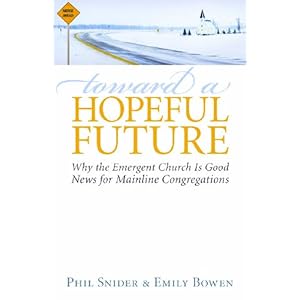
Toward a Hopeful Future -- Review

TOWARD A HOPEFUL FUTURE: Why the Emergent Church is Good News for Mainline Congregations. By Phil Snider and Emily Bowen. Cleveland: Pilgrim Press, 2010. X +290 pages.

Emergent, emerging, postmodern – these are all terms that are bandied about in certain circles, but they may not carry meaning for many people in Mainline Protestant circles. This is unfortunate because many of those who fit under these rather loose labels share much in common with Mainliners. A majority of emergent and emerging Christians are evangelicals or post-evangelicals who share with progressive Christians concerns for social justice and societal transformation. They’re concerned about poverty, the environment, and whether or not they believe in an inerrant bible, they’re more concerned about living out the faith than defending it.

It is true that there are many definitions of what it means to be emergent, emerging, post-evangelical, or postmodern. But what these definitions share in common is a growing dissatisfaction with the status quo. The Enlightenment has made its mark, but it has left many with a sense of great emptiness. Church growth, seeker services, mega-churches, conservative politics, have had an unsettling impact on many of these mostly younger Christians. They have much in common with Mainline Protestants, but they are also disenchanted with what they perceive to be a hidebound institutionalism and rationalism. And yet, with the right bridge builders, the two groups could come together, providing a natural home for Emergents and hope for the Mainline. At least, that is the belief shared by Phil Snider and Emily Bowen, two Disciples of Christ pastors who have embraced the Emergent movement and want to introduce skeptical and suspicious Mainliners to this movement.

The emergent church movement is rather diverse, though it is often linked to such people as Tony Jones, Doug Pagitt, Brian McLaren, and Rob Bell (with a nod to the much more conservative Mark Driscoll). Jones and Pagitt have, for their part, been key leaders in a movement that continually challenges the status quo in both evangelical and Mainline communities. McLaren has made a name for himself by trying to define what he calls a generous orthodoxy. All of these figures, with the exception of Driscoll, can be called post-evangelicals. I personally resonate with this group because I am myself a post-evangelical, though I began my journey outward from evangelicalism before I ever heard of any of these figures. Like them I found the evangelicalism of my earlier years to be too constrictive both theologically and socially. One of the reasons why this group needs an introduction to Mainliners is that many in the Mainline community are suspicious of evangelicals. I experienced this reality, being that I was a graduate of Fuller Seminary. Fortunately this has long since dissipated. Still, the bridge that Snider and Bowen seek to build between progressives and Emergents should prove beneficial to the Mainline Church.

The book begins by offering introductions and definitions. The authors point to several definitions, including that of Tony Jones, the former national coordinator of Emergent Village, who defines the Emergent movement as essentially a friendship or network of missional Christians. He notes that Scot McKnight, a friendly observer of things Emergent, suggests that emerging churches are prophetic, postmodern, praxis-oriented, post-evangelical, and political (that is, they are generally politically liberal evangelicals). Others would point to worship styles that seek to be both ancient and modern. There are in fact a wide variety of emergent types, which range from extremely conservative to relatively liberal. So, any definition is going to rely on adjectives. The version of the emergent church that Snider and Bowen link into is one that is open to progressive understandings. It’s one that seeks to listen for postmodern voices, is committed to social justice, is progressive in theology and expression. Snider and Bowen are attracted to the emergent perspective because it is organic and grass roots. It allows for freedom and nuance. Of course, being progressive Mainliners, the authors are very aware that most of the emergent voices are white and male. Of course, the charge of whiteness can be laid at the feet of most mainline Protestant churches.

The book is divided into three parts – Emergent Background, Emergent Ethos, and Emerging Worship. Through these three sections the authors introduce mainline progressives to the emergent movement and offer suggestions as to how this movement can enhance and empower and give hope to mainline churches. They do a good job of telling stories of people who have felt disenfranchised by both evangelicalism and Mainline Protestantism, suggesting that this movement can provide resources to transcend these difficulties. In part two the sections on justice and hospitality should prove especially helpful.

The final section deals with worship, which seems to be an ongoing point of dispute and discussion within mainline churches. Evangelicals may be conservative in their theology, but many of them have come to terms with the realities of style and technology much quicker than Mainliners. The “ancient-future” worship style that predominates among Emergents might offer some help in adapting to the needs and concerns of new generations of people who don’t connect with the traditional worship styles found in many Mainline Churches. That being said, the authors make it clear that they’re not simply adding one more voice to those that claim that simply adopting contemporary praise services will bring in hordes of young people. Snider and Bowen write:

Emerging forms of worship are much more concerned with grounding worship experiences that reflect specific contexts and theological convictions than they are with any specific style. (pp. 139-140).

That is, the question isn’t whether we should have old hymns or praise songs, organs or guitars, debates that have colored the so-called worship wars. But, the authors remind us that younger adults are more visual and kinesthetic in their orientation to worship. This is why many forms of emergent worship include candles and icons. In reaction to the seeker movement that removed Christian symbols from the worship space, Emergents have not only brought back the cross, but other visual forms – including icons that derive from the Eastern Church. Technology helps in all of this, but isn’t essential or normative.

In terms of worship, the authors make it clear that language, especially regarding gender, is important. They note the problem that exists in Mainline and Evangelical (including Emergent Churches) congregations is that the language is exclusive and patriarchal. For progressives there is the problem of hymns and songs that don’t fit their theology. This is especially true in relationship to references to the atonement and patriarchal references to God. Here is their set of guidelines relating to their choices in music at their emergent service:

[W]e hold fast to progressive approaches in general by making sure the music is grounded in nonviolence, justice, hospitality, and mutuality, and we try our best not to lose sight of the mystery and wonder of God. Like emergents in general, we focus on music that is neither highly individualistic nor concerned with pie in the sky. In short, we try to make sure that every element of the liturgy – especially our music – reflects the theology held dear by progressives and emergents so that they can joyfully sing their faith without sensing a bunch of disconnects in the process. More than anything else, it is the music that stays with the people, it is music that seeps into their bones and reimagines their world. (p. 172).

In two appendices, the authors offer more guidelines and examples of how one might construct an emergent worship experience. Being that they are Disciples of Christ, they place the celebration of the Lord’s Supper at the center of this worship, and they make a point of the fact that Disciples do not limit the celebration of the Eucharist to clergy.

Bowen and Snider have written an important introduction to emergent Christianity for progessive Mainliners. They create a bridge that will help the skeptical or suspicions deal with qualms and questions. The emergent movement isn’t a perfect vehicle, but it does offer hope to the mainline church with its deemphasis on institution and structure, while emphasizing tradition, justice, scripture, hospitality, and adaptability. The emergent movement isn’t the end all for mainline renewal; any more than was true of the seeker movement or the megachurch movement. The danger here is that a tradition that is experiencing both decline and an inability to reach younger generations will simply jump headfirst without truly understanding the ramifications. The reality is that even if the emergent movement offers a word of hope, each church will have to adapt itself in a way that is authentic to its own context and history. That being said, this book, and this movement, does offer a pointer toward a hopeful future.

Tuesday, December 28, 2010

Papias and the Mysterious Menorah -- A Review

PAPIAS AND THE MYSTERIOUS MENORAH: The Third Art West Adventure. By Ben Witherington III and Ann Witherington. Eugene: Pickwick Publications. 262 pages.


It’s interesting that leading biblical scholars have recently taken to writing novels, apparently with an eye to communicating their ideas to a wider audience that’s more likely to read a novel than an academic monograph. Marcus Borg did it with his Putting Away Childish Things (Harper One, 2010), a book I reviewed for the Christian Century. In that book Borg shares his own progressive/liberal view of religion and biblical studies. Unknown to me at the time, Ben Witherington, a professor at Asbury Theological Seminary, together with his wife Ann, a biology professor at Asbury College, has done much the same thing – only they have written a trilogy of books with an archaeological adventure theme. Considering that Ben Witherington has been a strong critic of the Jesus Seminar, of which Borg is a founding member, it shouldn’t surprise readers that his novel takes a rather different approach to biblical history than does Borg. Whereas Borg’s novel offers a progressive/liberal perspective, the Witheringtons’s book is clearly evangelical in its orientation. The two together provide an interesting contrast in perspectives.

I was asked to review the third Art West Adventure by the authors’ publicist, which I agreed to do even though I’d not having read the previous two installments. Doing so may be a bit like watching Revenge of the Jedi without watching the previous two installments of the Star Wars series, but since I’d read Borg’s volume, I thought it worth looking at something written by one of Borg’s leading critics.

Taking up this task, I encountered a book with three primary threads that the authors attempt to weave together – sometimes successfully and at other times less so. Early on in the book the authors deal with the threads in alternating chapters, which is rather typical of a novel, but it can also be distracting. In this case, there was one thread that seems to continue a story line from the previous volume, but which doesn’t connect well with the other two threads. This line of thought concerns a Charlotte Bobcat basketball player who is a Palestinian Christian, who had been a Muslim involved with Hamas, and who after conversion changes his name from Ishmael to Yakov, and ends up facing revenge for his rejection of Islam and Hamas. Oh, and Jake the Cat Arafat is boarding with Art West’s mother in North Carolina. I’m not too sure how this thread advanced the story line, but each reader will have to decide if it’s germane or not.

Leaving aside this particular story line, the primary focus of the novel concerns two important archaeological finds that are alluded to in the book’s title. . The first thread concerns an archaeological dig in Turkey that involved the figure of Art West, an American Methodist evangelical biblical scholar/archaeologist (a sort of Christian Indiana Jones – and yes reference to Indiana Jones is made in the book). The dig is located at Hierapolis, a center of Greco-Roman religion and early Christian prophetic enthusiasm. It focuses on Papias, a rather obscure 2nd Century CE bishop, whose references to the traditional authorship of the Gospels are found in the work of Eusebius. One of the features of this story seems to be Witherington’s desire to lift up the possibility that the gospels aren’t anonymous documents, but carry the identities of their actual authors – though he attributes the identity of the Beloved Disciple to Lazarus and not John the Apostle. Papias is, according to this story, a chiliast – a strong believer in the coming millennium, whose theology is directly influenced by the author of the Book of Revelation.

Any good novel needs a bit of romantic tension, and the Witheringtons provide it in the form of an attractive secular Turkish archaeologist named Dr. Marissa Okur. The confirmed bachelor who is now in his 50s develops feelings for his younger colleague who is leader of the dig, which raises the jealousy of another Turkish colleague, who will engage in some mischievous actions designed to either rid himself of his American rival or take credit for a major discovery. Of course, the question will be – are these to be unrequited feelings or not? And, of course, as an evangelical Christian, Art is concerned about being “unequally yoked.” You will have to read the book to find out how this tension will be resolved.

This discovery is the house of Bishop Papias, a domicile that provides important clues to the bishop’s theology and confirmation of theories of authorship and transmission of scripture, for in this house is found manuscripts of a long lost series of volumes that interpret the gospels and speak of their transmission – the volumes that Eusebius quotes from two centuries later. Here is a major find that would revolutionize our understandings of the Christian faith (if this were fact and not fiction).

The second thread that is mentioned in the title concerns a Menorah that is owned by a Muslim antiquities dealer. Having been purchased several decades earlier, the owner, Kahlil Said, has decided to give the menorah to Jewish friends, the bride to be being an archaeologist in her own right, as a wedding present. But first he must prove that he has properly obtained this menorah to the Israeli Antiquities Agency, and in the course of proving this, he discovers the presence of two pieces of paper, both of which appear to be ancient, and are hidden within the hollow core of the menorah. Both pieces of paper will prove intriguing and even dangerous. What is discovered is that this is no ordinary menorah. Not only was it ancient, it appears to have come from Herod’s Temple, making it the oldest menorah known and the only artifact known to exist from that Temple. Needless to say that when the wedding occurs, the menorah isn’t the present – but the intrigue that goes with discovering the nature of its existence proves to be an adventure in itself.

Since this is a review of a novel, I’ll leave the rest of the details of the story line to one’s imagination. As I noted in my review of the Borg book, I’m not much of a reader of novels, and so I’m not the best judge of literary style, but I know what I like. I did find this novel to have a degree of movement and adventure that wasn’t present in the more sedentary Borg novel. It is a pretty good tale that moves along fairly quickly. The inclusion of quotations in the Greek may be off-putting to some, but fortunately the authors provide translation – though perhaps the presence of the actual Greek in the text really isn’t needed to carry the story along. And, depending on your starting point you may find the little evangelicalism – like concern for being “unequally yoked” endearing or perhaps a little silly. I found some of these statements a bit odd considering that they supposedly come from the lips of a distinguished biblical scholar, but perhaps that’s due to my having been absent from the evangelical mainstream for some time.

Even as Borg attempted to lay out his view of a metaphorical interpretation of the biblical text, the Witherington book seems to be offering an imaginative rendering of a very traditional view of the transmission of scripture. Perhaps this is an area of conversation that needs further development, for it is a much more conservative view than I learned at Fuller and taught at the Bible college that employed me. What, I wonder is the rationale for such an interpretation of authorship, other than the assumption that if written by eyewitnesses or those who heard the story of Jesus from eyewitnesses gives these texts greater authority in a skeptical age. Due to the nature of this genre these questions are left hanging, but perhaps that’s the purpose – opening up a conversation about the importance of authorship to authority.

Although this isn’t Hemingway or even Dan Brown, it’s an interesting story that raises interesting historical questions in a “novel” way. And if you need another view than mine, consider that of Richard Baukham, who says of the book – on the back cover -- that each of these “archaeological thrillers is more enthralling than the last.” Baukham may be a bit biased, as the book is dedicated to him and he is mentioned as an authority, I think it’s worth considering his esteemed judgment (especially since I’ve not read the previous two installments). As I noted in my review of the Borg volume, Jesus scholars understand better than most the value of story in communicating ideas. The Witherington’s, like Borg, should be commended for picking up this genre. Writing novels isn’t, I expect, as easy as some might think. And they do a commendable job, making this a book worth reading.


Friday, December 3, 2010

America's Religious Identity -- Boom, Shocks, and After-shocks (Part 3A -- First Aftershock)

I want to spend a bit more time on the first aftershock to the 1960s reaction to the 1950s religiosity.  Robert Putnam and David Campbell, in their book, American Grace, have gone into some detail exploring the rise of evangelicalism in the 1970s and 1980s, a period in which the nation itself saw a conservative reaction to the more liberal 1960s.  They note the usual explanations, including higher birth rates and retention, as well as the possibility of converts. 

They note that conversion rates to evangelicalism rose signficantly during this period, with 1/3 of evangelicals today not being raised in evangelical homes.  They have also not suffered as much from intergenerational loss as Mainline and Catholic Churches (Catholic stability is the result of immigration, especially Hispanic immigration).  They note that as late as the 1960s, evangelical churches tended to lose some among their younger generations to Mainline churches as they rose into the middle class -- trading Baptist for Episcopal, even as they traded Chevy for Buick.  But in this period educated young adults stayed home. 

As they explore the demographics, they note that the studies suggest that the nation may have, during this period began to move in a rightward direction.  And if you look around, you'll find much evidence to support this -- especially for those who are forty years and older.  Although there are younger people in the Tea Party ranks, if you look closely the majority are 50 plus.  I think if you check, Fox News does best among the same demographic. Oh, and the demographics for Sarah Palin's Alaska series -- the median age for week 2 was 57 years old, 15 years older than the typical TLC audience. 

But, back to the period of the 1970s and 1980s when a conservative aftershock was first being felt (when I was just coming of age).  It doesn't seem as if this change was just theologically driven, as affirmations of biblical literalism have declined through this entire period.  Part of the answer may be simpler than you'd think -- "greater organizational energy and inventiveness" (p. 113).  Why have conservative evangelicals thrived?  It's not necessarily their theology or even their politics, but their entrepreneurial spirit -- their inventiveness -- contemporary music, worship, etc.  Going back to the 1970s, while mainline churches continued to affirm traditional liturgy and music (with the brief exception of folk mass forays), evangelicals embraced contemporary Christian music.  Jesus music proliferated.  They also made better use of small groups and of course they built churches in the suburbs and along freeways.  Oh, and they were strongly present on college campuses -- Campus Crusade for Christ, Navigators, and InterVarsity all being good examples -- while mainline campus ministries went into steep decline.

Still, the authors don't think this is the final explanation for the growing influence of conservative evangelicalism.  They suggest that the answer might be found in a Pauline injunction to "stand firm."  

This was an age of turmoil that many Americans found deeply repugnant to their fundamental moral and religious views.  Other trumpets might be uncertain, but evangelical trumpets were not.  Evangelicals were prepared to heed Paul's advice and stand up for their values.  (American Grace, p. 113).  
Even as Mainline churches expressed uncertainty in the face of change -- they seemed to cling to traditional liturgy and structures, while allowing more diversity in theology and moral practice, evangelicals seemed to stay true to traditional theology and values (even if they did so with new liturgical forms).  Consider:

Evangelicals' distinctive moral outlook, inherited from their fundamentalist forebears, is dark and somewhat puritanical (or Victorian).  They share a view of the world as sinful and of God as a harsh judge.  For them, heaven, hell and judgment day are realities, not metaphors, and moral issues are framed in absolute, black-and-white terms.  (American Grace, p. 113-114). 
And after the 1960s, this firmness of conviction seemed attractive to many, including to many younger adults who came of age at about the same time I did.   

I wanted to dig a bit deeper into this reaction, because it sets up a major aftershock to the first aftershock, and it helps explain why younger adults are fleeing churches today, whether conservative or liberal.  So, on to part 4!

Wednesday, December 1, 2010

America's Religious Identity -- Boom, Shocks, and After-shocks (Part 3 -- First Aftershock)


I graduated from high school in 1976, and we were by most measures a rather religious bunch.  My principal told my mother that my class was the most religious he'd ever seen come through the school (and he'd been there a long time).  Back in the mid to late 70s we saw Jimmy Carter ride a wave of evangelical support into the White House.  Being a Republican at the time I had to defend Gerry Ford's Christian faith.  The Moral Majority was active, Pat Robertson was popular, and Bill Bright sponsored his "I Found It" campaign, wherein blue bumper stickers got placed everywhere imaginable.  Oh, and I left my Episcopal church home for the excitement of the local Foursquare Church, along with a lot of other mainliners, who were attracted to the Jesus People message, and the Christian rock and roll (Love Song, Larry Norman, Barry McGuire, Keith Green, et al). 

According to Robert Putnam and Dennis Campbell, I was part of a conservative aftershock.  The excesses of the 1960s, which had been accompanied by major social/cultural changes, including the Civil Rights Movement and the Sexual Revolution, led to Richard Nixon's election in 1968 as voice of the so-called "Silent Majority," the "majority" that had not come of age in the 1960s.  As I came of age, I was caught up in this reaction that stemmed for a time, at least, the attendance decreases in the churches -- only the more liberal mainline churches continued to empty out -- in part due to a lower birth rate -- but also because many young adults, like me, chose to move over to the more conservative evangelical churches.  My cohort, which came of age in the late 70s and early 80s even saw an increase in attendance.  

Putnam and Campbell write that conservative religiosity in the 1970s and 1980s was most visible in the same niche as was the radicalism of the 1960s -- the college age group.  They note that while student radicalism peaked around 1968, by 1971 a new quietism had hit the campuses.  Interestingly, a more liberal view of sex continued through this era (we didn't go back to the 50s in this area).  What is interesting is the change in religious identification.  Whereas the number of college freshman who rejected a religious identity doubled between 1966 and 1971, it went up just as quickly in the following decade (my decade).  

But, again the key component here is not just that they returned to church, but the churches to which they turned.  

Just as in politics, many Americans of all ages were deeply troubled by the moral and religious developments of the Sixties.  For the next two decades, these people -- conservative in both religion and politics -- swelled the ranks both of evangelical Protestant denominations and of the rapidly growing evangelical megachurches that disavowed denominations and termed themselves simply "Christian." (American Grace, pp. 102-103). 
Thus, we can see the evangelical boom as a conservative reaction to the 1960s, but like all things, booms tend to come to an end, even if their after-effects continue long afterward.  One of the explanations for evangelical growth has been higher birth rates and more effectiveness in retaining one's young people.  

But as important as this growth in evangelicalism, Putnam and Campbell note that this evangelical rise began to dissipate in the early 1990s, and that over the past two decades the number of evangelicals has actually declined.  In fact, without the increases in non-denominational churches, the evangelical decline would have been even greater.  Therefore, and here is the kicker, "In twenty-first century America expansive evangelicalism is a feature of the past, not the present" (American Grace, p. 105). 

What this leads us to is the current cohort, and another aftershock -- a response to the aftershock of the Carter/Reagan era!  But that's for Part 4 of this series.  What is clear, and what Putnam and Campbell want us to understand is that the aggregate picture changes, gradually and slowly, but it changes none the less.  The 1960s provided clear change, especially in reaction to the perceived political radicalism of the age and the moral excesses (but even then a more permissive attitude persisted, even if tempered by a more conservative religious perspective).  But, as the Greatest Generation dies off, their conservatism will dissipate, and the early Boomers (those who came of age in the 1960s will see their influence grow), and on we go until we reach the current cohort, my son's cohort. 

Where will the political and religious trends take us?

Wednesday, November 24, 2010

Reviewing of Books -- there is no End!

As anyone who reads this blog with regularity can attest, I review a considerable number of books.  I'll confess, I'm addicted to reading books, and reviewing forces me to complete the books I'm reading, well sort of -- I've got such a stack right now that I'm way behind!  Briefer versions will sometimes appear elsewhere, at places like the Christian Century blog (formerly Theolog), Progressive Christian Magazine, and at the Englewood Review of Books, among other places.  Chris Smith, editor of the Englewood Review of Books asked me to blog the newly published print edition of the Review, which I'm pleased to do.  And no, none of my reviews appear in this first edition of the Review, nor is there any quid pro quo for future inclusions (though who knows!).  

The print edition of the Englewood Review of Books, to which you may subscribe here,  is an extension of an online presence that began in January 2008.  The online review appears weekly and covers a wide range of books, from serious theology to books of poetry.  What is true of the online presence, is true of the new print review.  It covers a wide range of books under review, that include a book of poetry by Seamus Heaney to a review of Amy Hungerford's Postmodern Belief:  American Literature and Religion Since 1960 (Princeton University Press, 2010).  There is original poetry and interviews with authors.  

Something should be said about the ethos of the editorial team.  This review is a ministry of Englewood Christian Church of Indianapolis.  Englewood is rooted in the same Stone-Campbell tradition as the Disciples (my community).  This branch is generally more conservative and tied into evangelicalism than is true of the Disciples.  But, it is also a congregation that, due to changing neighborhood demographics, had to reinvent itself.  Instead of moving to the suburbs it chose to minister to the community, and created a Community Development organization to facilitate this.  Thus, it shouldn't surprise readers to find a preponderance of books published by IVP, Baker, or Brazos.   But it also means that you'll find them focusing on works by people like Shane Claiborne and the New Monastic Movement.  The evangelical orientation that undergirds the ministry doesn't keep Chris from using my reviews or including books and publishers from the more liberal end of the spectrum (I'm reading through John Dominic Crossan's The Greatest Prayer for the Review at this moment in time).   

Hundreds of books get published every year.  Some are wonderful and others are pure duds.  It's helpful to have guides that can help us ferret through the good, the bad, and the ugly!  One of those key contributors to this cause can be found both online and in the pages of this newly published print review!  It has my recommendation!

I will be attending in short order to the interview with Willie James Jennings of Duke Divinity School, for it deals with something close to my heart, and that is the engagement with the city.  It is entitled "Thinking Theologically About Space."  So, stay tuned.

Friday, November 19, 2010

The Emerging Evangelicals -- Sightings

Trying to define the true nature of evangelicalism has never been easy.  Consider that in the 18th century both Whitefield and the Wesley's were called evangelicals, but despite similar methodologies, their theologies were quite different.  One was Calvinist and the other Arminian.  In Germany Evangelical means Protestant.  And so, when pundits and critics of the Religious Right equate evangelism with either Fundamentalism or the Religious Right they're only getting part of the description correct.  There are many different varieties of evangelicalism, something that Donald Dayton has been proclaiming for several decades.   Being a product of Fuller Seminary, I knew quite clearly that there was a difference between the kind of evangelicalism that was present there and that found to the south at Talbot Seminary. 

In this edition of Sightings Jenny Rae Armstrong suggests that there is a movement underway in evangelicalism that has embraced not just salvation in the next world, but a commitment to social justice and systemic transformation in this world.  She calls them Emerging Evangelicals, though as many can attest, even that term is subject to controversy.  Nonetheless, her analysis of the current political climate and the changes that are going on within the evangelical movement are worth considering.  The point being -- not all evangelicals are Republicans, and that is especially true in the under 40 set!

*********************************


Sightings 11/18/2010


The Emerging Evangelicals

- Jenny Rae Armstrong

The recent GOP rebound has been regarded by many as a victory belonging to rifle-toting, SUV driving, born-again Christians. But to oversimplify evangelicals in this manner is to ignore a growing rift within their ranks. Few mainstream evangelicals have attempted to link laissez-faire capitalism with the teachings of Jesus. Even though some claim to base their vote on issues such as abortion, single-issue voting doesn’t seem to be enough to keep younger evangelicals within the Republican fold.

Dubbed “The Joshua Generation” by the Obama campaigners who courted them vigorously, the voting practices of younger evangelicals have been shifting steadily to the left. One third of white evangelicals between the ages of 18 and 29 supported Obama in the 2008 elections, compared to the 16 percent who voted for John Kerry four years earlier, according to a Newsweek article published on January 17, 2009. Increased evangelical concern for social justice, coupled with growing discomfort with the “anti-gay, anti-poor, and anti-environment” stance of the religious right described by progressive Christian leader Tony Campolo, spurred many of them to vote for a democrat for the first time in their lives. Jim Wallis, editor of Sojourners magazine and author of the book God’s Politics: Why the Right Gets it Wrong and the Left Doesn’t Get It, expressed the growing discontent among his fellow evangelicals: “Many of us feel that our faith has been stolen (by the religious right), and it’s time to get it back… How did the faith of Jesus come to be known as pro-rich, pro-war, and pro-American?”

Self-described “Red Letter Christians” (social activists who take Jesus’s teachings on poverty, mercy, and justice literally) such as Campolo and Wallis have been making an impact, not just on evangelicals’ voting habits, but on their very self-image. A decade ago, if you asked an evangelical to sum up her faith, she likely would have quoted Romans 10:9: “If you declare with your mouth, ‘Jesus is Lord,’ and believe in your heart that God raised him from the dead, you will be saved.” Nowadays, if you ask the same question, you would be more likely to hear Micah 6:8: “He has shown you, O mortal, what is good. And what does the Lord require of you? To act justly and to love mercy and to walk humbly with your God.”

This cultural shift is well-illustrated by the recent publication of the book Radical: Taking Back your Faith from the American Dream by David Platt. Social justice manifestos penned from the fringes of evangelicalism are hardly new fare for the Christian publishing industry (think Shane Claiborne’s Irresistible Revolution), but Platt is pastor of a Southern Baptist mega-church in Birmingham, Alabama. As unappealing as his hellfire-and-brimstone views may be to the less “radical,” it is difficult for even the most conservative Christians to brush off his equally fiery insistence on “taking up the cross” of sacrificial living and concern for the poor as bleeding-heart liberalism. Social justice has become a centerpiece of mainstream evangelicalism.

Ironically, the high-profile rise of economically-focused groups such as the Tea Party could drive an even greater wedge between the GOP and evangelicals, who were drawn to the Republican Party more as a reaction against legalized abortion than an affinity for libertarianism. In fact, evangelicals have always expressed concern for the less fortunate, and are among America’s most generous givers, with almost 24 percent of them donating at least 10 percent of their income to charity, according to the Barna Group. But a growing number of young evangelicals are coming to the conclusion that it is going to take more than a carefully calculated tithe dropped into an offering plate to effect real, positive change for the poor and oppressed, and are willing to think, act, and vote accordingly.


References

Tony Dokoupil, “Faith Beyond His Father’s,” Newsweek, January 17,2009. 


Barna Group, “Americans Donate Billions to Charity, but Giving to Churches has Declined,” April 25, 2005.


David Platt, Radical: Taking Back Your Faith from the American Dream (Colorado Springs: WaterBrook Multnomah, 2010).


Jenny Rae Armstrong is a freelance writer who writes about faith and social justice for a variety of evangelical publications.


----------


Sightings comes from the Martin Marty Center at the University of Chicago Divinity School.

Monday, November 8, 2010

Look Back in Anger: The 1960s and Evangelical Conservatives

Randall Stephens

The rightward turn of voters in the 2010 elections and the traction that conservative candidates have gained has a variety causes. Certainly, a number of Americans are unhappy with health care reform, unemployment, and a president that they feel is far too liberal. But one group, white conservative Christians, is particularly up in arms.

The Pew Research Center reports that "Two of the largest religious groups in the electorate followed the same basic voting patterns in the 2010 elections for the U.S. House of Representatives as they have in prior elections: white Protestants voted overwhelmingly Republican and religiously unaffiliated voters cast their ballots overwhelmingly for Democrats. . . . However, among all white voters who describe themselves as born-again or evangelical Christians -- a group that includes Catholics and members of other faiths in addition to Protestants -- 78% voted Republican in 2010, compared with 70% in the last midterm election."

At least since the 1960s, many evangelical and fundamentalist Christians have felt besieged by new currents in the larger American culture. The upheaval of the swinging sixties shocked and frightened believers. Evangelicals and fundamentalists were horrified by campus riots, the counter culture, and what they saw as the excesses of the liberal political establishment. In the late 1960s and early 1970s Christianity Today, the chief magazine of American evangelicalism, published article after article on the terrors of the Left and the end of Christian civilization. Their world, so it seemed, was crumbling around them. (See Darren Dochuk's From Bible Belt to Sunbelt and Dan Williams recent God's Own Party for excellent insight into these and earlier developments.) The 1970s bestselling work of nonfiction, Hal Lindsey's Late Great Planet Earth, wove an evangelical end-times drama out of the explosive issues of the age. (Though Jesus People wore beads and Roman sandals and grew their hair "all long and shaggy," as Merle Haggard put it, they were in step with the apocalyptic temper of the times and drank in the anti-60s brew of the day.)

James Dobson, one of the most influential evangelical leaders of the modern era, described this anti-1960s view bluntly in 2008. Much of the wickedness of modern society, Dobson thundered, could be traced to that era of moral decline. The so-called Summer of Love in 1967 unleashed a whirlwind of hedonism and vice, he said. In his multi-million selling parenting manual, Dare to Discipline (1970), Dobson wrote: "In a day of widespread drug usage, immorality, civil disobedience, vandalism, and violence, we must not depend on hope and luck to fashion the critical attitudes we value in our children. That unstructured technique was applied during the childhood of the generation which is now in college, and the outcome has been quite discouraging. Permissiveness has not just been a failure; it’s been a disaster!"

Long after the bong smoke and tear gas have cleared, conservative American Christians--some in the Tea Party and many more who are happy enough with the Republican Party--continue to register post-60s fears. A number want to reclaim their America from secularists and godless liberals. They fear that an overpowering government wants to curtail their rights to raise their children as they see fit. They worry that their freedom to express their religious beliefs in the public sphere continues to come under attack. In other words, many are uncomfortable with a post-60s pluralism that has reshaped the nation and with a secular notion of the public good.

Such concerns are not lost on savvy politicians. Christine O'Donnell, Sarah Palin, Rand Paul, Ken Buck, and a host of others are intimately aware of constituents' fears. When such candidates lash out at secular experts and laud commonsense Christianity, they know perfectly well that they are tapping into a powerful counter ideology, one that has been decades in the making.

Saturday, October 16, 2010

Hijacking Bonhoeffer

Like many Christians, I have great regard for Dietrich Bonhoeffer.  I've read many of his works, am a subscriber to his Complete Works, took a class on Bonhoeffer in seminary, have read Eberhard Bethge's monumental biography, have read several others including John Moses' study The Reluctant Revolutionary, which I reviewed for the Christian Century, and Ferdinand Schingensiepen's new biography from T & T Clark (a review of which has been submitted to the editor of the Christian Century blog).  It is from that background that I sat down one day to skim the wildly popular "biography" of Bonhoeffer written by Eric Metaxas.  Just skimming through the book, aided by the index, I was horrified by what I found.  Bonhoeffer was none other than a conservative American Evangelical, whose battle with the German Christians can be compared to the battle between Intelligent Design folks (good people) and Evolutionists (bad people).  Barth is good, Harnack is bad -- though the Barth he describes seems far distant from the one I've read and studied.  

Now I didn't have the patience or desire to read the entire book, but I had hoped someone would write a response.  That response can be found in the most recent issue of the Christian Century.  Although the online version is available only to subscribers, Clifford Green, the Executive Editor of the English edition of Bonhoeffer's works offers a strongly worded and greatly needed response (is rebuke too strong a word) noting in some detail how Metaxas has hijacked Bonhoeffer in the name of rescuing Bonhoeffer from liberals, which, Green suggests is accomplished by downplaying Bonhoeffer's time spent at Union Theological Seminary and even more importantly basically dismissing the theological work he did while in prison.  Green writes:

Worse, if possible, [Metaxas's attempt to redefine Bonhoeffer's pacifist leanings] is Metaxas's embarrassment about Bonhoeffer's writing in Letters and Papers from Prison  about "religionless Christianity."  In a Trinity Forum interview he even stated that Bonhoeffer "never really said it," but then had to retract that because, well, Bonhoeffer did say it.  But, Metaxas continues, he wrote it privately in a letter to Bethge and never intended anyone to see it because it was " utterly out of keeping with the rest of Bonhoeffer's life."  He calls Bonhoeffer's theological prison reflections a "few bone fragments . . . set upon by famished kites and less noble birds, many of whose descendants gnaw them still" (CC, pp. 37-38).  
As Green points out those "few bone fragments" are directly connected to Bonhoeffer's Ethics.  While a lot of bad interpretation has taken place over the years, two wrongs don't make a right, and Metaxas's interpretation is at best self-serving.  Dietrich Bonhoeffer deserves much better!

If you want to truly know the nature of Bonhoeffer's life, then you would be better served reading Schlingensiepen's biography.  It may not be as rip-roaring a ride, but you'll get a better sense of the real Bonhoeffer than you ever will from Metaxas! 

Tuesday, August 31, 2010

A Good Enough Theology: Evangelical Passion (Bruce Epperly)

What is a "Good Enough Theology?"  And in defining this notion of theology, where might evangelicalism fit?  One of the things about evangelicalism, is that it is a hard term to pin down.  I'm a graduate of Fuller Theological Seminary, an evangelical flagship institution, but Fuller is quite different from other institutions in the evangelical community, such as Dallas Seminary or even Trinity Evangelical Divinity School.  There are conservative evangelicals and there are those, like me, who want to retain our connection with evangelical sensibilities and would be comfortable with the designation "liberal evangelical."  Then there are those who see themselves as "evangelical liberals," a designation that Bruce Epperly, the author of this series of posts, is quite willing to affirm.  If you are a liberal or progressive Christian, what might you take away from the evangelical mindset that can broaden and deepen your faith?  That is the purpose of Bruce's essay today (and next week he'll be bringing in fundamentalism). 

**************************************

A Good Enough Theology: Evangelical Passion


Bruce Epperly


For the past two weeks, I have affirmed that a good enough theology has the stature to embrace diverse theological and spiritual approaches. We can compare theological wholeness, or stature, to a balanced diet – recognizing favorite foods, but also including side dishes that not only add flavor but vitamins and minerals. We need basic foods, good theology, but also good seasoning, liveliness. As a progressive Christian, I recognize that I need to include the heart as well as the mind, contemplation as well as action, passion as well as intellect, to have a complete and balanced theological diet. Last week, we reflected on the gifts of the Quakers: the vision of God’s presence in everyone, the importance of contemplative prayer, and commitment to action for justice based on recognizing God in every face. Today, I will reflect on the evangelical passion for a personal relationship with God and Jesus.

Recently, I had a conversation with a member of a liberal/progressive congregation. He commented that although his pastor is a good preacher, he virtually never mentions Jesus in his sermons. I have heard this observation/critique many times from liberal/progressive congregants. They hear Jesus occasionally mentioned as the example of a “way of life,” but seldom as a contemporary reality - a personal reality - that can be experienced in daily life. While liberals and progressives are rightly concerned about making an idol of Jesus, seeing Jesus solely in individualistic terms, or promoting a relationship with Jesus that leads to denigrating other religious traditions, I believe that the evangelical passion for Jesus, for a personal relationship with God, contributes energy and vitality that balances and adds life to intellectual and contemplative faith experiences.

Now, many liberals are uncertain about using the word “evangelical.” For them, it connotes social and theological conservatism, televangelists, and religious exclusivism. In contrast, I like the word “evangelical”: perhaps, because I was raised in a small town Baptist church, perhaps because it points to the importance of passion in faith, perhaps because it reminds us that we have good news to share. While labels can be limiting, I am particularly fond of descriptions such as “evangelical liberals” and “spirit-centered progressives.” I claim them both, and believe that there is good news to be found in embracing both evangelical and Pentecostal perspectives as part of a good enough theology. (We will speak of spirit-centered faith next week.)

Anne Lamott uses the term “Jesus-y” to describe her faith, and that works for me. As a progressive-oriented Christian, I claim that Jesus is alive, not just as the proponent of a way of life, but as a personal reality within the dancing (perichoresis) trinity of divine creativity and companionship within God, us, and the world. In unity of spirit with God, Jesus is as intimate as our next breath. Yet, Jesus’ intimacy invites us to a global spirituality. As our companion on a holy adventure, Jesus calls us to “follow” him in growing in wisdom and stature – in embracing God’s presence in the outcast, the diseased, the stranger, and the enemy. Jesus says “I am in the least of these” and you love me best by loving them. Jesus “walks with us and talks with us” in the midst of life’s challenges.

Loving in the spirit of Jesus means a lot of things, too, certainly it means hospitality and healing; it also means sharing “good news.” And, sharing good news involves both a “what” and a “how” – as progressives we can be as passionate about our faith as those who call themselves evangelicals because we have good news to share. Just look at Eric Elnes’ Phoenix Affirmations or the principles of progressive Christianity, articulated by the Center for Progressive Christianity; just look at my Holy Adventure (Upper Room, 2008) and you will discover that we have a faith we can share, a faith that changes lives. Claiming the following visionary affirmations can change your life and the lives of countless seekers:

God loves us and is present in our lives.
God wants you to have abundant life.
God rejoices in your creativity.
God’s grace embraces, forgives, and makes whole.
Jesus shows us a way to healing of mind, body, spirit, and the planet.
Wherever there is truth, God is its source, in all its many forms.
Jesus is your companion in life and death.
God’s spirit is constantly inspiring us.
God wants us to be partners in healing the world.

This list is far from exhaustive and you can make up your own progressive affirmations of faith; but one thing is clear, living with any one of these affirmations will change your life. These affirmations “preach, teach, and transform.” They call us to a full-voiced Hallelujah!

And, they call us to share our faith in the spirit of hospitality, healing, and respect – learning as well as proclaiming in the spirit of young Jesus at the temple. We can have passion, share good news, and also listen to the gifts of others as part of our affirmation of God’s global and graceful presence.

We progressives have a theology that transforms: if we can personalize this theology, experience it through contemplative practices, and embody it in socially-transforming actions, we can proclaim faith with passion. We can be evangelical as well as contemplative and theologically open-minded. A balanced theological diet of mind, heart, and hands gives life, vitality, and witness to the world, and us.


Bruce Epperly is a seminary professor and administrator at Lancaster Theological Seminary, pastor, theologian, and spiritual companion. He is the author of seventeen books, including  Holy Adventure: 41 Days of Audacious Living, a response to Rick Warren’s Purpose Driven Life. His Tending to the Holy: The Practice of the Presence of God in Ministry, written with Katherine Gould Epperly, was selected Book of the Year by the Academy of Parish Clergy.  His most recent book is From a Mustard Seed: Enlivening Worship and Music in the Small Church, written with Daryl Hollinger.

Monday, July 12, 2010

Reporting on the God Gap -- Sightings

Whatever you may think of the relationship between religion and politics, there has always been a conversation between the two sectors of society.  Politicians and people concerned about public policy are always looking for allies in the religious community, and religious folk have often sought to influence public policy.   Martin Marty, who has devoted a lifetime to exploring this relationship, comments on a new study of this relationship, one that focuses on Catholic and Protestant faith traditions, a study that notes the complexity of these two faith traditions.  I think you'll find this interesting, as the public square isn't nearly as naked as some would think, and the Christian vote isn't as monolithic as some would want us to think!  

**************************************

Sightings 7/12/10


Reporting on the God Gap
-- Martin E. Marty


“A New Roadmap for Reaching Religious Americans on Public Policy Issues” is the subtitle for Beyond the God Gap, a 49-page report and chart for those who are trying to find their way among religious groups as they show up in politics and culture. The co-agents are think tank Third Way and the Public Religion Research Institute, whose regular issuances are useful for those who would “reach” and also those who “observe” religious Americans. The authors of Beyond the God Gap do know that there are non-religious folk and forces out there, but in their minds they cannot be “reached” efficiently on public issues. Forget the “new atheists” then, for a moment, as the authors of this report do.

What is more, while both of the sponsors of this project have interests in all religions, Beyond the God Gap deals only with Christians. The surveyors know that the varieties of Jews and Muslims are also reaching and being reached on public policy issues, but the topic for the Third Way and PRRI is “Catholics” and “Protestants.” What is clear from this and countless other opinion surveys is that the old standard typified by Will Herberg’s 1955 classic, Protestant, Catholic, and Jew, would be almost useless in changed America. What Herberg called “Protestant” stood for “White Mainline Protestants” (WMPs). He hardly noticed what today are termed “White Evangelical Protestants” (WEPs) or “African American Protestants” (AAPs). These are the two groups where the “reaching from and to” is most strenuous, effective, and controversial today.

Quick, now: Think of the few times when cable news dealt with “White Mainline Protestants” on public issues. We can foresee one, as the Presbyterian General Assembly soon will debate topics relating to Palestinians and Israelis. Another has to do with conflict over gay marriage and ordaining homosexuals. For the rest, dealings with WMPs are mainly diversions as politicians and public figures court or avoid WEPs and AAPs, who encamp in sufficiently definable identity sectors to warrant attention. Even here, Beyond the God Gap has to parse things somewhat more finely – for example, where they find substantial differences between young versus middle-aged WEPs on homosexuality and other such fronts of controversy. It is also clear that there is no simple “Roman Catholics” group, since left and right factions there differ so much from each other that politicians using this road map might well drive into the ditch, and certainly will hit potholes. AAPs are somewhat more predictable when it comes to addressing public issues, or being reached. Most still vote Democratic and get cast as “liberal,” but their part of the map is also increasingly diverse.

The authors of this report say they set out to shatter stereotypes simply by interviewing citizens and finding where their loyalties and goals may be. Add up these diverse groups, and it is easy to see why three-fourths of the road-mapped groups resent it when some WEPs claim that theirs is “The Christian vote,” and when mass communicators sleepily suggest that when polled majorities among white evangelicals are interviewed as they exit voting booths, they should have a monopoly on the term “Christian,” as in “the Christian vote.” They are claiming too much, and the members of the media who grant them a monopoly do the surveys, the faiths, and social scientists a disservice. Beyond the God Gap will help with more accurate reporting, and give the public a better picture of how the religious groups line up at the polling places. The old model won’t work. A significant power shift has already occurred.

Martin E. Marty's biography, current projects, publications, and contact information can be found at http://www.illuminos.com/.


----------

In this month's Religion and Culture Web Forum ("The Primacy of Rhetoric"), Marty Center Senior Fellow (2009-10) W. David Hall addresses the centrality of rhetoric in the Western humanist tradition by engaging the work of Ernesto Grassi, whose commentary on the Renaissance, especially, diverged from standard Platonic models of interpretation to include arts such as rhetoric, literature, and poetry. Of especial interest for Hall is Grassi's "retrieval of the humanist tradition" during this era and the possibilities that thorough understanding of such a retrieval opens more broadly in the fields of philosophy and religious studies. With invited responses from Andrew Hass (University of Stirling), Jeff Jay (University of Chicago), Santiago Pinon (University of Chicago), Donald Phillip Verene (Emory University), and Glenn Whitehouse (Florida Gulf Coast University).


----------

Sightings comes from the Martin Marty Center at the University of Chicago Divinity School.