Search This Blog

Showing posts with label Archives. Show all posts

Thursday, March 24, 2011

Seward Was an Upstate Lawyer

Dan Allosso

I was looking through the materials I photographed on my last trip to the American Antiquarian Society. This trip was mostly about acquiring background on the places where the people I’m researching lived. Although there are a LOT of old newspapers now available online, as Heather has recently pointed out, there are many that are not yet. The American Antiquarian Society has a huge collection of early papers, as well as broadsheets, political pamphlets, and books.

I photographed a lot of material, which is my strategy when I go to archives like this. Whenever digital photography is allowed, I focus on locating and recording as much in the archives as I possibly can in the time I have. There’s never enough time, but this strategy allows me to go home with more material than I’d ever be able to read, sitting at the desk in the archive. It amazes me that just a decade or so ago, people had to sit in these places for months and months—and then in many cases they still only managed to scratch the surface of what was available.

That’s not to say that past researchers haven’t done fabulously, getting to the meat of an issue and finding the relevant material. But I suspect it limited the time they had to look around the information they were seeking, to see, for example, what else might have been on people’s minds on the particular day a specific newspaper article they were looking for was printed. Not to mention, what might have been in the advertisements on the edge of the page.

For example, I was looking at a table of New York Bank Note discounts, in the Lyons NY Countryman for Tuesday, March 2nd 1830. The table was in the fifth column of page four. After I photographed it, I noticed there was a notice about the sale of a defaulted property in Lyons at the top of column six. So I shot a quick photo of it and moved on. It wasn’t until I reviewed my photos at home, that I read it through and found that, in addition to being an interesting example of a notice, complete with a detailed property description and a little more background information to add to my knowledge of people in Lyons, the final line answers an unresolved question from my earlier research.

As I was putting together all the legends that surround my subjects in upstate NY, I ran into a story that claimed they had spent a lot of time trying to build a ship canal around Niagara Falls. There were obviously good precedents to support the idea of an additional “internal improvement” in upstate New York. But it would take government money to build it, so they needed a patron. There was a brief mention of a long, late-1850s carriage-ride one of my subjects had with New York Senator and former Governor William Henry Seward, during which my guy bent Seward’s ear about the project and received the response that it would never happen until there was a change in administration. Which he took to be Seward’s way of saying “when I become President.”

I liked this story, and had always planned on using it. But the accidental newspaper discovery makes it much more plausible. The 1830 lawyer handling the default sale in Lyons, whose name appears at the bottom of the advertisement was none other than “Wm. H. Seward, Att’y.” A reminder that my guys, even though they were merely upstate businessmen, had a completely credible connection with the man who went on to become a key member of Lincoln’s “Team of Rivals.” Too often we forget that many of the “great men” who stride through the big histories, started somewhere as regular people. Unexpected material from the archives can not only provide background for a narrative, but from time to time, it can provide unexpected clues about meaning and context.

Tuesday, March 1, 2011

Using Primary Sources: Credit Reports

Dan Allosso

Unlike many of the records that I’ve been using so far in my research, credit reports like the R.G. Duns collection at Harvard’s Baker Library are a primary source that seems to stay much more in the background of many research projects. Partly this may be due to the Baker Library’s rules: no photography of the materials, no direct quoting of the reports without prior approval. But a much more reserved, qualified use of these credit reports probably also comes from the mediated form of the information in them.

As Christopher Clark described them in The Roots of Rural Capitalism, reports like those in the R.G. Duns books began to be used after the Panic of 1837, and became much more extensive after the Panic of 1857, to provide a way of evaluating the credit-worthiness of (mostly rural) borrowers for the benefit of (mostly urban) creditors. This geographic distance is key to the value of the reports; since the credit agencies employed local correspondents who reported facts, opinions, and rumors about their subjects that would have been common knowledge in the local business community. But we don’t know much about these reporters: the correspondents identified themselves in the bound volumes by code numbers, so the sources of these judgments are not at all transparent. This anonymity and the use of coded language (which as Clark points out, tends to apply contemporary “moral principles to business”) adds to the appearance of unanimity, authority, and consistency of judgment. But a closer look at the reports, especially those of long duration, casts some doubt on this supposition.

I’ve been to the Baker a couple of times to look at the R.G. Duns books. The librarians are very helpful; they bring the books out to your work table, one at a time, and can get additional volumes quickly, if your research takes an unexpected turn. One of my subjects, in Michigan, for example, did not turn up in the Kalamazoo book when I expected him to be there. Going back to the book for St. Joseph County (south of the city), I found reports of his business activities in his home community long after the “official story” of his life had him moving to the big city. The Duns reporters also wrote about him being involved in businesses that never came up in the other materials I’ve looked at, which gives me a whole new trail to follow in my investigation.

But while they are helpful for pointing to holes in my information, I think the Duns reports are most interesting for the way they describe changing attitudes toward the behavior (or “character”) of businessmen in these rural areas, and the expectations of urban creditors. It’s important to remember, when reading reports like these, that the correspondents were writing from the point of view of their distant clients. Tensions over the relative power of the local and distant parties to these credit relationships, as well as changing standards of personal and business conduct, are a central element of these narratives.

The contrast between the two brothers I’m studying in upstate New York is dramatic. They lived in adjacent towns, but in different counties covered by different Duns correspondents. They had been partners for decades, but later in life they became competitors. The younger of the two became the richest man in his county, and developed a reputation for credit-worthiness and stability that was amply recorded by his local Duns reporter. He set up his son as a banker, guaranteeing the young man’s credit with his own. When the son became an alcoholic and needed to be institutionalized, his father made good all the bank’s investors and depositors, and transferred the business to his younger son and two daughters. All these details are recorded, with very little personal judgment, in the Duns book.

In contrast, this man’s older brother seems to have pioneered the borders of financial respectability, by continually crossing them. The Duns reporter who covered his file for many years stressed the fact that the older brother was “fond of litigation,” tended to pay only after an “execution” by the court, and “cannot be trusted out of sight.” Like his respectable younger brother, this upstate businessman also started a bank, which he used primarily to finance his own business. This business was ultimately successful in a competitive national and international market, in part because its owner was willing to take substantial risks and go much farther out on a financial limb than his Duns correspondent was comfortable with. These conflicts of interest between the businessman’s activities and the standards of the Duns reporter suggest a changing dynamic of rural and urban financial power. As, I think, does the increasingly adversarial tone taken over time in several accounts. After a while, many of my local subjects seem to become less compliant with demands for information by their local Duns correspondents. It may even be a mark of financial success for them that some are able to completely stop cooperating with these reporters. In that case, the negative personal tone of the later entries in some of these credit narratives might be read as evidence of rural financial independence, rather than failure to conform in an increasingly urban credit regime.

Wednesday, January 19, 2011

Reading Primary Sources: Estate Inventories

Dan Allosso

One of the things that fascinates me about doing historical research, is that it doesn’t always involve long trips to exotic archives or well-known historical sites. For example, wills and estate inventories going all the way back to the earliest days of settlement are often kept in the county records office. Whether you are trying to find information on a particular family or individual, or looking for background material to help you rebuild the world your subjects lived in, probate documents can be a really interesting window into the material culture of the past, and into the attitudes and values of people long ago.

I went to the western Massachusetts town of Northampton a while back, to look at estate information for the town of Ashfield. Hampshire County encompassed the area which is now Franklin County until 1811, so I went to Northampton expecting to find Ashfield documents up to that time. In fact, I found several later than 1811, suggesting that people in the habit of going down to the Northampton Courthouse to conduct their business were not turned away. Sometime soon, I’ll make a similar trip to Greenfield, and see what they have in their files.

Wills are public records, so you don’t have to provide any credentials to look at them—but I don’t imagine they get a lot of use. In Northampton, there’s an old-fashioned card catalog where you can find the names you want to ask for, and a simple form you hand to the records clerk. The January 3, 1811 will and April 10, 1811 inventory of Joseph Clark is typical of what I found. Most of the old documents are folded into palm-sized packages, often bound with string. The inventory, taken by Clark’s executor Japhet Chapin, lists everything of value that Clark owned. First and most important, of course, are “Fifty acres of land including the buildings valued at $800.” Everything else Clark owned was worth about $159, including six cups and saucers valued at 12 cents, a vest worth 42 cents, and seven sheep and two lambs whose $13.50 value suggests they may have been newly introduced Spanish Merinos.

In his will, which Clark executed four months before his death, he first specifies “I would have all my just debt paid.” Next, Clark orders the division of his remaining assets. He specifies cash settlements to be paid “within one year after my decease” to his five daughters; fifty-five dollars to each of the unmarried, and five dollars to the married woman, who had probably received the fifty when she wed. He gives fifty dollars to his son Otis, and “to my dearly beloved wife” Clark orders “she should have a comfortable maintenance out of my estate so long as she remains my widow then the income of one third of my estate during her natural life.”

Clark’s widow’s income and maintenance would come out of the balance of his $959 estate after the $275 in cash bequests and whatever went to pay his debts. This balance was to be split equally between his two remaining sons, Joseph and Loring, who would presumably either work the farm together, split it into reasonably equal halves, or find a way for one to buy out the other’s equity. There was a practical limit to how small a farm could be and remain viable; if all fifty acres were “improved” cropland, they may just have been able to split the property. On the other hand, one or both of the brothers may already have owned other property, before their father’s death.

The will and inventory raises several questions that can help direct my further investigation. I can check the town’s Vital Records book (there’s one for every town in Massachusetts, covering births, deaths, and marriages up to 1850), to determine the ages of the family members in 1811. Town “valuations” (tax lists) will tell me what land the sons may have owned already, if they lived in town, and possibly whether either of them had cash on hand to meet the “within one year” requirement of the cash bequests. Since Clark left no cash and I believe he had no large sums owed him (I don’t know for sure, but I assume there are none because the two notes he held were crossed out at the bottom of the inventory list, suggesting they had been settled), the brothers would have needed to raise over three hundred dollars relatively quickly, to satisfy their siblings’ and provide for their mother.

In addition to these particulars of the Clark family, the documents tell me several things about Ashfield, that I can check against historians’ understanding of similar places at this time, to get a better sense of the town. Clark writes affectionately of his wife and leaves her not only a widow’s maintenance, but a third of the income of his estate, suggesting that he valued her contribution to the family's fortunes. The inventory is witnessed by Ebenezer Smith Jr., son of the Baptist minister and grandson of the town’s first settler, suggesting Clark (who was a member of the Congregational Society) was on good terms with neighbors outside his denomination. The will itself is witnessed by Polly Chapin and Margaret Wood, who signed their own names, suggesting that among Clark’s friends, both men and women were relatively well educated. It would be interesting to know exactly where the farm was, what type of land it was on, and how many buildings were on it; since the $800 valuation makes up the majority of Clark’s estate and seems a little high for the times. Finally, the list of items Clark owned is very valuable, not only for the relative values of the items, but as an inventory of the items that surrounded him during his life. The combination of indoor and outdoor tools, the three cows and three heifers, four dining chairs and four pewter plates, all help set the scene and give us clues about Clark’s life. They also suggest ways he may have been connected to extended family and neighbors. Ten “cyder barrels” but no press: so who pressed his apples? No plow and team: did one of his sons have one? One axe: how much of Clark’s land was cleared? This will and inventory give a fascinating glimpse into both the physical and social world in which Joseph Clark lived and died in 1811.

Thursday, January 13, 2011

Reading Primary Sources: Indentures

Dan Allosso

One of the most exciting and interesting things we do as historians is look at old documents. Exciting because we get to use all our “detective” instincts, and we’re never sure what we’re going to find. Interesting because along with the data we’re looking for, there’s often a lot more. Sometimes this additional information takes the form of a surprise that completely changes our idea of what happened; more often, it broadens and enriches our understanding of the setting, the people involved, and the times they lived in.

I recently had an opportunity to look at nineteenth-century land deeds, or “Indentures” in upstate New York. My goal was to establish when the people I was studying had arrived in the region. I went to the county records office and got permission to use their computerized database of indentures. This saved me the trouble of pulling a dozen old books off the shelves, since deeds were recorded in the order they were executed, so you need to find them in the index and then go to the appropriate “Liber” and page.

As I expected, the pile of documents I was able to find and print for a nominal fee, told me a lot about when my subjects had arrived in the area, but also a lot more that I hadn’t expected. For example, I found an 1842 record of an agreement between one of my subjects, Roswell Ranney, and Spencer Hildreth and Elijah Bement, “and Julia his wife.” Ranney bought a 106.25-acre parcel of land from these two men, “for the sum of Ten Dollars to them in hand,” as well as “payment & satisfaction of twelve hundred and fifty dollars being a part of a mortgage heretofore executed by Samuel H. And Henry Baggerly and their Wives to the New York Life Insurance and Trust Company for twenty seven hundred dollars.” The location and dimensions of this land were described in great detail, which allows me to not only plot it on a map and know where Ranney lived, but suggests that an acre of prime farmland in Phelps was worth about $12 in 1842, if this sale was at the market price.

But I don’t know that for sure, yet. Because, reading on, I find that there had been a previous mortgage, dating from 1838, between George Ranney, Roswell’s brother, and the late Russell Bement, whose exact relationship to Elijah I don’t yet know. George and Russell, I already knew, both came to Phelps around 1833 from the same town in Massachusetts. George Ranney died about six months after this indenture was recorded, so this land sale may have been part of an attempt to put his affairs in order. But now, to understand the sequence of events, I’d like to know why the Baggerly brothers had a mortgage with New York Life. Actually, until I saw this indenture, I wasn’t aware that the New York City company was involved in real estate lending in this small upstate village—so that’s definitely worth finding out more about.

In a footnote to the indenture, the county official appended a note witnessing the signatures and stating that in a private interview, Elijah Bement’s wife Julia “acknowledged that she executed the within deed freely and without any fear or compulsion of her said husband therefore let it be recorded.” It’s an interesting glimpse at the changing status of wives in 1842 New York, that although she clearly does not have the rights of the men, society is concerned about Julia’s willing participation in this sale.

Monday, December 13, 2010

The Original Live-Blogging: On the Ground with Antinuclear Activists in 1979

Morgan Hubbard

Professionals of all stripes know that some workdays are better than others. Much of the historian's task is tedious and thankless—slogging through reams of records that may or may not be important for the puzzle she's looking to solve, or the argument she's looking to build. Some days end up being totally useless.

Some days, though, are windfalls.

The Alternative Energy Coalition was an alliance of anti-nuclear and environmental activists in New England in the late 1970s. The AEC, together with the better-known Clamshell Alliance, staged a series of “actions” against the Seabrook Station Nuclear Power Plant in eastern New Hampshire. Some were more intense than others, and a few made national headlines. When the AEC dissolved in the early 1980s—members moved to affiliated groups or dispersed—the organization's papers lay fallow. In the 2000s, they were given to the University of Massachusetts-Amherst Special Collections.

Many of the AEC's records are run-of-the mill: mostly catalogs, routine correspondence, heaps of newspaper clippings. But tucked into one folder, fastened unceremoniously with a single staple, was something remarkable, a historian's goldmine: a sheaf of papers on which AEC protesters had logged, hour by hour, the events of a massive blockade action at the Seabrook plant in October 1979. (Click on the image of the log to enlarge.) The document is special not only for the intensity of its scribbled notes (“8:30 a.m., police dogs and water hoses are visible. Action before noon.” “10:00. Verified macing and clubbing.”) It's special because it's a step closer to historical reality than historians can usually get.

Most of the time, we have to reconstruct the past obliquely. But documents like this allow us to witness the past almost as its participants did, play-by-play, on the ground. Obviously, there's much missing from a written account: the smell of teargas, the overhead chop-chop-chop of police helicopters, the fervency of a protest at the height of the anti-nuclear movement's momentum. But documents like this—a live-blogging before there was such a thing—demonstrate that with the right sources, we can recapture some of the potency and urgency of the past.

Friday, November 26, 2010

Archeologists and Historians at Work

Randall Stephens

What do historians do? How do they go about their work?

The work of a historian is not entirely unlike that of an archeologist. Both see through a glass darkly. (Maybe that's more "darkly" for an archeologist.) They look at primary source materials (material culture and texts), make comparisons to corroborate evidence, think about the context of one era compared to that of another, and use secondary literature to give them a bigger picture.

A great deal of interpretation and analysis informs the work of archeologists and historians. What's more, archeologists often disagree with each other just as historians do. Questions still remain open for debate. And debates can easily become politicized, tied into issues of national identity, or personal.

The hard work of archeology is spelled out clearly in a wonderful piece in the latest issue of National Geographic: Robert Draper, "Kings of Controversy: Was the Kingdom of David and Solomon a Glorious Empire—or Just a Little Cow Town?" National Geographic (December 2010)

See, for instance, how Draper sets up the nature of controversies:

In no other part of the world does archaeology so closely resemble a contact sport. Eilat Mazar is one of the reasons why. Her announcement in 2005 that she believed she had unearthed the palace of King David amounted to a ringing defense of an old-school proposition under assault for more than a quarter century—namely, that the Bible's depiction of the empire established under David and continued by his son Solomon is historically accurate. Mazar's claim has emboldened those Christians and Jews throughout the world who maintain that the Old Testament can and should be taken literally. Her purported discovery carries particular resonance in Israel, where the story of David and Solomon is interwoven with the Jews' historical claims to biblical Zion.

Draper also sheds light on how texts are used (or misused) to ground the material evidence. Pieces of the puzzle are put together slowly over decades:

The books of the Old Testament outlining the story of David and Solomon consist of scriptures probably written at least 300 years after the fact, by not-so-objective authors. No contemporaneous texts exist to validate their claims. Since the dawn of biblical archaeology, scholars have sought in vain to verify that there really was an Abraham, a Moses, an Exodus, a conquest of Jericho. At the same time, says Amihai Mazar, Eilat's cousin and among Israel's most highly regarded archaeologists, "Almost everyone agrees that the Bible is an ancient text relating to the history of this country during the Iron Age. You can look at it critically, as many scholars do. But you can't ignore the text—you must relate to it."

Of course, historians don't use hard science or equipment in the same ways that archeologists do--carbon dating, chemical analysis, shock-proof computers that can handle intense heat and dirt. Historians don't typically study prehistorical cultures. And, historians spend their time digging, mostly, in the comfort of air-conditioned archives.

Still the similarities and points of contact between the two fields is quite interesting. We read evidence, whether that be in the form of pottery shards and olive pits stuck in the side of a Palestinian hill or 18th-century English newspapers and court records.

Does the ambiguity of the archeological record produce controversies that burn hotter than historical controversies? After reading the National Geographic article, I could not think of historical debates that rage with the same intensity.

Wednesday, June 23, 2010

London Calling Librarians

This guest post comes from Dana Goblaskas a former student of mine who works at the MIT library. Dana stuck out to me from the start because of her intellectual curiosity and because she was into pop music history, punk, and indie rock. Pluses in my book. Here she tells of her two-week trip across the water as a participant in University College London’s Librarianship Summer School.

Dana Goblaskas

As a self-proclaimed history nerd and an Anglophile, it’s hard for me to be giddier than when I’m immersed in the tangible history of England. And if I can earn credits toward my degree for that immersion, well, let’s just say the happy dances abound.

Last month, I took part in the inaugural session of University College London’s Librarianship Summer School, co-sponsored by the University of North Carolina’s School of Information and Library Studies. The two-week seminar examined the past, present, and future of Britain’s libraries and the field of librarianship, and featured daily field trips to museums, libraries, and archives throughout the city and beyond. Lectures by librarians, historians, and UCL faculty provided background for what my classmates and I saw during tours, and behind-the-scenes peeks into the workings of such places as the British Library and Bodleian Library at Oxford set our future-librarians’ hearts a-racing.

For the history nerd in me, there was plenty of “past” to learn about and see firsthand. Lectures about medieval manuscripts and eccentric pioneers of cataloging were coupled with glimpses inside Wren’s Library at Trinity College Cambridge (built in 1695), the Natural History Museum, and viewings of treasures like the Domesday Book at the National Archives.

Perhaps even more exciting than getting to drink all that in was seeing how much effort these institutions are presently putting into making their historical collections available to the world. With help from foundations like JISC (Joint Information Systems Committee), many of the places I visited were in the midst of massive digitization, indexing, or retrospective cataloging projects. Inspired by the popularity of the BBC’s Who Do You Think You Are? TV program, several libraries and archives were focusing on increasing public accessibility to the parts of their collections that could be used for genealogical research.

As for the future of Britain’s libraries, I think they’re heading in the right direction. Facing questions about libraries’ continuing relevance to society head-on, they are adapting to the communities around them and showing that they’re in it for the long run. A new “chain” of libraries called Idea Store is springing up around London, abandoning confusing catalog classifications and offering a wide variety of classes to support continuing education in their neighborhoods. The libraries in the London borough of Haringey recently won a grant that placed free medical clinics and wellness centers alongside their book stacks.

And in addition to focusing on expanding digital content and accessibility, some institutions are appealing to the public to help develop their collections. Projects such as Transcribe Bentham at UCL and Oxford’s First World War Poetry Archive rely on crowd-sourcing to create and identify materials, as well as on social networking tools like Twitter and Flickr to get the word out to wider circles of volunteers.

Coming back down to reality after two weeks spent doing not much more than hanging around inside and gawking at cool old libraries—or cool new libraries—was a little difficult. But coming back with great experiences, thousands of pictures, and a head full of ideas lessened the blow of the transition. And I’m excited by the prospect of so much more incredible content being made widely available. Now I just have to finish my research paper to earn those credits, and I think the happy dances will abound once again.

Thursday, April 29, 2010

Throwing Caution to the Wind: The Surprising Results of a History Class Project

Randall Stephens

I’ve never been big on class projects. The careful, OCD part of me sees millions of things that could go wrong. I’ve also not been much of a fan of student presentations. Ditto from above. Imagine hours and hours of classroom time eaten up by: “Webster’s Dictionary defines the Cold War as . . . In this presentation I plan to try to discuss why Khrushchev was so mad at America.” Or: “Mr. Abraham Lincoln stood head and shoulders above his contemporaries. According to Wikipedia, Abe was best known for writing down the emancipation renunciation . . .”

In recent years, though, I’ve begun to let go of past prejudices. With the right prep work and with plenty of guidance, student presentations can be educational, if not top notch, and they can be a wonderful end-of-semester exercise. So, on to class projects, I thought.

Eastern Nazarene College is right next to the Josiah Quincy House (built in 1770). It’s a beautiful colonial home and a national treasure sitting right in our backyard. But none of the students in my class even knew where it was located. So for my course on historiography, methods, and the practice of history I decided to have the students help me build a resource website for this storied home. The result was pleasantly surprising.

The students were interested in the project, if not wildly enthusiastic about it. We started with an early-March guided tour of the house. Eyes lit up when our guide Leah Walczak spoke of prominent visitors to the home: Benjamin Franklin, the Marquis de Lafayette, and, of course, John and John Quincy Adams. (The Quincys and the Adamses had a little rivalry going on, which added a dash of drama to the project.) The students invested considerable time in tracking down sources and finding out about this amazing colonial home and its remarkable history over the ages.

We tried to make the site a useful little guide for anyone who might be interested in the mansion and the illustrious Quincy family. So, along with some general information about the house and the Quincys, we've included architectural information; an extensive bibliographical page (the students went to town on this!); a JQ family line; hi res photos of the house; numerous maps, prints, and paintings; a video interview with Leah Walczak (chief curator); and a variety of links dedicated to local and regional history. We have also included links to as many full-text books, articles, and manuscripts related to the family and the mansion that we could find. I was impressed with student initiative. They were tracking down items and working on leads that had escaped me.

I plan to do it again. Next time around, though, we’ll be building a resource website on the now-destroyed second Josiah Quincy Mansion. That Victorian edifice once actually stood on our campus. (It was leveled in 1969 to make way for a Cold-War-styled modernist religion building. Sorry business.)

But, in the end, what do students take away from such a project? What use is it? Well, they certainly seemed to hone their research skills. They also have thought about how best to present history to a broader public. We discussed the layout of the website, the order and title of subpages, and more. I have hoped students come away from a class like this with renewed curiosity. I have also hoped they will think more about how history connects to the world around them. Among other things, their work on the Josiah Quincy site, it seems to me, linked past to the present quite effectively.

Tuesday, March 30, 2010

A Search Engine a Historian Can Love

My friend Alan Bliss forwarded the following BBC tech story to me. (Alan, congrats on your dissertation defense at UF!)

"Search Engine Collects Historical Resources," BBC News, March 23, 2010.

A search engine is being created to help historians find useful sources. The Connected History project will link up currently separate databases of source materials.

Once complete, it will give academics or members of the public a single site that lets them search all the collections.


Once completed the search engine will index digitised books, newspapers, manuscripts, genealogical records, maps and images that date from 1500-1900.
>>>

Monday, February 15, 2010

Disappearing History, Reappearing History

Randall Stephens

A recent TNR review, NYT essay, and a piece in the Chronicle shed light on the contested nature of history and memory here and across the pond. Mostly dark business. On the bright side, long-lost reels from the dark classic Metropolis are finally being shown. Der Spiegel reports on the recovery of the reels from the 1927 Fritz Lang film. Berliners recently previewed the restored classic. Turns out that this more than 20 minutes of extra material alters the story. (Hat tip to my wife Beth on the latter.)

Mark Mazower, "History's Isle," The New Republic, February 3, 2010

Cosmopolitan Islanders: British Historians and the European Continent
by Richard J. Evans

The effects of a great financial crisis ripple in many directions and last long. After a decade of expansion, for example, austere times lie ahead for British universities, with deep cuts on the horizon. There will be consequences for British scholarship and British culture. Richard Evans’s new study of the historical profession in Britain serves as a timely reminder both of what Britain’s historians have achieved over the past half-century, and what may be lost if their legacy is squandered. In particular, Evans celebrates his colleagues’ outward-looking mindset and their love-affairs with Europe, an engagement that is striking when compared to the introversion of their peers across the Channel, and—though he does not come out and say so—with the parochialism of contemporary British political and cultural life. read on >>>

Russell Shorto, "How Christian Were the Founders?" New York Times, February 11, 2010

The Christian “truth” about America’s founding has long been taught in Christian schools, but not beyond. Recently, however — perhaps out of ire at what they see as an aggressive, secular, liberal agenda in Washington and perhaps also because they sense an opening in the battle, a sudden weakness in the lines of the secularists — some activists decided that the time was right to try to reshape the history that children in public schools study. Succeeding at this would help them toward their ultimate goal of reshaping American society. As Cynthia Dunbar, another Christian activist on the Texas board, put it, “The philosophy of the classroom in one generation will be the philosophy of the government in the next.” read on >>>

John Castellucci, "The Night They Burned Ranum's Papers," Chronicle Review, February 14, 2010

At about 2:30 a.m. on May 22, 1968, as New York City police entered Hamilton Hall, on Columbia University's Morningside Heights campus, to clear it of demonstrators, files belonging to Orest A. Ranum, an associate professor of history, were ransacked, and papers documenting more than 10 years of research were burned. . . .

The papers were irreplaceable. They dated back to Ranum's time as a student at the University of Minnesota, where he got his Ph.D. in history. The notes were going to lay the basis for a textbook on early modern European history that he had been commissioned to write for a series edited by the British historian Sir John Plumb. read on >>>

Siobhán Dowling, "Back to the Future in Berlin: Restored 'Metropolis' Comes Home," Der Spiegel, February 13, 2010

After 83 years, Fritz Lang's Sci-Fi classic "Metropolis" has returned to Berlin in its full glory. On Friday night 2,000 fans braved the snowy weather to watch the restored classic at the Brandenburg Gate. It took restorers a year to repair the damage to the newly discovered scenes. They say the original film was much more complex and interesting than just a sci-fi cult classic. read on >>>

See Roger Ebert on streaming the restored version.

Wednesday, September 2, 2009

Know Your Archives: The Congregational Library

Randall Stephens

[Cross posted at Religion in American History.]

Henry Ward Beecher, America’s most well-known 19th-century preacher, was into books and libraries. “A library is not a luxury but one of the necessities of life,” he famously remarked. Fortunately for historians and all those interested in America’s past, Beecher’s Congregational denomination was also into books and libraries.

Last week I paid a visit to the impressive Congregational Library, located right next to the State House
on Beacon Hill in Boston. The Library has an extraordinary collection of historic documents, books, maps, and a range of material related to the congregational church, world cultures, and America. Established in 1853, with a modest 56 books, the Library now holds 225,000 items that chronicle the history of one of America’s oldest denominations.

The Library ranks with some of the more beautiful archives in the states. Its interior reminds me of a miniature version of the grand Jefferson reading room at the Library of Congress, with arched ceilings, paintings, and historic furnishings.

I spoke to Peggy Bendroth, executive director of the Library, about the work being done with the collection, the kinds of material housed there, and the role of the Library. (Bendroth’s publications on evangelicalism and her intimate knowledge of American Protestantism benefits those researchers who work at the Library.) I post here the video I made of my visit. Call it “Religion in American History Television.” (Real original title, I know.)

The Congregational Library has much to recommend it. I’ve been to plenty of cramped, denominational archives nestled in southern and midwestern industrial sections of suburbs. Most have hung ceilings, florescent lights, and church-like, indoor/outdoor carpet. So what, I’ve figured. I’m here to do research, not meditate on interior design. Yet, a nicely lit, pleasant environment does add something to the experience. (It’s the Boston Public Library appeal.)

Beyond that, there’s the issue of scope/time frame. The Congregational Library spans the ages as few other denominational archives or research libraries do. And since it’s been around for eons, it’s collected an avalanche of material. It all makes for a great experience for the casual visitor or the dedicated researcher.

Monday, July 20, 2009

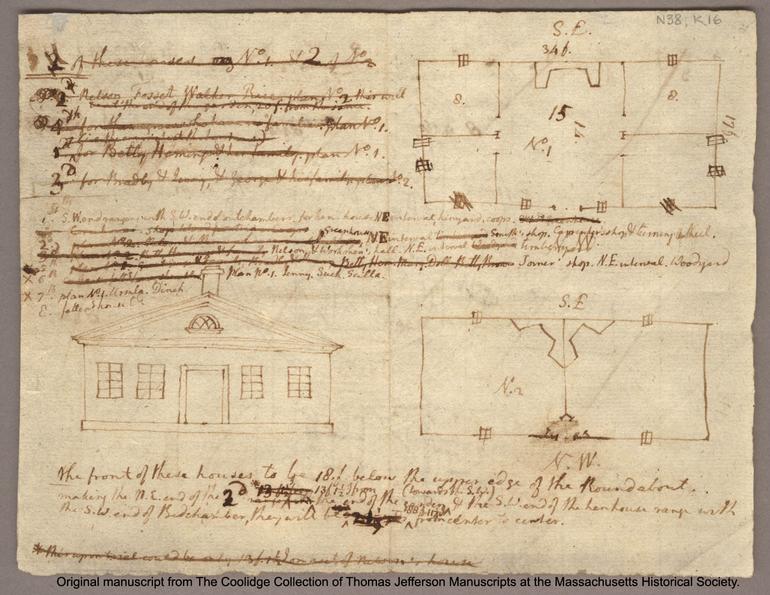
Working with the Papers of Thomas Jefferson and TJ as a Window into the Varieties of Early American Experience

Bland Whitley

Given that I’m new to both historical editing and the intensive study of Thomas Jefferson (about eight months on the job), I feel a bit unqualified to write about the work of the Papers of Thomas Jefferson. So what follows is something of a hybrid between the perspective of an outlier and that of an insider. The Papers, as some may know, consist of correspondence (incoming and outgoing) and other writings of our nation’s much celebrated and much deprecated third president and polymath. The project has made the lives of researchers easier by collecting all of Jefferson’s known papers, which are scattered among many archives and private collectors, into carefully annotated chronological volumes. Volume 36, which covers the months from December 1801 to March 1802, is now in press, while the first 33 volumes are now available online through UVA Press’s Rotunda imprint.

In researching and annotating documents, precision is essential. Transcriptions are verified against the originals to ensure accuracy. Supporting evidence is assessed carefully—if we are not reasonably certain of a given fact’s accuracy, it will not appear. If an interesting point or idea is not relevant to the document in question, we have to ignore it and move on. It’s not for nothing that documentary editing has been characterized as nuts-and-bolts, or blue-collar history. As much care and hard research goes into providing the context of particular documents, the goal always remains making Jefferson’s papers readily available and comprehensible to readers and researchers. Although like all documentary editors we must be engaged with the latest historiography, not just on Jefferson, but on seemingly the entire range of early American history, it is not necessarily our role to participate in the historiographical debates that tend to define the parameters of contemporary scholarship.

And there can be little doubt that Jefferson, or TJ as we know him, inspires more impassioned debates than any other founder. From reveries spun from his soaring rhetoric to anguish over his failure to extend the ideals embedded in his singular prose (a sub-genre that seemingly demands pairing with the adjective “Jeffersonian”) to anyone other than white men, he has become the catalyst of our own musings about America’s founding contradictions. That he likely carried on a long-term relationship with Sally Hemings, one of his slaves and quite possibly the half-sister of his dead wife, has only added to this racial (and now gendered) dramaturgy. Of course, fascination with TJ goes beyond these ideological concerns. As anyone who visits Monticello can attest, Jefferson the tinkerer and inventor (and he was certainly more the former than the latter) may be his most enduring image. His technical prowess only reinforces a sense that TJ can serve as a stand-in for the early American character—he is at once egalitarian and racist, nationalistic and provincial, visionary and practical (thus the constant tinkering). Presenting TJ, the binary code of early America.

That’s something of my outlier’s perspective but one to which I still partially subscribe. I say partially because although working on the Papers has deepened my appreciation of TJ’s multi-faceted nature, it has made me more leery of the ideological work that his image continues to allow commentators of all stripes to perform. One of the real virtues of a comprehensive documentary edition is that it places us students of history in the flow of events. It’s as close to a real time presentation of early American history as one can probably achieve. For this student, that heightens the sense that the set of wise men at the center of our story (TJ, Albert Gallatin, James Madison—our current volumes cover the presidency) had both a clear mission and understanding of what they wanted to accomplish but also had to muddle along, responding to contingencies as anyone else might. They appear as both the authors and subjects of events. One could certainly use the documents in our volumes to explore the binary TJ of the previous paragraph: the idealistic republican v. the hard-nosed, partisan Republican, the advocate for yeoman farmers v. the defender of planter slaveholders, and so on. But it’s even more evident to me, now, that laying all of these weighty themes at TJ’s feet and presenting him as either the hero of democracy or as America’s original sinner can be counter-productive. Nor does it represent the work that the Papers project performs.

Julian P. Boyd the founding editor of the TJ Papers, might have disagreed. The last five volumes that he produced served as platforms for his original and highly partisan analyses of TJ’s place in early America (central and exalted, one might say). And while the end of Boyd’s tenure became notorious for the slow pace of publication that his mini-monograph explications mandated (a pace I’ll point out is no longer a characteristic), it is the aggressive analytical posture that seems to me most problematic. With so many documents to and from Jefferson, which can and do speak for themselves (often with a push from the project editors’ annotations), there is little need to use the Papers as a platform to defend or attack Jefferson. The documents will naturally inform the more pointed analyses of other scholars, but in our work here we neither damn nor praise the man. Rather, it seems more appropriate to use TJ as a window into the varieties of early American experience.

And what a window! I won’t claim TJ as some kind of magic key, but I know of no other early American figure who can put a student into contact with so many different aspects of that period. During my short tenure, I have helped research and annotate documents concerning such topics as improvements in steel-yards, or weight balances, the efforts of Quakers to provide education for African-American children, the late career of English scientist and religious dissenter Joseph Priestley, some of Jefferson’s slaves, smallpox vaccination, tobacco marketing, the variable quality of Virginia hams, the invention of the lifeboat, and the early American publishing and bookselling industry. Even while president when he was often consumed by party-building, patronage requests, and foreign policy, Jefferson retained his diverse interests. And because people recognized him as a man of science and learning, he attracted correspondence on an enormous range of subjects.

It is this variety that keeps me excited throughout the workday. And it also points out the irony of this project. Jefferson is absolutely at the center of our little scholarly kingdom (er, I mean republic). The project is defined by documents that emanated from his pen or passed through his hands. Yet, for me its greatest value is the light it casts on the various people, objects, ideas, and events with which TJ engaged. Perhaps that merely reflects my training during a period that prized decentering and debunking the “great white men.” I’ll own up to that. But it also seems to me that the vastness of documentary projects such as ours precludes (or at least should) the kind of narrative coherence that a tight analysis requires. What such editions achieve is not a biography in documents. Rather, they foster multifaceted, sometimes chaotic, portraits of the social milieus in which the primary subjects and their peers acted.

For students of Jefferson (detractors, boosters, and others) the Papers project remains an unparalleled resource. Yet anyone interested in some small corner of the early republic can profitably consult its volumes. And the same might be said for documentary projects of all stripes. Don’t think of them as limited by their primary subjects, however rich and contentious.