Search This Blog

Showing posts with label Religion and Politics. Show all posts

Monday, December 27, 2010

Understanding the God Gap

The census report is out and from what I've heard a number of "blue states" will lose
Congressional representation, while a number of "red states" will gain representatives.  This, according to the pundits bodes ill for Barack Obama's reelection chances.  I really can't comment on the latter, the next election is two years away, so who knows how this all will work out.  But I'd like to think about some of the assumptions, like the idea that the God Gap we currently see in our political landscape will have long lasting governing implications.

I'm reading American Grace by Robert Putnam and David Campbell, and have been reporting from my experiences reading this tremendously important book.  I've reached the section of the book that looks at the relationship of religion to American Politics.  One of the interesting points that the authors make is that prior to 1980 there really wasn't much of a God Gap between the two parties.  Things changed around 1980 with the election of Ronald Reagan and the decision of the two political parties to place in their platforms planks both pro and con abortion.  The authors write:

Remember, though, that a political issue can only divide the electorate when voters are presented with a choice on that particular issue.  In the case of abortion, the Democratic and Republican parties did not diverge sharply on the issue until the 1980s.  In 1976, the Republican platform was more or less neutral on abortion.  By 1980 it unequivocally endorsed a constitutional amendment to ban abortion, language that has been preserved ever since.  Meanwhile, as described by political scientist Christina Wolbrecht, 1980 was "the first time the Democratic party firmly established itself as pro-choice and expressed its opposition to the curtailment of federal funding for abortions."  Beginning in the 1980s, voters had a choice on abortion.  The battle lines had been drawn. (American Grace, p. 391). 
  
From then on the GOP became the party of "moral traditionalism," and at least for religiously observant whites, it became the "God party."  The authors of this book note that Blacks, who are the most religiously observant group within American society, are the exception to this rule -- with few blacks voting GOP!  Although many Blacks share the GOP view on abortion and gay marriage, their list of social issues is much broader and thus they do not find themselves able to make common cause on these issues.  

So, what does that portend for the future?  Does it mean that you can't be religious and a Democrat?  I hope that's not true, but those who take a more secular view are more likely to be Democrat than Republican.  

And then the question is -- what is the electoral impact of this Gap?  Here is where the future is uncertain -- with a growing number of voters declaring themselves Independents -- religion apparently plays little role in their views.  So, with this growing swing group making itself felt, maybe religion will fade into the background in the near future?  Only time will tell, but I think this is a conversation worth having for both the sake of the church and the state!


Saturday, December 11, 2010

Wooing the "Nones"

As we noted in a previous post there is an increasing number of people, especially young adults, who the authors of American Grace term "Nones."  They are "Nones" because they choose not to identify with any particular religious tradition.  We've noted that many have been turned off by what they perceive are the "political overtones" of religion -- especially conservative politics.   So, is it possible that these disaffected younger adults might be enticed to come into the church?  Well, the authors say it's possible -- because they aren't by nature "ardent secularists."  They write that "a large portion of those who demur from indicating a formal religious affiliation believe religion is important, pray regularly, and even attend a congregation on occasion" (American Grace, p. 176).  They are, what sociologists Michael Hout and Claude Fischer call "unchurched believers."  They are, thus to quote the Putnam and Campbell, "an inviting target for "religious entrepreneurs."  

The term religious entrepreneurs might sound a bit off putting, but their point is well-taken.  It will take people who are willing to take risks and try new things to reach this group of disaffected people.  And what would this look like?  Well, if its partisan politics or a merging of religion and politics, especially relating to sex and family issues that can be seen in the evangelical/GOP alliance, that pushes them away, then it would be helpful to  deemphasize these kinds of issues in favor of others.  That might be a harbinger of good things for mainline churches that aren't as linked to such emphases.

Of course there is the possibility that something more geared toward them, such as the emerging church or emergent church movements might be more successful.  The reality, as the authors see it, innovation is at the heart of the effort.  I would add that from watching the young adults I'm in conversation with, there is a strong desire to be doing something, not just watching something be done.  They're not interested in committees, but they do want to make a difference. 

Can this be done?  Yes, I believe it can.  That is the possibility raised in a more detached way in American Grace and in a more direct way by Carol Howard Merritt in her book Reframing Hope (Alban, 2010).

Wednesday, December 8, 2010

America's Religious Identity -- Boom, Shocks, and After-shocks (Part 4 -- Second Aftershock)

American Grace: How Religion Divides and Unites UsIf you can remember back that far, the 1950s and early 1960s were the hey day of institutional religion.  I was, as I've noted, born at the end of the 1950s, grew up in the 60s and 70s and came of age in the early 70s.  I was born into a mainline church, but left it for a more "charismatic" and conservative religious orientation in the mid to late 70s.  Over time I grew disenchanted with my charismatic context, in large part due to the anti-intellectualism that I found there.  I will add, that I also found a lot of hypocrisy in that group as well.  We were very competent in covering our ways in spiritual language.  But, I didn't go "liberal" overnight.  I went to a premier evangelical seminary, though in evangelical circles Fuller is considered liberal, and while I continue to value my education at Fuller, I continued to chaff under the evangelical sub-culture that seemed unable to wrestle in meaningful ways with the intellectual challenges of the age.  That's my story, but there is another story of a more dramatic aftershock to the conservative aftershock of the 1970s and 1980s.

Robert Putnam and David Campbell, writing in their book American Grace, suggest that when we look at demographics, we need to keep in mind that the overall numbers change slowly as one generation gives way to another.  Consider that yesterday we observed Pearl Harbor Day.  World War II began for Americans on December 7, 1941.  That was 69 years ago.  Even the youngest survivors of that day are in their late 80s.   The Greatest Generation, the generation that birthed the Baby Boom and that fueled the religious surge in the 1950s and 1960s is dying off and soon their presence will no longer be felt.  This generation, along with the one that came of age right after WW II, the folks that fought in Korea and have not made as much of a dent in the public mind as either the Greatest Generation or the Baby Boomers, they're aging as well.  Both of these generations are relatively conservative.  As they pass away, the younger generations will begin to make themselves felt. 

Well, if the later Baby Boomers (sometimes called the Jones Generation) and the GenXers were more conservative, leading to the first aftershock, there is a new generation coming of age, and they are both more liberal and increasingly disaffected from institutional forms of religion.  I know one of these people quite well --he's my son!  

One of the key changes in this new generation is the growing presence of what have come to be known as the "None's."  They're a bit like the growing numbers of Americans who choose as their political party affiliation -- Decline to State.  Putnam and Campbell note that in the pre-boomer years maybe 5-7% of the population would have claimed no religious affiliation ("nones").  That doubled among boomers (10-15%), and that has doubled again to 20-30% among those who have come of age in the past two decades.   The authors note that there is no evidence to show that as these younger generations age they're becoming more attached to institutional religion.  Here is the kicker:

Since 2000 generational succession has meant that cohorts of whom barely 5 percent say they have no religious affiliation are being replaced by cohorts of whom roughly 25 percent say they have no religion, massively increasing the nationwide incidence of nones.  (American Grace, p. 123).
It's not that they don't believe in God or seek some kind of spiritual sustenance, as the authors note there are few atheists or agnostics in this bunch.  The New Atheists are making a big splash, but they're really not making many converts!  Many of this new cohorts of "Nones" emerge from homes that were not religious to begin with -- that is children of Boomers who never got introduced to the church or synagogue, but they are also increasingly present among children of the devout, even among the evangelicals.  

And, note this:

The new nones are heavily drawn from the center and left of the political spectrum.  Hout and Fischer have shown that the rise of the new nones closely corresponds (with a lag of about half a decade) to the visibility of the Religious Right in the public media, suggesting that the rise of the nones might be some sort of backlash against religious conservativism.  Our Faith Matters surveys confirm that few of the new nones come from the right half of the political spectrum. (American Grace, p. 127).
Although there are more progressive alternatives to conservative forms of religion, it would appear that the younger cohort isn't paying much attention to these alternatives.  Institutional forms of religion seem to them to be inherently politicized, and they'll get their politics elsewhere.

So, what does this bode for the church?   Although evangelicalism continues to have some presence, the trends don't look good for them either.  Evangelicals could be in much the same place that Mainliners were four decades ago.  And the movements that are tapping into all of this change are what have been called Emergent or Emerging churches.  

I think that the past two election cycles are good examples of this.  In 2008, President Obama and the Democrats had an amazing year, sweeping the Republicans out of the White House and creating huge majorities in Congress.  They did this with a lot of help from young voters.  In 2010, the situation reversed itself.  But all of the polling suggests that the electorate of 2010 was much older than the general population.  Will this reverse itself in 2012?  It's too early to say, but I think it's interesting to note that the Fox viewership mirrors the 2010 electorate, it's getting older.  Younger adults, who didn't show up at the polls in 2010, are turning to Stewart and Colbert!   Oh, and I thought interesting that the median age of viewers for Sarah Palin's Alaska was 57 years old, 15 years older than the typical TLC audience.  

The second aftershock is only now making itself felt -- the question that political parties and religious institutions need to consider, is how this shift will affect their longevity!   

Friday, November 19, 2010

The Emerging Evangelicals -- Sightings

Trying to define the true nature of evangelicalism has never been easy.  Consider that in the 18th century both Whitefield and the Wesley's were called evangelicals, but despite similar methodologies, their theologies were quite different.  One was Calvinist and the other Arminian.  In Germany Evangelical means Protestant.  And so, when pundits and critics of the Religious Right equate evangelism with either Fundamentalism or the Religious Right they're only getting part of the description correct.  There are many different varieties of evangelicalism, something that Donald Dayton has been proclaiming for several decades.   Being a product of Fuller Seminary, I knew quite clearly that there was a difference between the kind of evangelicalism that was present there and that found to the south at Talbot Seminary. 

In this edition of Sightings Jenny Rae Armstrong suggests that there is a movement underway in evangelicalism that has embraced not just salvation in the next world, but a commitment to social justice and systemic transformation in this world.  She calls them Emerging Evangelicals, though as many can attest, even that term is subject to controversy.  Nonetheless, her analysis of the current political climate and the changes that are going on within the evangelical movement are worth considering.  The point being -- not all evangelicals are Republicans, and that is especially true in the under 40 set!

*********************************


Sightings 11/18/2010


The Emerging Evangelicals

- Jenny Rae Armstrong

The recent GOP rebound has been regarded by many as a victory belonging to rifle-toting, SUV driving, born-again Christians. But to oversimplify evangelicals in this manner is to ignore a growing rift within their ranks. Few mainstream evangelicals have attempted to link laissez-faire capitalism with the teachings of Jesus. Even though some claim to base their vote on issues such as abortion, single-issue voting doesn’t seem to be enough to keep younger evangelicals within the Republican fold.

Dubbed “The Joshua Generation” by the Obama campaigners who courted them vigorously, the voting practices of younger evangelicals have been shifting steadily to the left. One third of white evangelicals between the ages of 18 and 29 supported Obama in the 2008 elections, compared to the 16 percent who voted for John Kerry four years earlier, according to a Newsweek article published on January 17, 2009. Increased evangelical concern for social justice, coupled with growing discomfort with the “anti-gay, anti-poor, and anti-environment” stance of the religious right described by progressive Christian leader Tony Campolo, spurred many of them to vote for a democrat for the first time in their lives. Jim Wallis, editor of Sojourners magazine and author of the book God’s Politics: Why the Right Gets it Wrong and the Left Doesn’t Get It, expressed the growing discontent among his fellow evangelicals: “Many of us feel that our faith has been stolen (by the religious right), and it’s time to get it back… How did the faith of Jesus come to be known as pro-rich, pro-war, and pro-American?”

Self-described “Red Letter Christians” (social activists who take Jesus’s teachings on poverty, mercy, and justice literally) such as Campolo and Wallis have been making an impact, not just on evangelicals’ voting habits, but on their very self-image. A decade ago, if you asked an evangelical to sum up her faith, she likely would have quoted Romans 10:9: “If you declare with your mouth, ‘Jesus is Lord,’ and believe in your heart that God raised him from the dead, you will be saved.” Nowadays, if you ask the same question, you would be more likely to hear Micah 6:8: “He has shown you, O mortal, what is good. And what does the Lord require of you? To act justly and to love mercy and to walk humbly with your God.”

This cultural shift is well-illustrated by the recent publication of the book Radical: Taking Back your Faith from the American Dream by David Platt. Social justice manifestos penned from the fringes of evangelicalism are hardly new fare for the Christian publishing industry (think Shane Claiborne’s Irresistible Revolution), but Platt is pastor of a Southern Baptist mega-church in Birmingham, Alabama. As unappealing as his hellfire-and-brimstone views may be to the less “radical,” it is difficult for even the most conservative Christians to brush off his equally fiery insistence on “taking up the cross” of sacrificial living and concern for the poor as bleeding-heart liberalism. Social justice has become a centerpiece of mainstream evangelicalism.

Ironically, the high-profile rise of economically-focused groups such as the Tea Party could drive an even greater wedge between the GOP and evangelicals, who were drawn to the Republican Party more as a reaction against legalized abortion than an affinity for libertarianism. In fact, evangelicals have always expressed concern for the less fortunate, and are among America’s most generous givers, with almost 24 percent of them donating at least 10 percent of their income to charity, according to the Barna Group. But a growing number of young evangelicals are coming to the conclusion that it is going to take more than a carefully calculated tithe dropped into an offering plate to effect real, positive change for the poor and oppressed, and are willing to think, act, and vote accordingly.


References

Tony Dokoupil, “Faith Beyond His Father’s,” Newsweek, January 17,2009. 


Barna Group, “Americans Donate Billions to Charity, but Giving to Churches has Declined,” April 25, 2005.


David Platt, Radical: Taking Back Your Faith from the American Dream (Colorado Springs: WaterBrook Multnomah, 2010).


Jenny Rae Armstrong is a freelance writer who writes about faith and social justice for a variety of evangelical publications.


----------


Sightings comes from the Martin Marty Center at the University of Chicago Divinity School.

Monday, July 12, 2010

Reporting on the God Gap -- Sightings

Whatever you may think of the relationship between religion and politics, there has always been a conversation between the two sectors of society.  Politicians and people concerned about public policy are always looking for allies in the religious community, and religious folk have often sought to influence public policy.   Martin Marty, who has devoted a lifetime to exploring this relationship, comments on a new study of this relationship, one that focuses on Catholic and Protestant faith traditions, a study that notes the complexity of these two faith traditions.  I think you'll find this interesting, as the public square isn't nearly as naked as some would think, and the Christian vote isn't as monolithic as some would want us to think!  

**************************************

Sightings 7/12/10


Reporting on the God Gap
-- Martin E. Marty


“A New Roadmap for Reaching Religious Americans on Public Policy Issues” is the subtitle for Beyond the God Gap, a 49-page report and chart for those who are trying to find their way among religious groups as they show up in politics and culture. The co-agents are think tank Third Way and the Public Religion Research Institute, whose regular issuances are useful for those who would “reach” and also those who “observe” religious Americans. The authors of Beyond the God Gap do know that there are non-religious folk and forces out there, but in their minds they cannot be “reached” efficiently on public issues. Forget the “new atheists” then, for a moment, as the authors of this report do.

What is more, while both of the sponsors of this project have interests in all religions, Beyond the God Gap deals only with Christians. The surveyors know that the varieties of Jews and Muslims are also reaching and being reached on public policy issues, but the topic for the Third Way and PRRI is “Catholics” and “Protestants.” What is clear from this and countless other opinion surveys is that the old standard typified by Will Herberg’s 1955 classic, Protestant, Catholic, and Jew, would be almost useless in changed America. What Herberg called “Protestant” stood for “White Mainline Protestants” (WMPs). He hardly noticed what today are termed “White Evangelical Protestants” (WEPs) or “African American Protestants” (AAPs). These are the two groups where the “reaching from and to” is most strenuous, effective, and controversial today.

Quick, now: Think of the few times when cable news dealt with “White Mainline Protestants” on public issues. We can foresee one, as the Presbyterian General Assembly soon will debate topics relating to Palestinians and Israelis. Another has to do with conflict over gay marriage and ordaining homosexuals. For the rest, dealings with WMPs are mainly diversions as politicians and public figures court or avoid WEPs and AAPs, who encamp in sufficiently definable identity sectors to warrant attention. Even here, Beyond the God Gap has to parse things somewhat more finely – for example, where they find substantial differences between young versus middle-aged WEPs on homosexuality and other such fronts of controversy. It is also clear that there is no simple “Roman Catholics” group, since left and right factions there differ so much from each other that politicians using this road map might well drive into the ditch, and certainly will hit potholes. AAPs are somewhat more predictable when it comes to addressing public issues, or being reached. Most still vote Democratic and get cast as “liberal,” but their part of the map is also increasingly diverse.

The authors of this report say they set out to shatter stereotypes simply by interviewing citizens and finding where their loyalties and goals may be. Add up these diverse groups, and it is easy to see why three-fourths of the road-mapped groups resent it when some WEPs claim that theirs is “The Christian vote,” and when mass communicators sleepily suggest that when polled majorities among white evangelicals are interviewed as they exit voting booths, they should have a monopoly on the term “Christian,” as in “the Christian vote.” They are claiming too much, and the members of the media who grant them a monopoly do the surveys, the faiths, and social scientists a disservice. Beyond the God Gap will help with more accurate reporting, and give the public a better picture of how the religious groups line up at the polling places. The old model won’t work. A significant power shift has already occurred.

Martin E. Marty's biography, current projects, publications, and contact information can be found at http://www.illuminos.com/.


----------

In this month's Religion and Culture Web Forum ("The Primacy of Rhetoric"), Marty Center Senior Fellow (2009-10) W. David Hall addresses the centrality of rhetoric in the Western humanist tradition by engaging the work of Ernesto Grassi, whose commentary on the Renaissance, especially, diverged from standard Platonic models of interpretation to include arts such as rhetoric, literature, and poetry. Of especial interest for Hall is Grassi's "retrieval of the humanist tradition" during this era and the possibilities that thorough understanding of such a retrieval opens more broadly in the fields of philosophy and religious studies. With invited responses from Andrew Hass (University of Stirling), Jeff Jay (University of Chicago), Santiago Pinon (University of Chicago), Donald Phillip Verene (Emory University), and Glenn Whitehouse (Florida Gulf Coast University).


----------

Sightings comes from the Martin Marty Center at the University of Chicago Divinity School.

Tuesday, June 29, 2010

On Not Polarizing Too Much: The Challenges of Prophetic Hospitality (Bruce Epperly)

As we near the Fourth of July holiday, a weekend in which citizens and residents of the United States of America will celebrate 234 years of independence, we also live at a time of increasing political and cultural polarization.  The political bases of the two parties have moved further and further from the center, so that less that civil statements and actions have come to the fore.  Bruce Epperly writes as a theological progressive and political liberal -- I note that both these terms are considered "unAmerican" in some circles."  Just today, I heard Jeff Sessions ask, with derision in his voice, whether Elena Kagan is a "progressive."  So, where are we as a nation when "birthers" and Tea Partiers seem to have taken hold of the imagination?  Bruce addresses some of these questions in what should prove to be one of his most provocative contributions to this blog.


****************************************

On Not Polarizing Too Much:
The Challenges of Prophetic Hospitality
Bruce G. Epperly


This week’s contribution includes affirmations, concerns, and confessions in responding to the growing polarization of our political and religious worlds. I begin with a concern: I believe that there are growing movements of political and religious polarization in our national life today. I believe these movements threaten the gains we have made as a nation in terms of health care, diversity, environmental protection, and human rights. These movements are motivated by a vision of reality that clearly and dramatically separates persons and policies in terms of good and evil, black and white, in and out, and us and them. When these movements draw on religious resources, they articulate a vision of God which is defined primarily in terms of judgment, power, exclusion, and destruction, rather than love, healing, and acceptance. In a world of diverse visions of reality and lifestyles, these groups believe that God is the ultimate divider, and calls us to do likewise. I will also make a confession: Many of the members of these movements of the religious and political “right” assume that people like me are the enemy, representing something that is destructive of true Christianity and the USA’s best interests.

While we progressives and liberals can be polarizing as well, seldom do progressive and liberal Christians or political activists threaten violence, insurrection, or question the patriotism of those with whom we disagree. I cannot recall among the many progressive and liberal diatribes against President Bush (which involved more than a little impolite conversation and words of demonization) calls for his assassination, the de-legitimization of his second election to the presidency, or the overthrow of the government. I suspect this was because in spite of their occasional vitriol, progressives and liberals are inherently big picture, inclusive, and global thinkers. I have concerns in terms of the growing influence of political and religious polarizing groups, especially in the context of their attempts to become the dominant voice of the Republican Party.

The question these groups raise for me as a progressive Christian is: “Can I be both prophetic and hospitable in relationship to the groups that judge my path as demonic, wrong, and hell-bent? Can I find ways to forcefully but lovingly respond to such groups and their belief systems?” I must confess these are challenges to me personally and spiritually, especially when I hear the comments of “birthers,” Tea Party members, libertarians, and Christian militia leaders. I am often angry, and am tempted to polarize in my own thoughts. I wrestle with how can I passionately advocate for what I believe is right for our nation and the future of our world, and what is congruent with my faith as a Christian – concern for global climate change, a greater sense of community and inclusion, welcome to strangers, health care for all persons, and affirmation of the interdependence of nations – and not demonize with whom I disagree, even when such persons see my views as demonic and dangerous to Christianity and the nation. How can I balance prophetic passion and justice-seeking with healing hospitality?

In her book Plan B, Anne Lamott admits that finding a way to envisage President Bush in a new light was her primary spiritual challenge. She passionately opposed everything about his leadership and policies, domestic and foreign. But, she came to realize that her hatred and demonizing of the President was hurting her spiritual growth and was standing in the way of following Jesus. She still continued to oppose President Bush’s policies, but began to visualize him as a child of God. This began a process of spiritual transformation that changed her life.


In many ways I feel like Anne Lamott when it comes to the rising polarizing political and religious right wing. As I seek to provide prophetic hospitality, my response is both theological and spiritual. First, as a process theologian, I believe that God influences every person to greater or lesser degree. The most vitriolic “birthers” are still touched by God; that is the meaning of omnipresence. While I suspect that they are turning their back on God’s call to a wider more creative and global vision of Shalom, God is still working within their lives, seeking wholeness and community. Second, all persons, even the most radical Tea Party persons, are God’s beloved children, deserving my basic human respect, despite the political gulf between us. Third, all persons, including myself, can experience transformation and conversion. From this perspective, my own political disagreements need to be framed as provocative alternatives, rather than attacks, grounded in the hope that “opponents” may awaken to the value of contrasting positions. Fourth, in order to avoid polarization, in the spirit of Reinhold Niebuhr, I am called to see the falsehood in my own truth, and the potential truth in the “opponent’s” falsehood. Sometimes, this is simply the recognition that your “opponent” is motivated by fear – fear of change, fear of economic insecurity, fear of otherness, fear of the inevitable decline in the American empire, and fear of losing one’s ethnic, social, or political place in society. To me, fear is the common denominator of all these groups in their quest to deport the alien, hold onto tax money, and delegitimize an African American president. Perhaps, they shout louder because they know that their cause is ultimately lost and that they are going against the grain of history and the nature of reality in its interdependence and diversity.

Theology inspires spiritual practices. I am working at “breathing deeply,” trying preserve my spiritual center when my own anger takes center stage. Gentle breath prayers break down the walls of division and open us to new possibilities for personal and communal transformation. Second, with Mother Teresa, I seek to see Christ “in all his distressing disguises,” including shouting Tea Party members, recalcitrant lawmakers, and violent militia persons.

Finally, as I seek to be hospitable to my “opponents,” I look for the truth in their falsehood even as I passionately affirm my vision of interdependence, community support, healthy diversity, equality for all persons, and ongoing evolution. I seek to experience God moving through all our lives, gently and persistently, even my political and religious “opponents.” Whether or not, we can find common cause in this time of knee-jerk divisiveness, I hope to bring forth the best in myself and my community by living by love rather than fear, imagination rather than stagnation, and hospitality rather than isolation.


Bruce Epperly is Professor of Practical Theology and Director of Continuing Education at Lancaster Theological Seminary and co-pastor of Disciples Community Church in Lancaster, PA. He is the author of seventeen books, including Holy Adventure: 41 Days of Audacious Living and Tending to the Holy: The Practice of the Presence of God in Ministry.


Thursday, June 24, 2010

Fire and Fraud: Touchdown Jesus Meets the Cult of Palin -- Sightings

Having worked at a Christian bookstore during my seminary years, I learned a lot about Christian kitsch, what we called Jesus Junk.   One thing that conservative Christianity figured out early on was how to sell itself.  It didn't just champion capitalism, it embodied it.  No one was better at it than Aimee Semple McPherson, whose talents gave birth to a whole number of imitators.  Well, as Jeremy Biles notes, Sarah Palin has caught the bug, and has combined piety and entertainment and politics together in a way that is almost cultish.  Jeremy Biles takes up the Sarah Palin event and discusses it together with the burning of the TD Jesus in Ohio.  It's an interesting piece, so read and offer your thoughts! 
*******************************

Sightings 6/24/10


Fire and Fraud:
Touchdown Jesus Meets the Cult of Palin
-- Jeremy Biles


I recalled C. G. Jung’s definition of “synchronicity” last week when two email messages, each containing a link to a religion news story, arrived to my inbox almost simultaneously. Synchronicity refers to “temporally coincident occurrences of acausal events.” In other words, synchronicity is about meaningful coincidence – two or more events or images not causally related, but connected in some significant way.

The first news item actually invoked coincidence: “We just all have to go on our faith and ask God. This cannot be a coincidence." This was one Solid Rock Church member’s response to the destruction of the famed “Touchdown Jesus” sculpture that had long caught eyes and raised eyebrows along a stretch of Interstate 75 in southwestern Ohio.

Officially titled “King of Kings,” this massive bust of Jesus, with arms raised to heaven in the posture that suggested its nickname, was struck by lightning last Monday night and subsequently burnt down, in what some characterized as an “act of God.” News images show the gigantic sculpture engulfed in flames, while a sign at Solid Rock ensures hope in the resurrection: “He’ll be back.”

The second link brought me to a Huffington Post article calling attention to the cover image on the latest issue of Newsweek. It depicts Sarah Palin, her hands pressed together in a prayerful gesture, her lit-up face turned heavenward, and her head endowed with a Photoshopped halo. Below this intentionally tacky image, in vintage calligraphy, are the words “Saint Sarah,” along with the tagline for Lisa Miller’s article: “What Palin’s appeal to conservative Christian women says about feminism and the future of the religious right.”

Miller’s report brings critical light to bear on Palin’s appeal to conservative Christian women. Miller emphasizes Palin’s much touted “authenticity,” as demonstrated in her book Going Rogue, where the former vice-presidential candidate talks, for example, about the unexpected pregnancy leading to the birth of her son Trig. “Nothing,” writes Miller, “makes a person, let alone a politician, appear more vulnerable, more ordinary, and more unambiguously female than a scene in a bathroom where she pees on a stick.”

The combination of sentimentality, pathos, and all-American ordinariness that constitutes Palin’s “authenticity” works hand-in-hand with her optimistic religiosity and buoyant patriotism. Miller describes Palin “wearing a rosarylike cross around her neck and a sparkly American flag lapel pin” as she spoke to over 500 women at the pro-life Susan B. Anthony List, each of whom paid at least $150 for the privilege of hearing Saint Sarah speak.

Miller notes that “a certain kind of conservative, Bible-believing woman worships” Palin. One Palin zealot, Vicki Garza, owner of a Dallas-based marketing firm, established a now heavily trafficked website called PrayForSarahPalin.com. Garza “believes a great cosmic battle is underway for the soul of America and that Palin has been singled out by God for leadership.” In Garza’s own words, “The anointing on [Palin] is so strong…. She’s just fearless.”

But what does Saint Sarah have to do with Touchdown Jesus? What makes the coincidence of these images significant? They are connected on at least this point: Whatever else they are, both Palin and the King of Kings can be seen as forms of advertising that might be characterized as kitsch: cheaply produced, popular, and marketable art that traffics in sentimentality and often adapts imagery from cultural iconography – Jesus or saints, for example.

To suggest that Touchdown Jesus – a sculpture of fiberglass and plastic foam mounted on a simple metal skeleton – might be perceived by some to be a kitschy oddity is not to deny that for others it is a meaningful icon, a monumental focal point for faith. It also has clear evangelistic intent, and thus works, for better or worse, as a kind of marketing tool.

But whereas the loss of Touchdown Jesus provoked both sadness and guffaws, the cult of Saint Sarah leaves little room for mirth. Palin’s self-construction as ordinary and “authentic” – her everywoman, working-mom routine; her down-home idiolect; her wink-peppered performances – is, at base, an advertisement for herself. With or without the fraudulent halo, she is a kitschy image designed to sell a particular brand of religio-political entertainment.

Cheaply produced (if sometimes expensive to consume), Palin is above all a popular commodity whose religious saleability is evidenced and abetted by the merchandise generated around her. Newsweek highlights the commercial aspect of Palin’s enterprise in a photo slideshow entitled “Cult of Palin.” Here you find images of Palin alarm clocks, Palin burlesque shows, Palin coloring books, and Palin shirts emblazoned with the slogan “God, Guns, Guts.” As an image, Palin is the patron saint of a form of commercialism in which religion, politics, and entertainment are collapsed.

Cheap and marketable: these terms may describe both Touchdown Jesus and Saint Sarah. But one suspects that human will, and not an act of God, will be required to dispel the cult of Palin.


References:

The Huffington Post calls attention to the “Saint Sarah” Newsweek cover here:

Lisa Miller’s Newsweek article, followed by a link to the “Cult of Palin” slideshow, can be found at:

Information about the destruction of the “King of Kings” statue can be found here:


For information on kitsch, see:  http://en.wikipedia.org/wiki/Kitsch


Jeremy Biles teaches courses on religion, philosophy, art, and popular culture at various institutions in Chicago. He is the author of Ecce Monstrum: Georges Bataille and the Sacrifice of Form (Fordham University Press, 2007).

----------


This month's Religion and Culture Web Forum features a chapter from literary critic Amy Hungerford's forthcoming volume Postmodern Belief: American Literature and Religion Since 1960 (Princeton University Press, August, 2010). In "The Literary Practice of Belief," Hungerford focuses upon two contemporary literary examples--the novels of Marilynne Robinson and the Left Behind series--in order "to engage (and revise) the current emphasis on practice over belief in our understanding of religion." With invited responses from Thomas J. Ferraro (Duke University), Amy Frykholm (The Christian Century), Constance Furey (Indiana University), Jeffrey J. Kripal (Rice University), Caleb J. D. Maskell (Princeton University), Edward Mendelson (Columbia University), Richard A. Rosengarten (University of Chicago Divinity School), and Glenn W. Shuck (Williams College).
http://divinity.uchicago.edu/martycenter/publications/webforum/index.shtml


----------

Sightings comes from the Martin Marty Center at the University of Chicago Divinity School.

Tuesday, June 15, 2010

Split Ticket -- WTF book announcement

Will Young Adults, especially Christian young adults, engage the political system?  Will the political shenanigans that muddy the waters lead to skepticism and cynicism?  There is a growing sentiment that the system is broken and many are ready to jump ship.  But is that the right choice?

Split Ticket: Independent Faith in a Time of Partisan Politics is the second volume in Chalice Press's Where's The Faith series for young adults, which is edited by Brandon Gilvin and Christian Piatt, is due out over soon.  You will want to get a copy, especially if you read and enjoyed the first volume Oh God! Oh God! Oh God! (Chalice 2010).  I've not yet read the newest collection of essays, which is edited by Brandon, Christian, and Amy Gopp, but I know all three, regard them highly (all three are Disciples by the way), and know it will be worth your attention.

So, until the book is available, you can read my review of the first volume and check out this trailer from Chalice Press:


Thursday, May 6, 2010

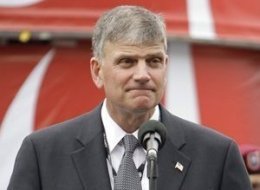
A Response to Franklin Graham

I must say this, Franklin Graham has never developed the political acumen of his father.  He has continually made statements that are narrow and inflammatory -- something his father shied away from (at least in public).  There are those comments on the Nixon tapes that are problematic!

Recently the younger Graham was disinvited from speaking at a Pentagon National Day of Prayer observance.  This occurred because Graham has continually made disparaging remarks about Muslims.  Yes, I know he loves Muslims, he just thinks their religion stinks and that they need Jesus.  But, his comments are incendiary, and his presence at a Pentagon sponsored prayer service, while the United States is at war in two Muslim countries (as it continually declares that it is not at war with Islam), is not helpful.

Graham, of course, won't let this thing die, and suggests that this disinvitation is a slap in the face of evangelical Christians.  Not only that, it is the sign that forces within the Obama administration are opposed to the Christian faith.  (What is interesting is that Graham cites Islam's treatment of women, but when he speaks of Obama's advisers, he speaks of "the men around" him -- I thought that there were some women among Obama's advisers, but I must have been misinformed).

In response to Mr. Graham -- it is not that evangelicals are being disinvited, it's people like you who are being disinvited.  Obama is on good relations with a number of evangelical leaders.  He seeks prayer support from evangelical pastor Joel Hunter and from evangelical United Methodist pastor KirbyJohn Caldwell -- who by the way served in a similar position with President Bush.  It is not, therefore, a repudiation of evangelicalism.  Instead it is a repudiation of the narrowness of figures such as Franklin Graham, Pat Robertson, and James Dobson.   It may also be a response to the self-proclaimed National Day of Prayer task force, a group of ultra-right conservative Christians who have seen fit to take over this day as their own. 

Barack Obama's 2010 National Day of Prayer Proclamation

Since today is the National Day of Prayer, an observance that has been held annually since 1952, when Harry Truman issued the first proclamation, I thought it appropriate to share Barack Obama's proclamation issued on April 30th.  It is important to note that the President has not canceled the National Day of Prayer as some emails have suggested.  How he personally observes it is up to him, but he has issued an encouragement to prayer, not that we should need such a thing!  

As for me, I'll be participating in the Troy Interfaith Group service at First Presbyterian Church of Troy.  This service will include Jewish, Hindu, Buddhist, Baha'i, Catholic, Protestant, Jain, and Muslim participants (and I've probably left out some).  This variety represents the variety that is in Troy, MI.  Now there is another observance, to be held on City Property, that is Christian focused.  I find it ironic that this is the case, but such is the realities of times such as these.

It is, however, important to note that in issuing this proclamation, the President -- unlike some prayer organizers -- recognizes the religious pluralism of the nation.  Note this emphasis:

I call upon the citizens of our Nation to pray, or otherwise give thanks, in accordance with their own faiths and consciences, for our many freedoms and blessings, and I invite all people of faith to join me in asking for God's continued guidance, grace, and protection as we meet the challenges before us.

I believe this is the proper focus of such a proclamation of the President of all the people, not just Christian people.


*************************


Presidential Proclamation--National Day of Prayer

A PROCLAMATION
April 30, 2010


Throughout our history, whether in times of great joy and thanksgiving, or in times of great challenge and uncertainty, Americans have turned to prayer. In prayer, we have expressed gratitude and humility, sought guidance and forgiveness, and received inspiration and assistance, both in good times and in bad.

On this day, let us give thanks for the many blessings God has bestowed upon our Nation. Let us rejoice for the blessing of freedom both to believe and to live our beliefs, and for the many other freedoms and opportunities that bring us together as one Nation. Let us ask for wisdom, compassion, and discernment of justice as we address the great challenges of our time.

We are blessed to live in a Nation that counts freedom of conscience and free exercise of religion among its most fundamental principles, thereby ensuring that all people of goodwill may hold and practice their beliefs according to the dictates of their consciences. Prayer has been a sustaining way for many Americans of diverse faiths to express their most cherished beliefs, and thus we have long deemed it fitting and proper to publicly recognize the importance of prayer on this day across the Nation.

Let us remember in our thoughts and prayers those suffering from natural disasters in Haiti, Chile, and elsewhere, and the people from those countries and from around the world who have worked tirelessly and selflessly to render aid. Let us pray for the families of the West Virginia miners, and the people of Poland who so recently and unexpectedly lost many of their beloved leaders. Let us pray for the safety and success of those who have left home to serve in our Armed Forces, putting their lives at risk in order to make the world a safer place. As we remember them, let us not forget their families and the substantial sacrifices that they make every day. Let us remember the unsung heroes who struggle to build their communities, raise their families, and help their neighbors, for they are the wellspring of our greatness. Finally, let us remember in our thoughts and prayers those people everywhere who join us in the aspiration for a world that is just, peaceful, free, and respectful of the dignity of every human being.


NOW, THEREFORE, I, BARACK OBAMA, President of the United States of America, by virtue of the authority vested in me by the Constitution and laws of the United States of America, do hereby proclaim May 6, 2010, as a National Day of Prayer. I call upon the citizens of our Nation to pray, or otherwise give thanks, in accordance with their own faiths and consciences, for our many freedoms and blessings, and I invite all people of faith to join me in asking for God's continued guidance, grace, and protection as we meet the challenges before us.

IN WITNESS WHEREOF, I have hereunto set my hand this thirtieth day of April, in the year of our Lord two thousand ten, and of the Independence of the United States of America the two hundred and thirty-fourth.


BARACK OBAMA

Thursday, April 22, 2010

The Supreme Court and the Transformation of Demographic Priorities __ Sightings

With the impending retirement of Justice John Paul Stevens, the Court's most liberal member (and a Gerald Ford appointee -- remember when the Republican Party had a bigger tent), the Supreme Court watchers are beginning to try to see who will get this coveted spot.  Since Republicans have controlled the White House for much of the last thirty years, they have gotten most of the chances to make these appointments, though not all have been as conservative as one might expect.  Now, President Obama gets his second opportunity.  One of the things that has been noticed is that the religious face of the Court has changed recently.  Protestants, who once dominated the Court, as well as most other sectors of government, now face the prospects of losing their lone "voice" (whatever that means).  Following up on Martin Marty's column Monday, Barbara Barnett, notes that today a different set of demographic concerns has become preeminent -- gender and ethnicity, rather than either religion or region.  It is an interesting analysis, worth considering.

*****************************************


Sightings 4/22/10

The Supreme Court and the
Transformation of Demographic Priorities
-- Barbra Barnett


As Martin Marty discussed in last Monday’s Sightings, John Paul Stevens is currently the only Protestant jurist on the United States Supreme Court and he has announced his retirement at the end of the current term. Of the eight remaining justices, six identify as Roman Catholic and two as Jewish. Some court watchers are gearing up for battle over the religious affiliation of the President’s next nominee to the court. Those who openly voice their fear that there may not be a single Protestant justice on the court argue that the particular worldview of a large swath of the nation will no longer have a sympathetic ear on the bench. As Marty notes, this grievance begs the question: Given the diversity within American Protestantism, is there a common Protestant worldview that could be represented by a member of one Protestant denomination, and if so, from which one? But rather than try to divine how President Obama could choose a nominee to appease a fractious nation, we might consider what the current (and future) makeup of the Supreme Court says about American religious history.

The composition of the Supreme Court tells a remarkable story of how members of once-marginalized groups have come to be accepted as members of mainstream American life. The U.S. Constitution clearly states that there will be no religious tests for office. But until fairly recently in American history the Supreme Court has been overwhelmingly Protestant. For the nation’s first two generations all members of the court of last resort in the land were Protestant. In 1836 Justice Roger Taney joined the court as its first Catholic member. But while Taney presided over the court, anti-immigrant, anti-Catholic sentiments flared across the country in nativist movements that erupted into violent attacks on Catholics and Catholic institutions, and spawned local and national political parties with explicitly anti-Catholic platforms. For thirty years after Taney the court was again entirely Protestant until the appointment of Edward Douglas White. But in the nineteenth century, the most important criteria for “diversity” on the bench was not religious but geographic, ensuring that justices represented the interests of northern, southern, northeastern, midwestern, and western states. Taney and White were both Catholic, but they were also both southerners, which was a far more significant factor in their day.

The role of religion in the Supreme Court nomination process rose in significance in the early twentieth century, when the nation began to expect a “Catholic seat” and then also a “Jewish seat” on the court. This practice was perhaps not wholly embraced. The nomination of the first Jewish Justice, Louis Brandeis, was bitterly contested and an anti-Semitic colleague refused to speak to him throughout his tenure on the bench. Anti-Catholic sentiments were also still common in the early part of the twentieth century. However, despite the nation’s uneasy relationship with its Catholic and Jewish citizens, the practice of having one Jewish and one Catholic Supreme Court justice continued more or less from 1916 until Richard Nixon broke with tradition in 1972.

By then the nation’s demographic and representational priorities had changed. In 1967, Justice Thurgood Marshall became the first African-American to join the court and in 1981 Justice Sandra Day O’Connor became the first woman to do the same. Today we tend not to view the religious views of a nominee as being definitional in the same ways that we see race, gender, ethnicity and class, as is clear from Justice Sotomayor’s “wise, Latina woman” comment. She did not describe herself as a “wise, Catholic, Latina woman.” We understand that religion plays an important role in individual formation, but other factors contribute as well. Ethnicity and gender now warrant a mention in describing ourselves and our worldview. From the Court’s earliest days until today we can trace a transformation of our demographic priorities. In the early period, American identity politics were cast primarily in terms of geographic balancing. As religious minorities claimed their right to equal participation in American life, Court membership needed to reflect this religious diversity. But religion again appears to be taking a backseat to other demographic factors.

Today, religious affiliation is not the only or even the main criteria for determining a jurist’s understanding of the Constitution or vision of justice and the law. In 1985, when asked about the future of maintaining a Catholic seat on the Supreme Court, Catholic jurist William Brennan remarked that in fifty years’ time “no one will care about these things.” Perhaps that time has come.

Barbra Barnett has a PhD in Ethics from the University of Chicago Divinity School and teaches at Elmhurst College.


----------

In this month’s Religion and Culture Web Forum, Web Forum editor emeritus Spencer Dew explores the relationship between Jack Kerouac’s religious thought and its expressive practice in the act of writing: “Indeed, his entire oeuvre can be read as an expression of his personal religious stance, a kind of ‘fusion’ of Catholic theology with notions taken from Buddhist philosophy and practice.”

Through a close reading of Kerouac’s novella Tristessa, Dew suggests that such a fusion—despite exemplifying Kerouac at his writerly best—leads to a solipsism that is ethically troubling, and likely reflective of Kerouac’s personal and professional shortcomings—especially later in his life. “Devotion to Solipsism: Religious Thought and Practice in Jack Kerouac’s Tristessa,” with invited responses from Benedict Giamo (University of Notre Dame), Nancy Grace (College of Wooster), Sarah Haynes (University of Western Illinois), Kurt Hemmer (Harper College), Amy Hungerford (Yale University), Omar Swartz (University of Colorado, Denver), Matt Theado (Gardner-Webb University), and Eric Ziolkowski (Lafayette College). http://divinity.uchicago.edu/martycenter/publications/webforum/index.shtml


----------

Sightings comes from the Martin Marty Center at the University of Chicago Divinity School.


Monday, April 19, 2010

Protestants on the Supreme Court -- Sightings

Although Protestantism -- in all it's diversity -- represents a majority of the American public, there is one institution where it barely merits a representative.  That institution is the Supreme Court, where the sole Protestant -- John Paul Stevens -- has announced his impending retirement.  The current line up includes six Roman Catholics and two Jews.  Some in the Protestant community are demanding that the President appoint a Protestant -- because we need representation!   But is that an appropriate response?  Don't we want the President to appoint the best qualified person, regardless of religion?   That is the question that Martin Marty addresses this morning in his Sightings column.

*********************************

Sightings 4/19/10


Protestants on the Supreme Court
-- Martin E. Marty

Score-keepers readying themselves for the forthcoming summer’s Armageddon-level Senate debates over the next Supreme Court appointment find plenty of skirmishing at the line of scrimmage before the first ball is snapped. One of the points of controversy, a side-issue to many and the whole ball game to others, has to do with the religion of a candidate to the bench and religious representation on the Court as a whole.

In the best of all possible worlds, or even in worlds slightly better than the one we have, citizens would pay attention to the U. S. Constitution's rejection of religious tests for office. However, since “everyone else” is violating the Constitution, “everyone” plays the game of keeping score. This time the noise comes from those who notice that there will be no Protestants on the bench unless the President nominates one and the Senate is dozing enough not to notice. But notice it will and notice it must, because of the clamor.

Geoffrey R. Stone of the University of Chicago, in one of the most noticed, cited, and responded-to reflections on the issue, showed how bizarre it would be were the Executive to try to assure true representation on the Supreme Court: “To bring total Christian representation…down to the percentage of Christians in the current population, none of the next 22 justices should be Christian.” Further, none of the next 69 should be Protestant, none of the next 139 should be Jewish, et cetera. Insisting on representation, then, is a game: “Notice us; we are so important that we get a religious seat on the Court!” or “Not notice us and you’ll pay for it.”

The brutal game will be played, and the alert public can listen to hear what cases are being made. To grant a para-constitutional point, most “religious tests” are “cultural tests” or “power tests.” On the positive side of that case, it is true that people steeped in a religious culture might well hear religious nuances in cases, and can adjudicate them more sensitively than the spiritually tone-deaf might. Others do and will clearly use their “nuances” as weapons of judicial power. Overall, it might be best if the public said, “We are reassured you justices are religious; just don’t ‘use’ that religion too much.”

In any case, pity the President who thinks he or she can assure representation of Protestantism simply by appointing a member of a Protestant church. Many Protestant churches are culturally so settled in that they wouldn’t know what or how to protest. Many other Protestant people are so unsettled that they will lobby for their faction. Can the one who makes an appointment satisfy the people called Protestant? Most are, top to bottom, at odds with each other. From a satellite distance, they come in three large tribes: “Mainstream” or “mainline,” “Evangelical,” and “African-American.” Most citizens in any of these three groups will neither say “Hurrah for our side!” nor feel represented by any representative of the other two.

Thus would evangelicals Charles Colson, James Dobson, or Marvin Olasky, who enthused about the ill-fated appointment of “evangelical” Harriet Miers during the Bush administration, have been satisfied with any mainstream sort, and vice versa? Stone has only two criteria, or wishes, for the next appointment: The nominee “must have the intellect, temperament and experience necessary to fulfill the responsibilities,” as many Protestants do and other Protestants don’t; and he or she “should have the vision of the law…that is consonant with the president’s own aspirations.” For Stone, that should be it – but no one expects that will be.

Reference:

Read Stone’s piece here: http://www.huffingtonpost.com/geoffrey-r-stone/the-protestant-seat_b_533093.html


Martin E. Marty's biography, current projects, publications, and contact information can be found at www.illuminos.com.


----------


In this month’s Religion and Culture Web Forum, Web Forum editor emeritus Spencer Dew explores the relationship between Jack Kerouac’s religious thought and its expressive practice in the act of writing: “Indeed, his entire oeuvre can be read as an expression of his personal religious stance, a kind of ‘fusion’ of Catholic theology with notions taken from Buddhist philosophy and practice.”

Through a close reading of Kerouac’s novella Tristessa, Dew suggests that such a fusion—despite exemplifying Kerouac at his writerly best—leads to a solipsism that is ethically troubling, and likely reflective of Kerouac’s personal and professional shortcomings—especially later in his life. “Devotion to Solipsism: Religious Thought and Practice in Jack Kerouac’s Tristessa,” with invited responses from Benedict Giamo (University of Notre Dame), Nancy Grace (College of Wooster), Sarah Haynes (University of Western Illinois), Kurt Hemmer (Harper College), Amy Hungerford (Yale University), Omar Swartz (University of Colorado, Denver), Matt Theado (Gardner-Webb University), and Eric Ziolkowski (Lafayette College). http://divinity.uchicago.edu/martycenter/publications/webforum/index.shtml


----------

Sightings comes from the Martin Marty Center at the University of Chicago Divinity School.

Friday, April 9, 2010

The Future of Islam -- David Crumm interviews John Esposito

The Future of IslamJohn Esposito is one of the premier interpreters of Islam.  A professor at Georgetown University, he has written a new book called theFuture of Islam (which I need to get my hands on).   David Crumm interviews Esposito at his blog Explore the Spirit.    I am reposting that interview (David permits it through the Creative Commons license), so you can get a sense of Esposito's perspective -- one that I find helpful.

*****************************************

Interview with Dr. John Esposito,
noted expert on "The Future of Islam"


In the nearly 30 years I've been reporting on religion, one name always leads lists of American experts on Islam: Dr. John Esposito of Georgetown University.

A good friend of mine who is a Muslim writer stopped by Washington D.C. a few years ago for business on Capitol Hill. Even though John Esposito wasn't in D.C. that week—this writer swung by Georgetown and sat for a while in John's offices.

Why? She said, "I just get inspiration being near where Dr. Esposito works."

That's a true story. He inspires that kind of admiration.

At the moment, in the rough-and-tumble, life-and-death debates over the influence of Islam in global politics, John has taken a few blows. Some activists who prefer to cast Islam as America's Enemy Du Jour don't like John's pragmatic and balanced view of the Muslim world. Some call him an apologist for Islam, although he's not Muslim himself and a careful reading of his many books shows a realistic understanding of the good as well as the evil potential within this faith.

After my own decades of reporting on Islam and my own travels not only to the Middle East but to Asian nations where the majority of the world's Muslims live, I can say: I trust his work and his judgment.

Whatever your viewpoint on his work, it's important to know what he's saying now—because many leading figures follow his conclusions.

Want a quick summary of his latest conclusions? See Monday's Part 1 of our 2-part series on "The Future of Islam." In Part 1, we published several paragraphs from the end of this new book.

Click Here to visit Amazon to order a copy of "The Future of Islam" now.

And, here is, Part 2 ...

Indonesian Mosque
Highlights of Our Conversation with John L. Esposito on "The Future of Islam"

DAVID: When we publish this interview, I will recommend your new book to our readers myself. But I want to start our interview by mentioning that glowing review your new book received from the Financial Times.

These are sharp-edged skeptics and they called your new book, “the handbook for this new age of engagement. Intolerant of the extremists bent on provoking a clash of civilizations—Western Islamophobes and violent Islamists alike—Esposito’s book is a calculated appeal to the moderate middle ground.”

Did they get your message?

JOHN: They did. I was very pleased with what they wrote. I heard from a number of people who regularly read the Financial Times and they said they were surprised the Financial Times would publish this kind of review. Yes, I think they did “get” the book—and it made me feel good, because frankly this was the toughest book I’ve had to write.

DAVID: Why so tough? You’ve written dozens of books.

JOHN: This book was supposed to have been finished before 9/11 and then it was put on the back burner after 9/11, because we wanted to do other books first, like “What Everyone Needs to Know About Islam.” Right after 9/11, it seemed that everything we knew about Islam was turned on its head.

The Financial Times really put its finger on what I wanted this new book to be about. This book is a bit of a capstone experience for me. I felt I had written so much about the issues within Islam—and engagement with Muslims—in other books and articles that I really wanted to pull it all together in one place. When I was finished wit this, I said: This is my last book.

DAVID: Hmmm. Perhaps not really your last book, but it does feel like a summation of where the Western world stands with Islam, at this moment in this new century.

JOHN: It is a summation in that sense. I did try to bring many things together. If you want to write a book for a broad audience, including policy makers and educated folks, you can’t assume that everyone already has read your stuff. I felt I had to set the context for people who come to this and have no background—but I also wanted to reset the context, for example, by using new Gallup data concerning American Muslims and Muslims in Europe and so on. There is important new material here.

I wanted this guidebook to be rooted not just in my own “take” on things, but also in new data like the Gallup data that give us a much more realistic view of these issues.

DAVID: Give us an example of something you really hope comes through to readers in this new book.

JOHN: One thing I try to hammer home is: We really have to get to a point where, when we look at Islam and Muslims as Westerners, we operate on a level playing field. If we want to talk about religious ideals, then we need to compare our ideal with someone else’s ideal—not our ideal to the more tragic realities that can turn up in someone else’s religion.

Number 2, if we realize that it’s a tiny fraction of a percent of Muslims in the world who engage in acts of terrorism, then we need to understand the context. We need to look at acting out in other religions like Christianity and Judaism—like Christian attacks on abortion providers or other violent and criminal acts from Christian groups that break out into the news from time to time. If we fairly compare religious experience, we’ll find that extremism is going to show up in every religious tradition over time.

DAVID: It’s pretty amazing to be talking about these issues nearly a decade after 9/11. I can’t begin to estimate how many times I’ve written and published passages like the exchange we just had.

JOHN: It’s very funny, David, or actually it’s not funny because I find this upsetting as someone who has been working in this field for 30 years or more: People always ask me the same questions.

The problem is—there’s not much learning curve! People always ask me: Is Islam compatible with modernity and with democracy? And I always say: We need to realize that the primary drivers in foreign policy are not religion—but political policies on the ground.

DAVID: We should make it clear, by the way, that you’re not Muslim yourself. So you’re not in the position of defending your own personal faith in this work.

JOHN: That’s right. I am Roman Catholic. I was with the Capuchin Franciscans for roughly 10 years, many years ago. My first degree was in Catholic theology, which I taught for some years before I moved on and did my PhD and Islam became the major focus of my work.

DAVID: Let’s give readers of this interview some examples of misconceptions that need to be cleared up. Obviously, some of these may seem basic to people who know a lot about Islam—but a surprisingly large portion of readers don’t know things as basic as this: Most Muslims aren’t Arab. In fact, most Muslims don’t live in the Middle East.

When we publish this interview, to underline that point, I think we’ll publish some images from Indonesia and Bangladesh—two very important Muslim nations that don’t show up much on the American radar screen.

JOHN: When I was starting out studying in this field, I wasn’t aware of this fact, either. If you studied Islam back then, it was assumed that you would focus on Arabs. When I had an opportunity to travel around the world, someone said: “Of course you’ll come to southeast Asia.”

That hadn’t even been on my map! The academic training I’d received was so Arab-centered.

In the West, we know that there are various forms of Christianity and Judaism—forms with very different cultures. But most people don’t know this about Islam. African Islam vs. Asian Islam vs. Islam in a country like Saudi Arabia are big differences in many ways.

But think about the way American media show Islam. If there’s a story about Muslim women, it’s likely you’ll see a Saudi woman who is fully covered. But the truth is, for example, in one country, women can’t drive a car. In another Muslim country, they’re out in the streets driving motorcycles! The implications of this diversity are quite large.

DAVID: Here's another major misconception that you debunk in your book—the idea that Muslims hate the West in general or that Muslims hate Christianity or democracy. We've heard that kind of claim thrown around by TV preachers and political activists.

You actually dig into Gallup data from a whole range of countries around the world and you make the case that Muslim populations actually are fairly nuanced in their viewpoints. Generally, their attitudes are shaped by political policies, you write.

Here are a couple of lines from your book: "Majorities of Muslims globally clearly do not see conflict with the West as primarily religious or civilizational. Rather, they distinguish Western powers by their policies.”

JOHN: I'm glad you asked about this. Yes, this is very interesting—and it's one reason I'm so glad we have this Gallup data. You don't have to take my viewpoint on this—or the viewpoint of someone opposed to what I'm saying. We can actually look at the Gallup data on what's happening in many different countries.

What you find is that Muslims distinguish very carefully on these government policies. The majorities of Muslims clearly judge countries in the West individually. The data show, for example, that Muslims gave very poor marks to policies of Bush and Blair—in contrast to the marks they gave to other European rulers.

Or, you can see this in Muslim attitudes toward Canada. In terms of culture, we might call Canada—America without the foreign policy. What attitudes do we find among Muslims about Canada? For example, in one Muslim country only 3 percent of people were critical of Canada, while 60-some percent were critical of the U.S. Why? The cultures are quite similar. The reason is: They were making a distinction based on foreign policy. Muslims do make these distinctions and the data show this.

DAVID: I don't think we can describe your book as rosy about the future. You describe a sort of global crossroads—and you do outline some nuanced policies that could make a positive difference in the future. But how do you feel yourself at the moment: Hopeful?

JOHN: That’s hard to answer. Most of us like to see things done, like, yesterday. I can appreciate that because my own personality type is not always: Ready, aim, fire. Sometimes, it’s: Ready, fire—aim. So, I do feel a little down right now because of my sense of immediacy. I want to see things improve. But, if one has the patience to think in terms of historical cycles, then I do think positive changes will unfold.

It’s going to take several decades. There are all kinds of powerful, entrenched forces—forces of resistance to change, resistance to moderation. But there are people around the world who are doing some creative new thinking.

In terms of the immediate future of Islam and the West, I think the jury is still out on where our relationships are headed. I think Obama does have a shot at improving these relationships. Brown in Britain hasn’t done well, though. And even with Obama, I think the jury’s still out on how he will be regarded worldwide by Muslims. It’s too early to tell whether Obama will have the grit and take the risks to do some of the stuff he needs to do to strengthen relationships in the Muslim world.

We’re living in an extraordinarily fluid and difficult time. Overall, things are moving forward, but we live in a world in which the actions of a minority—even the actions of an individual—can become a major setback.

This is why we need to know so much more about these forces unfolding all around us. Most Americans still are asking the same questions we were asking after 9/11. It’s time to learn more and look deeper.


This work by David Crumm Media LLC is licensed under a Creative Commons Attribution 3.0 License.  David Crumm is the proprietor of ReadtheSpirit.com