Search This Blog

Showing posts with label Church History. Show all posts

Friday, January 21, 2011

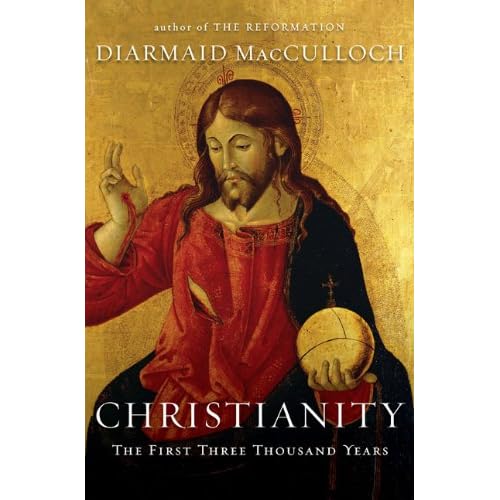
Diarmaid MacCulloch's Christianity -- A Review

CHRISTIANITY: The First Three Thousand Years.  By Diarmaid MacCulloch. New York: Viking, 2010. Xvii + 1161 pages.

You might be wondering about the subtitle of this massive history of Christianity. Maybe you thought that Christianity is around two millenniums old, so where did this extra 1000 years come from? The answer is simple; historian Diarmaid MacCulloch rightly reminds us that Christianity didn’t emerge whole cloth sometime after the year 1 CE. Christianity’s roots go much farther back, than simply the teachings of Jesus, but instead can be traced back to early Jewish history and Greek and Roman history.

Christianity can only be understood if we take into consideration both tributaries, the Hebrew and the Greek. As MacCulloch notes in the introduction:

Within the cluster of beliefs making up Christian faith is an instability which comes from a twofold ancestry. Far from being simply the pristine, innovative teachings of Jesus Christ, it draws on two much more ancient cultural wellsprings, Greece and Israel (p. 2).

As one can see from reading this impressive new history of Christianity, the origins and development of this faith are incredibly complex, a web of ideas and practices that converge in the person of Jesus and then spread out again from him through the teachings and practices of the church that emerges from his first century ministry.

The author of this expansive history of Christianity is Diarmaid MacCulloch, Professor of History of the Church at Oxford and author of several seminal books including an award winning history of the Reformation and an award-winning biography of the Reformation era Archbishop of Canterbury, Thomas Cranmer. As one might expect this British heritage gets expressed throughout the book, but that is to be expected. As a historian of the Nonjurors, I was pleased to see this seemingly insignificant group get mentioned in a general history of the church. Others might feel that there are groups that did not make the cut, who are more deserving, but this is the choice of the author.

Despite the fact that Britain may get an outsized share of the story, MacCulloch is incredible fair to the various traditions, east and west, north and south that make up the history of Christianity. As Philip Jenkins makes so clear in his important study of eastern Christianity – The Lost History of Christianity (Harper One, 2009), we cannot truly understand the history of the church if we don’t include these other stories and simply focus on the Euro-American trajectory. MacCulloch has taken heed of Jenkins’s advice and brings into our purview these other oft forgotten stories.

MacCulloch’s story takes a chronological trajectory, so the various traditions that emerge from the earliest forms of Christianity enter and leave and re-enter the picture. There is theology, politics, and cultural developments present. In the course of the book we encounter persons and groups well-known and unknown to most readers. The narrative is accompanied by a series of maps and plates, mostly in color that give a visual picture to the faith under consideration. One might disagree with the author’s interpretation here or there, or feel that something important has been omitted, but questions like these will be few and far between. Having read Kenneth Scott Latourette'scomprehensive history of the church in seminary, and used it in my own teaching, I can say that this book will prove to be even more valuable than its venerable predecessor.

In closing this review I would like to return to the beginning, because MacCulloch’s choice to start this history with Greece is an important contribution. In some ways this serves a corrective to the belief that in the course of time, the Jewish foundations of Jesus’ original message has been corrupted by the embrace of Greek philosophy by early Christian leaders. It has been suggested that this merger with Greek philosophy undermines the ethical component of Jesus’ message. While there is some truth to this view, MacCulloch reminds us that this Greek component isn’t just a filter, but part of the story. He opens the first chapter, entitled “Greece and Rome” with this sentence:

Why begin in Greece and not in a stable in Bethlehem of Judaea? Because in the beginning was the Word. The Evangelist John’s Gospel narrative of Jesus the Christ has no Christmas stable; it opens with a chant or hymn in which “Word” is a Greek word, logos. The Word, says John, was God, and became flesh and dwelt among us, full of grace and truth. (p. 19).
The author suggests that logos is more than a “word,” it “is the story itself.” And from there, he tells the story of Greece, so that we’re prepared to meet the one whom John declares to be the Word, a Word whose story is told in the lives of those who follow. Greece and Rome provide the foundation for this faith to expand beyond the borders of Judea. Yes, the Jewish component is essential, but Christianity as it became a lived religious force brings both to bear.

This isn’t the type of book that you’ll just sit down and read cover to cover in a couple of sittings. It will take time and require return visits to those parts of the story that intrigue and beckon. The time spent with this book will not be in vain. It will serve to remind modern readers tempted to skip over the intervening years and think that what happens between 100 CE and the 21st Century are of little value, that one cannot truly understand the Christian faith without some sense of the full-orbed nature of this faith. It is a faith that has been influenced by sources Greek, Roman, Hebrew, German, Spanish, Indian and Chinese. It has its share of tears and triumphs. There is much in this history we’d like to forget, but dare not. There is also much to celebrate, often in the stories of people whose names are largely history, people who stayed faithful in difficult times. Their stories appear, alongside those of much better known figures such as Augustine, Aquinas, and Luther.

I leave you with the closing paragraph of this important book, for it is a call to embrace the wonder of this story of a faith tradition embraced by one third of the human population.

Original sin is one of the more plausible concepts within the Western Christian package, corresponding all too accurately to everyday human experience. One great encouragement to sin is an absence of wonder. Even those who see the Christian story as just that – a series of stories – may find sanity in the experience of wonder: the ability to listen and contemplate. It would be very surprising if this religion, so youthful, yet so varied in its historical experience, hand now revealed all its secrets. (p. 1016).

Monday, September 20, 2010

Julian of Norwich (Amy Frykholm) -- Review

JULIAN OF NORWICH: A Contemplative Biography. By Amy Frykholm. Brewster, MA: Paraclete Press, 2010. xix + 147 pages.

The fourteenth and fifteenth centuries were marked by political, cultural, religious, and social turmoil. The crusades continued in one form or another, with Spain being the center of the battle between Christian and Muslim forces. The Byzantine Empire was crumbling and the plague took a heavy toll on Europe. This was the era of the Avignon Papacy and the Great Schism, eras when politics played a central role in the life of the Western Church. This was also the era of John Wyclif and Jan Hus, proto-reformers who challenged the ecclesiastical foundations of the Church and set the stage for Luther and his contemporaries in the sixteenth century.

It was into this world, one in which superstition and fear made themselves felt, and where dissent was viewed with suspicion and the voice of an educated woman voice was rarely welcomed that Julian of Norwich appeared on the scene. Although there were few places where a woman, especially an inquisitive one, could safely explore intellectual and spiritual ideas, the convent and the anchorage provided that kind of safe space. Julian of Norwich has become a well-known figure in the modern age among those who desire to engage the mystical side of the Christian faith. Although not as well known as Catherine of Sienna or Teresa of Avila, Julian was one of the earliest women spiritual and theological writers in England.

According to Amy Frykholm, a journalist and member of the staff of the Christian Century, Julian of Norwich’s Revelations of Divine Love was the first book composed in English by a woman in an era when books written in English were still uncommon. It may help to realize that this was the era of Geoffrey Chaucer’s Canterbury Tales. Indeed, according to Frykholm this book, also known as the Showings, “remains one of the greatest theological works in the English language” (p. ix).

Despite the importance of Julian’s book, we know little about her, including her true name, which could possibly be taken from the church where she served as an anchorite – St. Julian’s in Norwich. Although her life largely remains a mystery, except for the clues that emerge out of her own writings, Frykholm has done an excellent job of ferreting out from her own writings and from what we know about the historical context to offer us a rather compelling picture of Julian’s life. In part because Julian was a contemplative herself, Frykholm has chosen to write a contemplative biography.

What we do know about Julian is that she was born around 1342 in Norwich, which was then the second largest city in Britain. Second only to London, it was a major commercial and industrial region, known for its wool trade. But, this city also suffered a devastating blow from the plague during the fourteenth century that cut the population nearly in half. It is possible that she had been married, but there’s no record of this. Then in 1373, at the age of thirty, she began to receive visions, which she discerned were coming to her from God. But, concerned about the nature of these visions she sought guidance from an Augustinian friar who lived in a monastery nearby. This friar served as a spiritual guide and teacher, introducing her to the great theological writings of the church, including the works of Augustine and the Scriptures themselves. After a time she began, under the guidance of this teacher, to write down her visions. But, because it was dangerous for a woman to be known as a mystic and writer – outside the confines of ecclesiastically recognized entities, her spiritual director suggested that she become an anchorite.

Sometime around the age of fifty, she attached herself to the church of St. Julian in Norwich. Although we do not have direct information about the nature of her installation, we do know how such events transpired, and so Frykholm imaginatively describes what likely occurred in Julian’s case. There she lived until her death around 1416, spending her life in prayer and in writing down her visions. An anchorage was a solitary cell, in which a devout person would spend their lives, essentially cut off from the outside world. As Frykholm tells it, the typical anchorage was a single room, with possibly three windows, one of which would have opened up to the church, so that the anchorite could hear the mass. Another open would have opened up to the quarters of the servant, who cared for the needs of the anchorite, and finally there would have been a window opening up to a porch, where the anchorite received visitors, including visitors seeking her spiritual guidance. A box would be placed on the porch, where members of the community might leave alms for her support. Members of the community provided food for her, in exchange for her prayers. She would have been assigned a servant, who lived in quarters attached to the anchorage, and who tended to her physical needs. It appears that she was able to leave the anchorage to attend services, but beyond that her world was contained behind walls and dark curtains until the day of her death, after which her book of visions began to gain a readership.

One of the reasons why Julian may have become so popular in the modern age is that her vision of God is one of love and grace. The Jesus who appeared to her spoke in gentle tones and rarely if ever was the focus of the visions on topics such as hell, purgatory, or sin, which stood at the forefront of much of the religious teaching of the era. Frykholm writes of the theology that emerges from her visions:
She herself had received no visions of hell or of purgatory. “God is all love,” she offered. “He is all mercy and all grace. There is no wrath in God.” She often felt that she was speaking to the black curtain alone and that her words floated no farther than an inch from her mouth. They wanted her to tell them that she had seen this or that loved one saved from the jaws of hell by the flight of angels or that Mary had come to her and personally whispered the name of the one who would be saved. Julian did not see these kinds of visions, and she could only tell them honestly that she saw no wrath in God. She felt their disappointment, but she hoped that something of God’s love might echo for them, long into the future (pp. 97-98).
There was a significant dissonance between her visions and the belief systems of her contemporaries, which led some to fear that her visions would prove disruptive to a church that not only taught a theology of fear but used it to keep control of the people. Reflecting on the concerns of a critic, the fear was that opening oneself to love, might lead a person into the arms of the heretics (p. 111).

Whether one has read the works of Julian of Norwich, Frykholm provides an enjoyable and readable look at a significant figure in the life of the church. Since Julian left few traces of her own life, except her writings, Frykholm must fill in the gaps with accounts of life in the era in which Julian made her presence known. One can read this as an introduction to Julian’s life, and to the spiritual life of the middle ages. In either case, the book is a worthy gift to the modern Christian pursuing the contemplative life, or the person seeking to understand the mystical tradition that has been passed down from one generation to the next.


Friday, April 30, 2010

The Dangers of Spiritual Amnesia

Being a historian, I love to talk about the past.  I'm especially interested in talking about such obscure groups as the Nonjurors.  You  ask: who are the Nonjurors?   Well that is a subject for another day -- but here's a link just in case you're really curious. 

But, more to the point, American Christians have a tendency to relegate history to the back burner of the conversation.  We're all about the present and the future.  We'd just as soon not get stuck in the past, unless of course we're daydreaming about mythical golden ages when everyone was a Christian and the nation was Christian.  There is a tendency, as well to recreate history to suit our own purposes -- as we saw recently with the Texas Textbook Committee.  Or maybe we'll develop the hubris to think that our age is the beginning of the next great age of faith, surpassing all that came before. 

Diana Butler Bass wrote a piece yesterday for her new Huffington Post  blog posting entitled "Is Western Christianity Suffering from Spiritual Amnesia?"   I'd like to clip a couple of excerpts and comment on them because I believe she's raising important questions.

At the present juncture of history, Western Christianity is suffering from a bad case of spiritual amnesia. Even those who claim to be devout or conservative often know little about the history of their faith traditions. Our loss of memory began more than two centuries ago, at the high tide of the Enlightenment. As modern society developed, the condition of broken memory -- being disconnected from the past -- became more widespread. Indeed, in the words of one French Catholic thinker, the primary spiritual dilemma of contemporary religion is the "loss and reconstruction" of memory.

If we're suffering from spiritual amnesia, we're likely suffering from a spiritual identity crisis.  This is an age when the changes are coming at us fast and furious.  Many of us feel as if we're rafting the the white waters of the Colorado River.  Where is our anchor?  Our sense of identity?  One of the consequences of amnesia is a loss of identity.  You simply don't know who you are or where you come from.  That is the danger that faces us today, and its largely our own fault.  We've simply not told our stories.    

Although many recoil from the term tradition, tradition is something we need to reclaim if we're to reclaim a sense of identity that will anchor us as we shoot the rapids of modernity/postmodernity.    Diana clarifies this a bit in her closing paragraph:

About a year ago, I heard Newsweek's Jon Meacham say, "History is to a country what memory is to an individual." The quip seems particularly apt to American religious groups. To paraphrase, history is to a religion (or a denomination, church, or faith community) what memory is to an individual. To lose memory is neither funny nor sad; rather, it is a path to profound brokenness, a loss of self, meaning, and God that leaves us in darkness unable to act in purposeful ways in the world. Thus, I wonder: Is spiritual amnesia a precursor to religious Alzheimer's, a fatal loss of memory for which there is no cure? I hope not. And I hope that religious people -- especially my progressive brothers and sisters -- can tether their passion for contemporary faith to ancient wisdom.

As we seek to tether our passion for faith to the ancient wisdom, let me recommend Diana's own book People's History of Christianity (Harper One, 2009) as a good place to start.  And, if you're a bit more ambitious, you might check out Diarmond MacCulloch's Christianity:  The First Three Thousand Years (Viking, 2010).  MacCulloch's book just arrived in the mail from the publisher, and all I've had time to do is flip through the pages -- but even though it's over a thousand pages in length -- it looks as if it will be a good read.